Care Habits
Best All-Purpose Cleaner: What to Look For and What to Avoid
The best all-purpose cleaner is the mildest one that removes the dirt in front of you, on a surface the label says it is safe for. For most homes that means a pH-neutral or lightly alkaline spray with a surfactant base for everyday kitchen and bathroom wiping, plus separate products for the few jobs it handles badly: heavy grease, mineral scale, natural stone, and unsealed wood. No single bottle is right for every surface, and “all-purpose” is a marketing term, not a technical one.
This guide does not rank brands or claim to have tested products. Instead it explains how to read a label, how the main cleaner types differ, which surfaces an all-purpose cleaner should never touch, and how professional crews decide what to use where. Use it to choose from whatever is on your store shelf.
Quick answer
- What to look for: A label that lists the surfaces it is safe on, the dilution or “ready to use” instruction, and the contact time if it claims to disinfect.
- What to avoid: Using one strong cleaner on everything. Skip it on natural stone, unsealed or waxed wood, hardwood floors, touchscreens, and some metals.
- Cost of supplies: A spray bottle of ready-to-use cleaner or a concentrate you dilute yourself. Concentrates usually cost less per use, but only if you measure them.
- Difficulty: Easy, once you know what the label means.
- Rule of thumb: Start with the gentlest option (warm water and dish soap), then step up only if it does not work.
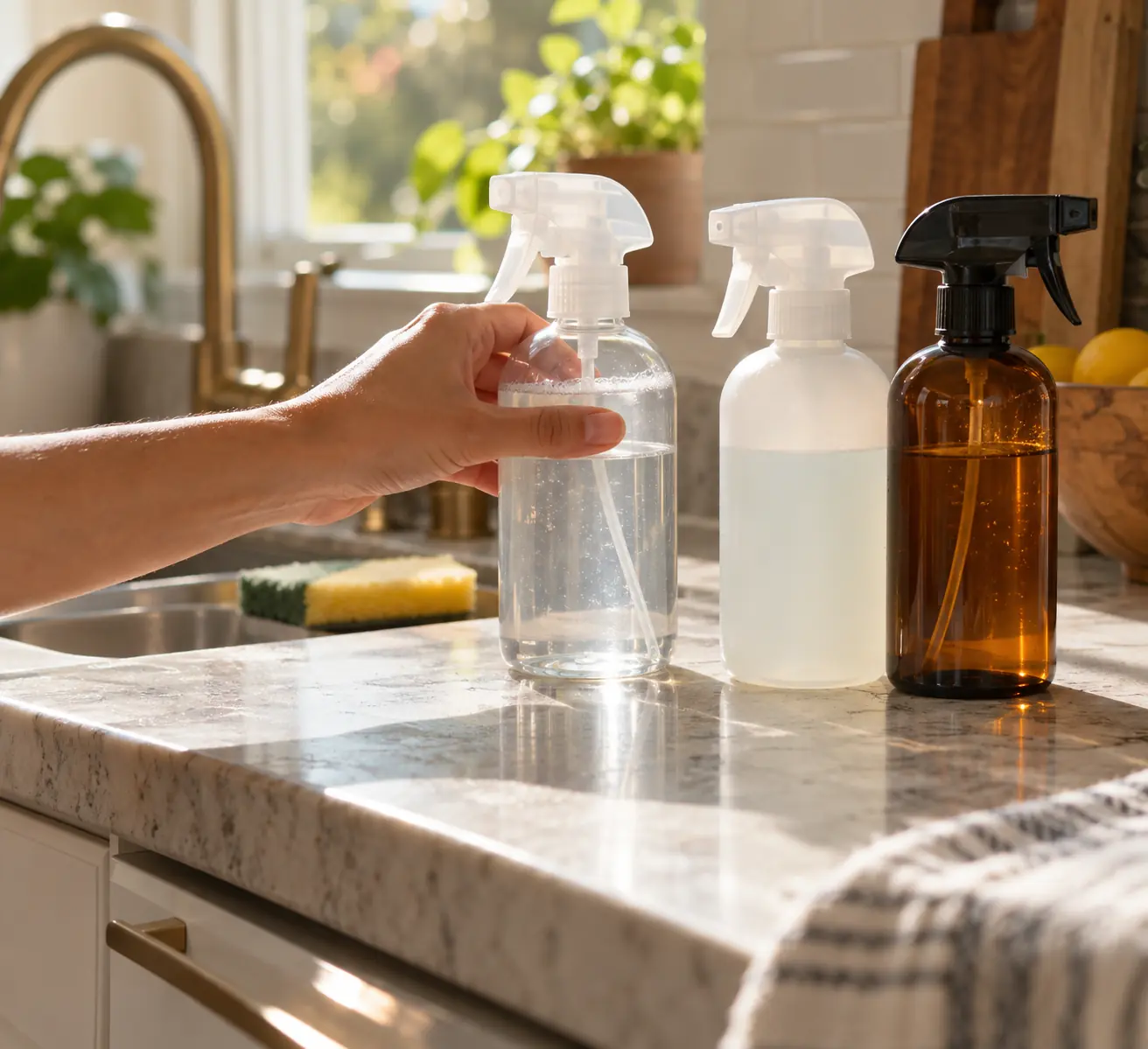
What “all-purpose” actually means
There is no legal or technical standard for the phrase “all-purpose cleaner.” It simply means the manufacturer designed the product to handle light to moderate dirt on many hard, non-porous surfaces. In practice, it usually describes a water-based cleaner with a surfactant (the ingredient that lifts oil and dirt), a solvent in small amounts, a scent, and a preservative.
What it generally does well:
- Wipes counters, tables, appliance exteriors, and cabinet fronts.
- Removes fingerprints, light grease, food splatter, and everyday film.
- Cleans painted walls and trim, with a damp cloth.
- Cleans sealed bathroom surfaces such as sinks, tubs, and tile on a light basis.
What it generally does not do:
- Cut through thick baked-on grease. That needs a degreaser.
- Dissolve hard water scale and soap scum build-up. That needs an acid-based or specialty descaler.
- Disinfect, unless the label says so and you follow the contact time.
- Safely clean every material. Natural stone, unsealed wood, and delicate finishes need specific products.
Think of an all-purpose cleaner as your daily driver, not your tool for every job.
All-purpose cleaner vs degreaser vs disinfectant
These three terms get mixed up. They do different jobs.
| Product type | Main job | How it works | Typical use | Not a substitute for |
|---|---|---|---|---|
| All-purpose cleaner | Remove everyday dirt and film | Surfactants lift dirt so it can be wiped away | Counters, tables, cabinets, appliance exteriors | Degreaser on heavy grease, disinfectant on germs |
| Degreaser | Break down grease and oil | Stronger alkaline or solvent action | Stovetops, range hoods, oven doors, greasy cabinets | Gentle daily wiping on delicate finishes |
| Disinfectant (or sanitizer) | Reduce germs on a surface | Active ingredient kills microbes after the label contact time | Toilets, door handles, cutting boards, diaper areas | Cleaning. Dirt must be removed first for it to work |
| Glass cleaner | Streak-free glass | Light solvent, evaporates quickly | Windows, mirrors | Heavy dirt or all surfaces |
| Descaler / bathroom cleaner | Remove mineral deposits and soap scum | Acid action | Shower glass, faucets, tile | Natural stone, some metals |
| Floor cleaner | Clean specific floor types | Formulated for the floor finish | Hardwood, tile, laminate, vinyl | Multi-surface wiping |
A key point about disinfecting: most all-purpose cleaners clean but do not disinfect. A product that disinfects must say so on the label and list the germs it targets, and the surface must stay visibly wet for the listed contact time. Wiping it off in seconds does not disinfect. Dirt on the surface also blocks the active ingredient, so you generally clean first and disinfect second.
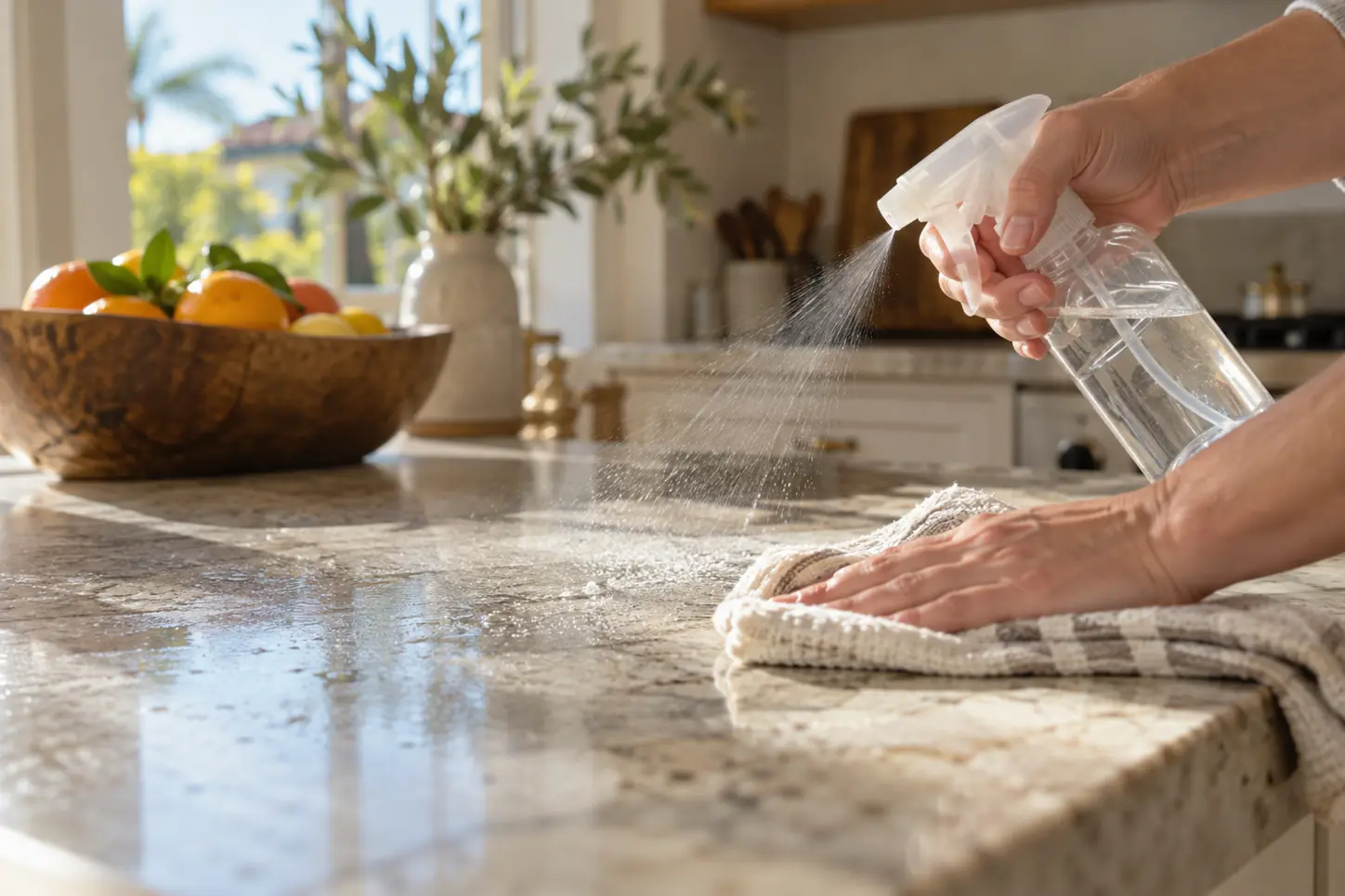
Cleaner types compared
| Type | What it is | Strengths | Weaknesses | Best for |
|---|---|---|---|---|
| Ready-to-use spray | Pre-diluted, in a spray bottle | Convenient, no measuring, consistent strength | Costs more per use, more plastic | Daily wipe-downs, households that want simplicity |
| Concentrate | Strong liquid you dilute with water | Cheaper per use, flexible strength, less packaging | Easy to over or under dilute, needs a labeled bottle | Larger homes, regular cleaners, cost-conscious users |
| Dish soap and water | A few drops in a spray bottle or bucket | Gentle, cheap, rinses well | Leaves residue if overused, weak on scale | Painted walls, light grease, sealed wood, many floors |
| DIY vinegar solution | White vinegar diluted with water | Cheap, cuts light film and mineral deposits | Not a disinfectant in the way a registered product is, damages natural stone and can dull some finishes | Glass, sinks, faucets, light bathroom use |
| DIY baking soda paste | Baking soda with a little water | Gentle abrasive, deodorizer | Can scratch soft finishes, needs rinsing | Sinks, tubs, spot cleaning |
| Plant-based or “green” cleaner | Cleaner with plant-derived surfactants | Often lower fragrance, label may show a third-party certification | Not always weaker or stronger, check what is actually in it | Homes with kids, pets, or sensitivities |
| Disinfectant spray or wipes | Registered antimicrobial product | Kills listed germs when used per label | Requires contact time, can irritate skin and airways, not for every surface | High-touch spots, bathrooms, sick-room cleaning |
| Multi-surface wipes | Pre-moistened cloths | Fast, portable | Costly, waste, can leave residue | Quick touch-ups, not full cleaning |
For a look at gentler formulas and how to read their claims, see our guide to best eco friendly cleaning products and the comparison in green cleaning vs standard cleaning.
Ingredients to know
You do not need a chemistry degree, but a few terms on the label tell you a lot.
| Ingredient (as it appears) | What it does | Notes |
|---|---|---|
| Surfactants (e.g., “alcohol ethoxylate,” “sodium lauryl sulfate,” “decyl glucoside”) | Lift oil and dirt from surfaces | The core of any cleaner. Plant-derived and petroleum-derived types both exist |
| Water | Carrier | Often the first ingredient |
| Solvents (e.g., “glycol ether,” “ethanol,” “isopropyl alcohol”) | Dissolve grease and help evaporation | Stronger odor; can affect some finishes or plastics |
| Alkaline builders (e.g., “sodium carbonate,” “sodium hydroxide” in strong products) | Cut grease, raise cleaning power | High pH can damage aluminum, some wood finishes, and natural stone |
| Acids (e.g., “citric acid,” “acetic acid,” “phosphoric acid,” “hydrochloric acid”) | Dissolve mineral deposits | Not for natural stone, grout seals, or some metals |
| Quaternary ammonium compounds (“quats,” e.g., “alkyl dimethyl benzyl ammonium chloride”) | Disinfect | Found in many disinfecting cleaners; need contact time |
| Sodium hypochlorite (bleach) | Disinfect, whiten | Never mix with ammonia or acids; can damage fabrics and some surfaces |
| Hydrogen peroxide | Mild disinfectant and stain remover | Can lighten some materials; breaks down over time |
| Fragrance, dyes | Scent and color | Not needed for cleaning; may bother people with sensitivities |
| Preservatives | Keep the product from spoiling | Normal in water-based cleaners |
| Enzymes | Break down organic soils | Common in pet and laundry products, not typical in all-purpose sprays |
Reading the ingredient list helps you spot the risk. A product heavy on strong alkaline builders will cut grease but may dull some finishes. A product heavy on acid will remove scale but should not touch marble. A product with quats may need rinsing on food surfaces.
Label facts to check
Labels carry real information. These are the parts to read before you buy and before you use.
- Surfaces listed as safe, and surfaces to avoid. Many labels list “do not use on” materials. Trust that list over the front-of-pack claim.
- Dilution instructions. For concentrates, this tells you how much product per bottle. Measure it. More is not better, and too strong can leave residue or damage finishes.
- Contact time. If the product claims to disinfect, the label lists how long the surface must stay wet (often several minutes). Without the full contact time, it is only cleaning.
- Rinsing instructions. Some products require rinsing on surfaces that touch food, such as cutting boards and kitchen counters.
- Third-party certifications. Some labels show a certification mark from an independent program, for example the U.S. EPA Safer Choice label, which means the product’s ingredients met that program’s criteria. Check the program’s website to confirm what the mark means. A certification is not a performance test, and it does not cover every claim a brand might make.
- EPA registration number. Products that make disinfecting claims are registered with the U.S. EPA and show a registration number. If a product claims to kill germs and has no such number, be cautious.
- Safety statements. “Keep out of reach of children,” “may irritate eyes,” “do not mix with other products.” These are not decoration.
- Ingredient disclosure. Some brands list every ingredient. Others list only “active” ones. More disclosure usually means easier decisions for people with sensitivities.
- Expiration or batch date. Some cleaners, especially peroxide-based ones, lose strength over time.
Marketing words such as “natural,” “powerful,” “heavy duty,” or “professional strength” have no standard meaning. Use the factual parts of the label instead.
Surface matrix: where all-purpose cleaner is safe
Always follow the manufacturer’s care instructions for the surface itself (a countertop, a floor, or an appliance), since they override any general guide. Test any new product in a hidden spot first.
| Surface | All-purpose cleaner OK? | Notes |
|---|---|---|
| Laminate countertops | Yes, diluted | Wipe and dry. Avoid soaking seams |
| Sealed granite or quartz | Mild, pH-neutral only | Avoid acids, harsh alkalis, and abrasive powders. Follow the stone maker’s care guide |
| Marble, travertine, limestone (natural stone) | No, unless labeled stone-safe | Acids etch the surface. Use a stone-specific pH-neutral cleaner |
| Tile (glazed ceramic or porcelain) | Yes | Grout may need separate care. See how to clean grout and tile |
| Natural stone tile | No, unless labeled stone-safe | Same as marble |
| Painted walls and trim | Yes, diluted, damp cloth | Rub gently. Glossy finishes tolerate more than flat paint |
| Sealed hardwood floors | No, use a floor-specific cleaner | Too much water and the wrong chemistry dulls or damages finish. Follow the flooring maker’s advice |
| Unsealed or waxed wood | No | Water and detergents can strip wax and stain wood |
| Laminate and vinyl floors | Mild, diluted, well-wrung mop | Excess water can seep into seams |
| Stainless steel appliances | Usually, with a soft cloth | Wipe with the grain. See how to clean stainless steel appliances |
| Glass and mirrors | Better with a glass cleaner | All-purpose can leave streaks or film |
| Electronics screens and keyboards | No | Use screen cleaner or a dry microfiber cloth. Never spray directly |
| Aluminum cookware and surfaces | Avoid strong alkaline products | They can darken or pit aluminum |
| Copper, brass, and unlacquered metals | Avoid | Specific cleaners are better |
| Plastic furniture and appliances | Usually yes | Test first. Some solvents cloud plastic |
| Upholstery and fabrics | No | See how to keep your sofa looking new for fabric-safe approaches |
| Leather | No | Use a leather cleaner. See leather furniture care |
| Cutting boards and food surfaces | Only if the label allows and you rinse | Use dish soap and hot water otherwise |
| Showers and tubs | Light cleaning only | Soap scum and scale need the right product |
| Toilet bowls | Not usually | Use a toilet bowl cleaner. See how to remove toilet bowl stains |
| Stovetop and oven doors | Light only | Heavy grease needs a degreaser |
Where not to use all-purpose cleaner
A few categories deserve extra caution, because a wrong choice can cause permanent damage.
Natural stone
Marble, travertine, limestone, and some granites are sensitive to acids and can be damaged by harsh alkaline products. Even mild acids such as vinegar and citrus can leave dull etch marks on polished marble. Use a pH-neutral cleaner made for stone, or mild dish soap and water, and wipe up spills promptly.
Unsealed or waxed wood
Water can swell the fibers, cleaners can strip wax and leave pale patches, and a heavy hand can darken the grain. For sealed wood furniture, a barely damp cloth and a drop of mild soap is usually enough. For hardwood floors, follow the flooring manufacturer’s cleaning instructions, which commonly call for a floor-specific cleaner and a well-wrung mop.
Electronics
Never spray cleaner on a screen, keyboard, or control panel. Liquid can seep behind the surface. Use a cloth lightly dampened with water or a screen-safe product, and unplug the device first where appropriate.
Aluminum and soft metals
Strong alkaline cleaners can darken or pit aluminum. Copper, brass, and plated surfaces can be dulled by acids or abrasives. Use a product designed for the metal.
Fabric, leather, and upholstery
All-purpose cleaners can leave rings, strip dye, or damage finishes. Fabric needs a fabric cleaner and a spot test. Leather needs a leather-specific product.
Cast iron and nonstick cookware
Harsh cleaners can strip seasoning or damage coatings. Follow the cookware care instructions.
Anything labeled “dry clean” or “spot clean only”
Those labels exist for a reason. Test or avoid.
Dilution: following the label
Concentrates save money, but only when diluted correctly. The label gives ratios for different jobs, for example a weaker mix for light cleaning and a stronger one for heavy dirt. A few principles apply:
- Use the measurements on the label, not a guess. A “glug” of concentrate is rarely correct.
- Use a clearly labeled bottle, with the product name and dilution written on it. Unlabeled spray bottles are a safety hazard, especially with children and pets.
- Add water first, then the concentrate, in a spray bottle. This reduces foaming.
- Use cool or lukewarm water, unless the label says otherwise. Hot water can evaporate active ingredients or cause burns.
- Do not combine different cleaners into one bottle. Mixed products can react, and you lose the ability to know what is in the bottle.
- Label with the date, since some diluted solutions weaken over time.
- Rinse where required. If the product leaves residue (a sticky or dull feel), you may be using too much.
Too-strong dilutions are one of the most common causes of tacky floors, hazy glass, and sticky counters. If a surface feels sticky after cleaning, wipe it with a cloth dampened with plain water and use less product next time.
Price tiers without the hype
Price is not a reliable sign of quality. Here is how to think about cost without relying on test results.
| Tier | What you generally get | When it makes sense |
|---|---|---|
| Budget ready-to-use | Simple formula, small bottle, basic scent | Occasional use, small household |
| Mid-range ready-to-use | Larger bottle, a wider list of “safe on” surfaces, sometimes certified | Everyday family use |
| Concentrate | Lowest cost per use if measured | Regular cleaning, large homes |
| Specialty (stone, wood, stainless) | Formulated for one surface | When you have that surface and want to protect it |
| Disinfectant | Registered claims, contact time | High-touch areas and illness |
Compare the price per diluted ounce, not the price of the bottle. A small concentrate can make more spray than a large ready-to-use jug. Check the label for how many bottles it makes. Whether a product performs better than another is something the label cannot tell you, so treat any claims about “best” with caution unless the source explains how it tested.
How professional crews choose products
A professional crew does not carry one bottle for everything. The usual approach is to match the product to the task and the surface, and to keep the set small enough to stay organized.
A typical kit covers:
- A mild all-purpose cleaner for counters, tables, cabinet fronts, and general wiping.
- A glass cleaner for mirrors and windows.
- A bathroom cleaner formulated for soap scum and scale on sealed, non-stone surfaces.
- A degreaser for stovetops, hoods, and greasy cabinets, used with care and rinsed.
- A disinfectant for toilets and high-touch points, used with the label’s contact time.
- Surface-specific products, such as a stone-safe cleaner, a wood cleaner, and a floor cleaner for each floor type.
- Microfiber cloths in color codes, so the cloth used on a toilet never touches a kitchen counter.
Our crews work with eco-friendly, pet-safe products and follow the same principle: use the mildest product that gets the job done, on the right surface, with the right cloth. Separating products by task prevents most damage and cross-contamination, and it saves time because you are not fighting dirt with the wrong chemistry.
Mixing safety
All-purpose cleaners seem harmless, but combining products is where real accidents happen.
- Bleach plus ammonia produces toxic chloramine gas. Some glass cleaners and other products contain ammonia.
- Bleach plus acids (vinegar, toilet bowl cleaners, some bathroom cleaners) can release chlorine gas.
- Bleach plus rubbing alcohol can create harmful compounds.
- Hydrogen peroxide plus vinegar in the same container can form peracetic acid, which is corrosive.
- Different cleaners in the same bottle can react, lose effectiveness, or become hazardous.
Safer habits:
- Use one product at a time and rinse the surface between products.
- Keep products in their original containers, or in properly labeled bottles.
- Ventilate the room.
- Wear gloves for strong products.
- Store cleaners away from heat, out of reach of children and pets, and not in the same cabinet as food.
Our full guide on cleaning products you should never mix has the complete table. For vinegar and baking soda in particular, see natural cleaning with vinegar and baking soda.
Storage and shelf life
- Keep products in a cool, dry place, away from sun and heat.
- Close caps tightly. Evaporation changes concentration.
- Do not store concentrates in unmarked containers.
- Check dates. Some products, particularly peroxide-based sprays and diluted bleach solutions, lose strength.
- Dispose of old products properly. Local household hazardous waste programs accept cleaners and chemicals. Do not pour unknown products down the drain together.
- Keep a short list. Having ten half-used bottles is both unsafe and unnecessary.
A simple starter set
For most homes, five items cover almost everything.
| Item | Use |
|---|---|
| Dish soap | Gentle cleaning, grease, floors, delicate surfaces |
| Mild all-purpose cleaner | Everyday surfaces |
| Glass cleaner | Mirrors, windows |
| Bathroom cleaner (descaler type) | Showers, faucets, sinks |
| Disinfecting cleaner (registered) | Toilets and high-touch areas |
Add specialty products only when you have the surface that needs them: a stone cleaner for marble, a wood floor cleaner for hardwood, a stainless steel polish if you want it. For a longer list with quantities, see the essential cleaning supplies list.
When it is worth handing off: The hardest part of cleaning with several products is knowing which one goes where. If you would rather not manage a cabinet of bottles and surface rules, a recurring cleaning service brings the right products for each surface and keeps your counters, floors, and bathrooms on a schedule.
Common mistakes
- Using one strong cleaner on everything. It can dull wood, etch stone, or leave film on glass.
- Using too much product. Residue attracts dirt and leaves surfaces tacky.
- Wiping a disinfectant dry immediately. Without contact time it only cleans.
- Skipping the pre-clean. Disinfecting over visible dirt is much less effective.
- Using dirty cloths. A dirty cloth spreads soil and bacteria. Wash microfiber after each use cycle, without fabric softener.
- Spraying directly onto electronics or controls.
- Mixing products. Dangerous and unnecessary.
- Ignoring the care guide for the surface. The countertop, floor, or appliance maker knows what it tolerates.
- Believing “natural” means safe for everything. Vinegar damages stone. Lemon juice can etch. Essential oils can stain or irritate.
- Never testing a hidden spot. One minute of testing prevents most disasters.
Orange County considerations
A few local conditions affect product choice.
- Hard water. Much of Orange County has hard water, so mineral deposits form on faucets, shower glass, and dishes. A standard all-purpose cleaner will not dissolve them. A mild acidic descaler works on sealed, non-stone surfaces. Check your local water quality report for hardness.
- Fine dust and sandy grit. Santa Ana winds and dry months bring dust indoors. Wipe with a damp microfiber cloth before spraying, so you are not grinding grit across a surface. For why this happens, see why Orange County homes get dusty fast.
- Coastal air. Salty humidity near the coast leaves a thin film on windows and metal. A damp cloth and a mild cleaner usually handles it.
- Stone counters and tile. Many newer homes and condos have granite, quartz, or marble. Check what you have before using acids or vinegar.
- HOA or rental rules. Some communities and landlords restrict certain products or require professional cleaning at move-out. Check your lease and rules.
Frequently asked questions
What is the best all-purpose cleaner?
There is no single best product. The right choice is a mild cleaner whose label lists the surfaces you are cleaning, used at the stated dilution. A basic pH-neutral cleaner plus dish soap covers most households. Add specialty products for stone, wood, and scale.
Can you use all-purpose cleaner on floors?
Sometimes. On sealed tile, vinyl, and laminate, a diluted cleaner and a well-wrung mop are usually fine. On hardwood, follow the flooring maker’s instructions, which often call for a floor-specific cleaner. On natural stone, use a stone-safe product only.
Is all-purpose cleaner a disinfectant?
Not usually. Most clean but do not kill germs. A disinfectant must say so on the label, list an EPA registration number, and be left wet on the surface for the stated contact time.
What can you not use all-purpose cleaner on?
Natural stone, unsealed or waxed wood, electronics and screens, leather, delicate fabrics, aluminum, and any surface the manufacturer says to avoid. When in doubt, check the label and test a hidden spot.
What is the difference between all-purpose cleaner and degreaser?
An all-purpose cleaner handles light dirt and film on many surfaces. A degreaser is stronger on oil and baked-on grease, often with more alkaline or solvent action, so it needs more care on delicate finishes and should be rinsed.
Is homemade all-purpose cleaner as good as store-bought?
For light cleaning, a few drops of dish soap in water works well. A vinegar and water spray handles glass and light film. Neither is a registered disinfectant, and vinegar is wrong for stone. Homemade is a good basic option, not a universal replacement.
Should I buy a concentrate or ready-to-use spray?
Concentrates cost less per use and create less packaging, but they require accurate dilution and a labeled bottle. Ready-to-use sprays are simpler. Choose based on how often you clean and how much you want to measure.
Does “green” or “natural” mean it is safer?
Not automatically. The words have no fixed meaning. Look for a clear ingredient list and, if you want an outside check, a recognized certification such as EPA Safer Choice, and confirm what it covers. Our guide to eco friendly cleaning products explains how to read these claims.
Can I mix all-purpose cleaner with bleach?
No. Mixing cleaners with bleach can create harmful gases depending on what is in the cleaner. Use one product at a time and rinse between them.
How do I know if a cleaner is safe for my countertop?
Check the label for listed surfaces and the countertop maker’s care guide. If the material is natural stone, assume you need a stone-safe, pH-neutral product. Then test in a hidden corner.
When to call a professional
Choosing the right product for each surface takes knowledge, and mistakes can be permanent: etched stone, dulled floors, clouded glass. A professional crew carries the products and cloths for each material and knows the order of work, from dusting down to floors, so you are not undoing your own cleaning.
Call a professional if:
- You have natural stone, specialty floors, or delicate finishes and do not want to risk the wrong cleaner.
- Years of buildup (soap scum, grease, scale) need a reset rather than daily wiping.
- You want routine cleaning handled on a schedule, so your time goes to daily upkeep and not to managing products.
For a one-time reset, a deep cleaning is the usual starting point. To see what a visit would cost for your home, use the instant quote on our pricing page. As a worked example, a two bedroom, two bathroom home is (60 + 25 x 2 + 35 x 2) = $180 on our formula, so a recurring clean on a biweekly plan with a 15% discount is $153 per visit, and a deep clean at the 1.5 multiplier is $270.