Care Habits
15 Cleaning Mistakes That Make Your House Dirtier
The biggest cleaning mistakes are not skipping chores. They are doing chores in a way that moves dirt around instead of removing it: a wet sponge that has not dried in a week, dusting before vacuuming, spraying and wiping instantly, or using too much product. Fix those four and a house usually looks and smells cleaner with less work. This guide ranks 15 common mistakes by impact, with a fix for each.
Quick answer
- Highest impact: reusing dirty tools (sponges, mops, rags), cleaning in the wrong order, and not letting products sit.
- Easiest wins: swap sponges often, wash microfiber properly, empty the vacuum, and work top to bottom.
- Time to fix your habits: about 30 minutes to reset your tools, then no extra time per week.
- Cost: a few dollars for a pack of cloths and a new sponge, a new vacuum filter or bag as needed.
- Difficulty: low. Most of these are habit changes, not new products.
How we ranked them
We ordered these by how often they undo your effort, not by how dramatic they sound. A mistake ranks higher when it (1) affects a large surface or many rooms, (2) makes the next cleaning harder, or (3) spreads dirt back onto surfaces you just cleaned. There are no studies behind the order. It is based on how cleaning works and what professional crews see in homes, so take it as a practical guide rather than a measurement.
The 15 mistakes, ranked
1. Using a dirty sponge, rag or mop head
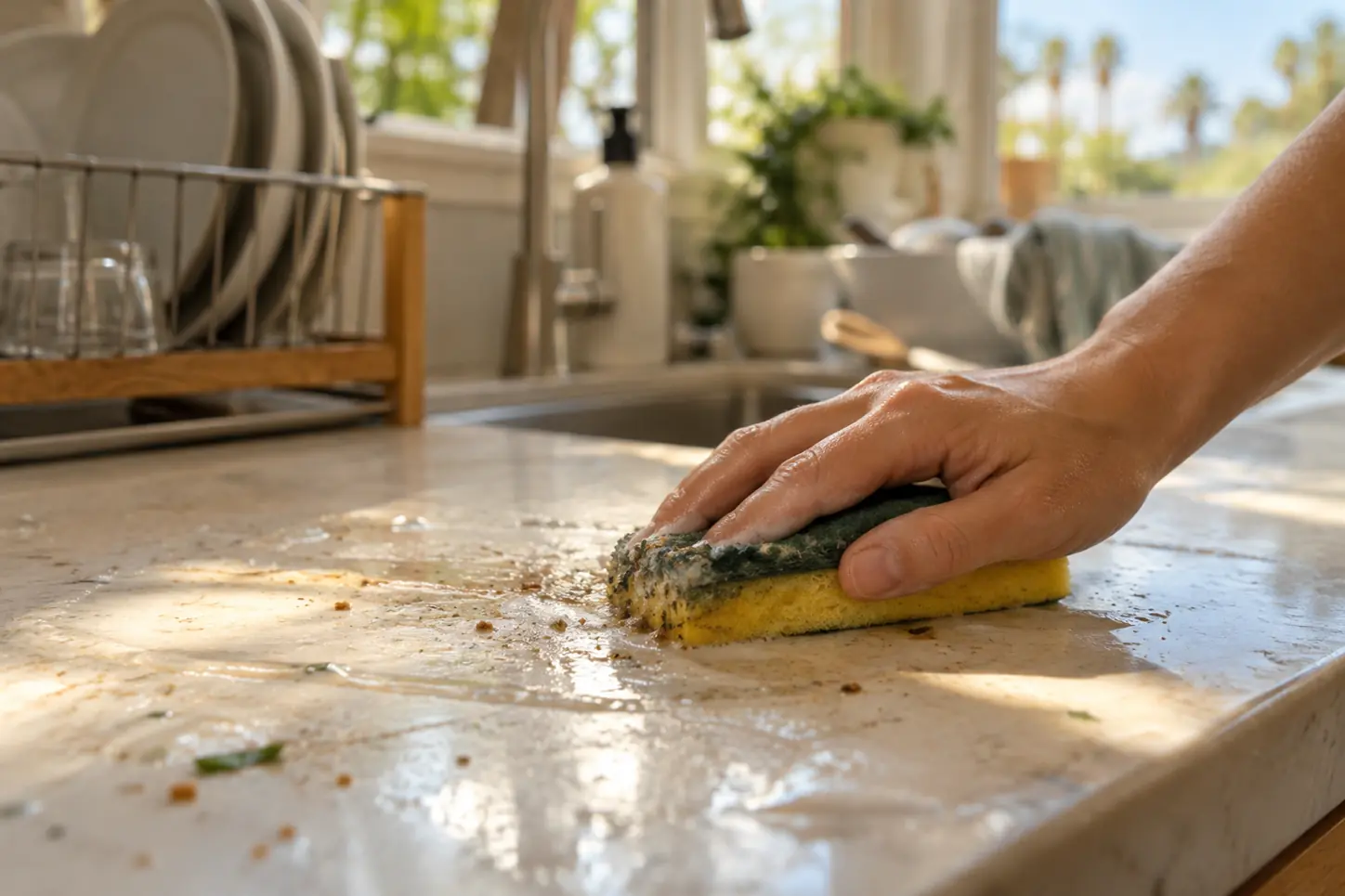
A sponge stays damp, holds food particles and sits in a warm kitchen. By the end of a week it can smell sour. Wiping a counter with it spreads residue rather than removing it. The same goes for a mop head that has not been washed, and for a rag used for the stove, then the sink, then the table.
Fix: Replace kitchen sponges every week or two, sooner if they smell. Run them through the dishwasher’s hot cycle between replacements if the manufacturer allows. Use cloth rags you can wash hot, and keep a dedicated set for the bathroom. Wash mop heads after every use and dry them completely.
2. Cleaning in the wrong order
If you vacuum, then dust, the dust lands on the clean floor. If you do the floors first, then the counters, crumbs fall. The correct order saves a second pass.
Fix: Work from high to low and from dry to wet. Dust shelves and fans first, then wipe surfaces, then vacuum, then mop. In a bathroom, spray fixtures and let the product sit, then do the floor last.
3. Spraying and wiping straight away
Most cleaners need contact time to loosen soil. Spray, wipe, and the product barely touched the dirt. People respond by scrubbing harder and using more product.
Fix: Read the label. Many all-purpose cleaners say to leave the product on the surface for a short time. Disinfectants usually require the surface to stay visibly wet for several minutes to work, often longer than people expect. Spray first, move to another task, then return to wipe.
4. Using too much product
More cleaner does not mean cleaner surfaces. Excess product leaves a sticky film that attracts new dirt. This is a common cause of floors that look dull after mopping and counters that feel tacky.
Fix: Measure concentrated cleaners. Use a small amount in mop water, a light mist on glass and counters, and rinse with a damp cloth when the label says to. A small amount of dish soap goes further than people think (more in natural cleaning with vinegar and baking soda).
5. Dusting with a dry rag or a feather duster
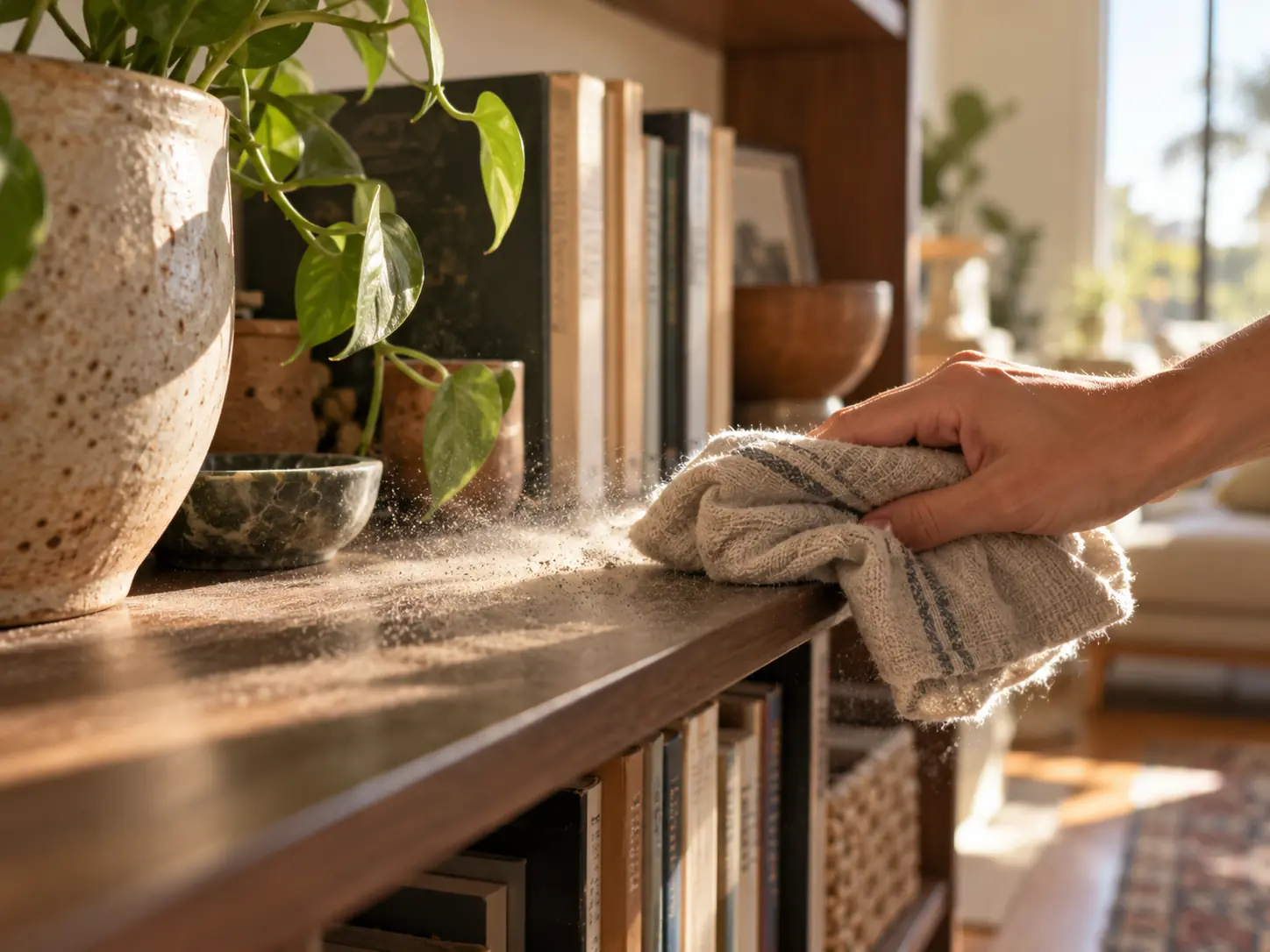
Dry dusting often flicks particles into the air, and they settle again within hours. A feather duster mainly relocates dust.
Fix: Use a barely damp microfiber cloth, which traps particles. For ceiling fans, slide a pillowcase over each blade and pull back to catch the dust. Dust before vacuuming so the vacuum picks up what falls. Orange County homes tend to see fine dust from Santa Ana winds and open windows, so a damp cloth makes a bigger difference here than most places (see why Orange County homes get dusty fast).
6. Mixing cleaning products
Stacking products to “boost” cleaning can release harmful gases. Bleach mixed with ammonia, or with acidic cleaners, is the classic example.
Fix: Use one product at a time and rinse surfaces between products. Never mix bleach with anything but water. Read which cleaning products never to mix before you combine anything, and ventilate the room.
7. Skipping the vacuum filter, bag and brush roll
A vacuum with a full bag, a clogged filter or a hair-wrapped brush roll loses suction and blows fine dust back out of its exhaust. You can vacuum every day and still feel the room is dusty.
Fix: Empty the canister or replace the bag when it is about two-thirds full. Wash or replace filters according to your manual. Cut hair off the brush roll with scissors every few weeks. Check hoses for blockages if suction drops. Pet households need this more often (see keeping a clean home with pets).
8. Letting wet things stay wet
Damp towels on the floor, a bathmat that never dries, wet sponges in the sink and a washer door that is shut after the last load all invite mildew and odor.
Fix: Hang towels to dry between uses, wash bathmats weekly, leave the washer door open after laundry, run the bathroom fan during and after showers for about 20 minutes, and squeeze out sponges and cloths. For more, see preventing mold and mildew in the bathroom.
9. Using the wrong cleaner on the surface
Vinegar on natural stone, abrasive powders on glass cooktops, harsh cleaners on wood: they can etch, scratch or dull a finish. Damage is permanent, and a dull patch then collects dirt faster.
Fix: Identify the surface before choosing the product. Use pH-neutral cleaners on stone and sealed wood floors. Use soft cloths on stainless steel and glass. When unsure, test a hidden spot. A starter list is in our eco-friendly cleaning products guide.
10. Wiping with the same side of the cloth
Fold a cloth into quarters and you have eight clean faces. Use one face for everything and you are wiping dirt back on.
Fix: Fold the cloth, wipe a section, flip to a fresh face, and swap to a new cloth when all faces are used. Bring five or six cloths to a room rather than one.
11. Washing microfiber the wrong way
Fabric softener and some detergents clog microfiber, and the cloth stops grabbing dust. Washing with towels also transfers lint.
Fix: Wash microfiber separately in warm water with a small amount of detergent, skip fabric softener and bleach, and dry on low or air dry. If cloths smell, wash them more often.
12. Disinfecting a dirty surface
Disinfectants are not designed to cut through grease and grime. If soil is present, the product may not reach the surface it is meant to treat.
Fix: Clean first with soap or all-purpose cleaner, rinse or wipe, then disinfect only where it matters, such as toilets, high-touch handles and cutting boards after raw meat. Follow the label contact time. For most living areas, thorough cleaning without disinfectant is enough for ordinary households.
13. Cleaning around clutter
Wiping around piles of mail, toys or kitchen gadgets leaves a patchwork of clean and dirty zones, and dust builds under clutter.
Fix: Clear the surface, wipe it, and put back only what lives there. A 10-minute reset before cleaning saves more time than it takes. Our daily habits that cut cleaning time covers this in more detail.
14. Over-wetting floors
Soaked wood, laminate or luxury vinyl planks can swell, cup or lift at the seams. Even tile grout holds standing water. A big wet mop smears dirt across the floor.
Fix: Use a well-wrung mop or a spray mop that applies only a mist. Vacuum first, then mop in sections, and change the water when it looks gray. Follow your flooring maker’s guidance. For wood, see how to clean hardwood floors.
15. Cleaning only what shows
Baseboards, vents, door handles, light switches, the top of the fridge and the inside of the dishwasher are out of sight until they are not. Dust and grease collect there and recirculate or transfer to hands.
Fix: Add a rotating “one hidden spot” task to your weekly routine. A list of what to rotate is in our deep cleaning checklist.
Fix table at a glance
| # | Mistake | Quick fix | Time to fix |
|---|---|---|---|
| 1 | Dirty sponge, rag or mop | Replace or wash after each use | 5 minutes |
| 2 | Wrong order | High to low, dry to wet | 0, just a habit |
| 3 | Wiping instantly | Spray, wait, wipe | 0 extra |
| 4 | Too much product | Measure, mist | 0 |
| 5 | Dry dusting | Damp microfiber | 0 |
| 6 | Mixing products | One at a time, rinse between | 0 |
| 7 | Neglected vacuum | Empty, filter, brush roll | 10 minutes monthly |
| 8 | Wet things staying wet | Dry, vent, open doors | 0 |
| 9 | Wrong cleaner on surface | Identify surface first | 1 minute |
| 10 | Same cloth face | Fold and flip | 0 |
| 11 | Microfiber wash errors | Separate wash, no softener | 0 |
| 12 | Disinfecting dirt | Clean first, then disinfect | 2 minutes |
| 13 | Cleaning around clutter | Reset first | 10 minutes |
| 14 | Over-wetting floors | Wrung mop or mist | 0 |
| 15 | Ignoring hidden spots | Rotate one weekly | 5 minutes |
Tools that spread germs and dirt
Some tools collect more than they remove. A short audit pays off.
| Tool | The problem | How often to replace or wash |
|---|---|---|
| Kitchen sponge | Stays damp, holds food residue | Replace every 1 to 2 weeks, sooner if it smells |
| Dish brush | Holds residue in bristles | Run through the dishwasher weekly, replace when worn |
| Mop head (cotton or microfiber) | Carries soil back to the floor | Wash after each use, replace when thin or matted |
| Microfiber cloth | Clogs with oils and softener | Wash after each room or use, replace when stiff |
| Toilet brush | Left wet in a caddy | Rinse, let it drip dry, replace if the bristles splay |
| Vacuum filter | Blocked, lets dust through | Clean per manual, replace when worn |
| Scrub brush | Mildew in the bristles | Rinse and air dry after each use |
| Spray bottle | Residue clogs nozzle, wrong product label | Rinse and label |
These intervals are practical rules of thumb. If your product maker gives different guidance, follow it.
Order-of-operations mistakes in each room
Doing the tasks in a good order is the cheapest improvement. Here is a sequence for the main rooms.
Kitchen
- Clear counters and load the dishwasher.
- Spray the stove top, sink and counters with cleaner and leave it on.
- Wipe appliances and cabinet fronts.
- Wipe counters and the sink last, starting with the cleanest surfaces and ending with the dirtiest.
- Sweep or vacuum, then mop.
Bathroom
- Spray the shower, tub and toilet and let them sit.
- Clean mirrors and counters.
- Scrub the shower and toilet.
- Rinse.
- Floor last.
Bedroom and living areas
- Strip the bed and start the laundry.
- Dust from top to bottom with a damp cloth.
- Vacuum furniture, then the floor.
- Make the bed with fresh sheets.
Product misuse
A few more product mistakes show up again and again.
- Skipping the label. Dilution and contact times are on the bottle for a reason.
- Using bleach as a general cleaner. It disinfects but does not remove grime, and it can damage some finishes and fabrics.
- Pouring cleaner on a sponge and then onto the surface. You waste product and may leave streaks.
- Storing products in the wrong container. Keep products in their original bottles, or label a new bottle clearly.
- Ignoring ventilation. Open a window or turn on the fan when using strong products.
- Using a scented cleaner as a deodorizer. Fragrance masks smells. If something smells, find the source.
Fabric and floor mistakes
Fabrics
- Rubbing a stain. Rubbing pushes it deeper and spreads it. Blot from the outside in.
- Using hot water on unknown stains. Heat sets proteins like blood and egg. Start with cold.
- Over-wetting upholstery. Soaked cushions can develop odor and water rings. Use a lightly damp cloth and let it dry fully.
- Skipping the care label. Some sofas are labeled “S” for solvent only, and water can leave marks. See how to keep a sofa looking new.
Floors
- Using one cleaner on every floor. Wood, tile, vinyl and stone each have their own needs.
- Steam mopping where it’s not allowed. Many wood and laminate manufacturers do not recommend steam.
- Forgetting entry mats. Grit tracked in from outside scratches floors. Sandy grit is common in coastal Orange County, and a mat at each door reduces it.
Skip this step: if the main issue is that cleaning keeps falling off your list, a recurring crew can do the kitchen, bathrooms, floors and dust on a set schedule so you are not rebuilding the routine each time. Our recurring cleaning is discounted 15% for biweekly service. For a 3 bedroom, 2 bathroom home, the base is 60 + 75 + 70 = $205, so biweekly is $205 minus 15%, or $174.25 per visit. Get your own figure on the instant quote.
What pros do differently
We do not claim a secret method. Professional crews rely on a few repeatable habits that most homes can copy.
- A fixed route. They clean each room in a set order, top to bottom, back to front, so they do not retrace steps.
- Color-coded cloths. One color for bathrooms, one for kitchens, one for dusting, so there is no cross-contamination.
- Contact time. They spray first in every room, then return to wipe.
- Fresh cloths often. They swap cloths rather than stretching them.
- Tools that are cleaned, too. Vacuum filters and mop heads are cleaned after each job.
- A checklist. The routine is written down so nothing is skipped.
These habits are what let a crew do in a couple of hours what takes an unorganized weekend. For a sample of what a full routine covers, see our weekly vs biweekly vs monthly cleaning guide.
Orange County angle
A few local conditions make some of these mistakes more costly here.
- Hard water. Much of Orange County has hard water, and the level varies by city. Too much product plus hard water leaves a film on glass, shower doors and faucets. Check your local water quality report.
- Dust and wind. Santa Ana winds and open-window living bring fine dust indoors, which makes dry dusting less effective.
- Coastal air. Salt and humidity near the coast mean towels and bathmats dry slowly, and mildew starts faster.
- Slab floors and tile. Many homes have tile or hard flooring that suffers from over-wetting less, but grout takes up residue.
- HOA and condo living. Shared walls and limited ventilation make exhaust fans and wet-item drying more important.
A one-week fix plan
If you want to put this into practice without a long project:
| Day | Task |
|---|---|
| Day 1 | Replace sponges, wash all cloths and mop heads, check the vacuum filter and bag |
| Day 2 | Label spray bottles, put away any mixed or unlabeled products |
| Day 3 | Reset the kitchen: clear counters, wipe with contact time |
| Day 4 | Bathroom: spray first, clean in order, run the fan |
| Day 5 | Dust with damp microfiber top to bottom, then vacuum |
| Day 6 | Mop with a wrung mop, add door mats |
| Day 7 | Pick one hidden spot (baseboards, vents, fridge top) and clean it |
Repeat the cycle and rotate the hidden spot each week.
When to call a professional
You can fix nearly every mistake on this list yourself, and most cost nothing. Changing the order, using contact time and swapping dirty tools will help right away.
A professional is useful when the problem is accumulated rather than technical: layers of grease, mineral film on glass, grimy baseboards, a kitchen that has not had a full reset in a long time, or a schedule you cannot keep. Our deep cleaning resets those areas in one visit. For a 3 bedroom, 2 bathroom home it is (60 + 75 + 70) x 1.5 = 205 x 1.5 = $307.50, and new customers get $39 off the first clean.
For an exact number for your home, use the instant quote.
Frequently asked questions
What cleaning mistakes should I avoid?
The main ones are using dirty sponges and mops, cleaning in the wrong order, wiping chemicals off right away, using too much product, dry dusting, and mixing products. This guide ranks 15 and gives a fix for each.
How often should I replace sponges?
Many people replace kitchen sponges every week or two, and sooner if they smell or fall apart. Dishcloths and microfiber can be washed hot and reused. Follow the product maker’s guidance if it differs.
Does a feather duster spread dust?
Often, yes. Dry dusters can flick particles into the air so they settle elsewhere. A slightly damp microfiber cloth traps dust better, especially on hard surfaces.
Should I wipe or spray first?
Spray first, wait for the contact time on the label, then wipe. Wiping immediately removes some surface soil but leaves the cleaner little chance to work.
Is it better to vacuum or dust first?
Dust first, then vacuum. Dust falls as you wipe, and the vacuum collects it. If you vacuum first, you will have to do the floor again.
Do I need to disinfect everything?
No. Cleaning with soap or a general cleaner removes most soil from ordinary surfaces. Disinfect where it matters, such as toilets, sinks after contact with raw meat, and high-touch handles during illness, and follow the label.
Why does my floor look dull after mopping?
Typically too much cleaner, dirty mop water, or a product left on the floor that attracts dirt. Use a small amount, change water often, and rinse or use a no-rinse formula designed for your floor type.
Can I wash all my cleaning cloths together?
Wash microfiber separately from towels and without fabric softener. Heavily soiled bathroom cloths should be washed separately from kitchen cloths. Use hot water if the fabric allows.
How do I know when a vacuum needs servicing?
If suction drops, the vacuum smells, or dust blows out of the exhaust, check the bag, filter, hose and brush roll first. Follow the manual for cleaning or replacement.
What is the one change that helps most?
Replace your sponges and mop heads, then clean top to bottom with a damp cloth. That removes dirt you were previously moving around.