Care Habits
Daily Cleaning Routine for Busy Families (15 Minutes a Day)
A daily cleaning routine for a busy family works best at about 15 minutes in the morning and evening combined, built around the three things that pile up fastest: dishes, laundry, and surface clutter. Anything beyond that belongs on a weekly list, not a daily one. The goal is not a spotless house every night. It is a house that never falls so far behind that catching up feels impossible.
This guide is about the structure of a family routine: who does what, in which order, and what to drop when the week goes sideways. If you want room-by-room micro-habits (squeegee the shower, wipe the stovetop while it is warm), those are covered in daily habits that cut your cleaning time. Here we focus on the system around them.
Quick answer
- Total time: 15 minutes a day for one adult, less when kids and partners share it. Add a weekly block of 60 to 90 minutes for the heavier tasks.
- What you need: A dish rack or empty dishwasher, a hamper in every bedroom, a basket by the door, a spray bottle of all-purpose cleaner, a few microfiber cloths, and a timer.
- Cost of supplies: Low. Most households already own everything on the list.
- Difficulty: Easy. The hard part is consistency, not technique.
- Skip this if: You are in the first weeks with a newborn or recovering from illness. Go straight to the “bad week” version near the end of this guide.
What a daily routine is actually for
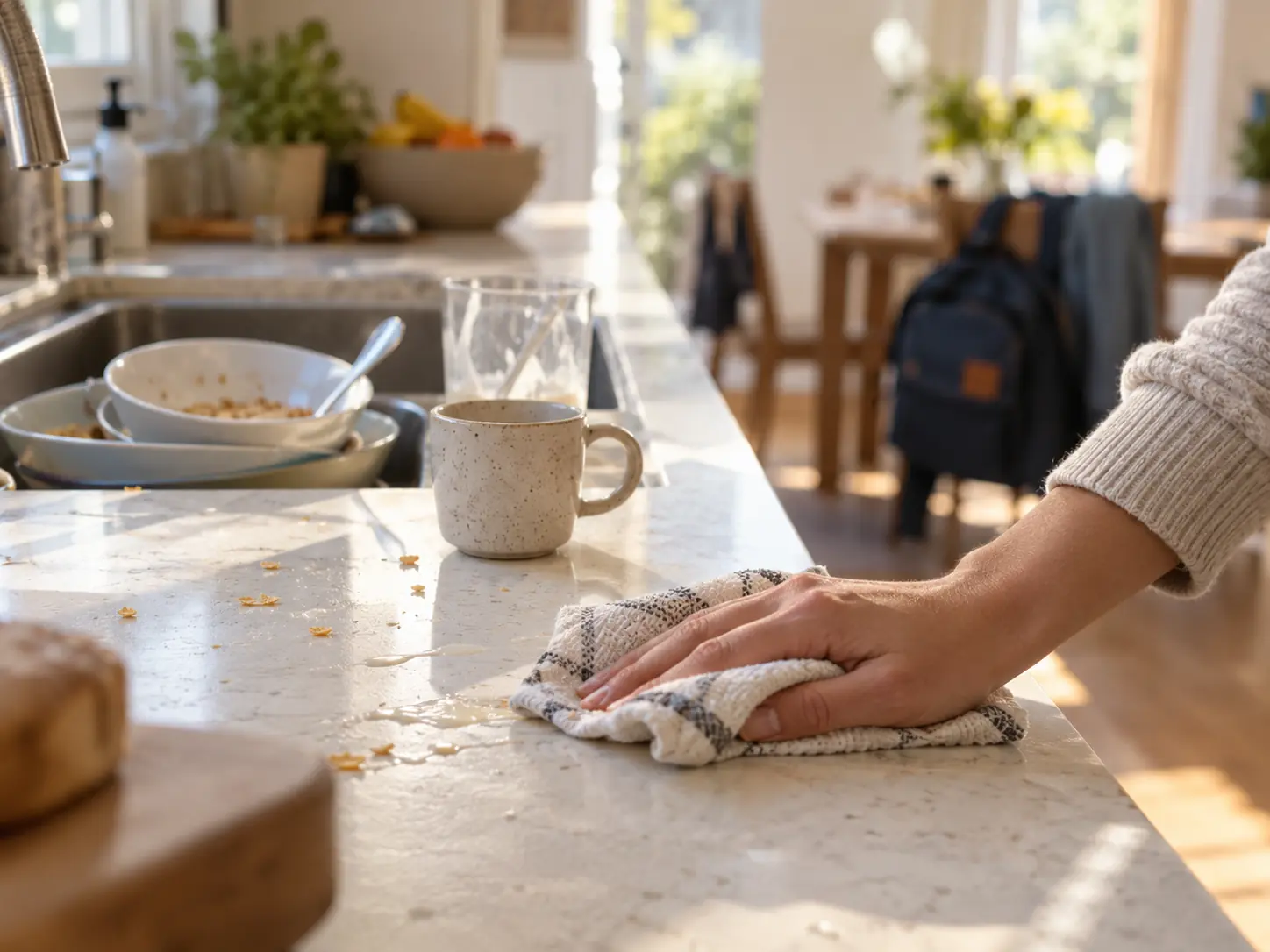
A daily routine has one job: stop mess from compounding. A sink of dishes after one dinner takes ten minutes. After three dinners it takes thirty, and the food has dried on. A hamper that is a third full is a normal laundry load. A hamper that is overflowing means you are already behind, and every pile on the floor adds to the visual noise that makes a home feel dirty even when it is not.
Daily cleaning is not deep cleaning. You are not scrubbing grout or wiping baseboards. You are resetting the rooms the family uses most so that the weekly clean starts from a baseline instead of a disaster.
It helps to separate three kinds of tasks:
- Resets: Returning things to where they live. Shoes, dishes, toys, mail, cups. These take seconds each but add up fast if skipped.
- Wipes: Quick surface passes that remove fresh mess before it sets. Counters, table, bathroom sink, stovetop.
- Flows: Processes that move through the house on their own schedule, mainly laundry. A flow only needs a nudge at the right moment.
Everything in the routine below is one of those three. If a task does not fit, it is probably a weekly task.
The 15 minute routine at a glance
| Block | Time | What happens | Who can do it |
|---|---|---|---|
| Morning reset | 5 to 7 min | Beds, dishwasher, counters, bathroom wipe | Adults, kids 6+ with help |
| After-dinner reset | 8 to 10 min | Dishes, table, stovetop, floor under the table | Everyone, rotating jobs |
| Evening sweep | 3 to 5 min | Living room reset, hamper check, tomorrow’s bags by the door | Adults, kids 8+ |
| Laundry nudge | 2 min, spread across the day | Start, move, or fold one load | Adult |
These ranges overlap on purpose. On a calm day you might finish in 12 minutes. On a heavy day, 20. The fixed part is the sequence, not the stopwatch.
Morning reset (5 to 7 minutes)
Mornings are rushed, so keep this block small. The point is to start the day with a clear kitchen and a made bed, which sets the tone for the rest of the house.
- Empty the dishwasher or dish rack (2 minutes). If the dishwasher is clean and empty, the day’s dishes have somewhere to go. This one habit prevents more sink piles than any other.
- Wipe the kitchen counters (1 minute). Use a damp microfiber cloth and a little all-purpose spray. Move small items out of the way as you go, do not wipe around them.
- Make the beds (1 to 2 minutes). Straighten the sheet, pull up the comforter, and set the pillows. A made bed flattens the whole room visually.
- Bathroom sink wipe (1 minute). Toothpaste splatter and water spots are easiest to remove while still wet. Keep a cloth or a pack of wipes in the drawer so there is no excuse.
- Quick floor scan (30 seconds). Pick up anything on the floor that does not belong there. Do not vacuum. Just clear.
Why this works: The empty dishwasher is the anchor. If you take only one thing from the morning block, take that one.
The after-dinner reset (8 to 10 minutes)
This is the biggest block of the day because dinner is the biggest mess. The trick is to treat it as a short team sprint with a clear end point, not an open-ended cleanup.
Kitchen reset step by step
- Clear the table (2 minutes). Everyone carries their own plate and cup to the sink or dishwasher. This works from about age three with unbreakable dishes.
- Load the dishwasher or wash by hand (3 to 4 minutes). Scrape, rinse only if needed, and load. Pots and pans that will not fit soak in the sink with hot water and a drop of dish soap.
- Wipe the table and counters (1 minute). Damp cloth, quick pass. Check the chair seats and the floor under the highest-chair area.
- Wipe the stovetop (1 minute). Do it while it is still warm, not hot. Cooking splatter is soft now and hard by tomorrow.
- Take out the trash if it is full (1 minute). A bag that is almost full at 8 p.m. is a bag someone will step around at 7 a.m.
- Run or start the dishwasher. If you have a delay-start option, set it for overnight so the machine does not run while the house is quiet and you are trying to sleep.
- Sweep or spot-vacuum under the table (1 to 2 minutes). A small handheld vacuum or a stick vacuum on the charger by the kitchen makes this almost painless.
Why this works: Kitchen mess gets harder with time. Grease cools and sets. Starch dries into a crust. Cheese and egg are the worst. The after-dinner window is the cheapest time to deal with all of it.
When you cook for a crowd
On nights with more people, use a sequence instead of a pile. Wash cooking tools as you finish with them. By the time the meal is served, the counters are mostly clear and the sink has only the plates. This is the same principle as the “clean as you go” rule that professional kitchens use, and it cuts the after-dinner block almost in half.
Evening sweep (3 to 5 minutes)
This is the “walk through the house” block. You are not cleaning anything deep. You are returning the downstairs to a state where tomorrow starts easily.
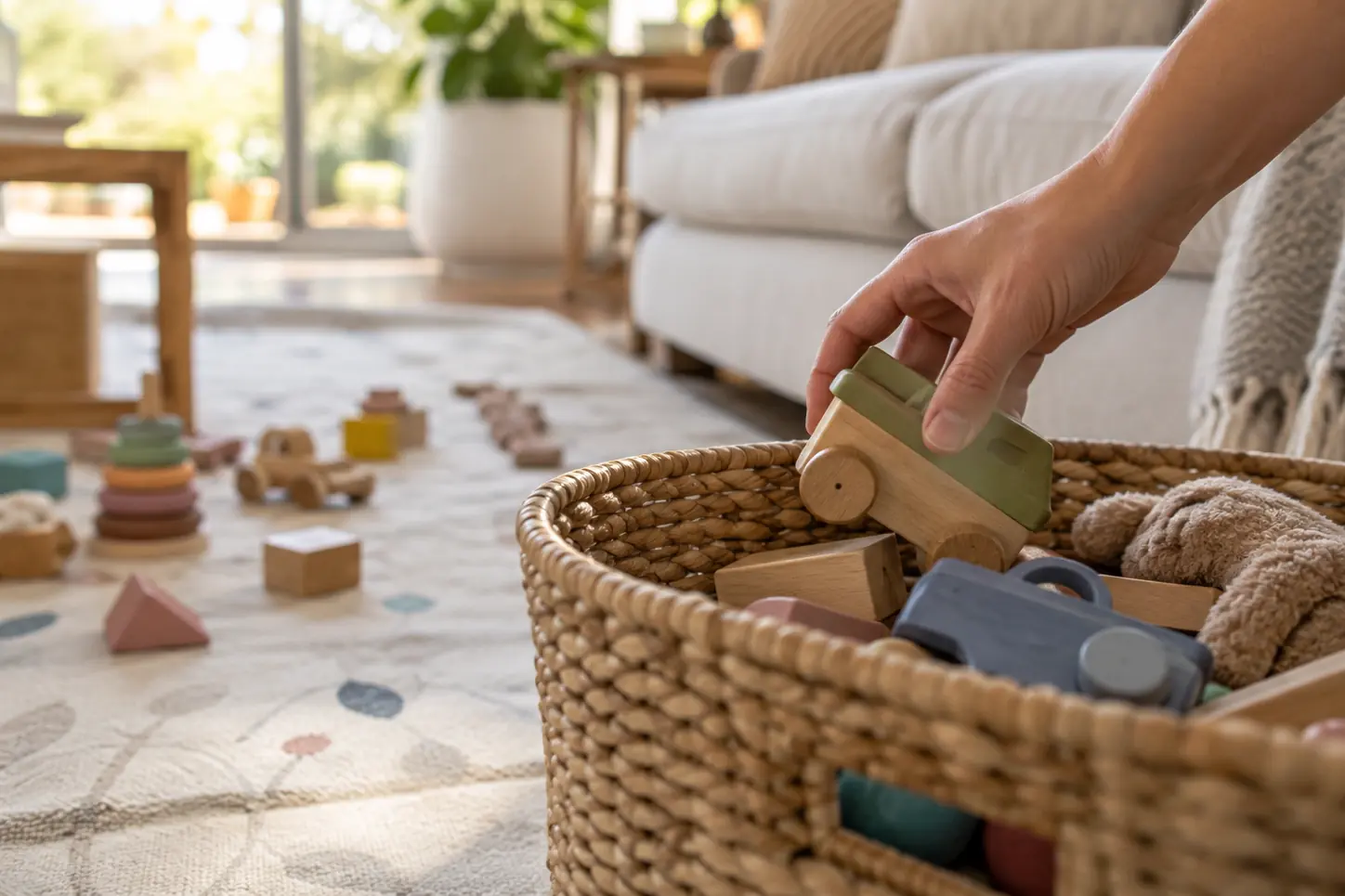
- Living room reset: Fold throw blankets, straighten cushions, collect cups and plates, and put toys in the bin. A basket or two makes this quicker. Anything that belongs upstairs goes in a “going up” basket on the stairs, and gets carried up once.
- Hamper check: Glance at every hamper. If one is more than two thirds full, that is tomorrow’s laundry load.
- Tomorrow’s bags: Backpacks, lunches, work bags, and shoes go to the same spot by the door every night. Mornings are calmer and fewer things get tracked back into the house.
- Lights and doors: Not cleaning, but part of the same sweep, so you only walk the house once.
Laundry flow
Laundry is the one daily task that people do not finish, because it has multiple stages and each stage can stall. The fix is to think in loads, not in baskets.
A one-load-a-day approach
For many families of three or four, one load per day keeps up with the household. A simple rotation looks like this:
| Day | Load |
|---|---|
| Monday | Towels |
| Tuesday | Kids’ clothes |
| Wednesday | Adults’ clothes |
| Thursday | Bedding (one set) |
| Friday | Kitchen towels and cleaning cloths |
| Saturday | Catch-up or sports gear |
| Sunday | Rest, or fold ahead |
Adjust for your size and your laundry room. The structure matters more than the specific days.
Nudge, don’t batch
Instead of an all-day laundry marathon, nudge a load at three points: start it in the morning, move it to the dryer at lunch or after school, fold it in the evening. Each nudge takes about two minutes. The load never sits wet in the washer, which is how that musty smell starts.
If the folding stage is the one that stalls, try one of these:
- Fold at the dryer and put items straight into labeled baskets, one per person. Each person puts their own basket away.
- Skip folding for the least visible items. Kids’ pajamas and gym clothes can go straight into a drawer or bin without a crease.
- Use a laundry sorter with separate bins for lights, darks, and delicates, so sorting happens when the clothes come off.
For more on laundry products and which detergent format suits which job, see the laundry section in our essential cleaning supplies list.
Kids’ chores by age
Children can help much more than most parents expect, as long as the jobs are clear, short, and match their abilities. The goal is not perfection. The goal is that the whole family treats the house as shared.
The table below uses ages as general guides. Every child is different, and safety comes first with cleaning products. Anything involving spray cleaners or hot water should be supervised or handled by an adult.
| Age | Good daily jobs | Weekly jobs | Notes |
|---|---|---|---|
| 2 to 3 | Put toys in the bin, put dirty clothes in the hamper, carry a napkin to the trash | Help sort socks | Keep jobs to one step at a time |
| 4 to 5 | Set the table with unbreakable items, feed the pet, make a simple bed | Wipe low shelves with a dry cloth | Praise effort, do not redo it in front of them |
| 6 to 8 | Clear their own plate, load utensils in the dishwasher, tidy their room, pack their bag | Water plants, sweep a small area, empty small bathroom trash | Use picture or word checklists |
| 9 to 11 | Load and unload the dishwasher, wipe the table, take out the trash, fold and put away their laundry | Vacuum a bedroom, clean the bathroom sink with supervision | Rotate jobs so nobody owns the worst one |
| 12 to 14 | Cook one simple meal a week, run a load of laundry, do dishes, wipe bathroom counters | Clean a bathroom, mop a small floor | Teach which products go where |
| 15+ | Most adult tasks, including a weekly room of their own | Yard, car, deeper kitchen tasks | Treat chores as skills, not punishment |
A few things help chores stick:
- Pair the chore with a fixed moment. “After dinner” works better than “later.”
- Use a visible chart. A whiteboard or printed grid on the fridge is enough. Crossing off a chore is satisfying for children and adults alike.
- Do the job with them first. Show it, do it together, then let them try. A job you never taught is a job you will redo.
- Keep the standard realistic. If the bed is lumpy but made, that counts.
- Rotate the least popular jobs so one child does not get stuck with the toilet or the trash every week.
Pets in the daily routine
Pets add three things to the daily list: hair, food and water mess, and paw traffic. A few small additions handle most of it.
- Wipe the feeding area. Once a day, wipe the mat and the floor around the bowls. Water bowls should be rinsed and refilled, and washed with dish soap every few days, because a slimy film builds up quickly.
- Brush the pet outside or on a washable towel. Brushing for a couple of minutes a day reduces loose hair that would end up on furniture and floors.
- Place a mat at each door. Wipe paws or let them dry before they come in on wet days.
- Run the vacuum on the main traffic path. If you have a pet that sheds, a daily five minute pass in the living room is far easier than a weekly full-house vacuum with a packed canister.
- Keep a lint roller or rubber brush near the couch. Pet hair on upholstery comes off much more easily with a dry rubber squeegee than with a vacuum on some fabrics.
For odor and deeper pet-related care, see keeping a clean home with pets.
Entryway systems
Most dirt enters the house on shoes and bags. An entryway that catches it saves time in every other room.
- Doormat outside and a second one inside. Two mats trap far more grit than one.
- A shoe tray or shelf. If everyone takes shoes off at the door, you vacuum less and floors last longer.
- One hook per person. Kids can reach it, bags and jackets stay off chairs.
- A mail and paper spot. Open mail over the recycling bin, put what matters in a tray, and clear the tray weekly.
- A basket for “belongs elsewhere.” Things that wander in (a library book, a toy, a sock) go in the basket and get returned during the evening sweep.
Southern California homes have a particular issue here: fine dust and sandy grit from dry months, coastal sand near the beaches, and the occasional Santa Ana wind that blows in extra dust. A good mat at the door and a no-shoes rule inside cut the amount of grit that gets ground into floors. For why dust returns so quickly here, see why Orange County homes get dusty fast.
Weekly slot-in tasks
The daily routine does not cover everything. Some jobs only need to happen once a week, but they still need a place on the calendar. Attach each one to a day so it does not float.
| Day | Slot-in task | Time |
|---|---|---|
| Monday | Vacuum main living area | 10 min |
| Tuesday | Clean bathrooms (toilet, sink, mirror, floor) | 20 min |
| Wednesday | Dust surfaces and wipe door handles | 10 min |
| Thursday | Mop kitchen and entry floors | 10 to 15 min |
| Friday | Change bed sheets, wipe the fridge handle and microwave | 15 min |
| Saturday | Family reset: everyone tackles one zone | 30 min |
| Sunday | Empty trash bins, plan the week | 5 min |
This spreads about 90 minutes of weekly work across the week. You can also compress it into one Saturday morning if that suits your schedule better.
A few tasks that rarely fit in a week and belong in a monthly list: wiping baseboards, cleaning the inside of the fridge, descaling the showerhead, vacuuming under furniture, and washing pillows. If you want a quarterly and seasonal view, see our spring cleaning checklist.
Habit stacking: attach cleaning to what you already do
Habit stacking means connecting a new habit to an existing one so it happens automatically. Examples:
- While the coffee brews: Empty the dishwasher.
- While the kettle heats or pasta boils: Wipe the counter.
- After brushing teeth: Wipe the bathroom sink.
- When you put your phone on the charger at night: Do a two minute living room reset.
- When you walk upstairs: Carry whatever is in the “going up” basket.
- When you take off shoes: Put them on the tray before you do anything else.
The cue is what makes the habit stick. If the cue is “when I have time,” it will not happen. If the cue is “when the coffee brews,” it will.
A simple family chore chart
You do not need an app. A paper chart with three columns works well:
| Who | Morning | After dinner | Weekly job |
|---|---|---|---|
| Parent 1 | Dishwasher, counters | Stovetop, trash | Bathrooms |
| Parent 2 | Beds, bathroom sink | Dishwasher load | Floors |
| Child (older) | Own bed, pack bag | Table clear, wipe | Vacuum a room |
| Child (younger) | Dirty clothes in hamper | Plate to sink, toys in bin | Water plants |
Review the chart every month. Jobs that were hard in September are easy in October, and children grow into new ones. If one person always does more than the others, the chart will show it.
Tips that keep it from becoming a fight:
- Agree on the standard first. “Clean” means different things to different people. Decide what done looks like (counters clear and wiped, no dishes in the sink) and say it once.
- Make the schedule visible, so nobody has to remind anyone.
- Do not criticize in the moment. Wait, then adjust the job or the standard calmly.
- Reward consistency, not perfection. A kid who does a decent job every day is more valuable than one who does it perfectly once.
What to drop on bad weeks
Every family has weeks when the routine breaks: sickness, travel, deadlines, a new baby, school events. Trying to maintain the full list during those weeks leads to guilt and burnout. A reduced version keeps the house from sliding too far.
The minimum viable routine (5 minutes a day)
- Dishes: Load and run the dishwasher. Hand wash nothing that can wait.
- Trash: Take out anything that smells (food waste, diapers).
- Bathroom: Wipe the toilet seat and sink only if needed.
- Laundry: Wash towels and underwear. Everything else can wait.
- Floors: Spot-sweep food, skip the rest.
What can safely wait
- Dusting
- Mopping
- Making beds (one person’s call)
- Folding laundry (use baskets)
- Wiping baseboards, doors, and glass
What cannot wait long
- Food waste and trash that smells
- Standing water or spills that can stain or attract pests
- Wet laundry left in the machine
- Anything touched by a sick person (door handles, remotes, toilets), which gets a quick disinfecting wipe if your household needs it
Giving yourself permission to run the short version makes it much easier to return to the full version afterward. When the bad week ends, restart with the morning reset and add the other blocks over a few days, not all at once.
When it is worth handing off: A routine keeps a house tidy, but it does not replace the heavier weekly work: bathrooms, floors, dusting, and kitchen surfaces. If that weekly block is the thing that keeps slipping, a recurring cleaning visit takes it off your plate while your daily habits keep the house in shape between visits.
How to make the routine stick
Starting is easy. Staying with it is the real work. A few practical rules:
- Start with one block, not all of them. Pick the after-dinner reset for two weeks. Add the morning reset when it feels automatic.
- Keep supplies where you use them. A cloth and spray in the kitchen, a cloth in each bathroom, a handheld vacuum on a hook. If you have to go find a product, you will not use it.
- Use a timer. Fifteen minutes with a timer is a game. Fifteen minutes with no end is a chore.
- Use music or a podcast, which makes short tasks feel lighter.
- Count the wins. Look at the clear counter in the morning and notice it.
- Reset on Sunday. A five minute look at the week ahead makes it easier to decide where the routine will be tight.
Mistakes that make a routine fail
- Making it too big. A list of 25 daily tasks will be abandoned by Thursday. Fifteen minutes is the cap.
- Doing it alone. If one adult does everything, resentment grows and the routine collapses. Share it, even imperfectly.
- Skipping the dishwasher anchor. A full dishwasher in the morning means dishes pile up all day.
- Perfectionism. A counter wiped with a quick pass is better than a counter you plan to scrub “when you have time.”
- Not having a home for things. If a thing has no place, it lands on a surface. Give every frequent item a spot, even a basket.
- Cleaning during chaos. Wiping a counter while kids are still eating is wasted effort. Do the wipe after the meal ends.
- Never reviewing it. A routine that fit a family with a toddler needs updating when the toddler is in school.
Mixing products and safety
Daily cleaning means frequent use of spray cleaners, and a few safety rules matter more with children and pets in the house.
- Never mix cleaning products, especially bleach with ammonia or bleach with acidic cleaners (including vinegar). The combinations can release harmful gases. Our guide on cleaning products you should never mix covers the full list.
- Store products out of reach, in a high or locked cabinet, in their original containers with labels.
- Ventilate when you use sprays, especially in small bathrooms.
- Follow the label for contact time and rinsing. Some products need to sit for a few minutes to work, and some need rinsing on food surfaces.
- Use the least strong product that does the job. For daily wiping, a mild all-purpose cleaner or soapy water is enough. Save the heavy products for weekly tasks.
If you want gentler options for a home with kids and pets, see best eco friendly cleaning products.
Adjusting for different households
Families with toddlers
Expect more floor mess and more laundry. Keep a small broom and dustpan or a cordless vacuum within reach of the high chair. Wipe the highchair tray right after the meal, because dried food on it is the hardest thing to remove. Consider two quick floor passes under the table per day.
Families with teens
Teens often have the most untouched mess: cups, towels, and sports gear in rooms. Agree on a rule such as “dishes come down at night” and make their own laundry their job. Do not try to enforce the standard of a clean room in a space they consider private, but do require that food and wet towels leave it.
Families with allergies
Add a damp dusting once a week, wash bedding more often, and keep pets out of bedrooms if needed. See reducing household allergens: a cleaning guide for the longer version.
Small apartments and condos
Less floor area, but clutter shows more. Prioritize surfaces: keep counters, the dining table, and the bed clear. A small home needs smaller storage, so reduce what you own that lives out on counters.
Large homes
Do the routine by zone, not by room. Choose one level for each day, so one person is not walking the entire house every night. Daily tasks stay the same; the weekly tasks rotate.
Frequently asked questions
What should be cleaned daily?
Dishes, kitchen counters and stovetop, the dining table, the bathroom sink, and the trash if it is full. Beds are optional but helpful. Floors, dusting, and toilets can be weekly in most homes.
How long should a daily cleaning routine take?
About 15 minutes for one adult, or 15 to 25 minutes total across a family when everyone helps. If it regularly takes much longer, either too much is on the list or weekly tasks have slipped into daily ones.
How do I keep my house clean with kids?
Lower the standard to “tidy and wiped,” not “spotless.” Give every item a home, build an after-dinner reset, and give children jobs that match their age. Expect to reset the main rooms every evening, not to keep them clean all day.
How do I get my family to help?
Show the job first, make it visible on a chart, and tie it to a fixed moment like “after dinner.” Avoid redoing the work in front of the person who did it. If someone does the job differently, accept it unless it affects safety or hygiene.
Should I clean in the morning or evening?
Both, in short blocks. A morning reset sets up the kitchen for the day, and an evening reset clears the day’s mess. If you can only do one, the after-dinner reset has the biggest effect.
How often should I do laundry?
For most families, one load a day or every other day keeps up. Towels and bedding on a weekly rotation. Wet laundry should not sit in the washer for more than a few hours, to avoid musty odors.
Is it okay to skip a day?
Yes. A skipped day is normal. Two or three skipped days in a row will make the next reset take longer, but the routine is easy to restart. The aim is to avoid weeks of skipped days.
Do I need special products for daily cleaning?
No. A mild all-purpose cleaner, dish soap, microfiber cloths, and a vacuum or broom are enough. Save specialty products for weekly or monthly tasks.
What is the difference between a daily routine and a weekly checklist?
A daily routine handles resets and quick wipes that stop mess from building. A weekly checklist handles the deeper tasks, like vacuuming whole rooms, cleaning bathrooms, and mopping. Most homes need both.
When to call a professional
A daily routine can keep a home in good condition, but it has limits. It will not remove built-up soap scum, hard water film on glass, greasy kitchen cabinets, or dust on baseboards and ceiling fans. Those jobs take time, specific products, and often better tools.
A professional crew is useful when:
- The weekly block (bathrooms, floors, dusting) keeps getting skipped.
- You want a reset after a rough few weeks, illness, travel, or a new baby.
- Heavy tasks have accumulated that a routine cannot reach, such as inside the oven, baseboards, or window tracks.
You can keep doing the daily routine yourself between visits. That is the best of both: you handle the 15 minutes that keep the house livable, and the crew handles the work that takes real time and equipment.
To see what a visit would cost for your home, use the instant quote on our pricing page. As a worked example, a two bedroom, two bathroom home on our formula is (60 + 25 x 2 + 35 x 2) = $180 for a single recurring clean. With a biweekly schedule, a 15% discount brings that to $153 per visit. For a one-time reset, a deep cleaning is $180 x 1.5 = $270. New customers get $39 off the first clean.