Checklists
Essential cleaning supplies for your home: starter kit and what to skip
Most homes need about ten items to stay clean: a good vacuum or broom, a mop, a stack of microfiber cloths, a scrub brush, a squeegee, a pH-neutral all-purpose spray, a glass cleaner, a toilet bowl cleaner, dish soap, and baking soda. Everything else is a specialty product you add only when a specific problem shows up. This guide builds the kit in layers so you spend money on what you will actually use.
Quick answer
- What you need to start: 10 core items (listed below), plus gloves.
- Time to set up: about 30 minutes to shop and organize.
- Cost of supplies: varies widely by brand and store, so we do not quote prices. Buy the starter tier first and add as needed.
- Difficulty: easy. The only skill is matching the product to the surface.
- Skip if: you hire a crew that brings its own supplies (ask yours first).
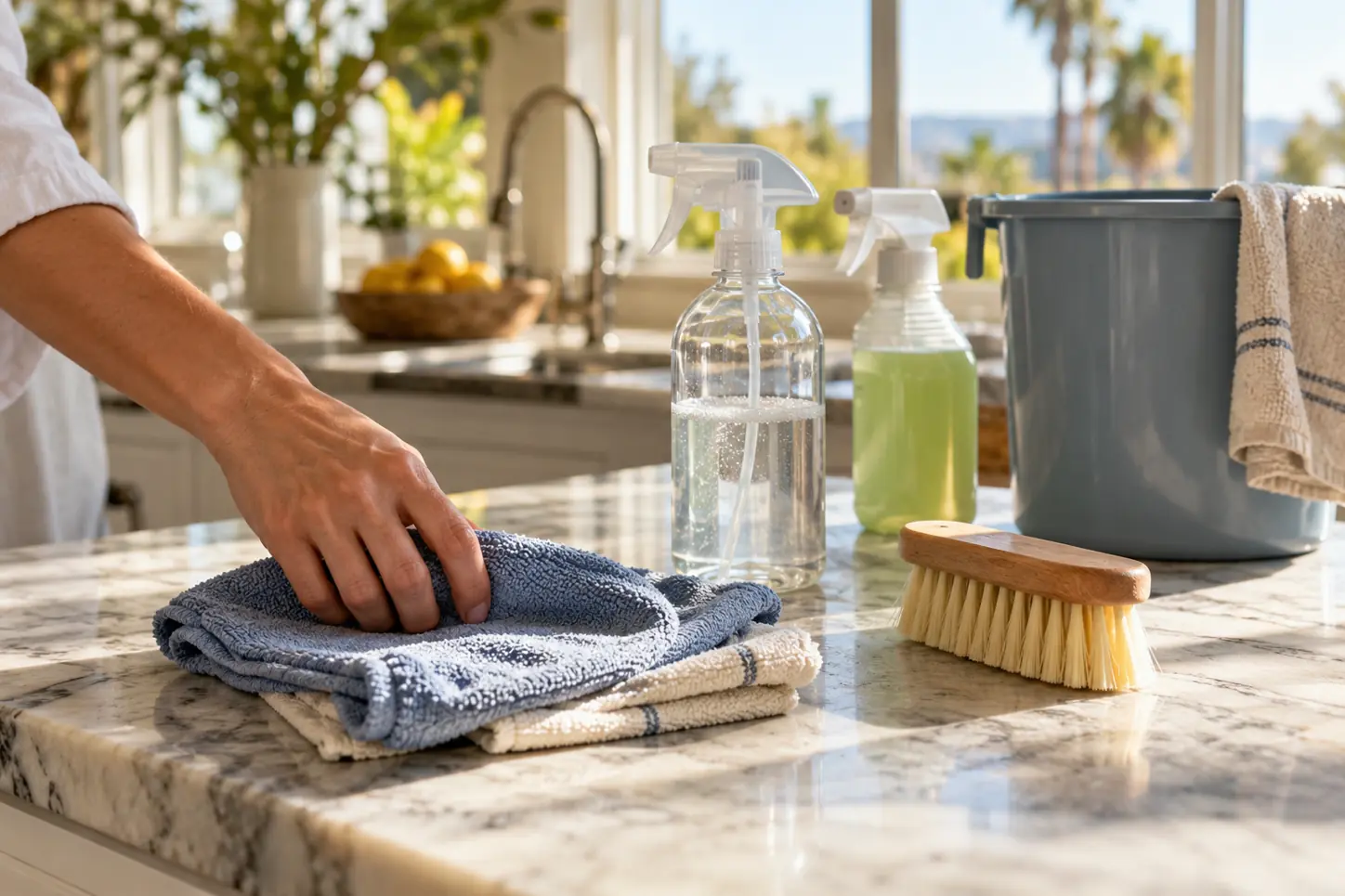
The minimal starter kit
The starter kit covers a one-bedroom apartment or a first week in a new house. It is small on purpose. People who buy fifteen sprays on day one usually end up with half of them unopened under the sink.
| Item | What it does | Notes |
|---|---|---|
| Vacuum or broom and dustpan | Removes dry soil before any wet cleaning | Do this first, every time. Wet cleaning over grit just moves grit around |
| Flat mop with washable pad | Cleans hard floors | A flat microfiber pad is gentler and uses less water than a string mop |
| 6 to 10 microfiber cloths | Wipes, dusts, polishes | Keep colors separate (see the color system below) |
| Non-scratch scrub sponges | Scrubs sinks, tubs, stovetops | Look for “non-scratch” on the label |
| Soft-bristle scrub brush | Grout, tile edges, soap scum | An old toothbrush is the budget version |
| pH-neutral all-purpose spray | Counters, appliances, cabinet fronts | Check the label for the surfaces it lists |
| Glass cleaner | Mirrors and windows | Ammonia-free is safer for tinted glass and around finishes |
| Toilet bowl cleaner | Bowl only | Keep it out of the mix with other products |
| Dish soap | Greasy messes, gentle floor mix, hand washing | See our dish soap uses guide |
| Baking soda | Mild abrasive paste, deodorizer | Cheap and useful for sinks and trash cans |
| Rubber gloves | Protects skin | Keep one pair for the bathroom and one for the kitchen |
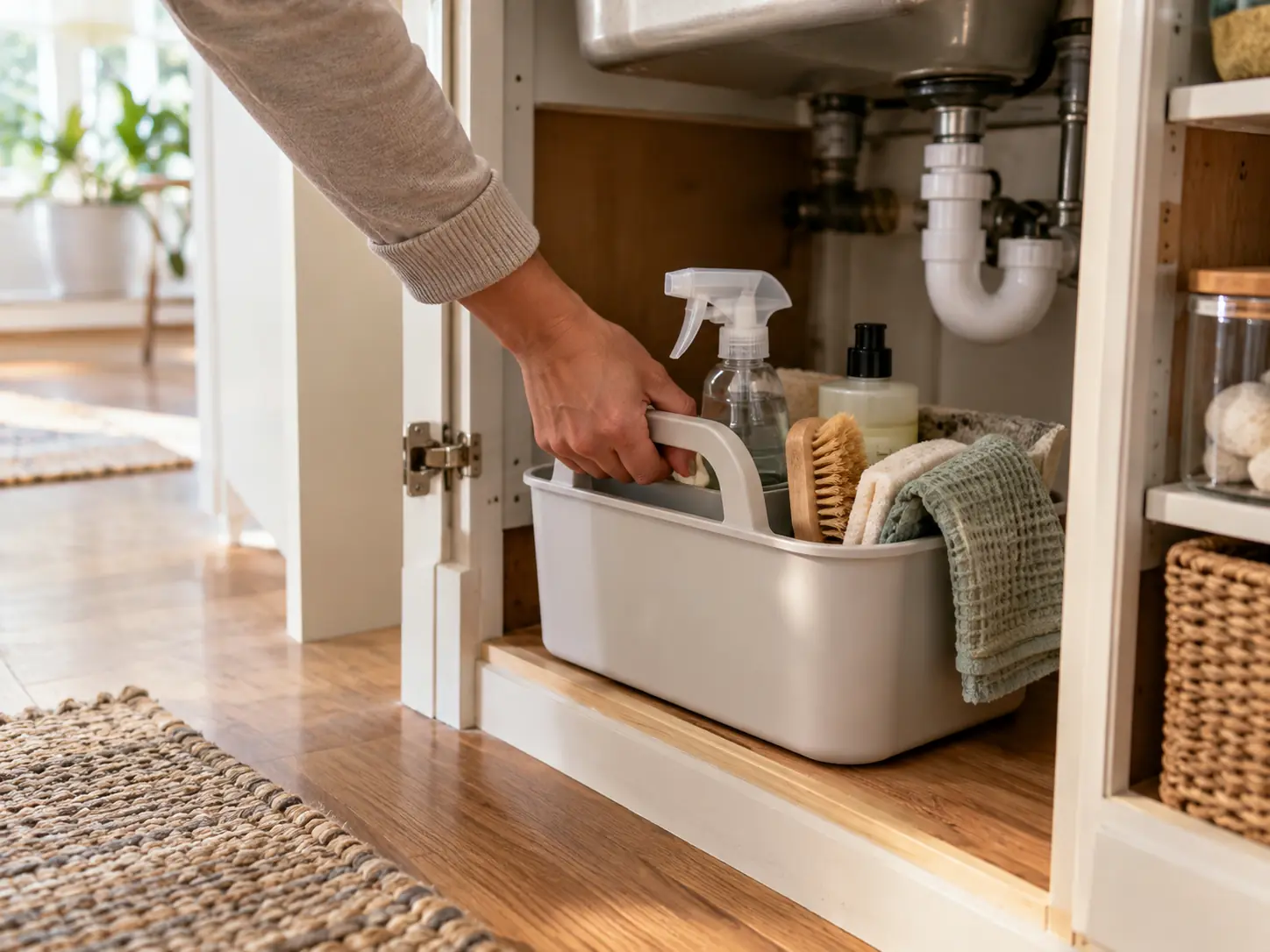
Add a bucket or caddy to carry it all and the kit is complete. A caddy matters more than it sounds: cleaning in one pass instead of walking back to a closet for every product is the single biggest time saver for a beginner.
Tools that last longer than products
Products run out. Tools stay. If you have a limited budget, spend on the tools first, because a good tool replaces a lot of chemistry.
Microfiber cloths
Microfiber picks up dust and light grime mechanically, which means it works with plain water on many surfaces. Buy a multi-pack and use a color system so the cloth that wiped the toilet never touches the kitchen counter.
A simple scheme many households use:
- Blue: glass and mirrors
- Green: kitchen surfaces
- Yellow or pink: bathroom sinks and counters
- Red or gray: toilets and floors only
Squeegee
A shower squeegee takes ten seconds and prevents most of the soap scum and mineral film that later needs a heavy scrub. It is one of the cheapest items on this list with the biggest payoff, especially where tap water is hard.
Scrub brushes and detail tools
Three shapes cover almost everything: a handled deck brush for tubs and floors, a small grout brush, and a bottle brush or narrow detail brush for faucet bases and tracks. Nylon bristles are fine for most surfaces. Brass-bristle brushes are for grills, not for your home.
Vacuum features worth paying for
If you buy one expensive item, make it the vacuum. Look for a sealed system or a HEPA filter if anyone in the home has allergies, a brush roll you can switch off for hard floors, and a crevice tool. Our guide to reducing household allergens explains why filtration matters more than suction numbers on a box.
Extension duster and step stool
A telescoping duster reaches ceiling corners and fan blades. A stable step stool saves you from using a dining chair. Neither is glamorous, both prevent injuries.
Types of cleaners and what each is for
The aisle looks confusing until you sort it by chemistry. Most products fall into five types.
| Type | Works on | Avoid on | Label clues |
|---|---|---|---|
| pH-neutral all-purpose | Everyday dirt on sealed surfaces | Heavy limescale, baked-on grease | “Multi-surface”, “pH-neutral” |
| Degreaser (alkaline) | Kitchen grease, stove hoods | Aluminum, some paints, unsealed wood | “Degreaser”, “heavy duty” |
| Acidic descaler | Limescale, mineral deposits | Natural stone, some metals | Citric acid, lactic acid, sulfamic acid |
| Disinfectant | Germs on hard, non-porous surfaces | Anything you are not told it works on | EPA registration number and contact time on the label |
| Oxygen bleach | Stains, whitening, laundry boost | Wool, silk, some dyes | Sodium percarbonate |
The label is the instruction
Disinfectants work only if the surface stays wet for the listed contact time, which is often several minutes. Spraying and wiping immediately cleans but does not disinfect. If you want to know more about what to combine and what to keep apart, read cleaning products you should never mix.
Powders vs liquids vs sprays vs pods
Format affects cost, storage, and results more than people expect.
Powders
Powdered cleansers contain a mild abrasive. They scrub well on porcelain sinks and tubs, and they store without spoiling. The downside is that they scratch some surfaces (acrylic tubs, glossy fixtures, glass cooktops) and leave a film if not rinsed thoroughly. Oxygen bleach powder is a different product: it dissolves in water and lifts stains without scrubbing, so it suits soaking and laundry.
Liquids and concentrates
A bottle of concentrate costs more up front and goes much further once diluted correctly. The risk is overdosing. More product does not clean better, it leaves residue that attracts dirt. Follow the dilution on the label.
Ready-to-use sprays
Sprays are convenient and consistent, and they are what most people use daily. You pay for water and the bottle. A reasonable middle path is to buy a spray for the products you use weekly and a concentrate for the ones you use a lot.
Wipes and pods
Disposable wipes are fine for a quick wipe-down and for travel, but they generate waste and are easy to overuse. Dishwasher and laundry pods are measured doses, which helps with consistency and costs more per load.
Which format for which job
| Job | Best format | Why |
|---|---|---|
| Daily counters | Spray plus microfiber | Fast, no rinse needed |
| Tub and sink scrubbing | Powder or paste | Abrasion helps on porcelain |
| Floors | Concentrate in a bucket | Dilution control, no streaks |
| Laundry stains | Oxygen bleach powder | Soaks well, gentle on fabrics that allow it |
| Toilet | Gel or liquid | Clings under the rim |
Soaps: dish soap, hand soap, castile, and laundry detergent
These are not interchangeable, even though they all foam.
- Dish soap is a surfactant blend designed to cut grease and rinse cleanly. It is the most useful single liquid in the house.
- Hand soap often contains moisturizers and fragrance that leave a film on surfaces. Fine for hands, poor for cleaning.
- Castile soap is a plant-oil based soap. It works, but in hard water it can leave a soap scum residue, a particular issue across much of Orange County (more on that below).
- Laundry detergent is formulated for fabric, with enzymes and brighteners. A teaspoon in a bucket is not harmful on many things, but dish soap is the better all-round choice for surfaces.
We cover the details of dilution and what to avoid in the dish soap guide.
Products by surface
This table is the part to screenshot before you shop. Always test in a hidden spot.
| Surface | Use | Do not use |
|---|---|---|
| Sealed granite, quartz counters | pH-neutral spray, mild dish soap solution | Vinegar, lemon juice, abrasive powders on a regular basis |
| Marble, travertine | pH-neutral stone cleaner | Any acid, including vinegar and many bathroom sprays |
| Stainless steel | Dish soap and water, microfiber, wipe with the grain | Steel wool, bleach |
| Glass and mirrors | Glass cleaner or diluted dish soap, squeegee or lint-free cloth | Paper towels that shed lint |
| Sealed hardwood | Cleaner made for finished wood, barely damp mop | Steam mops, soaking wet mops |
| Vinyl and laminate plank | pH-neutral floor cleaner | Wax-based polish |
| Porcelain and ceramic tile | pH-neutral cleaner, baking soda paste for grout | Bleach on colored grout |
| Fiberglass or acrylic tub | Non-abrasive spray, soft sponge | Powder cleansers with grit |
| Toilet bowl | Dedicated bowl cleaner | Mixing it with any other cleaner |
| Painted walls | Damp microfiber with a drop of dish soap | Scrubbing hard on flat paint |
If you want help with specific materials, see our posts on stainless steel appliances and grout and tile.
Budget tiers
Pick the tier that matches your situation and upgrade one category at a time.
Starter tier
Everything in the minimal kit above. This handles a clean home with normal upkeep. If you only buy this tier, nothing in your home will suffer.
Standard tier
Add:
- A degreaser for the stovetop and range hood area
- A descaler (citric acid based) for faucets, showerheads, and glass
- A dedicated tub and tile cleaner
- A second mop pad and extra microfiber
- A lint roller or rubber squeegee broom for pet hair
- Oxygen bleach powder
- A caddy that stays stocked
Advanced tier
Add only when you have the problem:
- A steam cleaner (read the manufacturer’s list of safe surfaces first)
- A wet-dry vacuum
- A carpet spot cleaner
- A small enzyme cleaner for pet accidents, see removing pet odor from carpet and furniture
- Grout sealer and stone-safe products if you have natural stone
For families who prefer plant-based products, the post on the best eco-friendly cleaning products walks through what the labels mean, and green cleaning vs standard compares performance.
What to skip
Marketing makes it easy to overbuy. Here is what most homes do not need.
- Separate sprays for every room. A multi-surface cleaner and a glass cleaner cover most rooms. A dedicated bathroom product is useful, but a kitchen-only, living-room-only, and bedroom-only line is redundant.
- Cleaning products with “antibacterial” on the label for everyday use. Regular cleaning removes soil and most microbes with it. Save disinfectant for toilets, raw meat contact surfaces, and when someone is sick.
- Scented sprays that cover odors. Find the source instead.
- Paper towels as the main tool. They cost more over time than washable cloths and leave lint on glass.
- Bleach as a default. It is a specialist product, it damages many surfaces, and it is dangerous to mix. You can run a clean home with no bleach.
- Drain “openers” you use as maintenance. These are harsh. A drain strainer and a plunger are the better first line.
- Single-use gadgets such as a special tool for one pan or one corner.
- Wooden furniture sprays with silicone, which build up and make later refinishing harder.
What professionals actually use
Professional crews work from a short list too. In practice that means microfiber cloths in color-coded sets, a few concentrated products diluted for the job, a vacuum with a good filter, a flat mop, and some specialized items for tile and glass. The point is not a secret formula. It is a consistent system and the right tool for each surface.
Our crews use eco-friendly, pet-safe products, which is why the same short-list thinking works at home: a few reliable products used correctly beat a cabinet full of experiments.
Skip this step: If stocking a kit feels like too much, we can handle the recurring chores for you. See recurring cleaning for what a regular visit covers, and ask which supplies we bring when you book.
Storage and safety
The cabinet under the sink is where most household chemical accidents begin. A few habits remove most of the risk.
Where to store
- Keep products in their original containers with the labels intact. Never pour cleaner into a drink bottle.
- Store on a high shelf or in a locked cabinet if children or pets are in the home.
- Keep acids (descalers, toilet cleaners) apart from bleach-based products.
- Avoid heat. A garage in an Orange County summer can get hot enough to degrade some products and pressurize aerosols, so a cool indoor closet is better.
- Close lids tightly. Some products lose strength once the cap is loose.
Ventilation and gloves
Open a window or run the bathroom fan whenever you use a product with fumes, and wear gloves when using anything beyond mild dish soap. If a product causes coughing or watering eyes, stop, air out the room, and switch to something gentler.
Never mix products
This is the one rule that matters most. Do not combine bleach with ammonia, bleach with acids (including vinegar and many toilet cleaners), or two different drain or bowl cleaners. Pick one product, use it, rinse, and wait before using another. The full breakdown is in cleaning products you should never mix.
Pets and children
Many household products are harmful if swallowed or if pets walk through wet residue and lick their paws. Let floors dry fully before animals return, and call poison control or a vet if you suspect ingestion. Our post on keeping a clean home with pets covers product choices around animals.
Microfiber care and replacement schedule
Microfiber works as long as the fibers are open. Treat it badly and it turns into a smear machine.
How to wash microfiber
- Wash with a plain detergent, with no fabric softener (softener coats the fibers).
- Skip bleach, which weakens the fibers.
- Wash separately from cotton towels, which shed lint onto microfiber.
- Tumble dry low or air dry. High heat can melt the fibers.
When to replace things
There is no universal schedule, so use condition as your guide.
| Item | Replace when |
|---|---|
| Microfiber cloths | They stop picking up dust or feel stiff |
| Sponges | They smell even after rinsing, or fall apart (every few weeks with daily use is common) |
| Mop pads | They stay gray after washing |
| Scrub brushes | Bristles splay or flatten |
| Vacuum filters | As the manufacturer states, or sooner if the suction drops |
| Spray bottles | When the trigger fails or the bottle cracks |
| Open chemical products | When the label says so, or if the color or smell changes |
Sponges deserve a special note. They hold moisture and bacteria. Rinse after every use and replace them on a schedule, and keep one for dishes and a separate one for everything else.
Orange County angle
Much of Orange County has hard water, so check your local water quality report to see yours. Hard water leaves mineral spots on faucets and glass, which makes a descaler (citric acid based) and a squeegee more valuable here than in soft-water areas. It also reduces how well some soaps rinse, so a little less product and a thorough rinse go a long way.
Coastal salt air can dull metal fixtures, so wipe them down with a damp cloth every so often. Fine dust, especially during Santa Ana wind days, settles on every surface, which is another reason microfiber and a vacuum with a good filter matter more than a shelf of sprays. See why Orange County homes get dusty fast.
If you rent a condo or live in an HOA community, check your documents before using strong chemicals on shared surfaces or balconies, and keep products stored securely if your unit shares a wall with a neighbor’s patio.
A sample shopping list you can print
Tools
- Vacuum or broom and dustpan
- Flat mop and two pads
- 8 microfiber cloths in 3 colors
- 2 scrub sponges (non-scratch)
- Soft scrub brush and grout brush
- Squeegee
- Telescoping duster
- Bucket or caddy
Products
- pH-neutral all-purpose spray
- Glass cleaner
- Toilet bowl cleaner
- Dish soap
- Baking soda
- Citric acid descaler (for hard water)
- Oxygen bleach powder (optional)
Safety
- Two pairs of rubber gloves
- A step stool
Mistakes that waste money or damage things
- Buying a cleaner for the brand, not the surface. Read the “use on” list.
- Using too much product. Extra soap leaves a film.
- Using one cloth for everything. Cross-contamination spreads germs.
- Skipping the dry pass. Vacuum before you mop.
- Washing microfiber with softener. It stops working.
- Buying a steam cleaner for surfaces that cannot handle it. Check the flooring warranty.
- Storing chemicals in a hot garage. Heat degrades them.
- Mixing products “for strength.” It is dangerous and rarely works better.
When to call a professional
A starter kit handles daily and weekly upkeep. It is not designed for oven interiors baked with years of grease, heavy mineral buildup on shower glass, or the first reset of a home that has not been deep cleaned in a long time. Those jobs take hours and sometimes specialty tools.
When it is worth handing off: A one-time deep cleaning resets the baseline, and then your small kit keeps it there. For a 3 bedroom, 2 bathroom home the formula works out to (60 + 75 + 70) x 1.5 = $307.50 before add-ons, and new customers get $39 off the first clean.
If you are renting and need a handover clean, our move-out cleaning covers the full list, and the post on what landlords check at move-out inspection shows what to prioritize. For your exact number, use the instant quote on our pricing page.
Frequently asked questions
What cleaning supplies do I need? Start with a vacuum or broom, mop, microfiber cloths, non-scratch sponges, a scrub brush, a pH-neutral all-purpose spray, glass cleaner, toilet bowl cleaner, dish soap, baking soda, and gloves. Add specialty items only when a specific problem appears.
What are the must-have cleaning products? An all-purpose cleaner, a glass cleaner, a toilet bowl cleaner, and dish soap. Baking soda is a cheap fifth that handles sinks and smells.
What do professional cleaners use? Typically microfiber cloths in color-coded sets, concentrated cleaners diluted to the label, a vacuum with a good filter, a flat mop, and a few specialty items for glass and tile. The system matters more than any single product.
How much should I spend on cleaning supplies? Less than you think. Buy the starter tier, use it for a month, and note what you ran out of or wished you had. Spend extra on a good vacuum and microfiber before spending on specialty sprays.
Do I need disinfectant? For most surfaces, regular cleaning is enough. Use a disinfectant on toilets, surfaces touched by raw meat, and during illness, and follow the contact time on the label.
Is bleach necessary? No. It is useful in narrow cases, but it damages many surfaces and is dangerous when mixed with ammonia or acids. Many households never need it.
How often should I replace sponges and cloths? Replace sponges when they smell or fall apart, and microfiber when it stops picking up dust. Rinse sponges after every use and wash cloths after each cleaning session.
Are natural cleaners enough? For routine upkeep, often yes. Vinegar is a poor choice on stone, though, and some jobs such as heavy grease or limescale need a purpose-made product. See natural cleaning with vinegar and baking soda for the limits.
Where should I store cleaning products if I have pets or kids? In original containers, on a high shelf or a locked cabinet, away from heat, with lids closed.
Next step
If you would rather keep your supplies to a minimum, get an instant quote at our pricing page and see what a recurring visit costs for your home size. For a full reset before you start your own routine, take a look at deep cleaning. Our crews are dispatched from Irvine across Orange County, including Irvine and the surrounding cities.