Green Cleaning vs Standard Cleaning: What's Actually Different
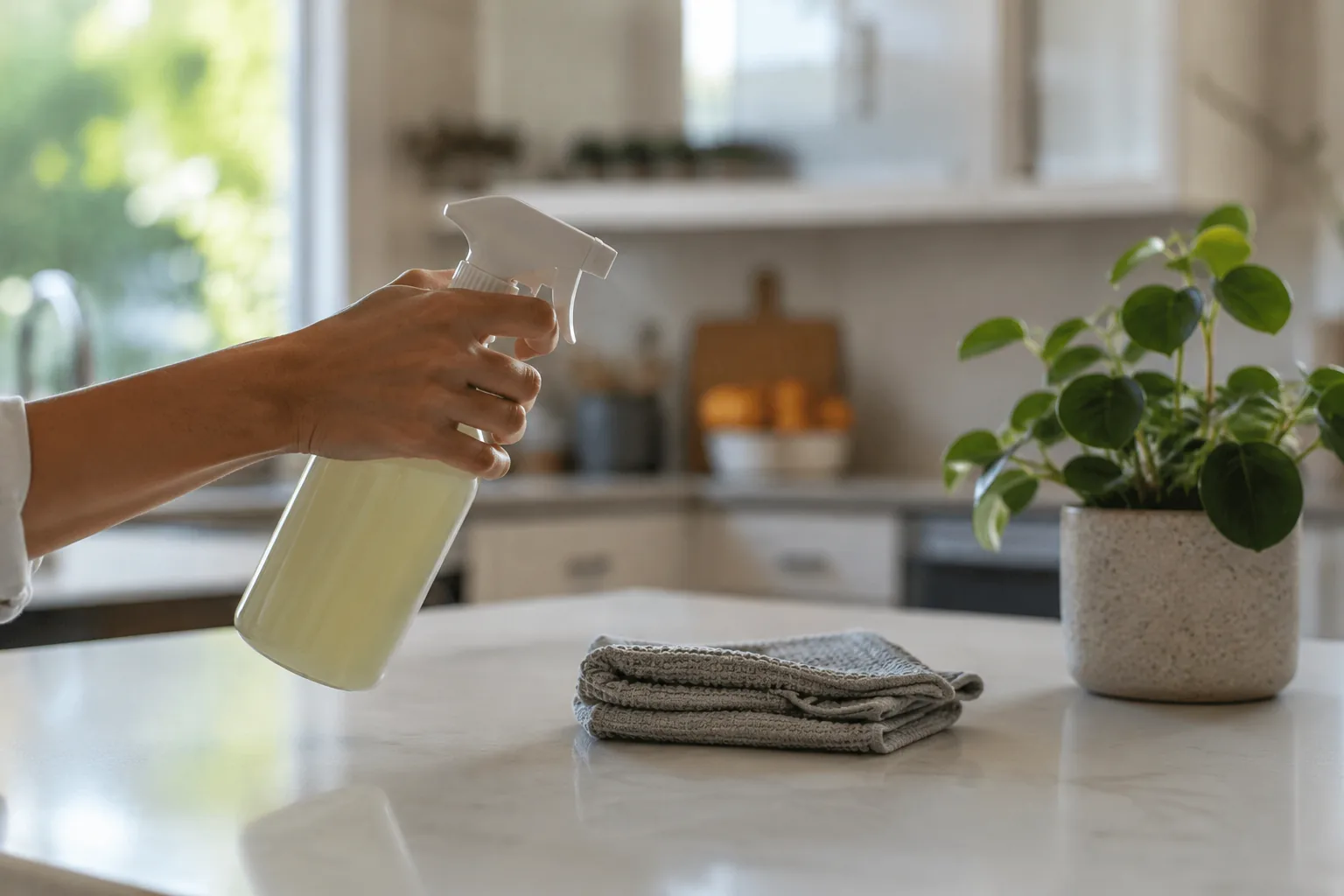
A product only counts as genuinely “green” if it discloses its full ingredient list, skips chlorine bleach and ammonia, and has a real third-party certification behind it, not just a leaf on the label. Anything less is marketing. Below: the chemistry, the fumes, the safety case for kids and pets, whether it cleans as well, and how to spot a genuine green product versus a greenwashed one.
What “green” actually means, versus a marketing label
“Green,” “natural,” and “eco-friendly” are not regulated words on a cleaning product label in the United States. A company can print any of them on a bottle that still contains ammonia or a synthetic fragrance blend and face no penalty. So the label itself tells you almost nothing.
What tells you something is the ingredient list and whether an independent body has checked it. A genuinely green product does three things a greenwashed one usually skips: it lists actual ingredients instead of vague categories like “surfactant,” it avoids chlorine bleach and ammonia as active ingredients, and it carries a real certification such as EPA Safer Choice or Green Seal rather than a brand’s own icon. That is the entire test.
The chemistry: what’s actually in each
Conventional, mass-market cleaners lean on a small set of aggressive chemicals because they work fast and cheap. Chlorine bleach kills germs and whitens on contact. Ammonia cuts through grease and streaks glass quickly. Synthetic fragrance masks the smell of both. None of these three ingredients are complicated or secret, they’re just harsh and volatile, meaning they evaporate into the air as you use them, which is where the fumes come from.
Genuine green formulas replace that trio with different chemistry, not weaker versions of the same chemistry:
- Plant-based surfactants (coconut or corn-derived, typically) lift grease and dirt the way soap does, by surrounding oily particles so they rinse away, instead of dissolving them with a caustic agent.
- Enzyme cleaners use proteins that break down organic soil, protein stains, starches, fats, the same principle as a laundry enzyme booster, applied to countertops and floors.
- Citric acid and vinegar-based descalers handle mineral buildup and soap scum through a straightforward acid-base reaction, similar to what dissolves scale in a coffee maker.
- Hydrogen peroxide is the one ingredient in this category that is also an actual EPA-registered disinfectant at the right concentration, so it does real disinfecting work without relying on chlorine.
The practical difference: conventional cleaners lean on a few fast, harsh, universal chemicals. Green formulas use several milder, more targeted ones, which is why a genuine green line usually needs a slightly different product for a slightly different job, rather than one bottle claiming to do everything.
Why fumes and residue happen, and why green products behave differently
Ammonia and chlorine bleach are both volatile, meaning a portion of what’s in the bottle evaporates into the air on contact with a surface, not just while you’re actively spraying. That’s what a sharp chemical smell actually is: airborne ammonia or chlorine compounds reaching your nose and throat. In a small, closed bathroom, that concentration builds faster than it would in an open room, which is why bleach fumes hit harder in a shower stall than in a kitchen.
Residue is a related but separate issue. Ammonia-based glass and surface cleaners evaporate fast for a streak-free finish, but the residual chemical left behind can sit on countertops and cabinet fronts, exactly the surfaces hands touch throughout the day.
Low-VOC green products are formulated without those volatile compounds in the first place, so there’s less to evaporate and less airborne concentration to build up in an enclosed room. Plant-based surfactants and enzyme cleaners are chemically less volatile than ammonia and chlorine, so they don’t off-gas the same way. That’s a factual point about evaporation rates, not a claim that green products are risk-free or that conventional products are dangerous at normal household use, just that there’s less smell and less noticeable film left behind once the surface dries.
Safety for kids, pets, and sensitivities
The reasoning here is straightforward. Kids and pets spend more time at floor and counter level than adults do, which means more direct contact with whatever residue is sitting there. A toddler crawling across a just-mopped floor, or a dog walking barefoot across it and then grooming its paws, gets a more concentrated, repeated exposure than an adult standing and walking on it in shoes.
Conventional cleaner labels that say “keep pets and children away until dry” are a direct acknowledgment of this, the manufacturer knows the product isn’t inert on contact and needs time and ventilation to become safe to touch. Low-VOC, ammonia-free, chlorine-free green products generally don’t carry that same waiting-period instruction, because there’s less volatile residue left behind for a crawling child or a grooming pet to pick up.
For people with asthma, allergies, or general chemical sensitivity, the same volatility applies. Ammonia, chlorine, and synthetic fragrance are common asthma and allergy triggers, and reducing what’s airborne reduces the exposure. That’s general safety reasoning, not a medical claim, and it doesn’t mean green products replace medical-grade disinfection when that’s specifically needed, covered next.
Does green cleaning actually work as well?
The honest answer: for most of what a house actually needs cleaned, yes. For a specific minority of situations, not without extra effort or a specialized product.
Where green products genuinely hold their own: Everyday grime, kitchen counters, bathroom surfaces, floors, glass, dusting, general surface dirt, is exactly what plant-based surfactants and enzyme cleaners are built for. A coconut-derived surfactant cuts through daily grease and food residue about as effectively as an ammonia-based spray, because the soil itself isn’t the kind of stubborn buildup that needs a harsher chemical. This covers the large majority of what a weekly or biweekly clean actually deals with.
Where extra effort or a specific product still matters: Two categories are worth naming honestly. First, heavy mineral buildup, months or years of hard water scale on a showerhead or fixture, sometimes needs a stronger descaling approach or more scrubbing time than a routine green product delivers on the first pass, even though citric acid and vinegar-based descalers handle routine buildup well. Second, true disinfection: after illness in the household, or on a surface that touched raw meat, plain vinegar is not a registered disinfectant and isn’t proven to reliably kill viruses like norovirus or flu. Hydrogen peroxide-based products are the genuine exception, an actual EPA-registered disinfectant at the right concentration that still counts as non-toxic.
The myth worth retiring is that green cleaning is a compromise accepted for the sake of safety. For routine cleaning, that framing is wrong, it’s a different set of chemistry solving the same everyday problem, not a weaker version of a standard clean. The honest caveat stands too: heavy scale and disinfection-specific needs sometimes call for a targeted product rather than assuming any green all-purpose spray covers every case.
Environmental impact
Green and conventional products differ downstream too, beyond what happens inside the house.
Biodegradability. Conventional cleaning chemicals, ammonia and chlorine compounds especially, don’t break down quickly once they go down the drain, and can affect aquatic life in the waterways treated wastewater eventually reaches. Genuine green formulas are built to break down into carbon dioxide, water, and biomass within a defined testing window rather than persisting. The credible version of this claim is “readily biodegradable,” a standard tied to OECD test protocols, not just the bare word “biodegradable” with nothing behind it.
Packaging. Concentrated green formulas diluted at home ship less water and less plastic per use than a ready-to-use spray bottle shipped mostly full of water. Refill pouches and concentrate systems reduce total plastic volume going into a landfill or recycling stream over a year of regular use compared to buying a new full-size bottle every time one runs out.
Water systems. Wastewater treatment removes most, not all, chemical residue before water returns to rivers, groundwater, or the ocean. Products built to biodegrade fully reduce what makes it through that process as a persistent compound, an aggregate effect across many households rather than any single home’s routine.
How to spot a genuine green product versus greenwashing
A few concrete signals separate the real thing from a bottle with a green leaf printed on it:
- Full ingredient disclosure. A genuine green brand lists what’s actually in the bottle, not just categories like “surfactant” or “fragrance.” California’s Cleaning Product Right to Know Act, passed in 2017, requires manufacturers selling in the state to disclose ingredients on the label or online, so this information is generally available even when the front label stays vague.
- A real third-party certification. EPA Safer Choice is the clearest signal: every ingredient in a formula, not just the finished product, is reviewed by EPA scientists against health and environmental criteria before the logo goes on the bottle. Green Seal (the GS-37 standard) works similarly through an independent nonprofit, testing VOC limits, aquatic toxicity, and biodegradability. Both require ongoing compliance.
- Specific claims instead of vague ones. “No chlorine bleach, no ammonia” is a checkable claim. “Made with natural ingredients” or “plant-powered” with no certification attached is not.
- No made-up seals. A logo that isn’t EPA Safer Choice, Green Seal, or a similarly recognized third party is decoration, not verification.
For a full category-by-category buying guide, including which products to trust in the kitchen, bathroom, and laundry room, see our best eco-friendly cleaning products breakdown.
Green cleaning vs standard cleaning, side by side
| Standard/conventional cleaning | Genuine green cleaning | |
|---|---|---|
| Active ingredients | Chlorine bleach, ammonia, synthetic fragrance | Plant-based surfactants, enzyme cleaners, citric acid, hydrogen peroxide |
| Ingredient disclosure | Often vague (“surfactant,” “fragrance”) | Full ingredient list, checkable against a label or online |
| Certification | Usually none, or a brand’s own icon | EPA Safer Choice or Green Seal (GS-37) when genuine |
| Fumes | Noticeable, especially in closed rooms like a bathroom | Low-VOC formulas produce less airborne concentration |
| Surface residue | Can leave film on counters and cabinet fronts | Less residue left behind once dry |
| Wait time before contact | Labels often say keep kids and pets away until dry | Generally safe to re-enter sooner |
| Everyday grime and grease | Effective | Equally effective for most routine soil |
| Heavy mineral scale (months/years of buildup) | Effective, sometimes faster | Effective on routine buildup, may need extra time or a stronger descaler for heavy scale |
| True disinfection (post-illness, raw meat) | Chlorine bleach is a registered disinfectant | Hydrogen peroxide-based products are also EPA-registered; plain vinegar is not |
| Biodegradability | Often persists in wastewater | Formulated to break down fully within a defined window |
| Packaging | Frequently full-size, ready-to-use bottles | Often available as concentrate or refill, less plastic per use |
Clover’s approach: no upsell, no separate tier
At Clover, green cleaning isn’t a premium add-on you choose at checkout. It’s included on every service at no extra cost, recurring cleaning, deep cleaning, move-in and move-out, all of it. There’s no “standard” tier priced lower with harsher chemicals to upgrade away from. Every crew uses non-toxic, biodegradable products by default, on every visit, in every home, a deliberate default, not a marketing claim layered on top of a conventional service.
See our green cleaning page for the specifics of what that looks like in your home, or get an instant quote for your city to see current pricing, the same price whether or not you’d have paid extra elsewhere for the eco-friendly option.
Frequently asked questions
Is green cleaning actually as effective as standard cleaning? For everyday grime, grease, and surface dirt, yes. The exceptions are heavy, longstanding mineral buildup, which can need extra time or a stronger descaler, and true disinfection, where a hydrogen peroxide-based product, not plain vinegar, is the right non-toxic tool.
Does green cleaning cost more? At Clover, no, it’s included on every service at no extra cost. Buying individual certified retail products can cost more than store-brand conventional cleaners, though concentrates and refills often close that gap per use.
What’s the difference between “green,” “natural,” and “non-toxic” on a label? Legally, nothing. None of these words are defined or enforced on cleaning labels in the US. Look for an EPA Safer Choice or Green Seal certification instead of trusting the word itself.
Why do conventional cleaners smell so strong? Ammonia and chlorine bleach are volatile, so a portion evaporates into the air on contact with a surface. That’s the sharp smell, and it concentrates faster in a small, closed bathroom than in an open room.
Is green cleaning safe to use around a newborn or a very young child? Fewer volatile compounds and less residue means less for a crawling infant to contact directly. This isn’t a medical claim; a specific pediatric question is worth asking a doctor rather than relying on a general comparison.
Can green products actually disinfect, or just clean? Both, depending on the product. Hydrogen peroxide-based cleaners are genuine EPA-registered disinfectants and count as non-toxic. Plain vinegar removes some surface bacteria through scrubbing but isn’t a registered disinfectant.
Do green products work on pet messes and pet odor? Enzyme cleaners are built for this. The enzymes break down organic compounds in pet urine at a molecular level rather than masking the smell, which tends to outperform a general fragrance-based spray on set-in odor.
How do I know if a “green” product is actually certified or just marketed that way? Check for an EPA Safer Choice or Green Seal logo specifically. A leaf graphic, the word “natural,” or a brand’s own badge has no independent verification behind it.
Does green cleaning help with allergies or asthma? Reducing airborne ammonia, chlorine, and synthetic fragrance, all common triggers, is a reasonable general step for a household managing sensitivities. This is a safety point, not a treatment claim; follow your own medical guidance alongside it.
Is there a “standard” cleaning option at Clover that costs less than the green option? No. There’s one product standard at Clover, the eco-friendly one, on every service, at every price point. It isn’t a paid upgrade.
What should I look for if I want to switch my own household products to green ones? Start with the product you use most, usually an all-purpose spray, and check for full ingredient disclosure plus an EPA Safer Choice or Green Seal logo. Our best eco-friendly cleaning products guide breaks this down category by category.
The bottom line
Green cleaning isn’t a softer version of standard cleaning. It’s a different set of chemistry that handles most household soil just as well, with less fume and residue left behind, and two honest exceptions, heavy mineral scale and true disinfection, where a specific product matters more than the “green” label itself. At Clover, that standard is already built into every visit. Get an instant quote for your city, or read our green cleaning approach to see exactly what it covers.
or call +1 (949) 330-0081.