Pricing Comparisons
Giving a Cleaner Access to Your Home: Keys, Lockboxes, Codes, and Security
The safest way to give a house cleaner access is a method you can change or cancel in minutes: a unique smart lock code, a lockbox whose code you reset after each change in service, or being home to let the crew in. A hidden key under a mat or planter is the one option most professionals advise against, and a physical key handed over for good is the hardest to take back. Pick the method that fits your door hardware and your comfort level, put valuables away, and change the code whenever your service changes.
This guide covers every common access method, how to tighten security around each one, what to put away, how to think about cameras, what vetting really means, and what to do if something does go missing. If you are still deciding whether to be home at all, start with our short post on whether you need to be home for a cleaning, then come back here for the security details.
Quick answers
- Safest low-effort setup: a smart lock with its own code for the cleaning crew, which you can delete at any time.
- Most common setup without a smart lock: a code-based lockbox mounted out of sight of the street, with the code reset after any change in service.
- Not recommended: a key hidden under a mat, in a planter, or on top of a door frame. Anyone can find it, not just your cleaner.
- Cleanest handoff: a key given in person to the crew lead or office, written down on a log, and returned or re-keyed when service ends.
- Always fine: being home. Many people do this for the first visit.
- Before the first visit: put away cash, jewelry, medication, passports, and anything you would be upset to see moved.
- After service ends or a crew changes: change the code the same day.
Access options compared
| Method | Cost to set up | Easy to revoke? | Audit trail | Main risk |
|---|---|---|---|---|
| Being home | None | Not applicable | You see everything | You lose the benefit of being out |
| Code-based lockbox | Roughly the price of the box | Yes, reset the code | None, unless it is a smart lockbox | Shared or forgotten codes, box visible from the street |
| Smart lock with a guest code | Needs compatible hardware | Yes, delete the code | Often shows when each code was used | Wi-Fi or battery problems, codes left active |
| Hidden key | Free | No, you cannot know who found it | None | Anyone can find it |
| Key handoff to the crew | Cost of a copy | Only by getting the key back or re-keying | None | A lost key means re-keying |
| Key with a neighbor or building desk | Free | Depends on the person | Informal | One more person involved |
Prices of hardware vary a lot by brand, so we have not listed numbers. The point of the table is the last two columns: how quickly you can shut access off, and how much you can learn after the fact.
Option 1: Being home during the visit
This is the simplest option and carries no access risk at all. You open the door, the crew works, and you lock up after. It is normal for a first visit, a move-out clean, or any appointment where you want to point things out in person.
Two practical notes. First, being home does not mean hovering. Pick a room away from the work and let the crew move through the house in its own order. Second, remember that a visit with you inside still needs a plan for pets and for any rooms you want left alone. Our guide on how to prepare for cleaners walks through that.
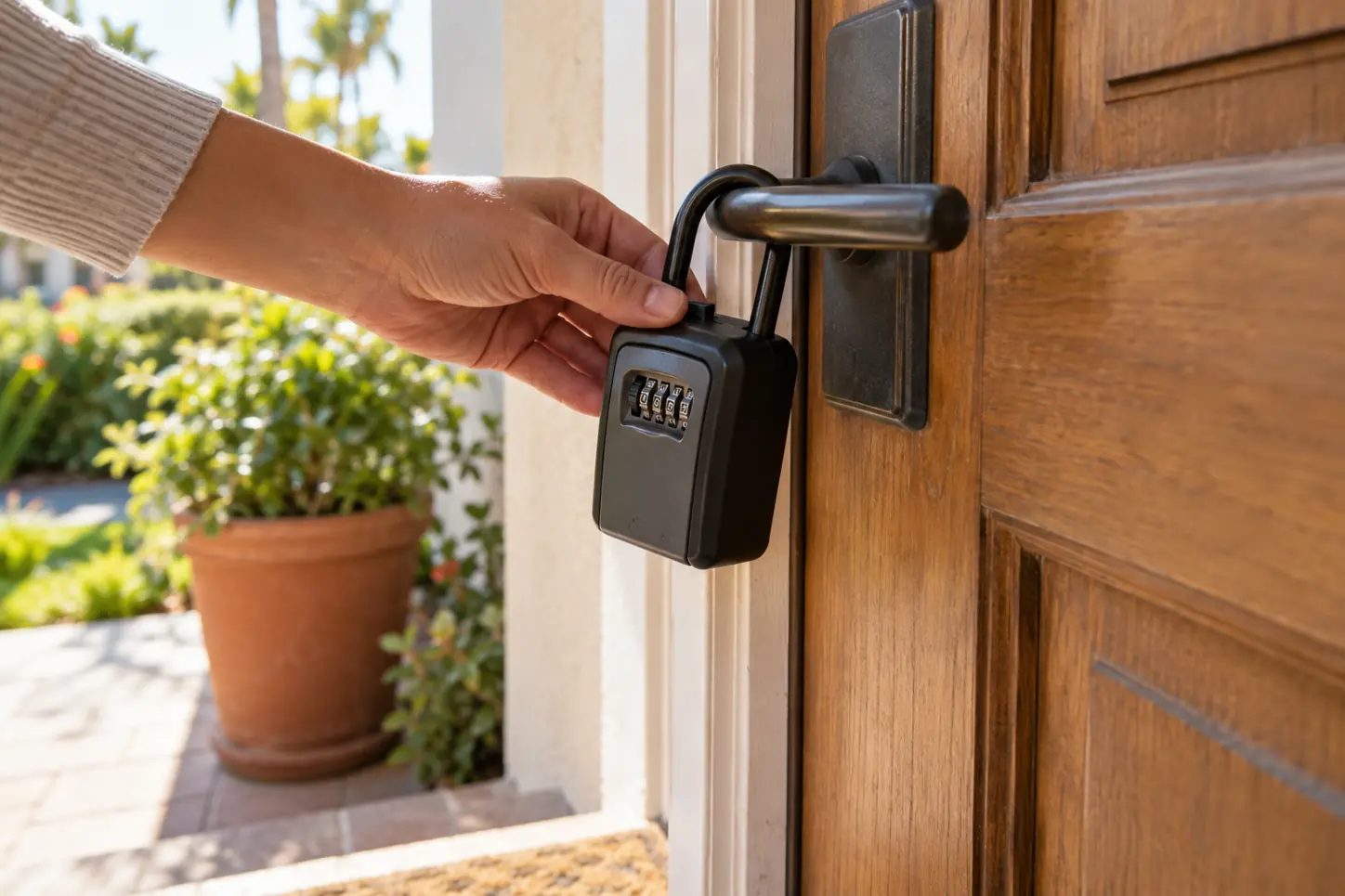
Option 2: A code-based lockbox
A lockbox holds a spare key behind a code. You mount it near the door, tell your provider the code, and the crew lets itself in and puts the key back when done. It is the most common choice for recurring clients because it needs no special door hardware.
How to make it safer:
- Mount it, do not hide it. A box bolted to a hose bib, gate post, or a wall near the door is better than a box dangling from a handle in plain view from the sidewalk. Out of sight of the street matters more than out of sight of the door.
- Avoid obvious codes. Skip your birth year, street number, or 1234. Pick four digits that mean nothing.
- Do not reuse the code. If the same four digits open your lockbox, garage keypad, and alarm panel, one leak opens everything.
- Share the code once, in writing, with the provider. Not with each crew member separately, and not in a group chat that includes other people.
- Reset it on a schedule. Many people reset the code once or twice a year, and always after a change in service. Tell your provider the same day so nobody is stuck outside on the next visit.
- Keep a second key you control. If the box jams or the battery in a smart lockbox dies, you still need a way in.
A smart lockbox, which can issue separate time-limited codes, adds an audit trail. That is useful if you ever need to know who opened it and when. A plain mechanical box does not record anything.
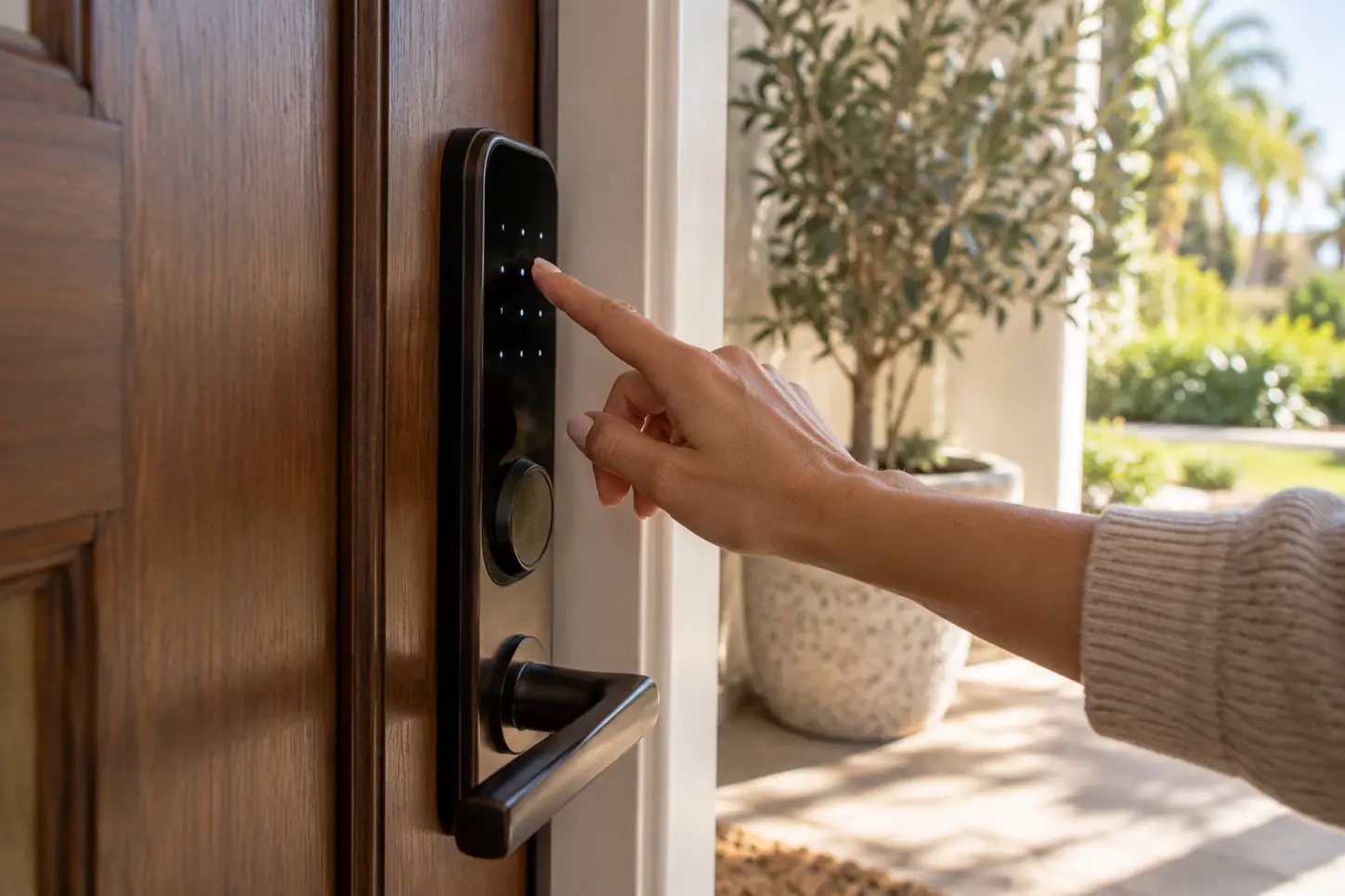
Option 3: Smart lock or door code
If your front door already has a keypad or smart lock, a dedicated code for the cleaning crew is usually the strongest setup. Reasons:
- You can delete it in seconds, from the lock or from your phone, without getting any key back.
- It is separate from your own code, so changing it does not disturb your family.
- Many models log each use, so you can see that the door opened at the scheduled time.
- Some can limit the code to a day and time window, though that takes upkeep when the schedule shifts.
The weakness is human, not mechanical. A common pattern is one shared code that the whole household, a dog walker, a neighbor, and the cleaner all use. When something goes wrong, nobody can say who entered. Giving the crew its own code solves that.
Keep the lock’s battery and app updated, and test the code before the first visit so the crew is not stuck on the porch. If your provider has told you what arrival window to expect, check the lock’s log afterward to confirm the visit happened.
Option 4: The hidden key, and why we do not recommend it
A spare key under the mat, inside a fake rock, in a planter, or above the door frame is the most familiar arrangement and the weakest. The problem is not the cleaner. The problem is that the hiding place is a guess about what strangers will not think of, and these are the first places anyone looks. It also leaves you without any record of who used it and no way to know when it was found.
If you currently use one, a lockbox or smart lock replaces it for a small cost. If a hidden key is your only option for now, at least do not leave it where a visitor to your front porch would step on it, and move it after each time someone besides your cleaner might have seen where it went.
Option 5: Handing over a key
Some people prefer a physical key, and that is a reasonable choice, especially if you have a deadbolt and no smart lock. Handing a key to a crew lead or the cleaning office works best when:
- The key is handed over in person, not left in a mailbox or sent by mail.
- You ask how the company stores and tracks keys. A good answer includes a log, secure storage, and keys that are not labeled with your full address.
- You write down the date and who has it.
- You agree on what happens at the end: returned, destroyed, or kept for a future visit.
- You treat a lost key as a rekey event, not a shrug. Replacing a lock cylinder is usually cheaper than the worry.
Ask the provider whether keys are tagged with a code or number rather than an address. If a key ring labeled with your street and unit gets lost, it tells a stranger exactly which door it opens.
Option 6: A neighbor, family member, or building desk
In apartments and condos, the building manager or front desk may hold keys and let the crew in. With a neighbor, the arrangement is informal and depends on the person. Either way, tell the person when the crew is expected, how long it usually takes, and what to do if the crew has not arrived. The security of this option is only as good as the person involved, and you would need to ask them for the key back if service ends.
Security best practices that apply to every method
Whichever option you choose, a handful of habits do most of the work.
Give the crew its own credential. A unique code or key that no one else uses means you can revoke it without affecting anyone else and, with a smart lock, see exactly when it was used.
Share the credential once, with one point of contact. Provide the code to the company’s office or crew lead, not to a chain of text threads. Ask how the company passes it to the crew and who can see it.
Write down who has access. A short note listing the date, the method, and who holds it keeps the situation clear six months later, when you may have forgotten that a neighbor still has a key.
Know the arrival window. If the crew is expected between 9 and 11 and a lock log shows the door opened at 2 p.m., you have found out something you wanted to know.
Lock up behavior. Confirm that the crew re-locks the door and puts the lockbox key back. This is a normal question to ask when you book.
Alarm systems. If you have an alarm, give the crew a separate alarm code if the system supports it, and tell your alarm company the visit is expected so a false alarm does not become a police call. Ask the crew what to do if the alarm is triggered, and give them a phone number to reach you.
Garage door codes. If the garage is the planned entry, treat the keypad code with the same care as the front door. Do not set it to the same code as your alarm.
What to put away before the first visit
You do not need to empty your house. You do need to think about a short list of items that are easy to lose track of, hard to replace, or private.
- Cash and checkbooks. Put them in a drawer or safe, not on a counter, desk, or in a jar.
- Jewelry and watches. Anything small and valuable goes in a locked place or with you.
- Medication. Particularly prescription pills. Putting these away protects children and guests, too.
- Documents. Passports, tax papers, birth certificates, and anything with account numbers.
- Keys and fobs. Car keys on the hook by the door are an easy thing to move accidentally.
- Electronics. Laptops and phones are usually left alone, but putting them in a closet removes any question.
- Fragile or sentimental items. These are not about theft. A crew cleaning around an heirloom may need to move it, and an accidental chip is easier to avoid if it is on a high shelf. Tell the crew what is delicate.
- Anything private. Journals, medical paperwork, and personal photos belong behind a closed door.
A locked closet or a single room marked as off limits works well. Tell the crew in advance which door to leave closed, and ask that it be left closed even if it is unlocked. If you are unsure what a crew normally covers, our post on what to expect from a first house cleaning explains the usual flow.
Cameras and recording in your home
Many people ask whether they can have cameras on when the cleaner is in the house. The short answer is that cameras are common, and the rules for recording are about disclosure and where the camera points. This is general information, not legal advice, and the law differs by state and city, so check the rules where you live.
What tends to matter in practice:
- Tell the crew. Telling the company in advance that there are cameras, and where, avoids misunderstandings. Many companies ask about this when you book.
- Think about audio. Video-only recording is treated differently from recording conversations in many places. Audio recording often has stricter consent rules. If your camera records sound, check the law and consider turning audio off.
- Keep cameras out of private areas. A camera in a bathroom or a bedroom aimed where someone changes clothes is a problem in most places, regardless of who lives there.
- Exterior and entry cameras are the least contentious. A doorbell camera or a camera pointed at the front door shows arrival and departure times and little else.
- Nanny-cam style hidden cameras are the area most likely to cause legal trouble and bad feelings. Disclosure solves most of it.
If you want a record without watching your own living room, a door log from a smart lock or a doorbell camera is often enough. It shows the visit started and ended when it should have.
What vetting actually means
You will see “insured, bonded, and background-checked” on many cleaning company websites. At Clover House Cleaning, our crews are insured, bonded, and background-checked. The terms are easy to blur together, so here is what each is meant to tell you.
- Insured generally refers to general liability coverage for accidental damage during a visit.
- Bonded generally refers to a bond that can reimburse a client for a covered loss, such as theft by an employee. The coverage terms and limits depend on the bond itself.
- Background-checked means the people sent to your home have been screened. What a screening covers and how often it is repeated differs by company, so it is fair to ask.
None of these is a promise that nothing will ever go wrong. They are the signs that a company has structure behind it, and that there is a process if something does happen. Our longer explainer on insured, bonded, and background-checked goes through the questions to ask. For a wider checklist when comparing companies, see red flags when hiring a house cleaner.
Questions worth asking any provider before handing over access:
- Is every person who enters my home individually background-checked?
- Is it usually the same crew each time? (On our recurring plans, the same local crew returns to your address.)
- How do you store and pass along keys and codes?
- Who do I call if I have a concern, and how fast do you respond?
- What is your process if something is damaged or missing?
A same crew each time matters for security as much as for quality. A familiar crew means fewer unknown faces and a clearer sense of who was in your home on a given day. If you want to see how recurring service works, our recurring cleaning page explains it.
If something goes missing or gets damaged
First, do not accuse anyone. Most “missing” items turn out to be misplaced, moved to tidy up, or taken by a family member. A calm sequence works best.
- Search first. Look where the item might have been moved: a drawer, a basket of items tidied away, the laundry, the car. Ask everyone in the household.
- Check your records. If you have a door log or doorbell footage, look at who entered and when.
- Contact the company promptly, by phone or message, with specifics: what the item is, where it was last seen, and when you noticed it was gone. Prompt reports are easier to investigate.
- Ask how their process works. A company that is insured and bonded should be able to explain how a claim is handled and what documentation it needs.
- Keep notes. Dates, photos, receipts, or appraisals for the item help with any claim, whether to the company or to your homeowner’s or renter’s insurance.
- Report a theft to the police if you believe a crime occurred. A police report is also useful for an insurance claim.
- Change your access. Change the lockbox or smart lock code while the matter is sorted out.
For damage, take photos and describe it plainly. For anything that is a quality concern rather than a loss, our guide on what to do if you are unhappy with a house cleaning lays out the steps. For our own service, if you are not satisfied, tell us within 24 hours and we re-clean the area free.
Coverage specifics, such as limits, deductibles, and what is excluded, depend on each policy. Ask the company and your own insurer, rather than assuming.
How and when to change codes
Changing the code is the single easiest security habit, and it works for every method except a handed-over key. Change it:
- When you end service or switch companies. Do it the same day.
- When a crew changes, if you want a fresh start.
- After a lost phone or a shared code gets forwarded.
- After a house guest, a contractor, or a short-term renter used the same code.
- On a schedule, such as every six months, so nothing stays active forever.
To change a lockbox code, follow the maker’s reset steps, usually a small lever or button inside the box. For a smart lock, delete the guest code in the app or on the keypad and create a new one. Then:
- Test the new code yourself with the door open.
- Send the new code to the company’s single point of contact.
- Confirm they received it before the next visit.
- Remove the old one from your notes, texts, and email.
If a key was handed over and service ends, ask for it back and write down the date. If it cannot be returned, rekeying the lock is the clean answer.
A simple setup that works for most homes
If you want a plan to copy, this one fits most Orange County homes and townhomes:
- Be home for the first visit and walk the crew through.
- Put away cash, jewelry, medication, and documents the day before.
- For visit two onward, use a smart lock guest code if you have one, or a mounted lockbox if you do not.
- Share the code once with the company, in writing.
- Check the door log or doorbell notification the first few visits.
- Reset the code if service pauses or ends.
This takes under an hour to set up and costs little. It also means that if you ever do need to cut off access, it takes one minute.
Ready to book
If you want to see what a visit costs, our pricing page has a calculator. We work in cities across the county, including Irvine and Newport Beach, and there is no minimum booking. We charge the card on file after the clean, with nothing upfront.
Frequently asked questions
Is it safe to give a house cleaner a key? It can be, if the company vets its crews and you set sensible limits. Ask whether each crew member is background-checked, how keys are stored, and how they are tracked. A code you can change is easier to manage than a physical key, so many people choose a lockbox or smart lock instead.
What is the best way to give a cleaner access when I am not home? A smart lock with a code just for the cleaning crew is the most flexible, because you can delete it at any time and some locks show when it was used. If you have no smart lock, a mounted code-based lockbox is the common alternative.
Should I hide a spare key for my cleaner? Most professionals advise against it. Hiding places under mats, planters, and door frames are the first places anyone looks, and you would have no way of knowing who has used the key. A lockbox or a code is a better choice.
Do I need to put valuables away before a cleaning? It is a good habit. Cash, jewelry, medication, passports, and important papers are best kept in a drawer, a safe, or a closet you have asked the crew to leave closed. This protects both you and the crew from misunderstandings.
Can I have cameras on while the cleaner is in my home? Often yes, but rules about recording vary by state and city, especially for audio and for private areas like bathrooms and bedrooms. Tell the company about any cameras, keep them out of private spaces, and check your local laws. This is general information, not legal advice.
What does bonded mean for a cleaning company? Bonded generally refers to a bond that can reimburse a client for certain losses, such as employee theft. It is different from liability insurance, which covers accidental damage. The specifics depend on the bond, so ask the company what it covers.
What should I do if something is missing after a cleaning? Search first, then check any door log or camera records, then contact the company promptly with details. Keep photos and receipts, file a police report if you believe a theft occurred, and change your door code while it is sorted out.
How often should I change my lockbox or smart lock code? Change it any time service changes or ends, after a code has been shared more widely than planned, and on a regular schedule such as once or twice a year. Tell your provider the new code the same day.
Do I have to leave a key or code at all? No. You can always be home to let the crew in. Many clients do that for the first visit and switch to a lockbox or code once they are comfortable.
Will the same people come each time? On our recurring plans, the same local crew returns to your address. That helps with security, because you know who has been in your home.