Pricing Comparisons
House Cleaning With Pets: What to Expect, How to Prepare, and What Cleaners Do Differently
You can absolutely have your home professionally cleaned with pets in it. Crews work around dogs and cats every day. What changes is the preparation, the products, and a few extra tasks: more hair to remove, a litter area to work around, and a plan for keeping animals calm and safe while strangers are in the house. At Clover House Cleaning, every clean uses eco-friendly, pet-safe, non-toxic products, and pet hair is an optional $25 add-on.
This guide covers what happens during a visit, how to prepare your pets and your home, how pet hair and odor are handled, what to do about litter boxes and aggressive or anxious animals, and exactly what to tell the crew. It adds to our general guides on keeping a clean home with pets and how to prepare for cleaners, so read those too if you want the day-to-day routine as well.
Quick answer: pets and a professional clean
- Products: eco-friendly, non-toxic, and pet-safe on every clean.
- Dogs and cats during the visit: most owners keep them in one room or outside; a calm friendly pet can stay out if you tell us.
- Pet hair: a standard clean removes loose hair as part of vacuuming; heavy shedding calls for the $25 pet hair add-on.
- Litter boxes: tell us what you want. Crews can work around a box; scooping is a conversation to have in advance.
- Pet odor: regular cleaning reduces it; odor set deep into carpet or upholstery needs targeted treatment.
- Aggressive or fearful pets: secure them in advance and tell us. This protects the animal and the crew.
- Scheduling: mention pets when booking so the visit can be planned around them.
- If something is missed: tell us within 24 hours and we re-clean the area free.
Why pets change the job
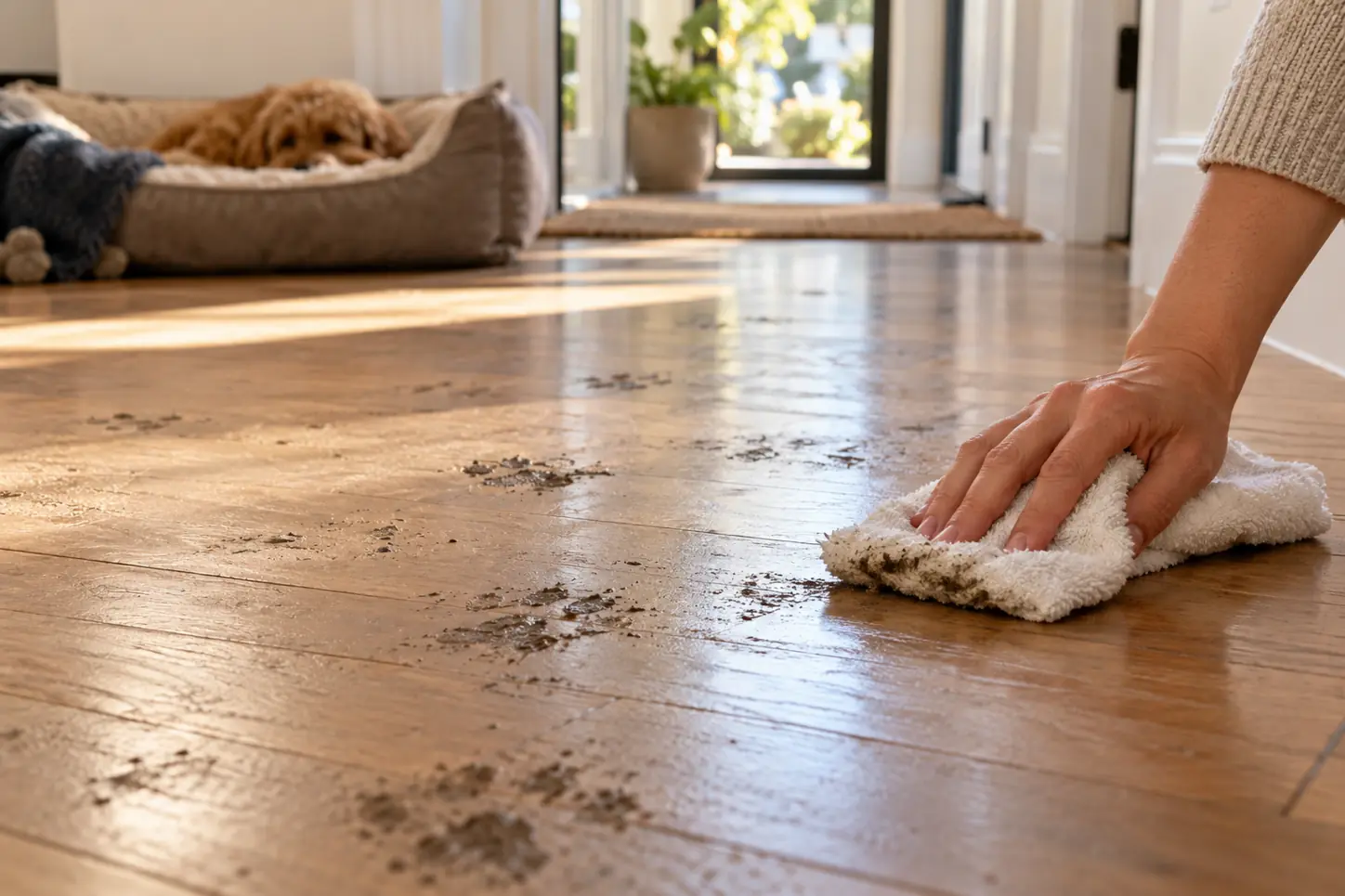
A home with animals gets dirty in a different pattern. Hair settles on soft surfaces, dander collects in corners and fabrics, and paws bring the outdoors across the floors. Feeding areas collect splashes. Favorite sleeping spots hold oils and odors. The same square footage can take a crew longer simply because there is more to lift, wipe, and vacuum.
That does not mean a pet household is a harder customer. It means the best results come from telling the crew what is going on. A home with a short-haired cat that rarely goes outside is different from a home with two large shedding dogs and a yard. Both are fine; they need different planning.
If you want to see how pet households tend to get dirty room by room, our pet cleaning guide covers entryways, furniture, feeding stations, and beds. This article focuses on what happens when someone else is doing the cleaning.
Pet-safe products: what that means during a visit
Our crews use eco-friendly, pet-safe, non-toxic products on every clean. You do not need to request it, and it costs nothing extra.
Pets are exposed to cleaning products differently than people. They walk on floors and then lick their paws. They lie on freshly cleaned surfaces. They drink from bowls near cleaned areas. Their noses are far more sensitive than ours. Products that are fine for a person who wears shoes and does not groom with their tongue can be a problem for an animal, which is why the choice of product matters.
Some points that are helpful to know:
- Pet-safe does not mean pets should be underfoot. Even gentle products are best applied and dried without a curious animal licking the floor. That is one reason to keep pets away from wet areas.
- Some animals are more sensitive than others. Birds, small mammals, and reptiles can be especially sensitive to airborne products and fumes. If you have a bird or a small animal, tell us so we can avoid sprays near its room.
- Essential oils are not automatically safe. Many natural-smelling products contain oils that can be a problem for some animals, cats in particular. If you diffuse oils at home, mention it, and avoid adding them to the cleaning process.
- Do not mix products. Our guide to products you should never mix explains why, and the same caution applies to anything you leave out for the crew.
- Fragrance is optional. If your pet reacts to scents, say so.
For a broader look at greener products and the reasons behind them, see our guide to eco-friendly cleaning products and the comparison of green cleaning versus standard cleaning.
If an animal ever shows signs of being unwell after a clean, such as drooling, vomiting, or lethargy, contact your veterinarian right away and tell us what you observed. This is true no matter what product was used in any home.
Dogs during the visit
Dogs react to visitors in very different ways. Some greet every stranger like an old friend. Others bark at the door for twenty minutes. A few are protective, and a few are afraid. What works depends on the dog.
Friendly dogs. If your dog is calm and social, tell us. Many crews are happy to work around a dog that stays out of the way. A friendly dog can still be a hazard: jumping on a crew member carrying a bucket, running through a freshly mopped floor, or trying to follow a vacuum.
Excitable dogs. A dog that barks, jumps, or herds people is best kept in a separate room with water, a chew, and a closed door. A baby gate may not be enough for a determined jumper.
Anxious dogs. A dog that is afraid of strangers or loud noises may be happier away from the home during the visit. The vacuum is the biggest source of stress. If your dog panics at the sound of a vacuum, plan for a walk, a daycare day, or a quiet room farthest from the work.
Protective dogs. A dog that guards the home should be secured in a way that does not rely on a latch the dog can open. Tell us, and keep the animal away from entry points. Do not count on a crew to manage a dog that may bite.
Dogs in crates. A crated dog is a reasonable solution if the dog is comfortable in the crate. A dog that howls in a crate for two hours is not.
Dogs and wet floors. Wet tile and wood are slippery for dogs, especially older ones. Keep the animal out of freshly mopped areas until they dry.
Outdoors. A secure yard can work, but make sure the gate is closed, the dog has shade and water, and the crew will not need to pass through the yard. Never leave a dog outside in a way that puts the animal at risk in heat or cold.
Cats during the visit
Cats are generally easier to plan around, and harder to find if a door opens.
- The escape risk is the main issue. An indoor cat that slips out the front door is a real concern. Keep cats in a room with the door closed, and mention it so the crew does not open that door.
- Hiding is normal. Many cats retreat under a bed or into a closet. Tell us where, so the crew does not startle the animal or trap it in a closet.
- Close the door and mark it. A note on the door, such as “cat inside, please do not open,” prevents mistakes.
- Provide the essentials. A litter box, water, and food in the cat’s room make a long visit comfortable.
- Expect a quieter result. Cats are usually less affected by cleaning than dogs, but a loud vacuum can still send a cat flying.
If your cat is very shy or has medical needs, the safest option is a closed, comfortable room. Bring the carrier out if you want the cat boarded elsewhere.
Small animals, birds, and reptiles
Not every pet is a dog or a cat. A few cautions for others:
- Birds are sensitive to aerosols, smoke, and fumes. Ask the crew to avoid sprays near the room, or move the bird to a well-ventilated area away from cleaning activity. Birds react to air quality more than most animals.
- Small mammals such as rabbits, guinea pigs, and hamsters should be kept in a quiet room with the cage closed. Do not let the crew open or move a cage.
- Reptiles and aquariums. Heat lamps, tanks, and terrariums are not part of a standard clean. Tell us what to avoid so no one touches equipment that keeps an animal alive.
- Free-roaming animals. Rabbits, ferrets, and similar pets that roam need to be contained before the crew arrives.
When in doubt, say what you have. The crew can plan around anything they know about.
Pet hair: what is included and the $25 add-on
Hair is the biggest difference between a pet home and a pet-free one.
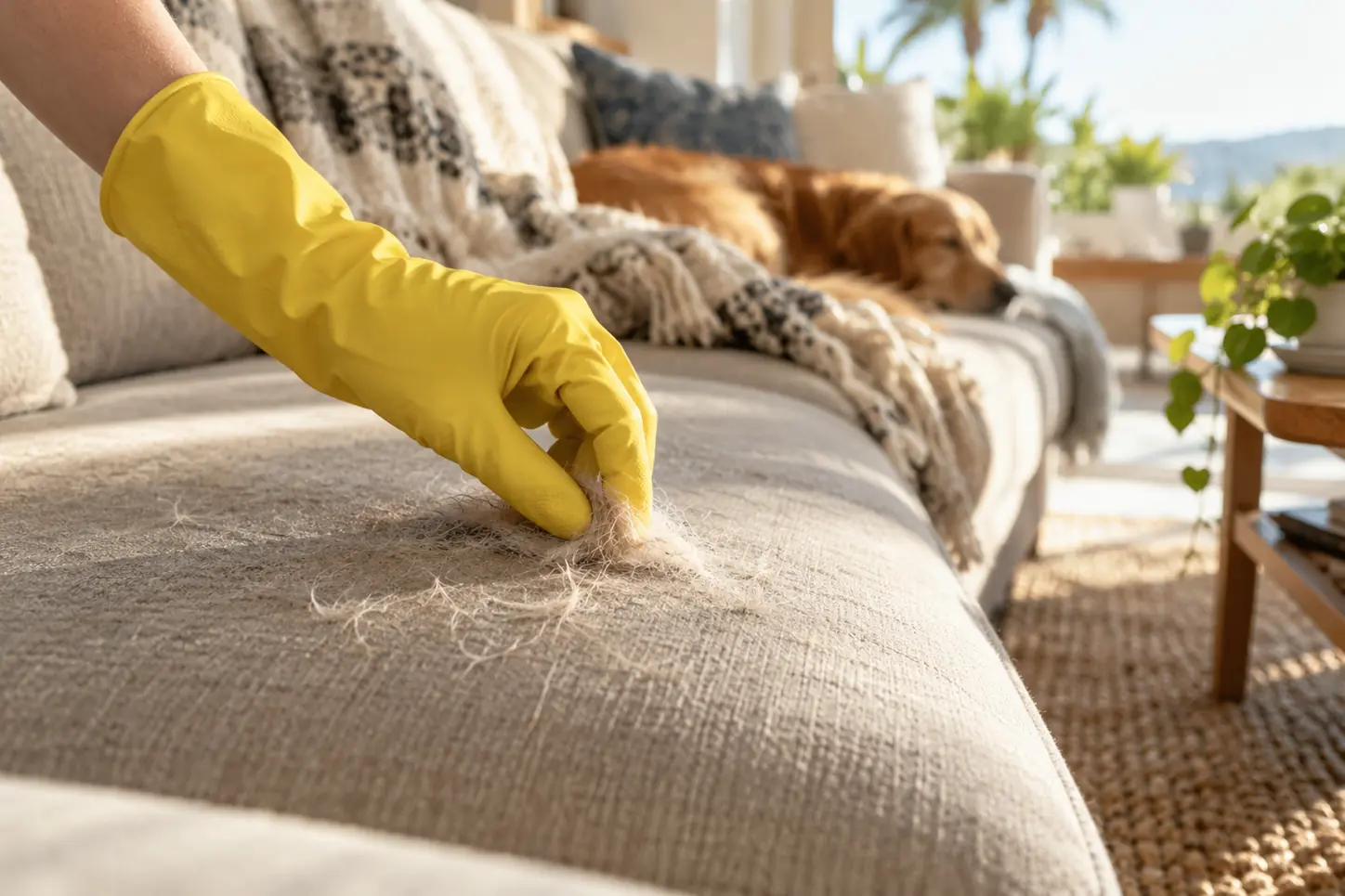
A standard clean includes vacuuming floors and the reachable surfaces of furniture as part of the visit. Loose hair on floors, rugs, and visible surfaces is handled by that process. What a standard clean does not budget for is the extra time needed when hair is embedded in carpet, layered on furniture, or caught in corners and along baseboards.
That is what the pet hair add-on covers. It costs $25 and is selected when you get your quote. It is worth adding if:
- You have a heavy shedder, such as a husky, a retriever, or a long-haired cat
- You have several animals
- Pets sleep on the couch or the bed
- You have carpet or area rugs that collect hair
- Your last clean was a while ago and hair has built up
- Someone in the household has allergies
For a 2 bedroom, 2 bathroom home on a recurring clean, the base is (60 + 50 + 70) x 1.0 = $180. With the pet hair add-on, that comes to $205. Frequency discounts apply to recurring plans: 10 percent for monthly, 15 percent for biweekly, and 20 percent for weekly. The instant quote on our pricing page shows the exact total for your home.
| Home type and situation | What to consider |
|---|---|
| Single short-haired cat, hard floors | Standard clean is often enough |
| One dog, light shedding, mixed floors | Standard clean; add pet hair if you notice build-up |
| Two or more pets, carpet | Pet hair add-on recommended |
| Heavy shedder, upholstered furniture | Pet hair add-on, plus consider upholstery cleaning |
| First clean after months without service | Consider a deep clean, then recurring |
Frequent service makes hair easier to manage. Hair that is cleared every week or two does not pack into carpet the way hair that sits for two months does. Our guide on weekly versus biweekly versus monthly cleaning can help you choose a frequency, and a recurring cleaning plan is the usual choice for pet homes.
What helps before the crew arrives
You do not need to remove hair before a visit. A few small steps make the clean more effective:
- Brush your pet outdoors in the days before, which reduces loose hair indoors
- Pick up pet beds and blankets so floors can be reached, or leave them out for washing if you want laundry done (laundry is a $25 add-on)
- Move bowls and mats off the floor in the area to be mopped, or tell the crew where they go back
- Put away toys and chews that litter the floor
Litter boxes: what to expect
Litter boxes are the item people most often hesitate to bring up. It helps to be direct about it.
We recommend settling this before the first visit, because policies and comfort levels can differ, and we would rather have the conversation early than have a surprise. The honest options are:
- Leave it as it is. The crew works around the box and cleans the floor near it. This is the usual choice.
- Scoop it before the visit. A freshly scooped box is cleaner and less smelly during the clean. This is a simple courtesy that helps everyone.
- Move it. If the box is in a bathroom or a small space, moving it to a room not being cleaned gives the crew room to work.
- Ask whether the crew can scoop or empty it. This is not part of a standard clean, and we ask you to tell us what you want so we can confirm what is possible. Do not assume it is included.
A few practical notes:
- Litter on the floor. Scattered litter around the box is swept or vacuumed as part of floor cleaning. A mat under the box catches most of it.
- Litter in a vacuum. Clumping litter can clog a vacuum filter, so crews prefer sweeping loose litter first. Telling us where the dustpan is helps.
- Pregnant or immunocompromised crew members. There are reasons some people prefer not to handle litter. This is a good reason to scoop before the visit yourself.
- Odor around the box. If the area has a lasting smell, the cause may be litter that missed the box, urine on the wall behind it, or a floor that needs a deeper clean. A thorough floor clean and an enzyme-based product often help. For stubborn cases, see our guide to removing pet odor from carpet and furniture.
If you are unsure what you want, say “please leave the litter box alone and clean around it.” That is a clear instruction, and it is easy to follow.
Pet odor: what cleaning can and cannot do
Odor is a different problem from hair. Hair is visible and sits on the surface. Odor is chemical and can sit deep in porous materials.
What regular cleaning handles well:
- Odors from dust, dander, and surface dirt
- Smells from pet bowls, feeding areas, and floors
- General “pet smell” in homes with hard surfaces
- Odor in bathrooms, entryways, and kitchens
What needs more than a standard clean:
- Urine soaked into carpet or carpet padding
- Accidents on upholstery or mattresses that have dried
- Odor in a sofa or a pet bed that has absorbed years of oils
- Marking spots on baseboards, walls, or furniture legs
Dried urine is the hard case. Moisture that reached padding or foam is not removed by wiping the surface, and a smell can return on humid days. For those, a targeted treatment is more suitable than extra passes with a mop.
Our upholstery and mattress services are priced by item, with a pet odor add-on at $40 per item. A sofa seat is $35, an armchair is $45, a dining chair is $18, and mattress prices start at $55 for a twin. These are separate from the house cleaning formula. If a favorite sofa or a mattress is the source of the smell, upholstery cleaning or mattress cleaning are the services to look at, and our upholstery cleaning cost guide explains the pricing.
Some honest limits:
- No clean can promise to remove every trace of a long-standing odor. Results depend on how deep the odor is and what material it is in.
- If an accident is fresh, blot it and tell us. Fresh accidents are far easier to treat.
- Masking a smell with fragrance does not remove it, and some scented products bother pets. We would rather remove the source.
Keeping pets safe during the visit
Safety has two sides: the pet and the people working.
For the pet:
- Keep animals away from wet floors and any area where products are in use
- Make sure doors and gates are closed, so no animal slips out as the crew comes and goes
- Provide water and a comfortable space if the pet is confined
- Move chew toys, medications, and small items that a pet could swallow
- Tell the crew about any medical issue, such as a pet that is on medication, elderly, or prone to seizures
- Put away anything toxic that belongs to you: medication, chocolate, and certain plants can be hazards if knocked over
For the crew:
- Let us know about any history of biting or snapping
- Keep leashes, harnesses, and carriers out of the way, not in doorways
- Secure animals that may rush the door
- Make sure the crew knows which rooms are off limits
Open doors and gates. The most common pet emergency during a service visit is not a chemical. It is an animal slipping out the door. If your pet is a flight risk, confine it to a closed room, and tell us. A note on the door helps.
Heat and cold. Keep pets comfortable. An animal confined to a car or a garage in summer is at risk. Choose a safe space.
Aggressive pets and scheduling
Some animals are not safe around strangers, and it is better to say so than to hope for the best.
If your pet has bitten or may bite:
- Tell us before booking, not at the door.
- Secure the animal in a closed room, a crate, or away from the home during the visit.
- Do not rely on a baby gate or a hand on the collar.
- If the animal cannot be secured, we may need to reschedule for a time when you can arrange for the pet to be elsewhere. We prioritize everyone’s safety, including the pet’s.
If your pet is fearful:
- Fear can look like aggression. A cornered, frightened animal may snap
- Give a fearful pet a quiet room and a closed door, with something familiar
- Consider a walk, a friend’s home, or daycare during the visit
- Keep the vacuum away from the animal’s room until it is calm
Scheduling choices that help:
- Choose a time when your pet is usually calm, such as after exercise
- Choose a time when you can be home, if your pet is more settled with you around
- For a very anxious animal, book a time when the pet can be out of the home
- Keep the same time slot for recurring cleans so the routine becomes familiar
- Tell us if the pet’s routine changes, for example after a surgery or a new adoption
If the day does not work for your pet, you can reschedule or cancel with 24 hours notice and there is no fee. Last-minute changes do happen with animals, so plan to message us as early as you can.
Our crews are insured, bonded, and background-checked, but that does not make it safe for a crew member to meet an unpredictable animal. Securing the pet is the right step. For an explanation of those terms, see insured, bonded, and background-checked explained.
What to tell the crew before the visit
A short note at booking prevents most problems. Use the list below.
- Species, number, and names. “Two dogs, Max and Luna, and one cat.”
- Temperament. “Max is friendly. Luna barks at the door but is harmless. The cat hides.”
- Where they will be. “Dogs in the back bedroom, cat in the office. Please keep both doors closed.”
- Escape risks. “The cat will run out the front door.”
- Medical or special needs. “Luna is old and is slippery on wet floors.”
- Litter box. “Please leave it alone and clean around it,” or “please do not move it.”
- Feeding areas. “Leave the bowls where they are,” or “please wash the bowls.”
- Areas with accidents. “A spot on the hallway carpet from this morning.”
- Allergy or fragrance concerns. “Our dog reacts to strong scents.”
- Anything off limits. “Please do not open the bird’s room.”
- Whether you will be home. Our guide to whether you need to be home covers this.
- Pet hair add-on. If you want it, add it to the quote.
Write the note once, and for recurring service the crew will know it each time. If something changes, update it.
A typical visit, step by step
Here is how a visit usually goes in a pet household.
- Arrival. The crew checks the notes. Any animals are confirmed to be in their designated space.
- Walkthrough. The crew lead reviews the home, the pets’ areas, and any problems you flagged.
- Hair and dust first. Dust and loose hair come off surfaces before floors, so nothing falls onto a finished floor.
- Kitchens and bathrooms. Counters, sinks, and fixtures are cleaned with pet-safe products. Pet bowls are left or washed as you instructed.
- Floors last. Vacuuming and mopping finish the job, working toward the exit.
- Final check. The crew checks that doors are closed and animals are where they belong.
- Payment. Your card on file is charged after the clean.
If it is your first clean, our guide to what to expect from a first house cleaning goes into more detail.
Which service fits a pet home
The right service depends on your situation.
| Situation | Suggested service |
|---|---|
| Regular upkeep, pets in the home | Recurring cleaning, with pet hair add-on if needed |
| Months of build-up, heavy shedding | Deep cleaning first, then recurring |
| Smelly sofa, armchair, or chairs | Upholstery cleaning |
| Mattress with pet accidents | Mattress cleaning |
| Moving out of a pet household | Move-out cleaning |
Deep cleaning has a 1.5 multiplier, so for the 2 bedroom, 2 bathroom example the base is (60 + 50 + 70) x 1.5 = $270. A deep clean is a good reset for a home where hair, dander, and odor have built up.
Move-out cleaning is worth special mention for pet owners. Rental properties often have security deposit rules about pet damage and cleanliness, and hair and odor are things landlords notice. Our guides to what landlords check at a move-out inspection and security deposits and move-out cleaning in California explain what to expect.
What cleaners do differently in a pet home
Compared with a pet-free home, a crew in a pet household typically:
- Spends more time vacuuming, and goes along baseboards and under furniture where hair collects
- Pays attention to the areas pets use: entryways, feeding spots, beds, and favorite windows
- Wipes surfaces where nose prints, drool, and paw marks appear, such as low windows and glass doors
- Avoids products that could bother animals
- Closes doors and keeps track of where animals are
- Works around crates, bowls, mats, and litter areas as you have asked
- Cleans up wet or muddy areas carefully, since these can be slippery
- Treats the visit as a shared space with the animal, not just the human
Those are not special secrets. They come from planning, and from a customer who has explained how the home is used.
Mistakes to avoid
- Not mentioning a pet at all. A surprise dog at the door helps no one.
- Assuming the crew will find the cat. Cats hide. Close the door and say where they are.
- Leaving an escape artist unsecured. Doors open and close many times during a visit.
- Leaving the litter box instructions vague. One sentence solves it.
- Skipping the pet hair add-on, then being disappointed. If your home is full of hair, plan for it.
- Expecting a standard clean to treat deep odor. Odor in padding or foam needs a targeted treatment.
- Using scented sprays right before the crew arrives. Strong scents can bother pets and hide the real problem.
- Forgetting to move bowls and toys. Floors can only be cleaned when they can be reached.
- Trusting a friendly dog around a crew with equipment. Friendly dogs also cause accidents.
Frequently asked questions
Can I have my house cleaned with dogs and cats at home?
Yes. Many of our customers have pets. Tell us about your animals when you book, keep them in a closed room or outside if they are excitable, and we will plan the visit around them.
Are your cleaning products safe for pets?
We use eco-friendly, pet-safe, non-toxic products on every clean. If your animal has a known sensitivity, or you keep birds or small animals, let us know so we can take extra care with sprays and airflow.
Should I put my pets in a room or leave them out?
It depends on the animal. Anxious, excitable, or protective pets are best kept in a closed room or away from the home. A calm, friendly pet may be fine out, but doors must be watched so the animal does not slip outside.
How much does the pet hair add-on cost?
The pet hair add-on is $25. It is useful for heavy shedders, multi-pet homes, and homes with carpet or upholstered furniture. You can add it when you get your quote on the pricing page.
Will the cleaners clean my litter box?
Scooping or emptying the box is not part of a standard clean, and we recommend telling us what you want before the visit. The usual choice is to leave the box where it is and have the crew clean the floor around it.
Can cleaning get rid of pet odor?
Regular cleaning handles surface odor from dander, bowls, and floors. Odor that has soaked into carpet padding, upholstery, or a mattress needs targeted treatment, and results depend on how deep the odor is. We do not promise that every long-standing odor can be removed.
What if my dog is aggressive or may bite?
Tell us before booking and keep the animal secured in a closed room, a crate, or away from the home. If the pet cannot be secured, we may need to reschedule. Safety for the crew and for your pet comes first.
Do I need to be home if I have pets?
Not necessarily. Many customers with pets are not home, as long as animals are secured and the crew has clear instructions and access. If your pet is nervous with strangers, being home or arranging for the pet to be elsewhere may be better.
What if a pet gets out during the visit?
Prevent it by closing doors and telling the crew which rooms hold animals. If a pet does get out, the crew will notify you right away. An ID tag and a microchip are the best protection for any pet.
How often should I clean if I have pets?
More often than a pet-free home, in most cases. Weekly or biweekly service keeps hair and dander from building up. See our weekly versus biweekly versus monthly guide to choose.
Ready for a cleaner home, with the pets included?
Get an instant quote on our pricing page, add the pet hair option if you need it, and leave a note about your animals. There is no minimum booking, your card is charged after the clean, and if you are not satisfied, tell us within 24 hours and we re-clean the area free. We serve homes across the county, including Irvine and Newport Beach.