How Much Does Mattress Cleaning Cost? Pricing, Allergens, and How Often to Book
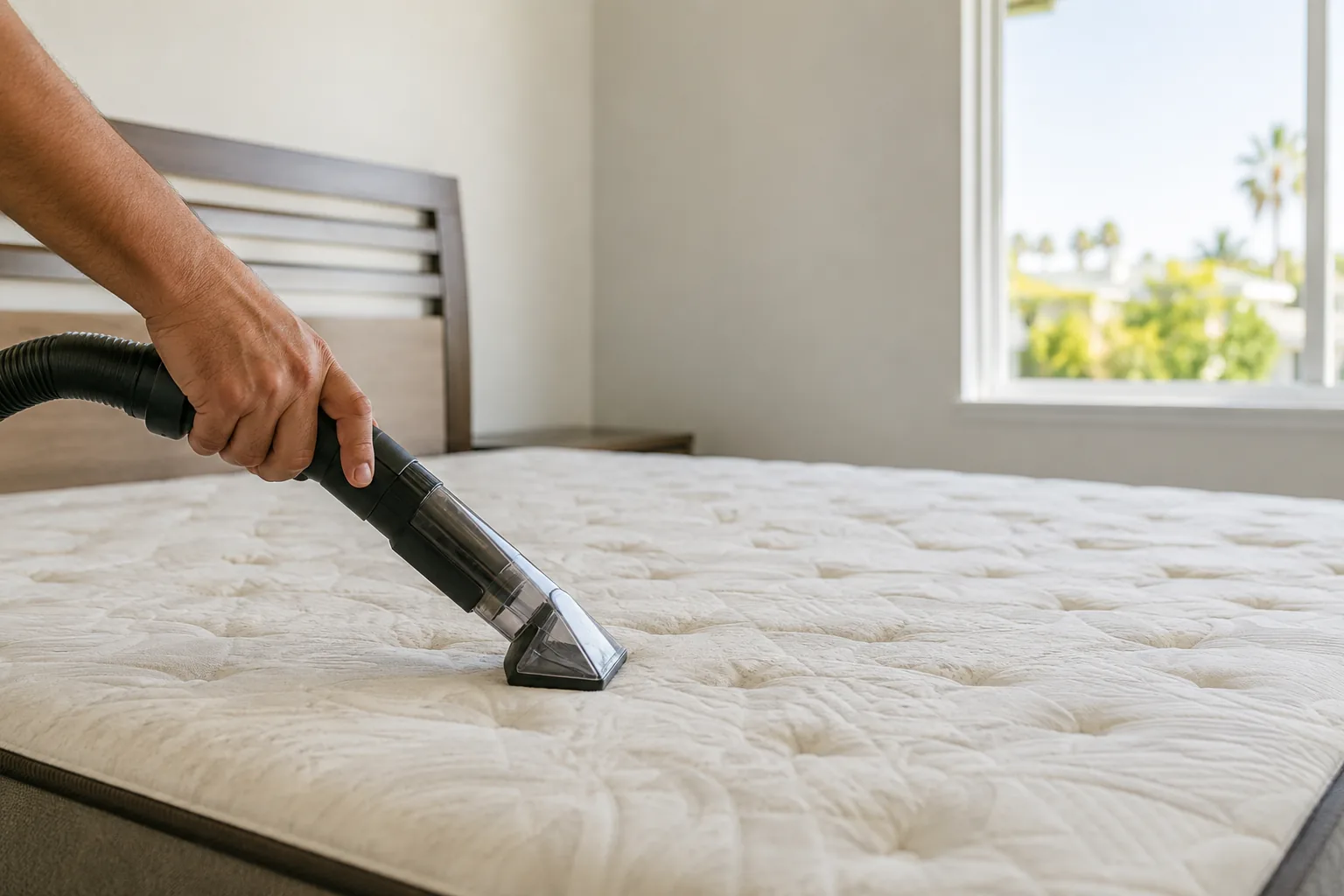
Mattress cleaning costs $55 for a twin, $65 for a full, $75 for a queen, and $95 for a king. That is the entire price list. There is no hourly rate, no square footage form to fill out, and no separate line item for setup. Book more than one mattress in the same visit and the prices simply add together.
The per-size pricing
| Mattress size | Price |
|---|---|
| Twin | $55 |
| Full | $65 |
| Queen | $75 |
| King | $95 |
These four sizes cover the large majority of bedrooms in Orange County. If your mattress is a Twin XL, California King, or another nonstandard shape, mention it when you request a quote so the crew can confirm pricing before the appointment rather than guessing on site.
New customers get $39 off their first booking, and that applies to mattress cleaning the same as it applies to a full house clean or any other service.
Why mattress cleaning is priced by size, not by the hour
Standard mattress sizes are not arbitrary marketing labels, they map to real, fixed dimensions. A twin runs 38 by 75 inches, about 19.8 square feet. A full is 54 by 75 inches, about 28.1 square feet. A queen is 60 by 80 inches, about 33.3 square feet. A king is 76 by 80 inches, about 42.2 square feet. A king mattress is more than double the surface area of a twin, and extraction cleaning is a surface-area job: more passes with the extraction wand, more cleaning solution applied, more time spent pulling moisture back out before the mattress is safe to sleep on again.
If you line up the price against the square footage, though, the two do not scale in a straight line, and that is worth understanding before you assume the pricing is arbitrary.
| Mattress size | Price | Approx. sq ft | Price per sq ft |
|---|---|---|---|
| Twin | $55 | 19.8 | $2.78 |
| Full | $65 | 28.1 | $2.31 |
| Queen | $75 | 33.3 | $2.25 |
| King | $95 | 42.2 | $2.25 |
A twin costs more per square foot than a king, not less. That is because every mattress job carries a fixed block of setup time that does not shrink with the mattress: unloading and connecting the extraction equipment, pretreating any visible spots, and positioning the mattress for even coverage takes roughly the same number of minutes whether the bed is a twin or a king. A twin carries more of that fixed setup cost relative to its size, while a king spreads the same fixed cost over a much larger surface. That is the actual mechanism behind the four prices, not a round-number guess.
What professional mattress cleaning does that vacuuming and store-bought sprays do not
A vacuum, even a good one, only removes what is loose on the surface. It cannot reach material that has worked its way into the quilted layers below the top fabric, and a mattress is mostly quilted layers. Store-bought upholstery sprays work on a similar limit: they sit on top of the fabric, and most are built to mask odor with fragrance rather than lift what is causing it.
Professional mattress cleaning uses extraction equipment, which sprays a cleaning solution into the fabric under pressure and then pulls it back out along with whatever it loosened, dust, dead skin cells, dust mite waste, and general buildup that has settled into the padding over months or years of nightly use. It is a wet process with real suction behind it, not a wipe-down. That is the mechanical difference: a vacuum removes what is sitting on top, extraction reaches into the layer underneath.
The same equipment addresses odor at the source rather than covering it. A smell that has worked into the fibers, from sweat, spills, or pets that sleep on the bed, does not go away with a scented spray, because the spray never touches the fabric where the smell is coming from. Extraction plus a deodorizing treatment breaks down what is causing the odor in the layer where it actually lives.
Deep-set stains work the same way. A surface wipe can lighten a fresh spill, but a stain that has had time to set into the padding needs the same pressure-and-extraction process as odor, applied directly to the spot before or during the full clean. Some stains, particularly old ones or ones on foam that has already absorbed and dried, will lighten but not fully disappear. A crew will tell you honestly on site if a stain is not going to come out completely rather than promising a result that is not realistic.
After extraction, the mattress gets a quick-dry finish, which is really just grooming the fabric surface and positioning airflow (a fan, an open window, or both) so the mattress dries evenly instead of staying damp in one spot longer than another. Uneven drying is what leads to a musty smell coming back after a cleaning, so this step is as much a functional step as a cosmetic one.
None of this is framed as a health cure. A deep clean removes what has physically built up in the mattress. It does not make a mattress permanently allergen-free, and it is not a substitute for medical care if you or someone in your home has ongoing allergy or respiratory symptoms. What it does is remove buildup that a vacuum and a spray bottle cannot reach on their own.
Worked pricing examples
One twin mattress. $55. This is the full cost of the job, no minimum visit fee added on top.
One full mattress. $65 on its own.
One queen mattress. $75, the most common single-mattress booking since queen is the most common bedroom size in Orange County homes.
One king mattress. $95 on its own, the largest surface area and the longest single-mattress job.
A queen and a king in the same visit (primary bedroom plus a guest room). $75 + $95 = $170. Booking both mattresses for the same appointment means the crew sets up extraction equipment once and works through both rooms, so it costs less overall than scheduling two separate visits.
A family home: one queen plus two twins. This is a common booking for a household with a primary bedroom and two kids’ rooms. $75 + $55 + $55 = $185 for all three mattresses in one visit.
Two queens (primary bedroom and a guest room or second primary). $75 + $75 = $150.
Add-ons are priced separately from the base mattress price. Pet odor treatment and stain protection are both available if a mattress has visible staining or regularly has a pet sleeping on it, mention either when you request your quote so the crew can plan for the right products.
Dust mites and allergens: what is actually in a mattress
Dust mites are microscopic. You cannot see them without magnification, and they do not bite or sting. The allergic reaction people have comes from proteins in dust mite waste and body fragments, which become airborne when a mattress, pillow, or piece of upholstery is disturbed, sat on, or slept in. Dust mites feed on shed human skin cells, and a bed is where a person sheds the most skin over the most hours of any surface in a home, night after night, for years. Combine that food source with the warmth and humidity a sleeping body generates under a blanket, and a mattress becomes one of the more common places dust mites concentrate indoors.
This is not unique to old or visibly dirty mattresses. A newer mattress that looks clean can still have significant buildup within the padding, since none of this is visible from the surface and a top sheet does not block it.
Extraction cleaning removes what has built up in the mattress at the time of the clean. It is not a permanent fix, buildup starts again the moment the mattress goes back into daily use, which is part of why periodic cleaning rather than a single one-time visit makes sense for households managing allergy symptoms.
Mattresses are one source of household dust mite and allergen buildup, but not the only one. Carpet, upholstery, curtains, and HVAC filters all play a role, and Orange County’s dry, windy climate adds pollen and dust into that mix from outside. For the full household picture, including HVAC filter habits, bedding wash frequency, and how OC’s climate factors in, see our guide on reducing allergens at home. This page focuses specifically on the mattress itself and what it costs to address.
Signs your mattress needs professional cleaning
Visible staining. Sweat rings, old spill marks, or discoloration that a top sheet has not prevented are the most obvious sign. If you can see it, it has already worked past the surface.
A smell that persists after washing the sheets. Fresh sheets on a mattress with an underlying odor problem will smell fine for a day or two and then start to carry the smell again, because the source is in the mattress, not the bedding.
Noticeable symptoms tied to the bedroom specifically. If sneezing, congestion, or itchy eyes are worse at night or first thing in the morning and improve during the day away from the bedroom, that pattern is worth mentioning to a doctor and is also a reasonable prompt to have the mattress professionally cleaned, alongside other allergen sources in the room.
It has been longer than a year since the mattress was last professionally cleaned, or it has never been cleaned at all. Most mattresses in daily use are never professionally cleaned unless something prompts it, which means buildup has often had years, not months, to accumulate by the time someone books a first cleaning.
A recent move, illness, or a new pet or baby in the house. Mattresses picked up dust in storage or in a moving truck, illness can leave residue worth addressing before the next person uses the bed, and a new pet or infant in the home is a common reason people decide to have an existing mattress cleaned rather than replaced.
How often to professionally clean a mattress
A reasonable baseline is once or twice a year for a household without specific allergy concerns. That interval gives buildup enough time to accumulate to a level worth addressing, without paying for a clean before there is meaningfully more to remove than the last visit picked up.
Households with allergy symptoms, asthma, young kids, or pets that sleep on the bed generally get more value out of cleaning closer to twice a year than once, since those households both generate more buildup between cleans and have more reason to keep it low. A single adult with no pets and no allergy history can often go closer to once a year without much difference in outcome.
Outside of a fixed schedule, a few events are reasonable prompts to book regardless of when the last cleaning happened: moving into a new home, recovering from an illness that involved a lot of time in bed, bringing a new baby or pet into the house, or noticing a stain or odor that was not there before.
What to do between professional cleanings
Use a mattress protector. A protector is a barrier, not a cleaning product. It stops new spills, sweat, and skin cells from reaching the mattress fabric in the first place, which means less builds up between professional cleanings. If you do not already use one, adding a protector right after a cleaning gives you a clean starting point and a way to keep it that way.
Vacuum the mattress surface periodically, ideally with an upholstery attachment, when you change the sheets. This will not reach what extraction cleaning reaches, but it does remove loose surface dust before it works further into the padding.
Wash bedding weekly in hot water. Sheets and pillowcases sit closest to the mattress and closest to your face for hours every night. Keeping them clean reduces what transfers onto and into the mattress surface between deeper cleans. This is covered in more detail, along with pillow and comforter care, in our household allergens guide.
Air the mattress out when you can. Stripping the bed and letting the mattress sit uncovered for a few hours, ideally with a window open or a fan running, gives moisture a chance to evaporate instead of staying trapped under sheets and a mattress protector. This matters most in humid weather or after any spill that has already dried.
Mattress cleaning vs. replacement: when cleaning is not enough
Cleaning addresses what is in the mattress: dust, allergen buildup, odor, and surface or shallow stains. It does not address what is wrong with the mattress structurally. A mattress with visible sagging, broken or shifted internal springs, or foam that has permanently compressed and lost its support is not going to feel or perform differently after a cleaning, because none of those are surface or padding issues.
If your main concern is dust, allergens, general buildup, or a stain or odor on a mattress that still feels supportive and structurally sound, cleaning is the right call and the cheaper one. If the mattress is sagging in the middle, causing back or neck discomfort that was not there before, or old enough that support has clearly declined, no cleaning schedule fixes that, and continuing to clean a mattress that needs to be replaced is spending money without solving the actual problem. When in doubt, a straightforward way to tell the difference is whether the issue is something you can see and smell, which cleaning addresses, or something you can feel in how the mattress supports you at night, which cleaning does not.
Mattress manufacturers commonly put the useful life of a mattress somewhere in the range of 7 to 10 years, though that varies with mattress quality, body weight, and how the mattress has been used and maintained. A well-maintained mattress with a protector and periodic cleaning can reasonably sit toward the longer end of that range, while a mattress used without a protector, or by more than one person over the years, tends to show structural wear sooner. Age alone is not the deciding factor either way, a five-year-old mattress that already sags is past the point cleaning can help, and a nine-year-old mattress that is still flat and supportive is still a reasonable candidate for cleaning rather than replacement.
Frequently asked questions
How much does mattress cleaning cost? $55 for a twin, $65 for a full, $75 for a queen, and $95 for a king. Multiple mattresses in the same visit are priced by adding the individual sizes together.
Does mattress cleaning remove dust mites and allergens? The extraction process removes dust, dust mite waste, and general buildup from the mattress padding at the time of the clean. It is not a permanent or medical fix, and buildup begins accumulating again with normal use, which is why periodic cleaning rather than a single visit is the more realistic approach for ongoing allergy management.
How long before I can use my mattress again? Most mattresses are dry and ready to sleep on within 4 to 6 hours, depending on humidity and airflow in the room. A fan or open window speeds this up.
Does memory foam dry differently than an innerspring mattress? Yes. Memory foam holds moisture longer than an innerspring mattress with a quilted fabric top, since the foam itself absorbs some of the cleaning solution rather than letting it pass through to a spring layer underneath. Drying time for memory foam tends to run toward the longer end of the 4 to 6 hour window, especially in humid weather. Mention your mattress type when you book so the crew can plan moisture levels and airflow accordingly.
Can you treat stains on a mattress? Yes, spot stain treatment is included as part of the service. Fresh and moderate stains typically lift well. Older, deep-set stains, especially on foam that has already fully absorbed and dried, may lighten without disappearing completely. The crew will tell you honestly on site if a stain is not going to fully come out rather than guaranteeing a result that is not realistic.
Do you clean box springs too? Ask when you book. Box springs can often be added to the same visit, and the crew can confirm pricing and scope once they see the piece.
Is this safe for kids and people with allergies? Yes, non-toxic, eco-friendly products are used on every mattress cleaning, the same as every other service.
Can I book mattress cleaning with another service? Yes. It is commonly bundled with a recurring house cleaning or an upholstery cleaning in the same visit, since the crew is already on site with the extraction equipment.
How often should I clean my mattress? Once or twice a year is a reasonable baseline for most households. Homes with allergies, asthma, young kids, or pets that sleep on the bed generally benefit from being closer to twice a year.
Does the mattress material change the price? No. Unlike upholstery cleaning, which adds a surcharge for leather pieces, mattress pricing is based on size only, twin, full, queen, or king, regardless of whether the mattress is memory foam, innerspring, or a hybrid.
Does the new customer discount apply to mattress cleaning? Yes. The $39 new customer discount applies to mattress cleaning the same as it applies to house cleaning or any other service.
Can mattress cleaning be booked as a standalone visit, or does it require a full house cleaning? Mattress cleaning is its own standalone service and does not require booking a house cleaning alongside it. You can book just the mattress, or bundle it with another service if it is more convenient.
How far in advance should I book? A few days ahead is enough to guarantee your preferred time slot in most cases, though same-day or next-day appointments are sometimes available depending on crew openings in your area.
Is odor removal guaranteed? No cleaning process can guarantee complete removal of an odor that has fully set into old foam or padding over years, and it would not be honest to promise otherwise. What the extraction and deodorizing treatment reliably does is significantly reduce odor caused by buildup in the fabric and upper padding layers, which covers the large majority of odor complaints. If a mattress has an unusually old or deep-set odor problem, mention it when you book so the crew can set realistic expectations before starting.
What if I do not know my exact mattress size? That is common, especially for mattresses that came with a home or were bought years ago. Measuring is the most reliable way to check, twin, full, queen, and king all have distinct standard dimensions, but if you are still unsure, describe the bed and bedroom when you request your quote and the crew can confirm the size on arrival before starting.
Get an exact price
Mattress size is the only real variable in this quote, so getting a firm number takes about a minute. Request a quote for mattress cleaning, tell us how many mattresses and what sizes, and you will get an exact price back, not a range. New customers also get $39 off their first booking, mattress cleaning included.
or call +1 (949) 330-0081.