Care Habits
How to Clean a Coffee Maker (Drip, Pod, and Espresso) and How Often
To clean a drip coffee maker, wash the removable parts in hot soapy water, then run a descaling cycle with either a half-and-half mix of white vinegar and water or a citric acid solution, and finish with two or three plain water cycles to rinse. For most homes that means a quick wash of the carafe and basket every few days and a descaling run about once a month. Pod machines and espresso machines follow the same logic, but the details change, so your manual always wins over any general guide.
The key idea most articles skip is that there are two different jobs. Cleaning removes coffee oils and residue that you can see and smell. Descaling removes mineral buildup (limescale) that you usually cannot see until it is thick. One does not replace the other.
Quick answer
- What you need: Dish soap, a soft sponge, a microfiber cloth, white vinegar or citric acid (or the descaler your manufacturer recommends), and fresh water.
- Time: About 10 minutes of hands-on work for a drip machine, plus 30 to 60 minutes of machine time. Pod and espresso machines usually take a bit longer.
- Cost of supplies: Low. Vinegar and citric acid are inexpensive pantry or hardware aisle items. Branded descaling solutions cost more, and we will not guess at prices here.
- Difficulty: Easy.
- How often: Wash removable parts after every pot or every couple of days. Descale roughly monthly with daily use in hard water, less often with soft or filtered water, or when the machine tells you to.
- Skip the vinegar if: Your manual says not to use it. Some manufacturers specify their own descaler, and some warranties are written around it.
Cleaning versus descaling: why you need both
Coffee contains oils. Those oils coat the carafe, the brew basket, the lid, and the spout. Left alone they turn rancid, and that is the bitter, stale taste people blame on the beans. Soap and hot water handle this.
Water contains dissolved minerals, mostly calcium and magnesium. Every time the heating element boils water, some of those minerals are left behind as a hard white or gray crust. That crust coats the heating element and narrows the tubes. Soap does nothing to it. Acid does.
| Cleaning | Descaling | |
|---|---|---|
| What it removes | Coffee oils, grounds, film | Mineral scale (limescale) |
| What you use | Dish soap, warm water | Acid: vinegar, citric acid, or a manufacturer descaler |
| Where | Carafe, basket, lid, reservoir, exterior | Inside the machine: tubes, heating element, pump |
| Sign you need it | Bitter or stale taste, visible film | Slow brewing, lukewarm coffee, loud gurgling, white flakes |
| How often | Every few days | Roughly monthly to every few months, depending on water |
What you need
| Item | What it does | Notes |
|---|---|---|
| Dish soap | Cuts coffee oils | A plain, unscented one is fine |
| Soft sponge or bottle brush | Reaches the inside of the carafe | Avoid steel wool, it scratches glass and ruins coatings |
| White distilled vinegar | Mild acid for descaling | Check the manual first. The smell lingers, so rinse well |
| Citric acid powder | Descaling without the vinegar smell | Look for pure citric acid with no added fragrance. Follow the dilution on the package |
| Manufacturer descaling solution | Made for that machine | Often the safest choice for pod and espresso machines |
| Microfiber cloth | Wipes the exterior and warming plate | Dry, then buff |
| Cotton swabs or a small brush | Cleans around the spout and pod needle | Gentle only |
| Fresh cool water | Rinse cycles | Use more than you think you need |
Do not use: Bleach in the reservoir, abrasive powders, oven cleaner, or any product that is not labeled safe for food contact appliances. Never put anything electrical in the dishwasher or under running water.
Safety first
- Unplug the machine before wiping the body, warming plate, or any area near the cord. Plug it back in only for the cycles.
- Never mix cleaning products. Do not combine vinegar with bleach or any product that contains chlorine. Our guide on cleaning products you should never mix covers the combinations to avoid.
- Let the machine cool. The warming plate and heating parts stay hot well after a brew.
- Ventilate. A hot vinegar cycle smells sharp. Open a window or run the kitchen fan.
- Read the manual. Some machines have a descale light or a dedicated descale mode, and some void the warranty if you use an acid the maker does not list. When in doubt, check the manufacturer’s site for your model number.
- Do not drink the descaling cycle. Pour it out, then rinse until there is no smell.
Step-by-step: drip coffee maker
Step 1: Empty and disassemble (2 minutes)
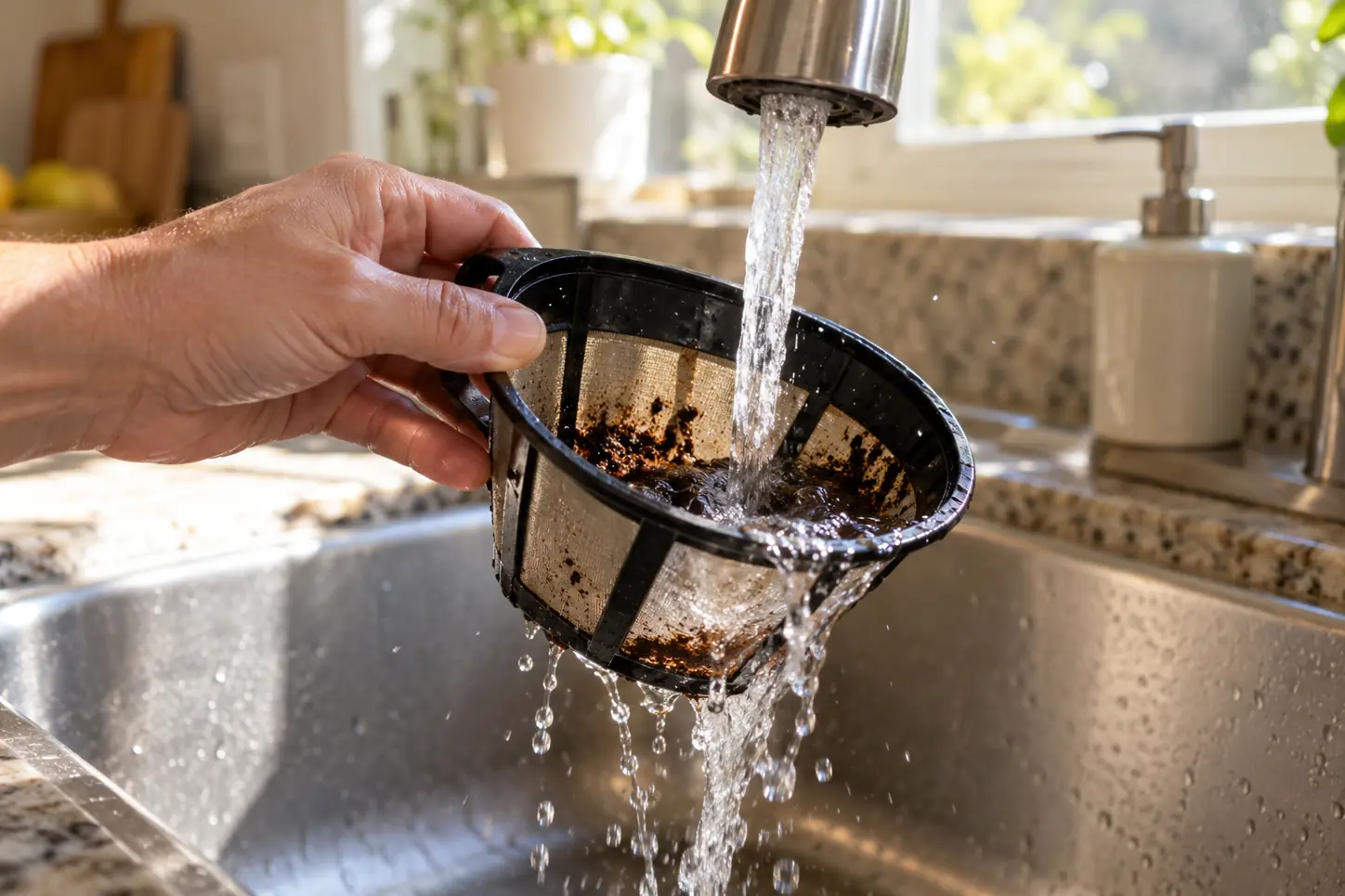
Throw out the used filter and grounds. Remove the carafe, lid, brew basket, and any permanent filter. If your machine has a water filter cartridge, take it out before descaling, because the acid can wear it down or be absorbed by it.
Step 2: Wash the removable parts (5 minutes)
Wash the carafe, lid, and basket in hot soapy water. Most carafes and baskets are listed as top-rack dishwasher safe, but check the label. Use a bottle brush for the carafe, and pay attention to the lid, where oils collect in the seam.
Why this works: Soap lifts oil that water alone slides past.
Step 3: Mix the descaling solution (1 minute)
Choose one:
- Vinegar: A common starting point is equal parts white distilled vinegar and water. Some manuals call for a different ratio, so match your manual.
- Citric acid: Dissolve according to the package directions in warm water. Different products use different strengths, so follow the label.
- Branded descaler: Mix exactly as the bottle says.
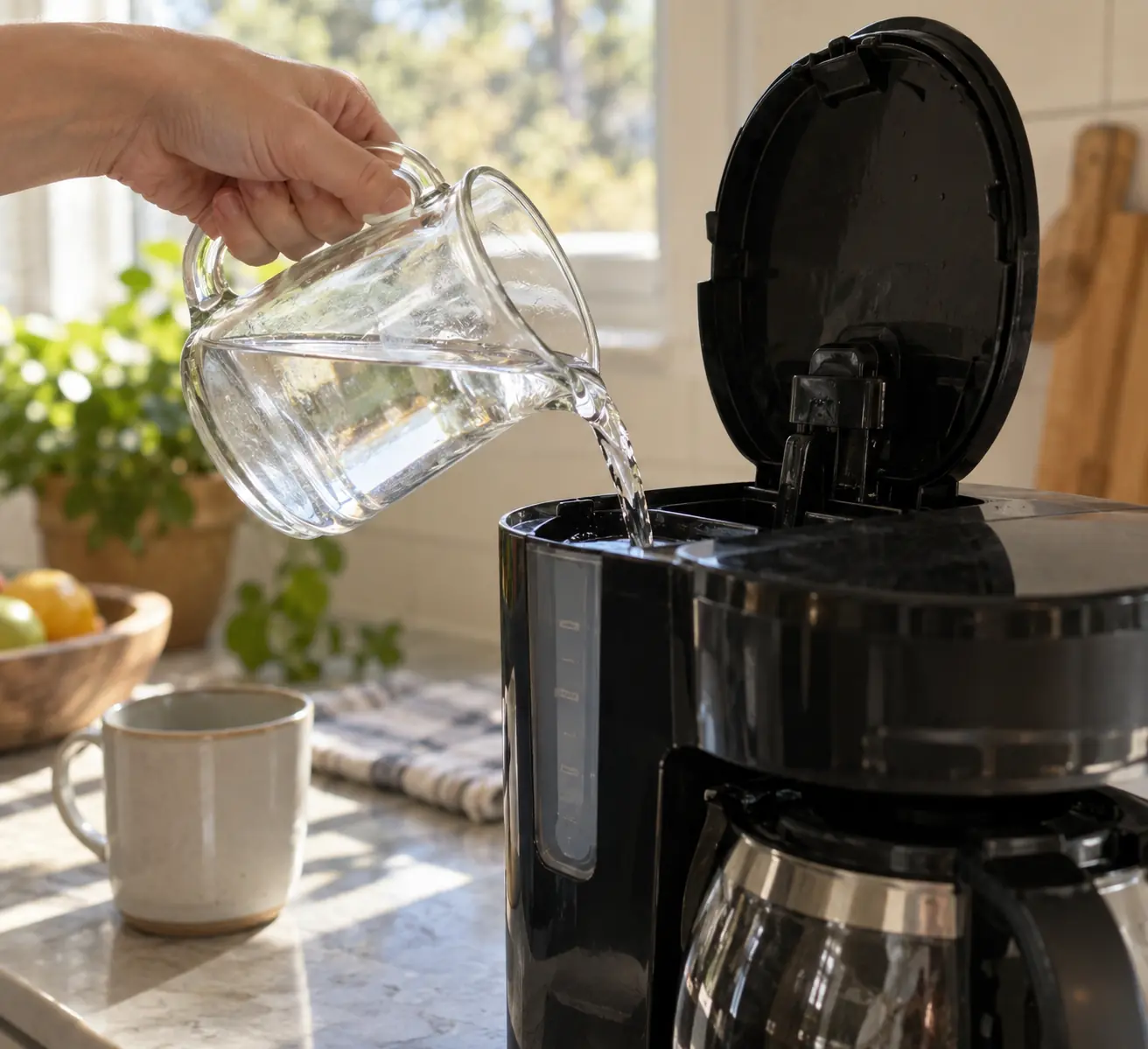
Fill the reservoir with the solution up to the maximum line.
Step 4: Run the cycle (30 to 45 minutes)
Put the empty carafe and an empty basket (no filter, no grounds) in place. Run a normal brew. Some people pause the cycle halfway, let the machine sit for 30 minutes, and then finish it. This is common advice, but it is optional, so follow the manual if it says otherwise.
Why this works: Hot acid dissolves mineral scale on the heating element and in the tubes. The pause gives it more contact time on heavier buildup.
Step 5: Rinse, rinse, rinse (15 to 20 minutes)
Empty the carafe. Fill the reservoir with fresh cool water and run a full cycle. Repeat at least two or three times, until the water has no vinegar smell or citric tang. Taste a small sip of the last rinse. If it tastes sour, run another.
Step 6: Wipe the outside and the warming plate (3 minutes)
With the machine unplugged and cool, wipe the exterior with a damp microfiber cloth. For stubborn drips on the warming plate, use a little dish soap on a cloth, never a soaked sponge.
Step 7: Let it dry (open lid)
Leave the lid and reservoir open for a few hours so moisture does not sit inside. This matters more than it seems. A closed, wet reservoir is where the slimy film comes from.
Pod coffee makers (Keurig style and similar)
Pod machines move small amounts of water through narrow lines, which means scale can cause trouble earlier than in a drip machine. Many models have a dedicated descale mode or indicator light, so use that and the maker’s instructions.
- Unplug, remove the water tank, and wash it with warm soapy water. Rinse well.
- Wash the drip tray and the pod holder.
- Wipe the needle area gently. Many models include a cleaning step for the needle, so look in the manual before you poke at it.
- Descale using the maker’s recommended solution or the method in the manual.
- Run several plain water cycles until the water tastes neutral.
Pod machines also collect moisture around the pod chamber, which is a place where residue can build up. A quick monthly wipe is enough for most homes.
Espresso machines
Espresso machines add a few parts: a portafilter, a group head, a steam wand, and sometimes a built-in grinder. They also run hotter and under pressure, so the manual is not optional here.
- After every use: Rinse the portafilter and basket, wipe the steam wand with a damp cloth immediately after steaming milk, and purge it for a second so milk does not dry inside.
- Weekly: Backflush or run a cleaning cycle if your machine supports it, using the cleaner the manufacturer recommends.
- Descaling: Frequency depends on water hardness and the model. Many machines have a descale alert.
- Do not use vinegar on machines whose manual warns against it. Some espresso machines have parts that do not tolerate it.
If your machine is a super-automatic with a built-in brew group, you may need to remove and rinse the brew unit on a schedule given in the manual.
Single-serve and cold brew gear
- Cold brew pitchers and French presses: Wash every time. Coffee oils collect in the mesh.
- Moka pots: Rinse with water only if you want to protect the seasoning on aluminum, and dry fully. Check the maker’s guidance.
- Reusable pod cups and filters: Wash after each use, because fine grounds clog mesh quickly.
Which acid for which job
| Option | Good for | Avoid when | Notes |
|---|---|---|---|
| White distilled vinegar | Basic drip machines, if the manual allows | Manual forbids it, or the machine has rubber seals you are worried about | Strong smell, rinse thoroughly |
| Citric acid | Drip, kettles, many other appliances | The manual names a different product | Often less odor than vinegar |
| Manufacturer descaler | Pod, espresso, and super-automatic machines | You want the cheapest option | Safest for warranty |
| Lemon juice | Not recommended | Almost always | Contains sugars and pulp that can leave residue |
| Bleach | Never in the reservoir | Always | Do not use it, and never combine it with an acid |
Hard water in Orange County
Much of Orange County gets water that is considered hard, which means more minerals and faster scale. The hardness varies by city and water district, so check your local water quality report (your utility publishes one every year) to see where you land.
If your water is hard, you will likely need to descale more often than the monthly rule of thumb. Signs that you are in that group:
- White crust on faucets and showerheads
- Cloudy glassware
- Scale on the kettle
Options that help: using filtered water in the machine, or following the shorter end of the manufacturer’s descaling interval. Filter pitchers reduce some minerals but do not remove all of them, so do not skip descaling just because you filter.
For more on dealing with mineral buildup around the house, read how to remove hard water stains.
What about mold?
Coffee makers are warm, wet, and dark, and many articles claim they are full of mold. The honest version: damp reservoirs and filter baskets can grow mold and bacteria if left wet for long periods, and it is reasonable to clean them regularly. How much risk this carries for a healthy person varies, and we cannot give medical advice. If you have a weakened immune system, asthma, or allergies, ask your doctor and keep up with cleaning.
What you can do without worrying about it:
- Empty the reservoir if you will not use the machine for a couple of days.
- Leave the lid open to dry.
- Wash the basket and carafe daily if you can.
- If you see black or pink slime that does not rinse off, do a full clean and descale. If it comes back right away, consider replacing the part or the machine.
Special cases worth knowing
A machine you have never cleaned. If it has been a year or more, expect heavy scale. Run the descaling cycle once, rinse, and then run it a second time on another day rather than making the solution stronger. Stronger acid does not help the machine and can stress seals. Patience works better than strength.
A machine that sat unused for weeks. Wash every removable part, drain the reservoir, and run at least two plain water cycles before the first pot. Taste the water before you brew coffee with it.
Office or shared machines. More users means more oils and more water through the heater. Weekly washing and a monthly descale is a reasonable starting point, and a visible note on the machine with the date of the last descale keeps it from being forgotten.
Travel mugs and thermoses. They hold the same coffee oils as the carafe. A soak in warm water with dish soap, plus a bottle brush, handles it. Do not forget the gasket in the lid, which is where the stale smell hides.
Burr grinders. If your grinder sits next to the machine, fine coffee dust and oils build up there too. Follow the grinder’s manual, and never run water through it.
Troubleshooting
| Problem | Likely cause | Fix | When it will not work |
|---|---|---|---|
| Coffee tastes bitter or stale | Oils on carafe and basket | Wash with soap, wash the lid seam | The beans are old, or the grind is off |
| Coffee tastes sour or like vinegar | Rinse was incomplete | Run three more plain water cycles | Residue is in the lines of an espresso machine, check the manual |
| Brewing is very slow | Scale in the tubes | Descale, possibly twice | The pump is failing |
| Coffee is lukewarm | Scale on heating element, or old machine | Descale | The heating element has failed |
| White flakes in the cup | Loosened scale | Descale and rinse thoroughly | Hard water keeps depositing it |
| Gurgling or banging | Scale or air in the lines | Descale | Machine has a mechanical fault |
| Brown stains in the carafe | Coffee tannins | Soak in warm water with a spoonful of baking soda or a diluted citric acid solution | The glass is etched, which is permanent |
| Warming plate is crusted | Burnt drips | Cool, wipe with soapy cloth | Plate is damaged |
| Smells like plastic | New machine or overheated parts | Run two or three plain water cycles | The smell persists, contact the maker |
Common mistakes
- Descaling with grounds in the basket. The acid wastes itself and you taste it later. Always run descaling empty.
- Skipping the rinse cycles. Two cycles is a minimum. Three is better.
- Using vinegar on a machine that bans it. Read the manual.
- Soaking electronic parts. Wipe, do not submerge.
- Scrubbing glass with steel wool. It leaves scratches that hold stain.
- Leaving the reservoir full for days. Stale water develops film.
- Ignoring the water filter cartridge. Replace it on the maker’s schedule.
- Mixing cleaners. One product at a time.
How to keep it clean after
| Frequency | Task |
|---|---|
| After each pot | Dump grounds, rinse basket and carafe |
| Every 2 to 3 days | Wash carafe, basket, and lid with soap |
| Weekly | Wipe the exterior, warming plate, and drip tray. Wash the reservoir |
| Monthly (daily users in hard water) | Descale |
| Every 2 to 3 months (light users or soft water) | Descale |
| Per maker’s schedule | Replace water filter cartridge |
| Always | Leave the lid and reservoir open to air dry |
When to call a professional
A coffee maker is a small, inexpensive job, and almost everything above is easier to do yourself than to hire out. Where a pro does help is the rest of the kitchen around it.
When it is worth handing off: If the whole kitchen has hard water crust and grease buildup, a deep cleaning visit covers counters, appliance exteriors, and the sink area in one go. For a 3 bedroom, 2 bathroom home, the formula works out to (60 + 75 + 70) x 1.5 = $307.50 before any discounts. You can see your own number in seconds with the instant quote.
Call an appliance technician or the manufacturer instead if the machine leaks, trips a breaker, smells like burning plastic, or does not heat after a descale. Cleaning will not fix a failed part.
If you want the whole kitchen on a routine, our recurring cleaning service handles wiping appliance exteriors and counters on a schedule, so only the inside-the-machine tasks are left for you. Related reading: how to clean a dishwasher, how to clean a microwave, and the kitchen deep clean checklist.
Frequently asked questions
How often should you clean a coffee maker? Wash the removable parts every few days, or after each use if you can, and descale about once a month with daily use. If your water is soft or filtered, every two to three months is often enough. Always follow your manual.
Can you use vinegar to clean a coffee maker? Many drip machines allow a half-and-half mix of white distilled vinegar and water. Some makers advise against it, particularly for pod and espresso machines, so check the manual. If vinegar is not allowed, use citric acid or the recommended descaler.
How do you clean a coffee maker without vinegar? Use citric acid dissolved in warm water per the package directions, or a descaling solution made for your machine. Run it through an empty brew cycle and rinse with several plain water cycles.
How do you clean a Keurig or pod machine? Wash the tank, drip tray, and pod holder in warm soapy water, wipe the needle area gently per the manual, and use the descale mode or the maker’s descaling solution. Rinse with several water cycles.
Is it safe to drink coffee from a machine that has mold? We cannot give medical advice. A machine with visible slime or a musty smell should be cleaned and descaled before use, and anyone with health concerns should ask a doctor. Preventing the problem is easy: empty the reservoir, dry the parts, and wash the basket often.
How do you remove coffee stains from a glass carafe? Soak with warm water and a little dish soap, then scrub with a soft brush. For stubborn brown film, a spoonful of baking soda or a dilute citric acid soak often helps. Avoid steel wool.
Why does my coffee maker brew slowly? The most common cause is scale in the lines. Descale it, and rinse well. If it is still slow, the pump or a clog may need service.
Can you put coffee maker parts in the dishwasher? Many carafes, baskets, and lids are top-rack safe, but not all. Check the label or manual. Never put the machine body in the dishwasher.
How much vinegar do you put in a coffee maker? A common method uses equal parts vinegar and water filling the reservoir to the maximum line. Your manual may recommend a different ratio or a different product altogether.
Do water filters mean I can skip descaling? No. Filters reduce some minerals but not all, and a cartridge needs replacing on schedule to keep working.
Ready for the rest of the kitchen?
If the coffee maker is the least of your worries, we can take the rest. Get a price in under a minute with our instant quote, or start with a deep cleaning so the whole kitchen is reset and you only have to keep up the small habits above. If you are in Irvine, see our Irvine house cleaning page for how scheduling works.