Checklists
How to Clean Baseboards, Walls and Scuff Marks
The easiest way to clean baseboards is to dust or vacuum them first, then wipe with a damp microfiber cloth and a drop of dish soap in warm water, working in sections and drying as you go. Walls follow the same rule: dry dust, then a lightly damp cloth, top to bottom, with extra care on flat paint, which marks easily. Most homes can be done in one to two hours, with supplies that cost very little.
Quick answer
- What you need: a vacuum with a brush attachment, microfiber cloths, a bucket, dish soap, a soft sponge, an old towel for kneeling, and a melamine foam sponge for stubborn marks (used carefully).
- Time: about 30 to 60 minutes for baseboards in an average home, and an hour or two for walls, depending on how much surface and how dirty.
- Cost of supplies: low. Most are household items.
- Difficulty: easy but tedious. Kneeling and bending are the hard part.
- How often: baseboards every month or two for a light wipe, with a full wash a few times a year. Walls spot-cleaned as needed, washed once or twice a year.
What you need
| Item | What it does | Notes |
|---|---|---|
| Vacuum with brush attachment | Removes loose dust and pet hair first | Skip this and wet dust turns to mud |
| Microfiber cloths | Wipes dust and washes surfaces | Use a clean one for each section |
| Two buckets or one bucket and a rinse bowl | Soapy water and clean rinse water | Changing water often matters |
| Dish soap | Mild degreaser | A few drops per quart or liter |
| Soft sponge | Gentle scrubbing | Use the soft side, not the abrasive side |
| Melamine foam sponge | Lifts some marks and scuffs | Micro-abrasive; test first (see below) |
| Old towel or knee pad | Protects your knees and the floor | Also catches drips |
| Dryer sheet (optional) | Reduces static for a final dust wipe | Skip on unfinished wood |
| Painter’s tape or a plastic edge guard | Protects the floor edge | Optional |
| Old toothbrush | Grooves and ornate molding | Soft bristles only |
| Step stool | For walls near ceilings | Stable footing |
| Spray bottle | For light mist cleaning | Water and a drop of soap |
Do not use: steel wool, abrasive powders, bleach mixed with anything, or soaking wet rags on painted or unfinished wood.
Safety first
- Ventilate when using any cleaner beyond dish soap.
- Never mix bleach with ammonia or acidic cleaners. See cleaning products never to mix.
- Turn off the power or avoid wet cloths around outlets and switches. Wipe those with a barely damp cloth.
- Test in a hidden spot, such as behind a door or furniture, before using any new product or the melamine sponge.
- Wear gloves if you have sensitive skin.
- Use a stable stool for high walls, and avoid standing on chairs.
- Lead paint note: in homes built before 1978, dry sanding or scraping old paint can release lead dust. Washing gently with a damp cloth is generally fine, but avoid sanding or scraping and ask a qualified professional if you are unsure. This is general information, so check state and federal guidance for your home.
Why baseboards get so dirty
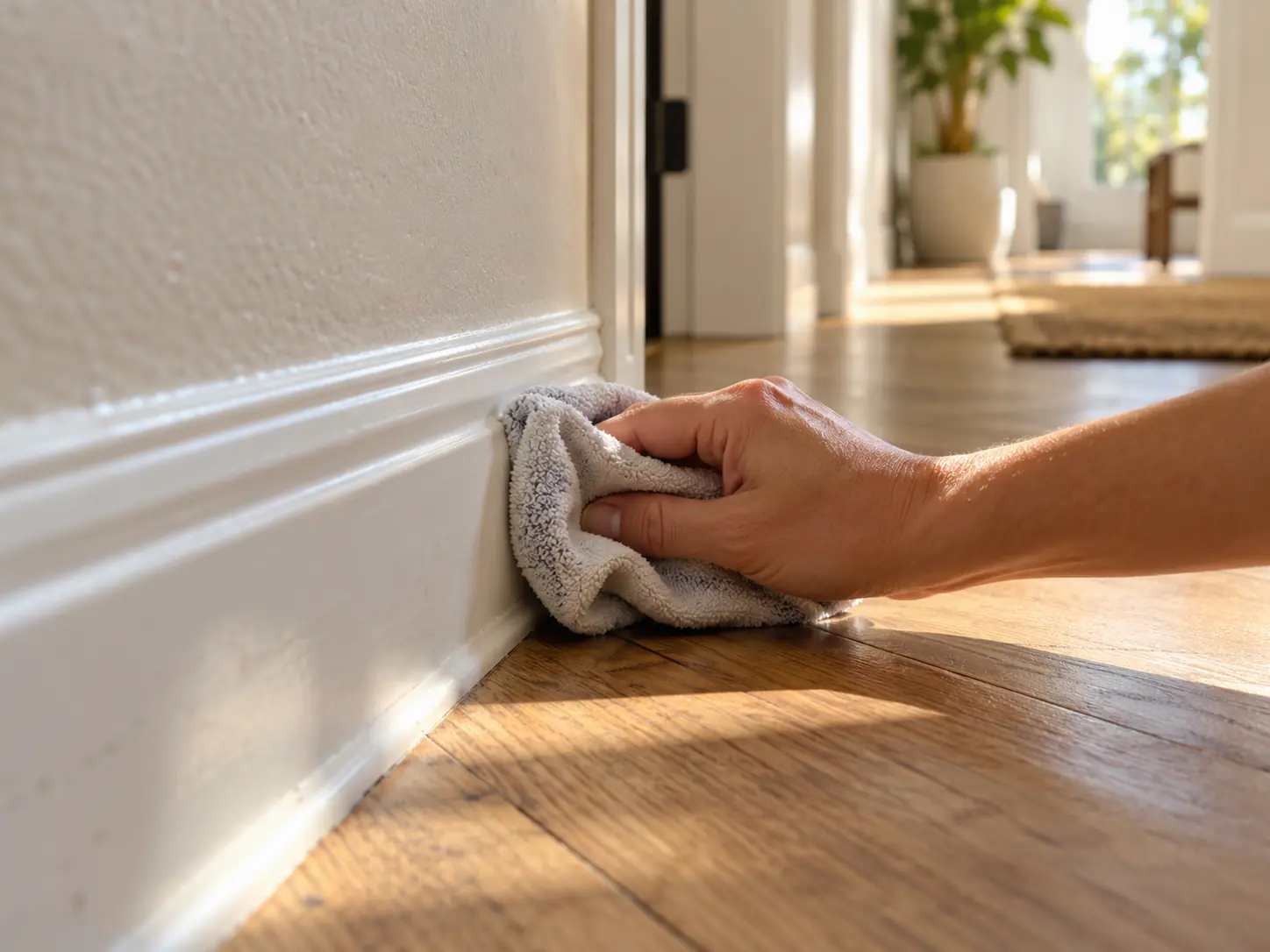
Baseboards sit at the point where dust, pet hair, mop splashes and shoe scuffs gather. Dust drifts down and settles on the top edge. Mop water flicks up the face. Vacuum bumpers and shoes leave marks. In Orange County, fine dust and sandy grit from open windows and nearby construction settles quickly, which is why many homes see a visible line of grime within weeks. Our guide on why Orange County homes get dusty fast explains the pattern.
The dust-first method
Most people reach for the spray bottle first. Don’t. Wet dust smears into streaks that need extra scrubbing.
- Clear the area of furniture, cords and decor along the wall. (5 minutes)
- Vacuum the tops and faces of the baseboards using the soft brush attachment. Include the corners and the tops of door and window trim. (10 to 15 minutes)
- Wipe with a dry microfiber cloth or a slightly static-charged cloth to catch what the vacuum missed. (10 minutes)
- Check the wall above the baseboard for cobwebs and dust, and dust it before you wash anything below.
That alone may be enough if your baseboards are only dusty.
Washing baseboards step by step
Time: about 20 to 30 minutes per room, depending on how dirty.
Step 1: Mix your solution (2 minutes)
Add a few drops of dish soap to a bucket of warm water. If the baseboards are in a kitchen or have grease, a slightly stronger solution works, but still keep it mild.
Step 2: Wring the cloth very well (ongoing)
A dripping cloth is how paint gets damaged and how water reaches the floor. The cloth should feel damp, not wet.
Step 3: Wipe in sections (5 to 10 minutes per room)
Start with the top edge, then the face, then the bottom edge. Work along 3 to 4 feet at a time. Turn the cloth to a clean face often.
Step 4: Rinse (3 to 5 minutes)
Use a second cloth dampened with plain water to remove soap. Leftover soap attracts dust again.
Step 5: Dry (3 to 5 minutes)
Wipe each section dry with a clean cloth. This avoids water spots, swelling on unsealed wood, and streaks.
Step 6: Detail the corners and grooves (5 minutes)
Use an old toothbrush or a cotton swab for decorative grooves and corners.
Step 7: Look from a low angle (1 minute)
Check for missed spots with the light coming across the surface. Touch up as needed.
Shortcut for people who hate bending
Baseboards are the reason many people dread this chore. A few ways to avoid the bend:
- Use a mop with a flat microfiber pad, dampened and wrung out, and run it along the base. A dry pad works for dust.
- Use a long-handled duster or a vacuum with a crevice tool.
- Clip a cloth to the head of a broom or use a cleaning wand with a pivoting head for a damp wipe.
- Sit on a low stool or a rolling cart. Scoot along the wall.
- Wear knee pads, which are cheap and make the job much easier.
- Break it up: one room per day, 10 minutes each, instead of a marathon.
Tall baseboards (five inches or more) and ornate molding take longer. A paintbrush or a soft brush works better than a flat cloth in the grooves.
Painted, stained and sealed baseboards
The right approach depends on the finish. Most baseboards are painted, but you may have stained wood or vinyl.
| Finish | How to clean | Avoid |
|---|---|---|
| Painted, semi-gloss or gloss | Damp cloth with mild soap works well | Abrasive pads |
| Painted, satin | Gentle damp cloth, spot clean | Scrubbing hard, melamine sponges |
| Painted, flat or matte | Very gentle damp cloth, dab rather than rub | Soaking, melamine sponges |
| Stained and varnished wood | Barely damp cloth, dry right away | Soaking, vinegar mixes in quantity |
| Unfinished or raw wood | Dry cloth or vacuum; a barely damp cloth if needed | Water |
| Vinyl or PVC | Mild soap and water | Solvents |
| MDF (common in newer homes) | Damp, not wet, dry immediately | Water pooling, which can swell the board |
MDF baseboards, common in newer tract homes and condos, swell and bubble if they are wet for long. Wring the cloth hard, work in short sections, and dry right away.
Scuff marks and paint types
Paint sheen affects how the wall and baseboards respond to cleaning. From most to least washable:
- Gloss and semi-gloss: hard, smooth, easy to wipe. Typical on trim and baseboards.
- Satin and eggshell: moderately washable, often used on walls in kitchens and halls.
- Flat or matte: more porous, marks easily, and can burnish (shine) or lose color if scrubbed.
If you do not know which you have, look at a hidden spot in raking light. A shiny surface is glossy, a dull one is flat.
How to remove scuff marks
- Start with a dry microfiber cloth to remove loose dirt.
- Use a damp cloth with a drop of dish soap and dab, don’t scrub. Many scuffs are just dirt on the surface.
- Try a plain white pencil eraser for light rubber or shoe marks on hard finishes. Use light pressure.
- Try baking soda on a damp cloth for marks that don’t lift, with very gentle pressure.
- Use a melamine foam sponge only as a last resort, and test first (see below).
- If the mark remains, touch up with matching paint. Cleaning cannot fix a gouge or a paint transfer from a deeper scrape.
Magic erasers: when they damage paint
A melamine foam sponge works like very fine sandpaper. It lifts marks by abrading the surface. On a hard gloss finish, that is often fine. On flat or satin paint, it can leave a dull, burnished patch that is more visible than the original mark.
Use it this way:
- Test in a hidden area first.
- Wet it, wring it until barely damp.
- Use light pressure, not circles with force.
- Rinse the area afterward, since residue can remain.
- Stop if the paint looks shinier, duller or lighter.
- Skip it on flat paint, textured walls, wallpaper, stained wood and anything with a clear coat you want to preserve.
If a wall is washed with a magic eraser and shows light patches, paint is the fix, not more scrubbing.
Washing walls without streaks
Walls are quicker than they look, if you do not over-wet them.
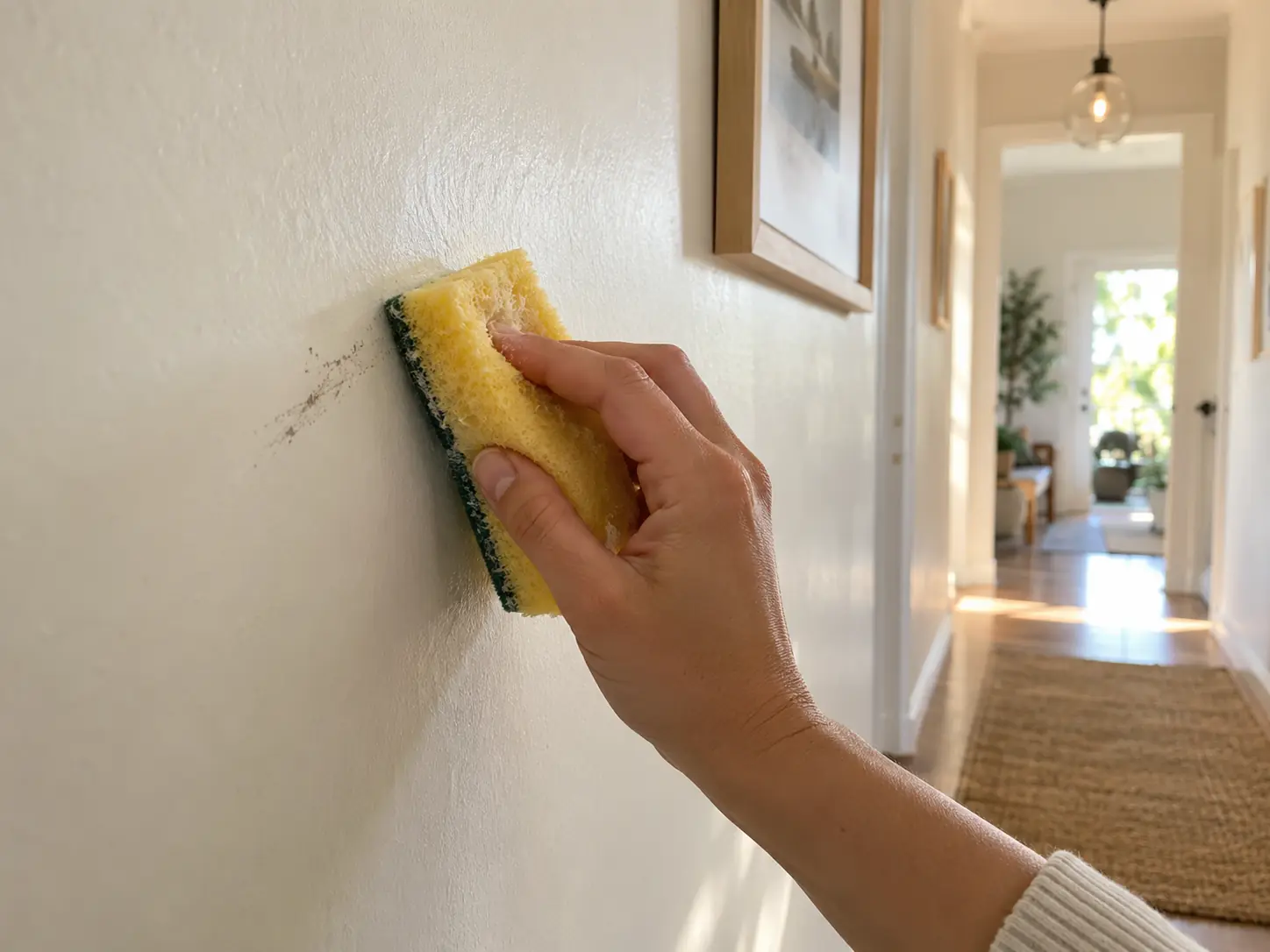
- Dust first. Use a dry microfiber mop or a vacuum brush from the top of the wall down, including corners where the walls meet the ceiling. (10 minutes per room)
- Protect the floor. Lay a towel along the baseboard to catch drips.
- Mix mild soap and warm water. Use less soap than for a floor.
- Wring the sponge or cloth until barely damp.
- Wash in sections from the bottom up when the surface is dirty. This might seem backward, but it prevents drips from creating tracks on dirty paint that are hard to remove. If the wall is only lightly dusty, wash from the top down instead.
- Use even, overlapping strokes, like wiping a window, not circles.
- Rinse the cloth often and swap the water when it turns gray.
- Dry with a clean cloth to avoid streaks and spots.
- Stop at natural breaks such as corners and door frames, so any slight difference is hidden.
Work from one side of a wall to the other and don’t leave a half-washed section drying. Overlap edges while still damp.
What about textured walls and ceilings
Textured finishes, like knockdown or popcorn, hold dust. Vacuum with a brush attachment rather than wiping. Wet cloths can drag texture off the wall, and popcorn ceilings should not be wet cleaned. Spot-treat a mark with a barely damp sponge and blot, or touch up the paint.
What about wallpaper
Check the type. Many wallpapers can be wiped with a barely damp cloth, but others cannot get wet. Test in a hidden spot. Dust with a dry cloth or the vacuum brush.
Kitchen grease on walls
Kitchen walls near the stove carry a sticky layer of airborne grease that traps dust.
- Dust first.
- Mix warm water with a squirt of dish soap, a degreasing one if you have it.
- Wipe a small section and let the soapy water sit for a minute.
- Wipe again with a clean damp cloth.
- Rinse with plain water.
- Dry.
For stubborn grease, repeat rather than escalating to harsh products. A bit of white vinegar in water can cut residual film on painted surfaces if you rinse well, but do not use it on stone or unsealed finishes. Our kitchen deep clean checklist covers other grease hotspots.
Kids’ crayon, marker and pet marks
| Mark | First try | Next try | Caution |
|---|---|---|---|
| Crayon | Dry cloth to flake off wax, then soapy water | Baking soda paste, gentle | Hot hair dryer can soften wax for wiping, but don’t overheat |
| Washable marker | Damp cloth with soap | Pencil eraser | Often comes off easily |
| Permanent marker | Cover and repaint is usually the answer | Rubbing alcohol on a cloth, test first | May lift paint |
| Pencil | Soft eraser | Damp cloth | Don’t scrub flat paint |
| Pet nose and paw marks | Damp soapy cloth | Pencil eraser | Test on flat paint |
| Dirt handprints | Damp cloth, dab | Mild soap | Flat paint may burnish |
| Grease or food splashes | Soapy cloth, dwell | Repeat | Rinse well |
| Tape residue | Warm soapy water | A bit of rubbing alcohol on a cloth | Test first |
For pet-related dirt along walls and baseboards, see keeping a clean home with pets.
Light switches, door frames and trim
These get touched all day but are often skipped.
- Wipe light switches and outlet covers with a barely damp cloth. Don’t spray directly.
- Wash door frames and trim the same as baseboards.
- Wipe door handles and door edges where fingers rest.
- Dust the tops of door frames and window trim with a dry cloth.
Troubleshooting
| Problem | Likely cause | Fix |
|---|---|---|
| Streaks on walls | Too much soap, dirty water, over-wetting | Rinse with plain water and dry |
| Shiny patches on paint | Scrubbing or melamine on flat paint | Repaint the section |
| Swollen baseboard | Water on MDF | Stop wetting; replace or repair if severe |
| Grime returns quickly | Soap residue or dusty home | Rinse well; dust more often |
| Gray edges at floor | Mop splash and dust | Clean the baseboard when mopping |
| Paint peeling | Old paint or too much water | Stop, let dry, repair |
| Yellowing | Age, smoke, cooking | Wash; repaint if it persists |
| Mildew spots | Moisture, poor airflow | Treat gently, fix moisture source; see mold and mildew prevention |
Mistakes that damage paint and trim
- Skipping the dust step. Wet dust becomes streaks.
- Using a soaking wet cloth. Swelling, peeling and drips.
- Scrubbing flat paint. It burnishes.
- Using melamine sponges on everything.
- Using too much soap. Residue attracts dust.
- Mixing products.
- Cleaning baseboards before the floors, in a way that splashes dirt back. Work baseboards first, then vacuum and mop.
- Starting low on a dirty wall without protection, causing drip tracks.
- Ignoring the wall above the baseboard. Dust falls on clean trim.
- Using vinegar on unsealed wood.
Order of operations in a room
- Clear the floor and move furniture.
- Dust ceiling corners, vents and light fixtures.
- Dust and wash the walls if needed, top down.
- Wash baseboards.
- Vacuum the floor.
- Mop the floor.
- Put furniture back.
Doing baseboards before the floor means debris falls to the floor you are about to clean. For a full room-by-room order, see our deep cleaning checklist.
How often to clean
| Task | Frequency | Notes |
|---|---|---|
| Dust baseboards | Every 2 to 4 weeks, with vacuuming | More often with pets |
| Wash baseboards | Every 2 to 3 months, or 3 to 4 times a year | Kitchens and entries may need more |
| Spot clean wall marks | As they appear | Fast action helps |
| Dust walls and corners | Every 1 to 3 months | Cobwebs and dust in corners |
| Wash walls | Once or twice a year | Kitchens and kid areas more often |
| Wipe switches and door frames | Weekly to monthly | High-touch spots |
| Ceiling and vents | Twice a year | See blinds and fans |
These are rules of thumb. A home with pets, small children or heavy cooking needs more. A quiet home with few pets needs less.
Before moving out or selling
Baseboards and walls are among the first things a landlord or buyer notices up close. Scuffs, dust lines and finger marks are common deductions and distractions. Wash baseboards, spot clean marks, and touch up paint if needed. Our move-out cleaning checklist and what landlords check at move-out show what usually gets inspected. Rules about deposits and normal wear vary, so check your lease and state resources.
When it is worth handing off: baseboards are the chore people most often leave until last. Baseboard cleaning is a $30 add-on to a house cleaning, and baseboards are part of our deep cleaning. If you are moving out, our move-out cleaning covers them as part of the whole home. For a 3 bedroom, 2 bathroom home, move-out is (60 + 75 + 70) x 1.6 = 205 x 1.6 = $328.
When to call a professional
You can do most baseboards and wall wiping yourself. It is low-risk, low-cost and satisfying once finished. Dust first, wring the cloth well, and go gently on flat paint.
Call a professional when you have many rooms of tall baseboards, a whole-home reset, moving out with a deadline, or physical limits that make kneeling hard. Pros also bring the tools to do the whole house quickly and the experience to spot where paint is too fragile for scrubbing. If paint is damaged, a painter is the right call, not a cleaner.
A full deep clean for a 3 bedroom, 2 bathroom home is (60 + 75 + 70) x 1.5 = 205 x 1.5 = $307.50, and new customers get $39 off the first clean. For your own home’s figure, use the instant quote.
Frequently asked questions
What is the easiest way to clean baseboards?
Vacuum or dust first, then wipe with a damp microfiber cloth and a drop of dish soap, and dry. A flat mop pad on a handle saves bending.
Can you use vinegar on baseboards?
Diluted vinegar can be used on sealed, painted baseboards if you rinse and dry, but it is not needed and can dull some finishes. Avoid it on unsealed or stained wood. Dish soap and water is the safer start.
How often should you clean baseboards?
Dust or vacuum them every few weeks and wash them a few times a year. Kitchens, entries and homes with pets need more.
How do you clean baseboards without bending?
Use a flat microfiber mop, a long-handled duster, or a wand with a pivoting head. You can also sit on a low stool or wear knee pads and do one room a day.
How do you remove scuff marks from walls?
Try a damp cloth with dish soap first, then a soft pencil eraser, then baking soda on a damp cloth. Use a melamine sponge only as a last resort and test first.
Do magic erasers damage paint?
They can. They work by gently abrading, so on flat and satin paint they may leave dull or shiny patches. Test in a hidden spot and use light pressure.
Should I clean walls top down or bottom up?
For lightly dusty walls, work top down. For dirty walls, many people wash from the bottom up to avoid drip tracks, then rinse top down. Keep the cloth barely damp so there are few drips.
How do I get crayon off a wall?
Flake off wax with a dry cloth, then wipe with warm soapy water. For leftover marks, baking soda on a damp cloth with gentle pressure. Test first on flat paint.
What is the best cleaner for painted walls?
A mild dish soap in warm water. Stronger products are rarely needed and increase the risk of dulling the paint.
Can I clean baseboards with a steam cleaner?
It is not recommended on most baseboards. Steam can soften paint, swell MDF and push moisture into joints. Check the manufacturer’s guidance for your trim before using it.