Care Habits
How to Clean a Dishwasher: Filter, Spray Arms and Odors
To clean a dishwasher, pull the bottom rack, take out the filter and rinse it, check the spray arms for clogged holes, wipe the door gasket, then run one empty hot cycle with a dishwasher-safe descaler such as citric acid. The whole job typically takes 30 to 45 minutes of hands-on work, and most of that is the filter. Almost every smell, white film and gritty-glass complaint traces back to food trapped in the filter or minerals coating the inside.
Quick answer
- Time: 30 to 45 minutes hands-on, plus one empty cycle (typically 1 to 2 hours, mostly unattended).
- Difficulty: Easy. The only fiddly part is removing the filter, and most are a quarter turn.
- Supplies: Citric acid powder or a dishwasher cleaner tablet, dish soap, an old toothbrush, a soft cloth, a toothpick or paper clip. Typically a few dollars in supplies you may already own.
- How often: Filter every 1 to 4 weeks depending on use. Full descale every 1 to 3 months, more often with hard water.
- Skip if: The machine will not drain at all, leaks, or shows an error code. That needs the manual or a repair technician, not a cleaner.
Why dishwashers get dirty in the first place
A dishwasher looks like the cleanest appliance in the house because it runs hot water and soap every day. In practice it is a closed, warm, damp box that sits shut for hours after every cycle, which is exactly what bacteria, mold and mineral scale like.
Three things build up over time:
- Food particles. Most modern machines do not grind food. They catch it in a filter and wash it down the drain. If the filter is full, the water that sprays your dishes passes through a layer of old debris first.
- Grease and soap scum. Fat from pans coats the walls and the underside of the door, especially when the water is not hot enough or the detergent is too weak for the load.
- Mineral scale. Hard water leaves calcium and magnesium deposits on the walls, spray arm holes and heating element. That is the chalky white film many people mistake for soap residue.
Knowing which one you are fighting decides what you reach for. Grease needs soap and heat. Scale needs a mild acid. Food needs a brush and a rinse. Using the wrong one is why a “cleaning cycle” with the wrong product so often changes nothing.
What you need
| Item | What it does | Notes |
|---|---|---|
| Citric acid powder | Dissolves mineral scale and film | Look for food-grade citric acid on the label. Check your dishwasher manual first, since some makers recommend only their own cleaner. |
| Dishwasher cleaner tablet or liquid | Cuts grease and freshens | Handy if you want one product that does both. Follow the package for the cycle to use. |
| Dish soap | Washing filter and removable parts by hand | A plain liquid is enough. |
| Old toothbrush | Scrubbing filter mesh and gasket folds | Soft bristles only on plastic parts. |
| Toothpick or straightened paper clip | Clearing spray arm holes | Gentle pressure, so you do not widen the holes. |
| Soft cloths or microfiber | Wiping seals and the door edge | Avoid abrasive pads on stainless interiors. |
| Rubber gloves | Handling slimy debris | Optional but pleasant. |
| Flashlight | Seeing the drain area | Your phone light works. |
Do not use: steel wool, chlorine bleach in a stainless interior without checking the manual, or any combination of bleach and an acid product. That last one is a safety issue we cover below.
Safety first
Short list, because it matters:
- Never mix cleaning chemicals. Bleach with vinegar, citric acid or any acidic cleaner releases chlorine gas. Bleach with ammonia releases other toxic fumes. Run one product per cycle, and let a full cycle rinse before you try another. Our guide to cleaning products you should never mix has the full list.
- Check the manual before using bleach at all. Many manufacturers advise against it, especially for stainless steel tubs and machines with certain seals.
- Turn off power at the breaker if you will reach near the bottom of the machine, for example when checking the drain hose. Most filter and spray arm work is fine with the door open, but the manual rules.
- Ventilate the kitchen and wear gloves when handling acidic or strongly scented cleaners.
- Test any new product on a hidden spot, such as the inside of the lower door edge, before you use it on visible plastic or rubber.
Know your parts
Most dishwashers share the same layout. Find these before you start.
| Part | Where it lives | What goes wrong |
|---|---|---|
| Filter (cylindrical or flat mesh) | Bottom of the tub, under the lower spray arm | Clogs with food, causes smell and gritty dishes |
| Lower spray arm | Bottom, snaps or twists off | Holes clog with seeds, label scraps, scale |
| Upper spray arm | Under the upper rack or in the ceiling | Same clogging; weak spray |
| Door gasket | The rubber seal around the door opening | Black mold, slime in the folds |
| Drain basket or sump | Under the filter | Broken glass, olive pits, bones |
| Door edges and bottom | The strip along the lower inside of the door | Grease and grime the wash does not reach |
| Detergent dispenser | Inside of the door | Caked detergent, which stops it from opening fully |
| Rack wheels and tines | Both racks | Rust spots, grime in the wheels |
Your model may differ. If you cannot find the filter, your manual will show it, and a few older machines have no removable filter at all.
Step-by-step: the full clean
Step 1: Empty the machine and pull the bottom rack (3 minutes)
Take out all dishes and slide the lower rack out. Set it on a towel. This gives you a clear view of the filter and the tub floor.
Why this matters: The debris you want is under the rack, and you cannot reach it any other way.
Step 2: Remove and wash the filter (5 to 10 minutes)
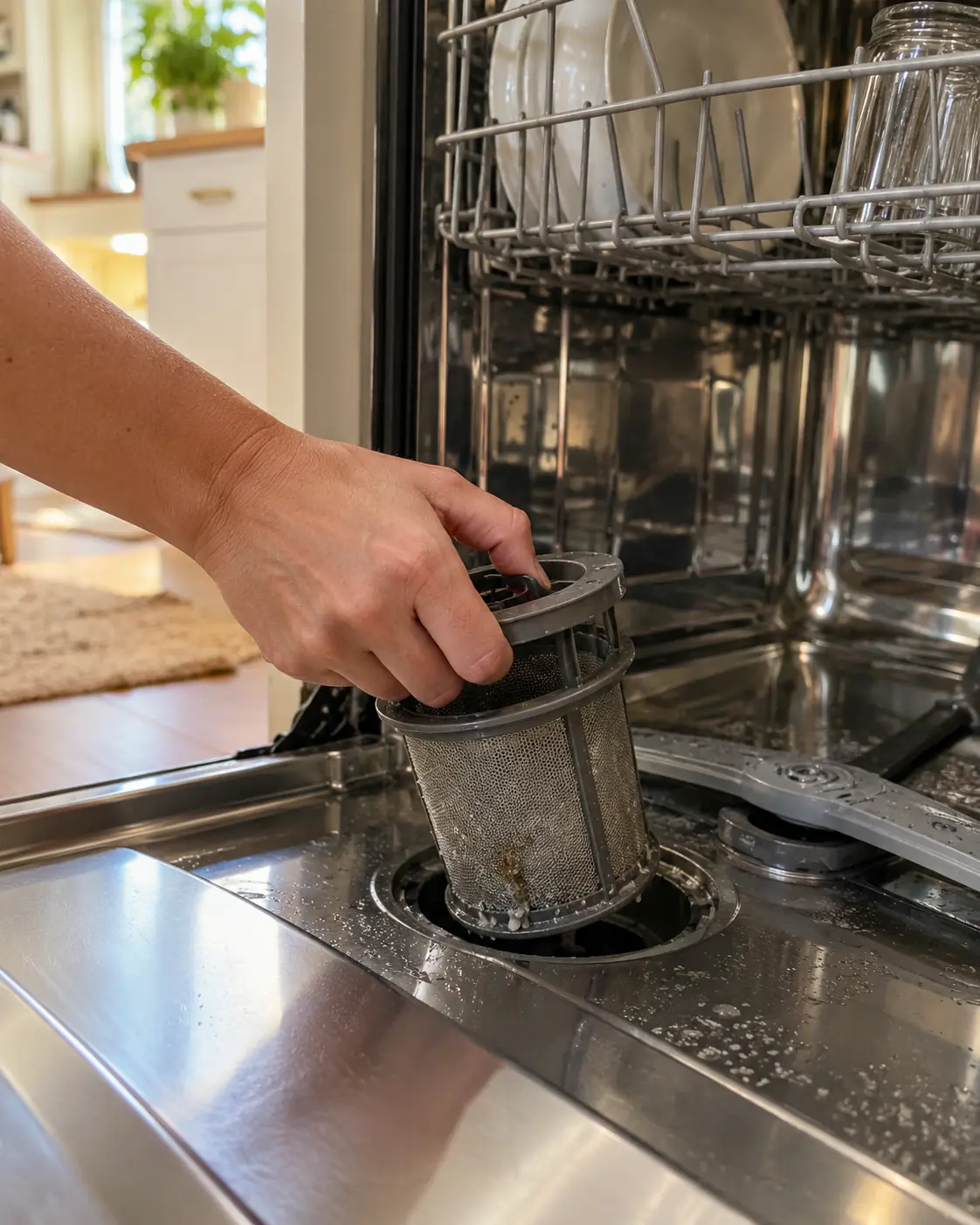
Most filters twist a quarter turn and lift out. Some have two parts: a coarse cylinder and a fine mesh. Take both out and look at what is caught. Slimy, gray, smelly residue is normal if it has been a while.
Rinse under warm running water, then scrub gently with dish soap and the toothbrush, working along the mesh rather than poking through it. If it is greasy, soak it in hot soapy water for 10 minutes first. Rinse until the water runs clear and no film remains on the mesh.
Why this works: The filter is the single biggest source of smell. Cleaning it is the highest-value 10 minutes in this guide.
Step 3: Clear the drain area (3 minutes)
With the filter out, look into the sump with a flashlight. Pick out any visible debris with gloved fingers: bits of glass, bones, olive pits, fruit stickers. Wipe the area with a damp cloth. Do not push anything down the drain opening.
If you find broken glass, pick it out carefully and do not run a cycle until it is gone, since it can damage the pump.
Step 4: Check and clean the spray arms (5 to 10 minutes)
Most spray arms release with a twist or a clip. Your manual shows how. Hold each arm up to light and look through each hole. Clear any blockages with a toothpick or straightened paper clip. Swish the arm under water and make sure it spins freely when you put it back.
Upper arms in some models are built into the rack or the ceiling, and may not detach. In that case clear the holes in place.
Why this works: Spray arms push water at high pressure through small holes. A third of them blocked by scale can mean dishes that look washed, but are not.
Step 5: Wipe the gasket and door edges (5 minutes)
Dampen a cloth with warm soapy water and wipe the rubber seal all the way around, pulling it gently open to reach the folds. Black spots are usually mold or residue. Use the toothbrush for the stubborn bits. Wipe the inside bottom edge of the door, where grime collects and where the wash never quite reaches.
Dry the gasket with a cloth when you finish. A seal left wet is a seal that grows mold.
Step 6: Clean the detergent dispenser (2 minutes)
If detergent cakes in the dispenser or the lid does not spring open fully, scrub it with a damp toothbrush until it moves freely. A stuck dispenser means soap does not reach your dishes at the right time.
Step 7: Reassemble (2 minutes)
Put the filter back and make sure it locks. A filter left loose can let debris pass through. Replace the spray arms and the lower rack.
Step 8: Run a descaling cycle (hands-off)
Put the dishwasher-safe cleaner into the machine, following the product label. The two most common routes:
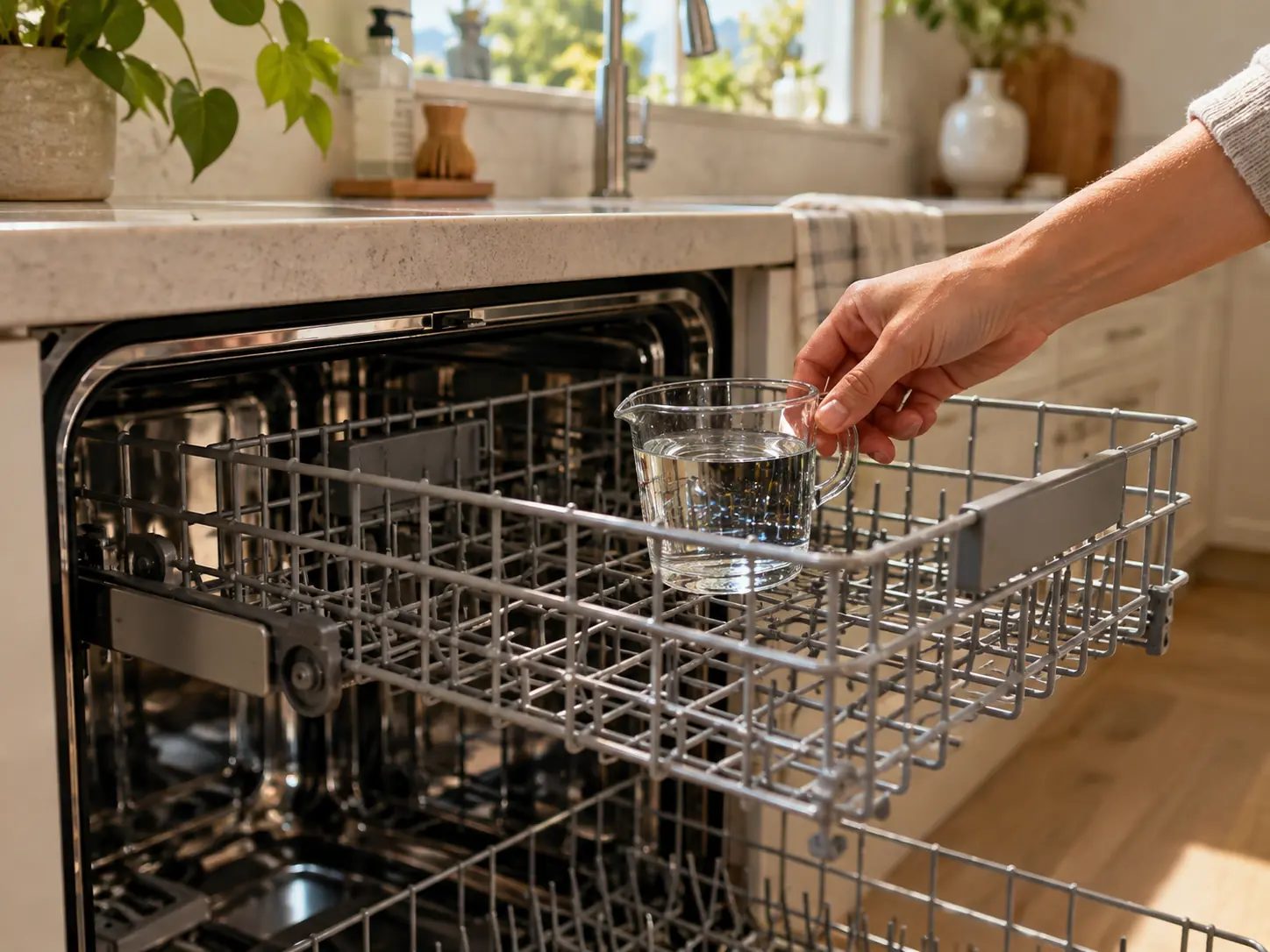
- Citric acid: Place a small amount, often 2 to 4 tablespoons or the amount listed on the package, in a dish on the bottom rack or in the detergent cup, and run a hot cycle with nothing else inside. Check your manual for the amount that is safe for your model.
- Dishwasher cleaner tablet or liquid: Use as directed on the package.
Run the hottest, longest cycle your machine offers. When it finishes, wipe the interior with a dry cloth and prop the door open to air out.
If you also see grease, run a second empty cycle with a dishwasher-safe degreaser or tablet. Do not stack products inside a single cycle.
Vinegar, citric acid or a tablet: which one
| Product type | Best for | Watch out for | Notes |
|---|---|---|---|
| White vinegar | Light odor, mild film | Some manufacturers say it can degrade rubber seals over time | Fine for occasional use in many machines, but check your manual. Never mix with bleach. |
| Citric acid powder | Hard-water scale and film | Strength matters: follow package amounts | Typically the stronger descaler of the household options. |
| Commercial dishwasher cleaner | Grease and odor | Choose one rated for your machine type | Convenient but can cost more per cycle. |
| Baking soda | Light freshening | Does not dissolve scale | Fine as a deodorizer, not a descaler. See our guide to vinegar and baking soda. |
| Chlorine bleach | Occasional sanitizing on some models | Often discouraged by manufacturers; damages stainless and seals in some cases | Only if your manual allows it. Never combine with acids or ammonia. |
A good default for most people: citric acid for scale, a commercial cleaner or hot soapy wipe for grease, and vinegar only if your manual is fine with it.
Fixing the most common problems
| Problem | Likely cause | Fix | When it will not work |
|---|---|---|---|
| Musty or rotten smell | Food in the filter, damp gasket | Clean the filter and gasket, run a hot empty cycle, leave the door ajar | If it returns in days, check for a drain hose problem or a clogged air gap |
| White cloudy film on glasses | Hard water minerals, or too much or too little detergent | Descale with citric acid, add rinse aid, check the detergent amount | Glass that is already etched (permanently dull) will not recover |
| Gritty dishes | Clogged filter or spray arm | Clean both | If grit persists, the pump may need repair |
| Standing water at the bottom | Clogged filter, drain hose kink, garbage disposal knockout plug | Clean the filter, check the hose, check the disposal connection | Persistent standing water needs a technician or a plumber |
| Dishes still dirty | Blocked spray arm, overloaded racks, cold water | Clear holes, reload, run the tap hot before starting | Weak pump or inlet valve problems |
| Black flecks | Mold on the gasket or rubber | Scrub the gasket, dry it | Heavy mold in hidden hoses may need a repair visit |
| Rust spots on the tub | Worn coating, hard water with iron | Rust remover made for dishwashers, if the manual allows | Chipped tub coating does not repair itself |
| Dispenser will not open | Caked detergent | Scrub it clean | Broken spring or latch needs a part |
White film vs etching
People often cannot tell these apart, and the fix is totally different.
- Film wipes off, or dissolves with a mild acid like citric acid. Rub a wet finger on the glass. If it comes off or looks better when wet, it is film.
- Etching is physical damage to the glass surface, caused over time by soft or very hot water combined with strong detergent. It looks like a permanent rainbow or frosted haze that does not respond to acid.
If it is etching, nothing cleans it back. The fix is prevention: use the correct amount of detergent, avoid pre-rinsing dishes to bare skin, and do not run delicate glassware on the hottest cycle repeatedly.
What to do about hard water
A lot of Orange County tap water is hard, and the amount varies by city and water district. If you see chalky white scale in your dishwasher, kettle or shower, that is a clue. The simplest way to know your local numbers is to read your water provider’s annual quality report or ask them directly. Do not guess, and do not rely on a neighbor’s number from a different part of town.
If your water is hard:
- Use rinse aid. It helps water sheet off glass and reduces spots.
- Check whether your machine has a built-in softener or salt reservoir. Some European-style models do, and they need salt refilled.
- Descale more often, roughly monthly rather than quarterly.
- Wipe the door seal and edges weekly, since hard-water film dries there first.
For the wider problem of scale on glass, faucets and showers, see our guide to removing hard water stains.
Mistakes that damage things
- Mixing bleach and an acidic product in the same cycle. This produces toxic gas. One product per cycle, always.
- Using too much detergent. More soap does not mean cleaner dishes. Excess residue builds up and leaves film.
- Washing with the wrong soap. Dish soap meant for the sink creates heavy suds in a dishwasher and can overflow. Use detergent made for the machine.
- Running it with a full, dirty filter. You are rewashing old food over clean dishes.
- Pre-rinsing everything. Modern detergents need some food to work against. Scrape, do not rinse to bare plates. Heavy pre-rinsing can also leave detergent with nothing to do except etch glass.
- Closing the door tight right after a cycle. Trapped humidity encourages mold. Crack the door open once it cools.
- Using steel wool or scouring pads inside. They scratch the tub and open the way for rust.
- Blocking the spray arms with tall items. A pot handle sticking into the arm path means a section of the load is never washed.
What not to put in the dishwasher
Machine dishwashing is rough on some things. Check the label, and as a rule keep these out:
- Cast iron and carbon steel pans (they rust and lose seasoning)
- Wooden spoons, cutting boards and bowls (warping and cracking)
- Good kitchen knives (dulling and handle damage)
- Hand-painted or gilded china, and antique crystal
- Anything with a glued handle or label that is not marked dishwasher safe
- Nonstick pans, unless the maker says they are safe, since detergent can damage the coating over time
- Insulated travel mugs and thermoses, unless marked safe
- Aluminum cookware, which can darken and oxidize
Clean the outside and control panel
While you are at it, spend a few minutes on the outside. This is where fingerprints and cooking splatter live.
- Stainless steel fronts: Wipe with a microfiber cloth along the grain. Our guide to cleaning stainless steel appliances covers this in detail.
- Control panel: Use a barely damp cloth and never spray directly onto buttons. Moisture inside a control panel is a repair bill.
- Handle and door edges: These are the touch points with the most bacteria. A cloth with warm soapy water, then dry.
- Kick plate and floor edges: Dust and grease often gather here. A damp cloth is enough.
Skip this step: If the dishwasher is one of a dozen things on your kitchen list, our deep cleaning service covers the kitchen, including the exterior of appliances, and you can add the inside of the fridge or oven for $35 each. For example, a 3 bedroom, 2 bathroom home is $307.50 for a deep clean: (60 + 25 x 3 + 35 x 2) = 205, times 1.5.
How to keep it clean after
| Frequency | Task | Time |
|---|---|---|
| After every load | Leave the door cracked open until it dries | 0 minutes |
| Weekly | Scrape plates before loading; check the filter if the machine smells | 2 minutes |
| Every 2 to 4 weeks | Rinse the filter under warm water | 5 minutes |
| Monthly | Wipe the gasket, door edges and dispenser | 5 minutes |
| Every 1 to 3 months | Run an empty hot cycle with citric acid or a dishwasher cleaner | 1 minute to start |
| Twice a year | Full clean: filter, spray arms, gasket, rack wheels | 30 to 45 minutes |
| Yearly | Inspect the drain hose and the air gap if you have one | 10 minutes |
Heavy households that cook a lot, wash greasy pans, or have hard water should shorten each interval. If you rarely run the dishwasher, run a short hot cycle weekly so seals do not dry and grow stale.
Load tips that keep it clean
- Face the dirtiest sides toward the center spray.
- Do not nest spoons and bowls, since water cannot reach nested surfaces.
- Scrape large food into the trash, not the machine.
- Run the tap until hot before starting if your water heater is far from the kitchen.
- Use the right detergent amount for your water hardness. Too little leaves grime, and too much leaves film.
Smell that keeps coming back
If you cleaned the filter and the gasket and the smell is still there, work through this order:
- Check the drain hose. A hose that sags or has a low loop can hold dirty water that backs into the tub. Your manual shows the proper loop height.
- Check the garbage disposal connection. A disposal can send smell backward if the dishwasher drain line is partially blocked.
- Check the air gap, the small cylinder near the sink on some setups. Debris can plug it.
- Run the sink and the dishwasher separately, to see if the smell shows up with only one of them.
- Look under the kitchen sink for leaks or a damp cabinet floor.
If the smell still returns, a plumber or appliance technician can check the drain path. At that point more cleaning will not help.
When to call a professional
Some jobs are better handed off. Call an appliance technician when:
- The machine will not drain even after the filter is clean
- You see leaks under the door or underneath
- It shows repeated error codes
- It makes grinding noises, which can mean a failed pump or debris in it
- The tub coating is chipped and rusting
Call a cleaning service when the machine is one small part of a much bigger kitchen reset. We handle kitchens as part of a deep cleaning, and if you want the appliances kept fresh on a schedule, recurring cleaning keeps the outside, counters and floors maintained between your own dishwasher cleans. If you are moving out, the dishwasher exterior and interior are standard checks in a move-out clean, and our security deposit guide for California renters explains what landlords look at.
Not sure what size of job you have? Get an instant quote at our pricing page. A first-time customer gets $39 off the first clean.
For the rest of the kitchen, see our kitchen deep clean checklist and our ideas for keeping the kitchen clean between cleanings.
Frequently asked questions
Can you put vinegar in a dishwasher? Many people do, and it often works for light odor and film. However, some manufacturers advise against it because repeated acid exposure may wear rubber seals and gaskets over time. Check your manual. If it allows vinegar, use it occasionally rather than every cycle, and never combine it with bleach.
How often should you clean your dishwasher filter? Typically every 2 to 4 weeks for normal use. If you cook a lot, do not scrape plates, or notice smell or gritty glasses, check it weekly. Some machines have self-cleaning filters, so look at your manual.
Why does my dishwasher smell? Almost always trapped food in the filter or drain area, combined with a wet, closed door. Clean the filter, wipe the gasket, run a hot empty cycle, and leave the door cracked afterward. If it persists, check the drain hose and the garbage disposal connection.
Is it OK to run bleach in a dishwasher? Only if your manual says so. Many makers advise against it, and it can damage stainless steel and seals. Never run bleach together with vinegar, citric acid or any acidic cleaner. Do not run it in the same cycle as another product.
How do I get white film off dishes? Figure out whether it is hard water film or glass etching. Film responds to a descaling cycle with citric acid, plus rinse aid going forward. Etching is permanent damage. Using less detergent and avoiding the hottest settings for glassware helps prevent it.
How do I clean a dishwasher without vinegar? Use citric acid powder or a commercial dishwasher cleaner for scale and odor, wash the filter by hand with dish soap, and wipe the seals with warm soapy water. Baking soda can freshen but will not dissolve scale.
How long does a dishwasher cleaning cycle take? The hands-on work takes 30 to 45 minutes. The empty cycle afterward usually runs 1 to 2 hours depending on your machine and settings.
Do dishwasher cleaning tablets really work? They typically help with grease and odor and are convenient. They do not replace cleaning the filter, which is where most smell starts. Use them as a supplement.
Should I clean the dishwasher if I use it every day? Yes. Frequent use means more food passing through the filter, so check it more often. Daily-use machines typically need filter cleaning about every 2 weeks and a descale every month or two.
Can I clean the dishwasher with dish soap in the machine? No. Dish soap creates heavy suds that can overflow. Use dish soap only to hand-wash the filter and removable parts. Use dishwasher detergent in the machine.