Care Habits
How to Clean Granite, Quartz, and Marble Countertops Safely
For daily cleaning of granite, quartz, and marble, use a soft cloth, warm water, and a few drops of mild dish soap, then rinse with a damp cloth and dry with a clean towel. That one routine is safe on all three. The differences show up with everything else: marble etches under acids, granite needs sealer to resist stains, and quartz (an engineered stone held together with resin) is damaged by high heat and harsh chemicals.
That is why “just use vinegar” is the worst advice in countertop care. Vinegar, lemon, and many bathroom sprays are acids. They dull marble and can wear down the sealer on granite. The sections below explain which surface you have, what each one tolerates, and how to fix the damage you might already have.
Quick answer
- What you need: Mild dish soap, warm water, two microfiber cloths, a soft sponge, baking soda, rubbing alcohol (isopropyl) for disinfecting, and plastic scraper.
- Time: About 5 minutes for a daily wipe, 20 to 30 minutes for a deeper clean with stain treatment.
- Cost of supplies: Low. The core kit is dish soap and cloths. Stone sealer and poultice products cost extra, and prices vary by brand and size.
- Difficulty: Easy for daily cleaning, moderate for stains and sealing.
- How often: Wipe after cooking. Deep clean weekly. Test granite and marble sealer once a year.
- Skip the DIY step if: You see cracks, deep chips, or large etched areas. Those usually call for a stone restoration professional.
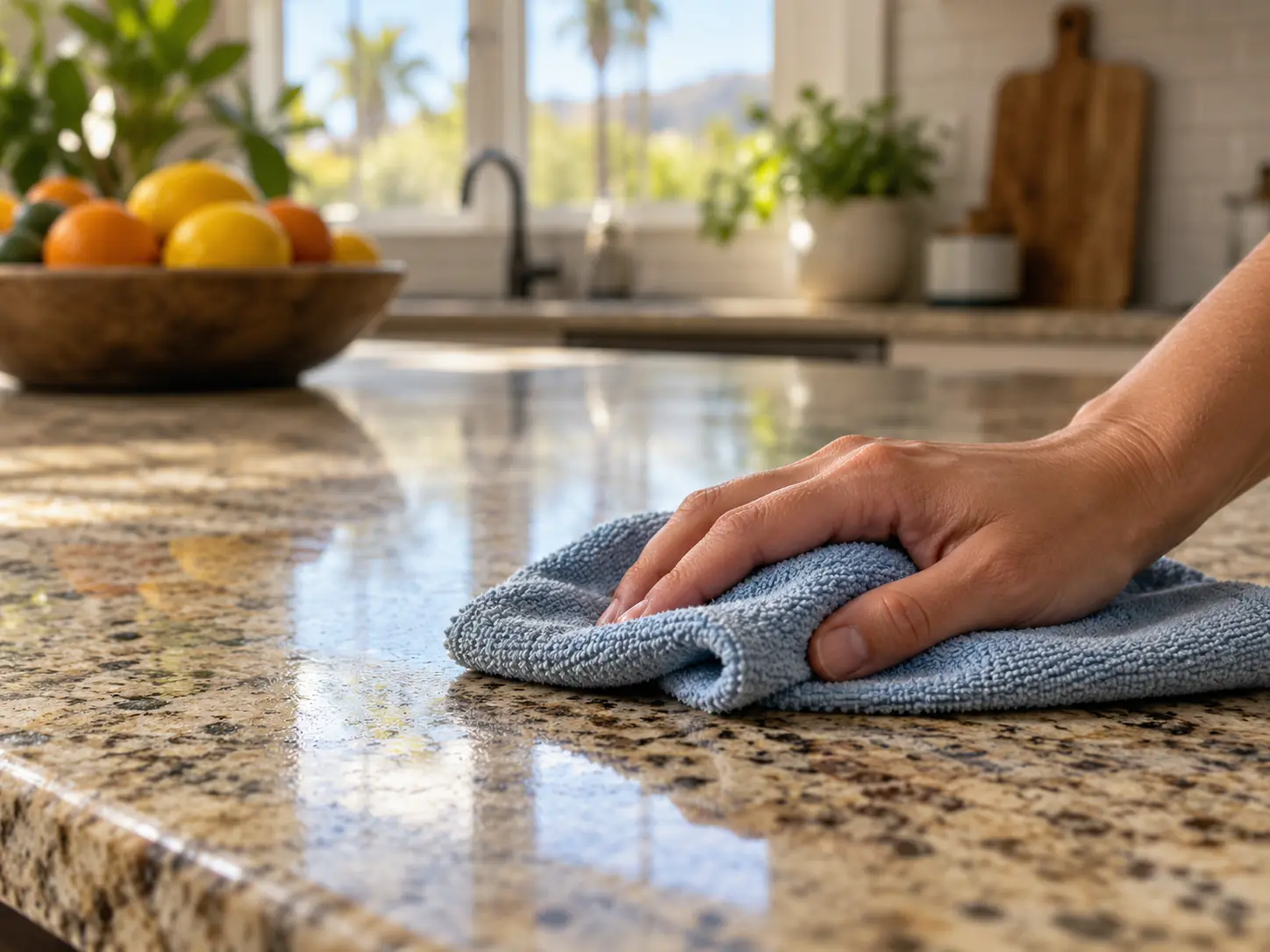
First, figure out what you have
Many people do not actually know what their countertops are. Here is how to tell, though a countertop installer, the paperwork from your remodel, or the builder’s spec sheet is a more reliable answer than guessing.
| Surface | What it looks like | What it is | Biggest weakness |
|---|---|---|---|
| Granite | Speckled, with visible grains and a natural, uneven pattern. Cool to the touch | Natural stone | Stains if the sealer wears off. Harsh cleaners strip sealer |
| Marble | Soft veining, often white or gray, with a milky depth | Natural stone (softer, more porous) | Etching from any acid. Stains easily, especially if honed |
| Quartz | Very even, uniform pattern, sometimes with sparkles. Repeating patterns across slabs | Engineered stone: crushed quartz bound by resin | Heat damage, discoloration from harsh chemicals |
| Quartzite | Looks like marble, behaves more like granite | Natural stone, harder than marble | Needs sealing, same cautions as granite |
| Laminate made to look like stone | Thin edge, visible seam, light weight | Plastic over particleboard | Water at seams, heat |
If you are renting, ask the landlord. If you are buying, ask the seller or agent for any care sheet. If you still are not sure, treat the countertop as the most delicate type on the list (marble) until you know more.
Etching versus staining: a distinction that saves counters
People often call every mark a stain. It matters because the fix is different.
- Stain: A color change caused by liquid or oil soaking into the stone’s pores. The surface feels smooth. Treatment lifts the color out.
- Etch: A dull spot caused by acid dissolving the surface of the stone (mostly marble, and also some other calcium-based stones). The texture feels slightly rough or looks lighter than the surrounding area. Cleaning will not remove it.
A quick test: wipe the area clean and dry, then look at it from an angle. If the mark looks like a dull ring or a ghost of a drip and the color of the stone around it has not changed, it is probably an etch. If the mark is darker than the surrounding stone, it is probably a stain.
Etches on polished marble can sometimes be improved with a stone polishing powder, but deep etching typically needs professional honing. Do not try to fix either with more acid.
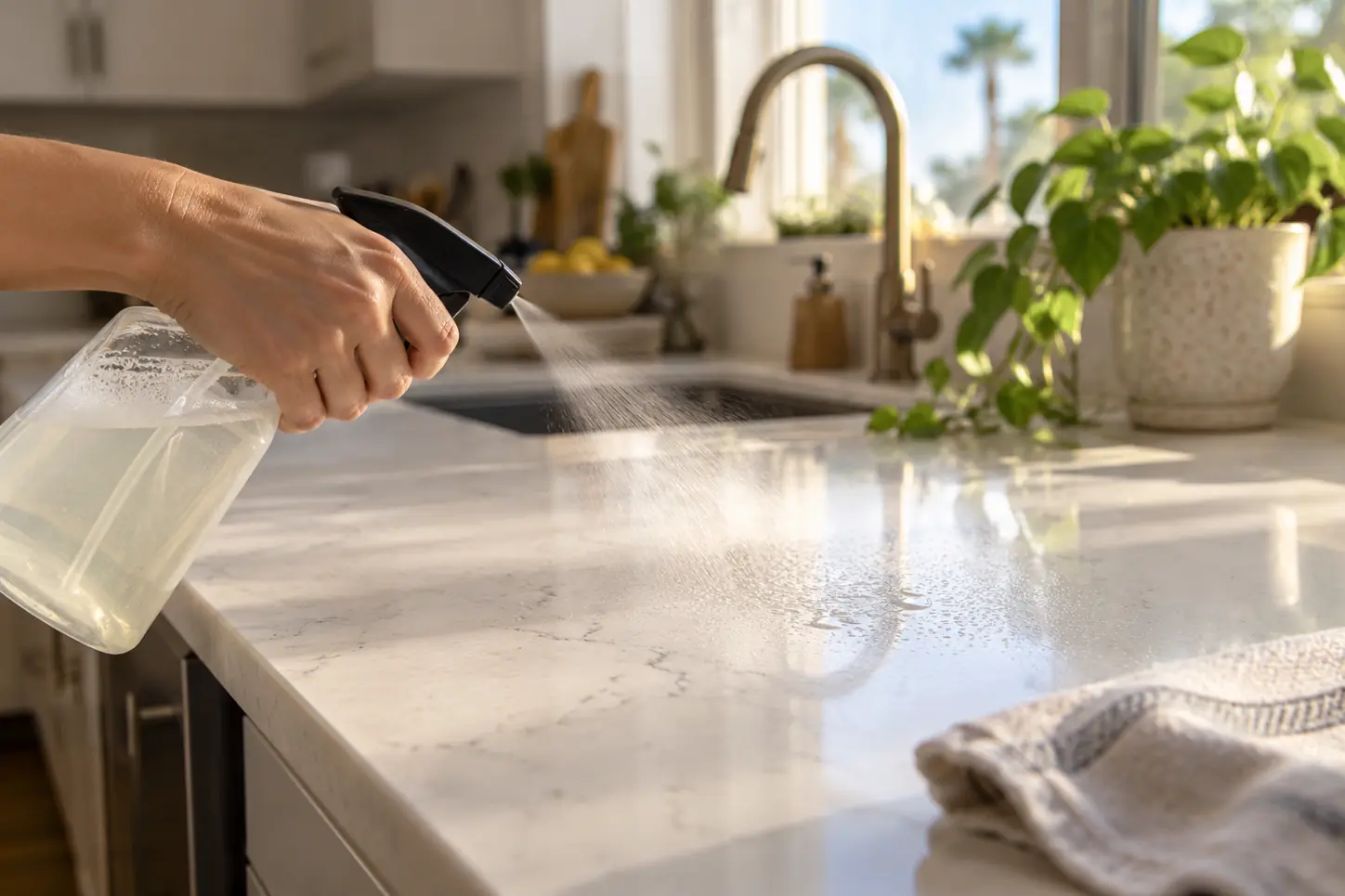
What you need
| Item | What it does | Notes |
|---|---|---|
| Mild dish soap | Cuts grease and food film | A few drops per bowl of warm water. Look for plain, non-citrus formulas for marble |
| Two microfiber cloths | One to wash, one to dry | Drying prevents streaks and water spots |
| Soft sponge | Lifts stuck-on food | Non-scratch only |
| Plastic scraper or old gift card | Removes dried food, gum | Never metal |
| pH-neutral stone cleaner | Daily cleaner made for stone | Check the label for “safe for granite, marble, quartz” |
| Baking soda | Gentle paste for stains on quartz or granite | Mix with water, do not scrub hard |
| Isopropyl (rubbing) alcohol | Disinfecting and streak removal | Dilute with water. Usually safe on sealed stone and quartz, but test first |
| Poultice powder or ready-made poultice | Draws stains out of porous stone | Follow the label |
| Stone sealer (granite, quartzite, marble) | Fills pores to slow staining | Choose one labeled for your stone type |
| Trivets and cutting boards | Protect from heat and scratches | The best “product” you can own |
Do not use: Vinegar, lemon juice, or any citrus cleaner on natural stone. Skip bleach on marble. Avoid ammonia-based glass cleaners, oven cleaner, drain cleaner, toilet bowl cleaner, scouring powder, and steel wool anywhere on stone or quartz.
Safety first
- Test every new product in a hidden spot. Pick a corner behind an appliance or an area that will be covered.
- Never mix cleaners. In particular, do not combine bleach with ammonia or with any acid. See our guide on cleaning products you should never mix.
- Ventilate and wear gloves when you use poultices, sealers, or stronger cleaners.
- Follow the manufacturer’s care sheet. Some warranties on quartz and granite specify which cleaners are allowed. Using an unapproved product can affect coverage.
- Check the label of any disinfecting wipe. Sources disagree about whether wipes are fine on quartz, so look at what your countertop maker says.
- Keep children and pets away from sealers while they cure.
Daily cleaning (all three surfaces)
- Clear the counter (1 minute). Move small appliances, mats, and containers.
- Remove loose crumbs with a dry microfiber cloth or a handheld vacuum (1 minute).
- Wipe with soapy water (2 minutes). Use a soft cloth with warm water and a few drops of dish soap. Work in overlapping strokes.
- Rinse with a cloth dampened in plain water, because soap film dulls stone and attracts grime.
- Dry and buff with the second cloth (1 minute). This is what prevents water spots and cloudy streaks.
Why this works: Warm soapy water lifts grease without changing the pH of the surface. The rinse and dry steps remove the film that leaves streaks.
The weekly deeper clean
- Wipe as above.
- Spray a pH-neutral stone cleaner or a mix of warm water, a few drops of dish soap, and a splash of isopropyl alcohol (a common homemade mix uses about a cup of water, a tablespoon of dish soap, and a tablespoon of alcohol, though a ready-made stone cleaner is simpler).
- Let it sit for a minute or two.
- Wipe, rinse, and dry.
- Pay attention to the area around the sink and stove, where grease, soap, and water collect.
Disinfecting: If you need to disinfect after raw meat, wash first with soap and water, then apply a diluted isopropyl alcohol solution and let it sit as the label directs. Check your care sheet before using stronger disinfectants. Bleach and hydrogen peroxide products can harm some stones and resin finishes, so read the label first.
Granite: sealing and the water drop test
Granite is hard and heat tolerant, but it is porous, which means oil and liquids can soak in if the sealer has worn thin. Many granite counters are sealed at installation, and a sealer slowly wears off with use and cleaning.
The water drop test
- Clean and dry a small area, ideally near the sink where it matters most.
- Place a few drops of water on the surface, spaced apart.
- Wait about 15 to 30 minutes.
- Look at the spots. If the water beads and the stone stays the same color, the sealer is still working. If the stone darkens beneath the water, it is soaking in, and it is time to reseal.
Some guides also suggest testing with a drop of cooking oil, since oil is the more realistic kitchen stain. Wipe it up after the test.
How often to reseal
Guidance varies a lot, from about once a year to once every several years, depending on the stone, finish, and use. A dense, polished granite may hold up for years, while a lighter or honed stone may need attention sooner. Rather than following a fixed calendar, run the water test once a year and reseal when it fails.
Resealing basics
- Clean the surface thoroughly and let it dry fully.
- Apply the sealer exactly as the product directs, usually wiped on in thin even coats.
- Wipe off excess before it dries to avoid hazy patches.
- Keep the surface dry for the time the label states.
Sealer slows staining. It does not make stone stain-proof, and it does not prevent etching on marble.
Marble: the acid problem
Marble is softer and more porous than granite, and it contains calcium carbonate, which reacts with acid. Common culprits:
- Lemon, lime, orange juice
- Wine, vinegar, tomato sauce
- Some soda
- Many bathroom and kitchen cleaners marketed as “descaling” or “bathroom”
- Toilet bowl cleaner
- Some personal care products set down on a vanity
What to do after a spill
- Blot, do not wipe. Wiping spreads the liquid.
- Rinse the spot with plain water.
- Wash with mild dish soap and water.
- Dry.
If a dull spot remains, it is likely an etch, and cleaning will not fix it. Light etching on polished marble may respond to a marble polishing powder used per directions. Deeper damage is a job for a stone restoration professional.
Honed versus polished
Honed marble has a matte finish. It hides etching better but absorbs stains more easily. Polished marble shows etching more but is more stain resistant. Neither is maintenance free.
Quartz: heat, chemicals, and care
Quartz countertops are made of ground quartz mixed with resin. They do not need sealing, which is one reason people choose them. Their weak points are different from natural stone:
- Heat: The resin can discolor, mark, or crack under high heat. Sources disagree on the exact temperature at which damage begins, so use a trivet for every hot pan, pot, and baking sheet. Treat “heat resistant” as meaning “heat tolerant up to a point,” not heatproof.
- Harsh chemicals: Oven cleaner, paint stripper, strong degreasers, and similar products can dull or damage the surface.
- Abrasives: Scouring powder and scrub pads can scratch the finish.
- Acids: Not as damaging as on marble, but not recommended for regular use. Rinse spills promptly.
Stuck-on spots on quartz
- Soften with a warm damp cloth for a minute.
- Lift with a plastic scraper held at a low angle.
- Wipe with soapy water.
- For stubborn residue, make a loose paste of baking soda and water, rub gently with a soft cloth, rinse, and dry.
Stain removal by stain type
| Stain | Granite | Marble | Quartz |
|---|---|---|---|
| Oil, grease | Poultice with baking soda and water, left on under plastic wrap for a day, then rinse (follow poultice directions) | Same method, test first | Dish soap and warm water, or a degreaser approved by the maker |
| Coffee, tea, wine | Wash with soap and water. If it persists, a poultice made for organic stains | Act fast, use a marble-safe poultice | Soap and water, then baking soda paste |
| Ink, marker | Isopropyl alcohol on a cloth | Isopropyl alcohol, test first | Isopropyl alcohol on a cloth |
| Rust rings | Rust remover poultice made for stone | Same, product made for marble | Gentle baking soda paste, check maker’s guidance |
| Hard water spots | Soap and water, dry well | Do not use acids. Wipe dry after each use | Soap and water, or a quartz-safe cleaner |
| Dried food, gum | Plastic scraper after softening | Plastic scraper | Plastic scraper |
| Water rings on marble | N/A | Likely etching. Polishing powder or professional | N/A |
A poultice is a paste of absorbent powder and a liquid that you spread over the stain and cover. As it dries, it draws the stain out of the stone. Because techniques differ by product and stain, follow the directions on the one you buy.
Mistakes that damage countertops
- Using vinegar or lemon on natural stone. The most common cause of dull marks.
- Setting hot pans on quartz. Use trivets.
- Cutting on the counter. Stone dulls knives, and knives can still mark softer stones and engineered surfaces.
- Leaving spills overnight. Oil and wine are more difficult once absorbed.
- Using abrasive scrubbers. They create dull patches that cannot be buffed out.
- Ignoring the sealer. Stains on unsealed granite show up faster.
- Mixing cleaners. Never.
- Using stone cleaners on laminate or the reverse. Match the product to the material.
- Leaving wet sponges on the counter. They trap moisture and can leave rings.
- Dragging heavy cookware or appliances. Lift instead.
Cleaner comparison
| Type | Best for | Avoid on | Rough price tier |
|---|---|---|---|
| Dish soap and warm water | Daily cleaning on all three | Rarely a problem, though avoid citrus-scented soaps on marble | Lowest |
| pH-neutral stone cleaner | Weekly cleaning on granite, marble, quartzite | Check label for quartz | Mid |
| Diluted isopropyl alcohol | Streak removal, light disinfecting on sealed stone and quartz | Unsealed or unfinished stone (test first) | Low |
| Baking soda paste | Light stains, stuck-on residue | Heavy scrubbing anywhere | Lowest |
| Poultice | Deep oil and organic stains on natural stone | Quartz, unless the maker says so | Mid to higher |
| Disinfecting wipes or sprays | Use only if the care sheet allows | Marble, unsealed stone | Varies |
| Vinegar, lemon, citrus cleaners | Not recommended on stone | Marble, granite, quartzite | Not worth it |
Orange County angle
Hard water is common across much of Orange County, and it leaves white spots and rings around faucets and sinks. On granite and quartz, wipe spots promptly and dry the surface so minerals do not build up. On marble, do not reach for acid descalers. Check your local water quality report to see how hard your water is.
Fine dust blown in by dry winds and sandy grit can also scratch counters when wiped dry. Always damp wipe first. In condos and HOA communities, countertops are sometimes a shared spec, so check if your association has rules about replacement or finishes before making major changes.
If you are dealing with mineral deposits elsewhere, see how to remove hard water stains.
How to keep counters looking new
| Frequency | Task |
|---|---|
| After each use | Wipe spills, especially oil, wine, coffee, and citrus |
| Daily | Soapy wipe, rinse, dry |
| Weekly | Stone-safe cleaner on the full surface, including edges and backsplash seams |
| Monthly | Check around the sink and cooktop for buildup. Wash cutting boards and mats |
| Yearly | Water drop test on granite, marble, and quartzite, reseal if needed |
| Always | Use trivets and cutting boards. Keep coasters near drinks |
Small habits make the largest difference. A dish of lemon wedges, a bottle of wine, or a hot pot set down for ten seconds is how most damage starts.
When to call a professional
Handle daily cleaning, spot treating, and testing yourself. Call a stone restoration professional for:
- Deep etching on marble
- Chips, cracks, or seams that are lifting
- Heat marks or burn damage on quartz
- Widespread staining that has not responded to a poultice
- Full refinishing or re-polishing
When it is worth handing off: If you want the counters wiped, the sink area cleaned, and the kitchen reset without spending your weekend, a deep cleaning visit covers the kitchen from top to bottom. For a 3 bedroom, 2 bathroom home, the formula gives (60 + 75 + 70) x 1.5 = $307.50 for a deep clean. A recurring visit is (60 + 75 + 70) x 1.0 = $205, or $164 on a weekly plan after the 20% frequency discount. Ask about countertop material when you book, so the crew uses products that fit your stone.
Our crews use eco-friendly, pet-safe products, and you can tell us if your counters are marble or have a manufacturer care sheet. If you want an exact price for your own home, the instant quote takes under a minute. For ongoing upkeep, look at our recurring cleaning service.
Related reading: the kitchen deep clean checklist, how to clean stainless steel appliances, and best all-purpose cleaner guide.
Frequently asked questions
What is the best way to clean granite countertops daily? Warm water, a few drops of mild dish soap, and a soft cloth, followed by a rinse and a dry buff. Some stone care companies recommend a pH-neutral stone cleaner instead of dish soap, so either approach is reasonable. Avoid acids and abrasives.
Can you use vinegar on granite or quartz? It is best to avoid it. On granite, acid can wear down the sealer over time. On quartz, it is not usually recommended by makers, since it can dull the finish with repeated use. On marble, vinegar etches the surface.
What should you never use on marble? Vinegar, lemon, citrus cleaners, bleach, acidic bathroom cleaners, abrasive powders, and scrub pads. Stick to mild, pH-neutral soap and water.
How do I know if my granite is sealed? Do the water drop test. If drops bead up and the stone stays the same color after 15 to 30 minutes, the sealer is working. If the stone darkens under the water, it is time to reseal.
How often should granite be sealed? There is no single answer. Some stones need sealing about once a year, others last for several years. Testing once a year tells you more than a calendar does.
Does quartz need to be sealed? No. Quartz is engineered with resin and is non-porous, so sealer is typically unnecessary. Check your manufacturer’s care sheet.
Can hot pans damage quartz? Yes. The resin can discolor or crack under high heat, and sources disagree on the exact temperature. Always use a trivet.
Can I use disinfecting wipes on countertops? It depends on the product and the stone. Some quartz makers say yes, while some stone experts say no. Check your care sheet, avoid wipes on marble, and rinse after use.
How do I get a stain out of marble? Treat quickly. Blot, rinse, and wash with mild soap. For set-in stains, a poultice made for marble can draw color out. If the mark is dull and rough, it is probably an etch, and a professional may need to hone it.
Is Windex safe on granite? Many glass cleaners contain ammonia, which can wear down sealer over time. A stone-safe cleaner or soapy water works better.
Want the kitchen handled for you?
If you would rather spend the weekend elsewhere, get your price with the instant quote, or learn more about our deep cleaning service. We serve homes across Orange County, including Newport Beach, and we are glad to note your countertop material on the booking.