Care Habits
How to get rid of kitchen sink and trash can odors
Most kitchen odors come from food film inside the drain, the underside of the garbage disposal, or a trash can with residue stuck to the bottom. Flush the drain with hot water and dish soap, scrub the sink strainer and stopper, clean the disposal with ice and citrus or baking soda, and wash the trash can with hot soapy water and a disinfectant. If a rotten egg smell persists, the cause may be plumbing, not cleaning.
Quick answer
- What you need: dish soap, baking soda, hot water, a stiff brush or bottle brush, rubber gloves, a disinfectant, a hose or tub, and a drain strainer.
- Time: 15 to 30 minutes for the sink and drain, 20 to 30 minutes for the trash can (plus drying time).
- Cost of supplies: mostly pantry items and tools you may own.
- Difficulty: easy to moderate.
- Skip if: the smell is sewage-like in several fixtures at once. That points to a plumbing problem, so call a plumber.
Find the source first
Spraying air freshener on a smell never works. Find the actual source, then clean it. This table is the shortcut.
| Where it smells | Likely cause | Main fix |
|---|---|---|
| Right at the drain opening | Food film on the strainer or stopper, or the top of the drain | Scrub strainer, flush with hot soapy water |
| Under the sink, when running water | Slow leak or a dirty P-trap | Check for moisture, clean the trap |
| Disposal, especially after use | Food buildup on the blades and splash guard | Scrub splash guard, grind ice and citrus |
| Sink with dishwasher | Dishwasher drain hose or filter | Clean the filter (see the dishwasher guide) |
| Rotten egg smell from multiple drains | Possible plumbing or sewer gas issue | Call a plumber |
| Trash can, even after you take out the bag | Residue and bacteria on the walls and bottom | Wash and dry thoroughly |
| Trash can lid | Splatter and mold | Scrub the underside |
| Cabinet under the sink | Leaks, trash, or wet sponge storage | Dry the cabinet, fix the source |
| Sink basin (not the drain) | Dirty sponge or dish rack or standing water | Wash the sink, change sponges |
| Compost bin | Wet food waste, not enough airflow | Empty often, rinse, and use liners |
Do the sniff test with a clean sink. Run hot water for a minute, pour a little dish soap down, and note where the smell comes from. If it clears for an hour and returns, the film is back. If it never clears, look at the plumbing.
Safety first
- Never mix drain cleaners, bleach, ammonia, or vinegar with each other. Mixed chemicals can release harmful gases. See cleaning products you should never mix.
- Wear gloves and ventilate. Open a window and run the exhaust fan.
- Turn the garbage disposal off at the wall switch before putting anything near it. Never put your hand in the disposal, even when it is off. Use tongs or pliers to remove objects.
- Do not use bleach products with an older drain or a septic system. If you have a septic tank, ask your installer which products are safe.
- Skip heavy chemical drain openers for routine odor. They are caustic and can damage pipes, finishes, and skin.
- Don’t use boiling water on PVC pipes. Very hot tap water is fine, but a full kettle of boiling water can soften some plastic pipes and loosen joints.
- Keep pets and children out of the room while you clean with strong products.
What you need
| Item | What it does | Notes |
|---|---|---|
| Dish soap | Breaks down grease in the drain | Works with hot water |
| Baking soda | Mild deodorizer and scrub | Cheap and safe for most surfaces |
| White vinegar | Cuts mineral and light film | Do not combine with bleach. Not on natural stone |
| Lemon, orange peel, or citric acid | Freshens a disposal | Not a cleaner by itself |
| Bottle brush or drain brush | Scrubs inside the drain | Reaches past the strainer |
| Old toothbrush | Cleans the strainer and stopper | Detail work |
| Rubber gloves | Protects hands | Dedicated pair |
| Ice cubes and rock salt | Scours disposal blades | Use only on disposals |
| Disinfectant (hard surface) | Kills germs on the trash can | Follow the label contact time |
| Hose or tub | Washes the trash can | An outdoor spot is easiest |
| Enzyme drain cleaner | Digests organic film slowly | Good for ongoing maintenance |
| Plunger or drain snake | Clears clogs | Only if water is draining slowly |
If you are stocking up, our essential cleaning supplies list shows a lean kit that covers this job.
Part 1: Deodorize the kitchen sink drain
Step 1: Remove and scrub the strainer and stopper (3 minutes)
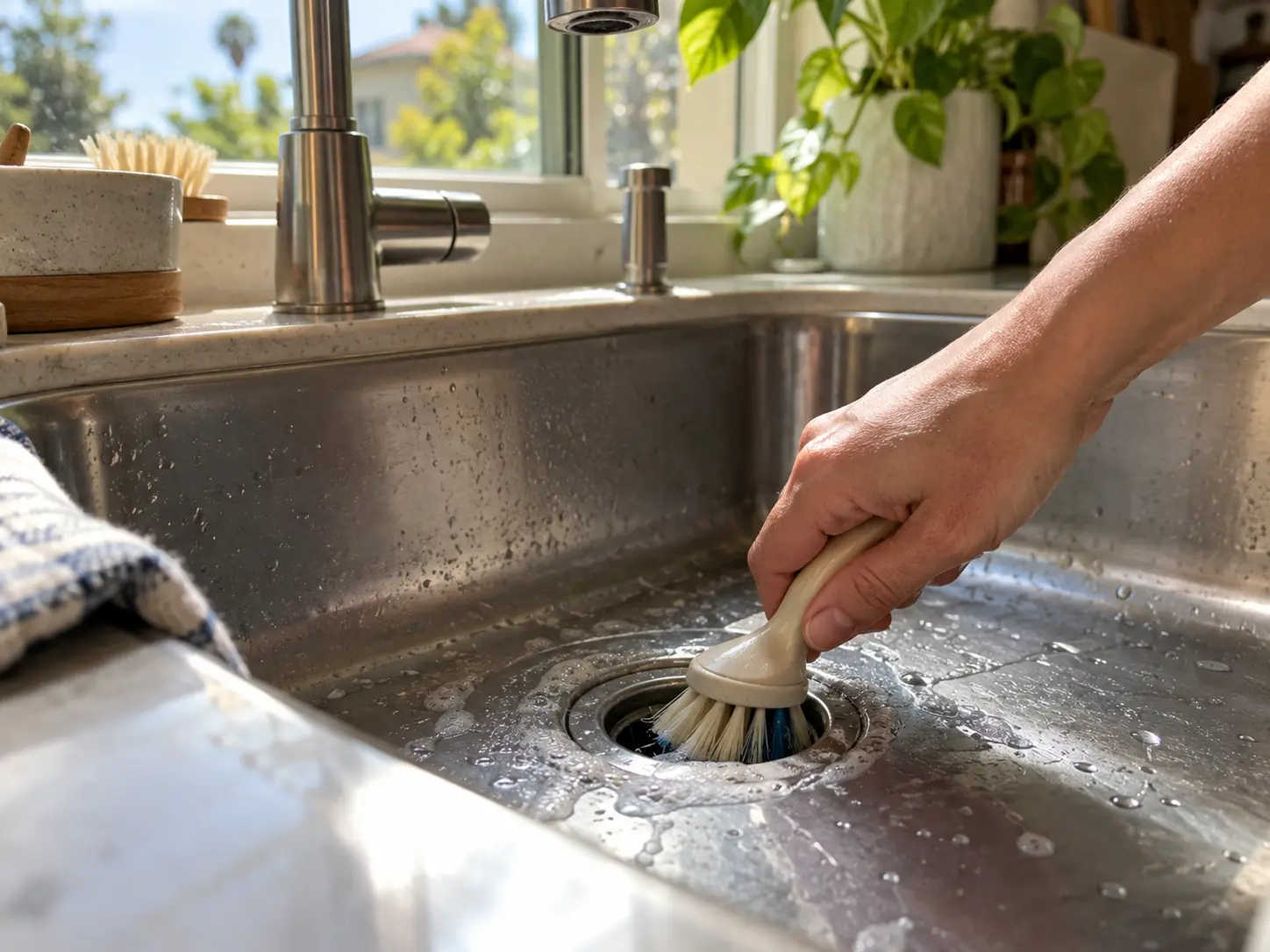
Pull out the basket strainer and stopper. Scrub with dish soap and an old toothbrush, especially the underside where slime builds up. Rinse and set aside.
Step 2: Flush with hot water and dish soap (2 minutes)
Run the hot tap for a minute to warm the pipes. Squirt a tablespoon of dish soap into the drain and run hot water for another minute. The soap lifts the grease layer coating the pipe wall.
Step 3: Scrub inside the drain opening (5 minutes)
Use a bottle brush or a dedicated drain brush to scrub the first several inches of the drain. You will likely pull up gray or brown slime. That is the source of most odors.
Step 4: Baking soda and hot water (10 minutes)
- Pour about half a cup of baking soda into the drain.
- Let it sit for 5 to 10 minutes.
- Flush with a kettle of hot (not boiling, if you have plastic pipes) tap water.
If you want extra fizz, follow the baking soda with a cup of white vinegar and cover the drain for a few minutes, then flush with hot water. The reaction produces bubbles but does not do much more than a baking soda soak. It is fine and safe on its own, so long as you have not used any drain chemicals first. The honest limits of this combination are in natural cleaning with vinegar and baking soda.
Step 5: Rinse and dry the strainer (2 minutes)
Replace the strainer and wipe the sink. Make this a regular routine.
Why this works
Odors come from bacteria feeding on food residue and grease. The soap breaks up the grease, the brush removes the film, and the baking soda neutralizes acids that cause smell. Repeated hot water flushing keeps new film from forming.
Part 2: Clean the garbage disposal
A disposal hides a lot of residue under the rubber splash guard and on the blades’ underside.
Step 1: Turn off power
Switch off the disposal at the wall, and if you can, at the breaker. Do not put your hand inside.
Step 2: Clean the splash guard (3 minutes)
The rubber flap at the top is the number one odor source. Pull it up and scrub both sides with an old toothbrush, dish soap, and hot water.
Step 3: Ice and salt (2 minutes)
- Fill the disposal with ice cubes and a handful of rock salt.
- Turn on cold water and run the disposal for 15 to 30 seconds.
The ice knocks residue off the walls. Do not use bones or hard shells as a scouring method. They can clog the unit.
Step 4: Citrus freshener (2 minutes)
Drop lemon or orange peels in and run with cold water. This freshens the air but does not clean on its own. Do the ice step first.
Step 5: Baking soda (optional)
Sprinkle baking soda into the disposal, let it sit for 10 minutes, and flush with hot water.
What not to put in a disposal
- Grease, oil, and fat (they coat pipes and cause smells)
- Coffee grounds in quantity
- Pasta, rice, potato peels (they swell)
- Fibrous vegetables like celery and corn husks
- Bones and fruit pits
- Eggshells in large amounts (their effect is debated)
- Non-food items
A good rule is to scrape plates into the trash or compost first and treat the disposal as a backup.
Part 3: Check the dishwasher link
If the smell is strongest when the dishwasher runs, the drain hose or filter is the culprit. Remove and rinse the filter, check the drain hose for kinks, and run a hot cycle with a dishwasher-safe cleaner. Check your manual for the right approach. We cover dishwasher care in a separate guide, so see how to clean a dishwasher.
Part 4: Polish a stainless steel sink
A smelly drain often comes with a dull sink. While you are scrubbing, give the basin attention.
- Rinse the sink to remove loose food.
- Sprinkle baking soda across the surface.
- Scrub with a damp non-scratch sponge, moving with the grain.
- Rinse thoroughly.
- Dry with a microfiber cloth to prevent water spots.
- For shine, buff with a cloth that has a drop of mineral oil or a stainless steel polish made for sinks.
Avoid bleach on stainless steel, since prolonged contact can pit the surface. Avoid steel wool, which leaves tiny particles that rust. For appliances and finishes, see how to clean stainless steel appliances.
Porcelain, composite, and granite composite sinks each have their own rules, so check the manufacturer’s care guide. Light baking soda scrubs are usually fine on all three.
Part 5: Clean a trash can step by step
Trash can odors persist because bags leak and liquid pools on the bottom. A fresh bag does not fix a can that already smells.
Step 1: Empty and rinse (3 minutes)
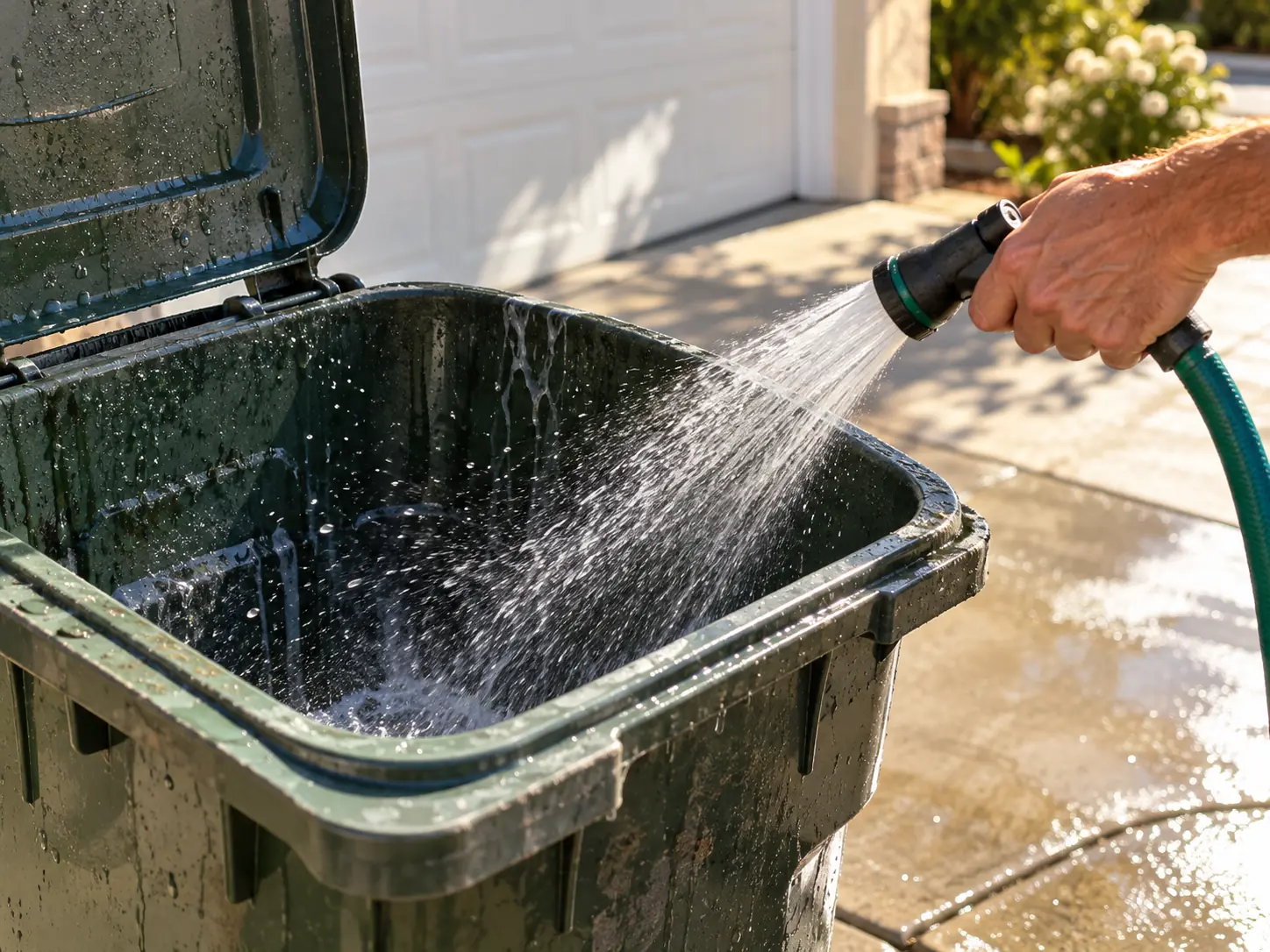
Take the can outside. Remove the bag, and spray out loose debris with a hose.
Step 2: Scrub with hot soapy water (5 minutes)
Add hot water and a few squirts of dish soap. Scrub the inside, bottom, rim, and lid with a long-handled brush. Pay attention to corners and the seam where the lid attaches.
Step 3: Disinfect (5 to 10 minutes)
Spray the inside with a disinfectant labeled for hard, non-porous surfaces. Leave it wet for the contact time on the label, which is often several minutes. Wear gloves and avoid breathing the spray.
If you prefer to avoid chemical disinfectants, a hot water rinse after a good soap scrub gets the can very clean, though it does not technically disinfect.
Step 4: Rinse (2 minutes)
Rinse inside and out with a hose. Make sure no product remains.
Step 5: Dry fully (30 to 60 minutes)
Turn the can upside down in the sun or wipe with a towel. A can that goes back in service damp breeds mold quickly.
Step 6: Deodorize
Sprinkle baking soda in the bottom of the dry can before putting in a new bag. A paper towel or newspaper at the bottom absorbs liquid. Some people add a few drops of essential oil to a cotton ball, but keep that away from pets, since certain oils can be harmful to them.
Kitchen trash can with a lid
For an indoor can, take it to the tub or outside. Scrub the lid hinge and the underside of the lid, where splatter builds. Wipe the pedal and the sides. Most stainless steel cans respond well to the same method as a sink.
Outdoor bins
Rinse them out after every pickup if you can. A weekly rinse and a monthly scrub is a good schedule. If you leave bins at the curb, hose them down after the truck leaves, because that is when residue is freshest.
Part 6: Compost bins and food scrap containers
Compost caddies smell when wet scraps sit for days. Empty every day or two, line with a compostable bag or paper, and keep the lid closed. Wash the container weekly with hot soapy water and let it air dry. A layer of dry material, like shredded paper, soaks up moisture. If you have fruit flies, a clean, covered caddy and a dry bottom stop most of them.
Part 7: Check under the sink
The cabinet below the sink can be the source of a smell that seems to come from the drain.
- Look for moisture, stains, or a swollen cabinet floor.
- Check the P-trap (the U-shaped pipe) and connections for drips.
- Remove stored items, and wipe the cabinet with soapy water.
- Keep sponges and wet cloths out of the cabinet.
- Use a small tray to catch drips.
If you find a leak, tighten the connection or call a plumber. Slow leaks cause mold, and mold smells musty rather than sour.
Troubleshooting
| Problem | Cause | Fix | When it will not work |
|---|---|---|---|
| Sour smell returns in a day | Film is deeper in the pipe | Repeat brush and soap flush, add enzyme cleaner | If it keeps returning, see a plumber |
| Rotten egg smell | Bacteria in the trap or sulfur in the water or sewer gas | Clean the drain, fill the trap with water | If several drains smell, call a plumber |
| Sink drains slowly | Clog or heavy buildup | Plunger or drain snake | Persistent clog needs a plumber |
| Gurgling noises | Venting problem | None (do not ignore) | Call a plumber |
| Disposal smells after cleaning | Residue under the baffle | Scrub the splash guard again | Worn disposals may need replacement |
| Trash can still smells after washing | Plastic has absorbed odor | Soak with baking soda and water, sun dry | Replace the can |
| Mold on the trash can lid | Moisture and food residue | Scrub with soapy water and a disinfectant | None |
| Smell only on hot water | Water heater issue | Contact a plumber | Not a cleaning problem |
Can I put baking soda and vinegar down the drain?
Yes, for light maintenance. The reaction fizzes, and that action can help loosen surface film. It will not clear a real clog, and it will not do more than a hot water and dish soap flush. Do not combine it with commercial drain cleaners, and rinse with hot water after.
Why does my kitchen sink smell like rotten eggs?
A rotten egg smell is usually hydrogen sulfide gas. It can come from bacteria growing in the drain, a dry P-trap that has lost its water seal, a problem with the water heater, or a venting issue. Start by cleaning the drain and running water. If the smell is in one drain only and clears, you had a film problem. If it appears in multiple fixtures or comes with gurgling, call a plumber.
Prevention: keep the smell from coming back
| Frequency | Task |
|---|---|
| After every use | Run water a few seconds after the disposal |
| Daily | Empty the strainer and wipe the sink dry |
| Weekly | Flush the drain with hot water and dish soap |
| Weekly | Wash the trash can lid and rim |
| Monthly | Scrub the splash guard and run ice and salt through the disposal |
| Monthly | Wash the trash can with soap and water |
| Quarterly | Enzyme cleaner in the drain, clean under the sink |
| Seasonally | Check pipes and connections |
Other habits make a difference:
- Scrape plates before rinsing.
- Never pour grease down the drain. Cool it, wipe it into the trash.
- Use a drain strainer.
- Tie trash bags tightly and take them out before they drip.
- Double-bag wet or smelly waste.
- Freeze meat scraps or fish waste until trash day.
- Use a can liner with a few extra bags at the bottom to catch spills.
Our guide to keeping the kitchen clean between cleanings pairs well with this schedule, and daily habits that cut cleaning time shows how to fit it in.
Mistakes that make it worse
- Covering the smell. Air fresheners hide the issue and let bacteria keep growing.
- Pouring bleach down the drain regularly. It can damage pipes and is dangerous if mixed with other products.
- Using chemical drain openers as maintenance. They are harsh and not for odors.
- Putting grease down the sink. It coats the pipes and feeds odor.
- Boiling water on PVC. Use hot tap water.
- Reaching into the disposal. Always cut the power and use tongs.
- Not drying the trash can. Moisture creates mold.
- Scrubbing stainless with steel wool. It leaves rust spots.
- Ignoring the sponge. A dirty sponge smells like the drain. Replace it often.
- Mixing cleaners to “boost” them. Dangerous, and rarely helpful.
Orange County angle
Many Orange County homes have hard water, and mineral scale narrows pipe walls and gives film something to hold onto. Check your local water quality report to understand yours. Warm weather speeds up bacterial growth in trash bins, so a weekly rinse in summer matters more than in cooler months. In condos and HOA communities, trash may be handled in shared enclosures, so check the rules about washing bins outdoors and where runoff goes. Condos with shared plumbing stacks can also pass smells between units, which is another reason to call a plumber or property manager when several drains smell at once.
Skip this step: A scrubbed disposal, drain, sink, and trash can is a one-hour chore if you do it in a rush and a three-hour one if you do it properly. During a deep cleaning we handle the kitchen sink area and fixtures as part of the full checklist, and recurring cleaning keeps them from getting that bad again.
When to call a professional
Call a plumber when:
- Multiple drains smell like sewage.
- Water drains slowly in more than one fixture.
- You hear gurgling.
- You see leaks under the sink.
- The smell does not go away after two cleanings.
Call a cleaning professional when the issue is built-up grime across the kitchen, you want the inside of the cabinets, the fridge, and the oven done at the same time, or you need a clean ahead of a move. A cleaning crew handles surface cleaning and fixtures. It does not repair plumbing.
When it is worth handing off: If the whole kitchen smells because several things have piled up, a one-time deep cleaning covers sinks, fixtures, and appliances. For a 2 bedroom, 1 bathroom home the formula is (60 + 50 + 35) x 1.5 = $217.50 before add-ons. Our pricing page shows your exact number in about 30 seconds.
If you are about to hand back keys, our move-out cleaning checklist covers the sink and trash areas landlords inspect.
Frequently asked questions
How do you get the smell out of a kitchen sink drain? Scrub the strainer and stopper, brush the first few inches of the drain, flush with hot water and dish soap, then pour in baking soda and flush again. Repeat weekly.
Why does my kitchen sink smell like rotten eggs? Bacteria growing on food film in the drain is the common cause. A dry trap or a plumbing or venting problem can also create the smell. If several drains smell or the sink gurgles, call a plumber.
How do you clean a smelly trash can? Rinse it, scrub with hot soapy water including the lid and bottom, disinfect following the label, rinse, and let it dry completely. Put baking soda in the bottom before adding a new bag.
Can you put baking soda and vinegar down the drain? Yes, as a light maintenance step. It does not unclog a pipe. Flush with hot water after and never combine with commercial drain cleaners or bleach.
How do I clean a garbage disposal? Turn it off, scrub the rubber splash guard, run ice and rock salt with cold water for 15 to 30 seconds, then run citrus peels for freshness. Never put your hand inside.
Is bleach safe to use down the drain? It is not a good habit. It can damage pipes and cause dangerous gases if mixed with other products. Skip it for routine odor.
How often should I clean my trash can? Rinse weekly, and scrub with soap monthly, more often in summer or if the bag leaks.
How do I stop my kitchen trash can from smelling? Take out the trash often, double-bag wet waste, keep the bottom dry, and clean the can regularly. Put baking soda or a piece of newspaper at the bottom.
Can boiling water clear a smelly drain? Hot tap water is usually enough. Boiling water can soften or loosen some plastic pipes, so use hot, not boiling, if you have PVC.
Why does my sink smell worse after cleaning? Cleaning can stir up old film. Rinse well, repeat, and check the trap and under the sink for leaks.
Next step
If you would like the kitchen done properly without giving up your weekend, see deep cleaning and get an instant quote at our pricing page. Our crews are dispatched from Irvine to all of Orange County, including Irvine.