Care Habits
How to Clean Laminate and Vinyl Plank Floors Without Warping
Clean laminate and vinyl plank floors by sweeping or vacuuming first, then using a well-wrung microfiber mop with a pH-neutral cleaner. Keep water to a minimum, dry any wet spot right away, and never use a steam mop, wax, or oil soap. Laminate is the more water-sensitive of the two, so treat its seams like a place water must not reach.
Most of the damage on these floors comes from three things: standing water working into seams, grit that scratches the surface like sandpaper, and cleaner residue that builds into a dull haze. All three are avoidable. This guide explains how laminate and vinyl differ, how to clean each one step by step, and how to fix a floor that already looks cloudy or streaky.
Quick answer
- Time: 15 minutes to dry clean a main living area, plus 20 to 30 minutes to damp mop.
- Difficulty: Easy. The skill is using less water than your instinct says.
- Cost of supplies: Low. A microfiber flat mop, a vacuum with a hard floor setting, and a pH-neutral floor cleaner cover almost every home.
- How often: Sweep or vacuum weekly (daily in entryways and with pets). Damp mop every 1 to 4 weeks depending on traffic.
- Skip this if: Your floor is unfinished or is a different material, such as real hardwood. See our hardwood floor guide instead.
Laminate and vinyl plank are not the same thing
They look alike, and many people use the names interchangeably. They are built differently, and that changes how much water they can take.
| Laminate | Vinyl plank (LVP, LVT, luxury vinyl) | |
|---|---|---|
| What it is | A fiberboard core (compressed wood fibers) with a printed photo layer and a clear wear layer on top | Layers of vinyl (PVC) with a printed layer and a clear wear layer. Some have a rigid core, some a flexible one |
| Water tolerance | Low at the seams. The core can swell if water gets in | Higher. The material itself is water-resistant, but water can still seep under the edges and get trapped |
| Common failure | Swollen, puffy, or lifted edges. Chipped corners | Dull haze, scuffs, yellowing under rubber mats, gaps if water gets under |
| Main enemy | Standing water, steam, harsh scrubbing | Residue, abrasive scrubbing, rubber backing, grit |
| Can it be refinished? | No | No |
“Water-resistant” and “waterproof” are marketing terms, and they do not always mean the same thing. A vinyl floor can be waterproof on top and still have seams where water seeps underneath. Check your product literature or manufacturer website, which often lists approved cleaners and sets warranty rules.
Not sure which one you have? Look at a plank edge in a doorway or at a transition strip. A brown, wood-fiber-looking edge points to laminate. A plastic-looking or layered edge points to vinyl. If you cannot tell, treat it as laminate, which is the safer, drier method.
What you need
| Item | What it does | Notes |
|---|---|---|
| Soft broom or dust mop | Picks up loose dust and grit | Avoid stiff bristles that can scratch |
| Vacuum with a hard floor setting | Pulls grit out of seams | Turn the beater bar or brush roll off. A rotating brush can scratch |
| Microfiber flat mop with washable pads | Cleans with little water | Have at least two pads so you can swap them |
| Spray bottle | Lets you control how much liquid goes on the floor | A mop that sprays is fine too, as long as you control the amount |
| pH-neutral floor cleaner for laminate or vinyl | Dissolves everyday soil without leaving a film | Read the label. A neutral cleaner is not an alkaline or acidic one |
| Dish soap (plain, no added bleach) | Small-batch DIY cleaner | A few drops in a spray bottle of water, not a squirt |
| Clean dry microfiber cloths | For wiping spills and drying | Keep a few separate from kitchen cloths |
| Felt pads for furniture legs | Prevent scratches | Replace them when they wear down or collect grit |
| Entry mats (non-rubber backing) | Catch grit before it reaches the floor | Rubber or latex backings can stain vinyl |
Do not use: steam mops, wax, polish, “shine” products, oil soaps, ammonia, bleach, abrasive powders, steel wool, or scrub pads. We explain why below.
Safety first
- Slip risk: a damp floor is slippery. Mop in sections and keep kids and pets off until it is dry. Be extra careful with polished or glossy surfaces.
- Never mix cleaning products. Using vinegar with bleach, or bleach with ammonia, can create dangerous fumes. Our post on cleaning products you should never mix lists the pairs.
- Test any new product in a hidden spot, such as inside a closet or under a heater, and wait until it dries before judging it.
- Check the manufacturer’s care guide, which can list approved products. Some warranties state that unapproved cleaners can void coverage.
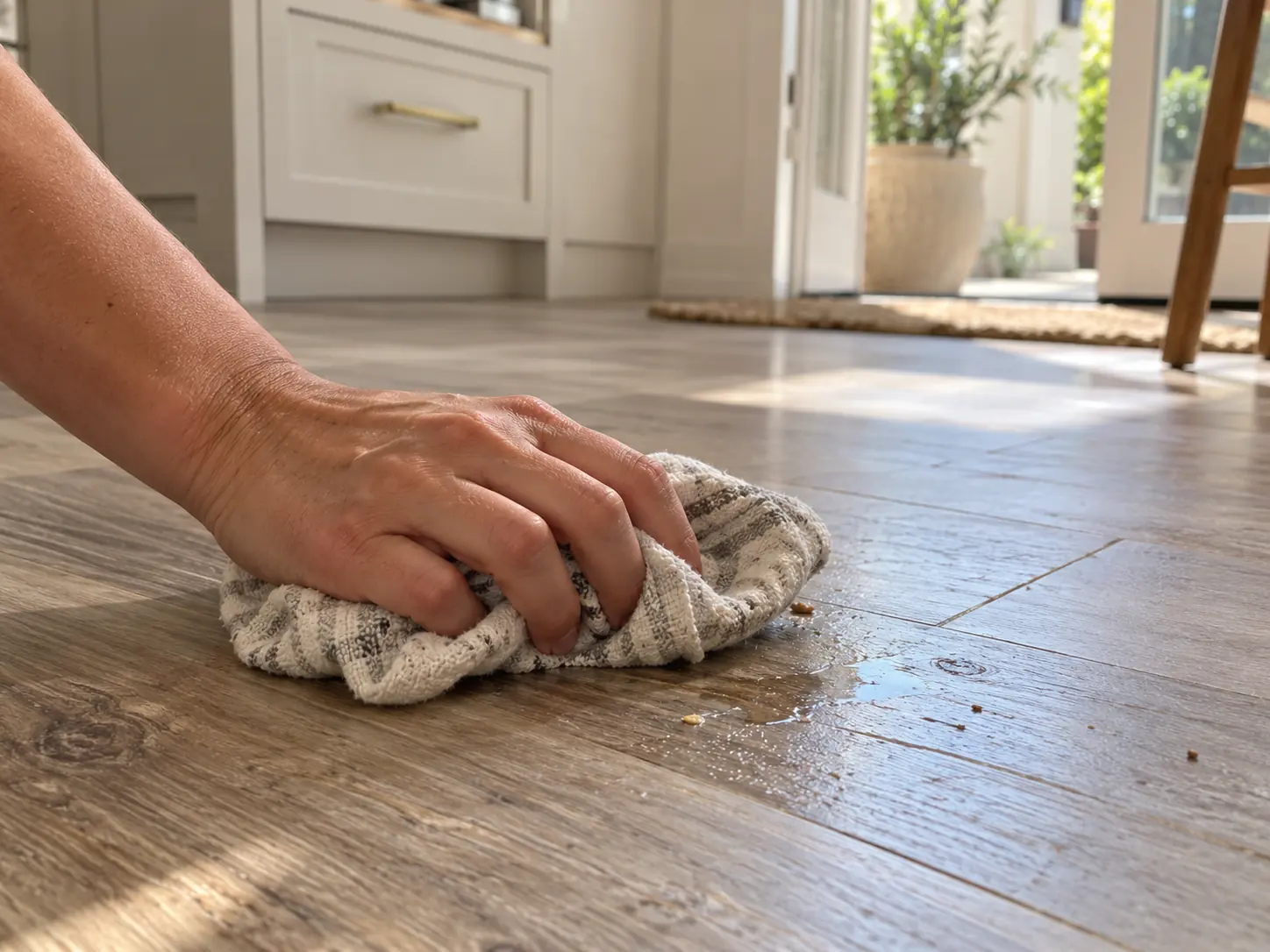
- If water has soaked a laminate floor or is trapped under vinyl, stop, mop up what you can, and read the water damage section below.
Why steam mops are a bad idea here
Steam mops push hot water vapor into seams. On laminate, that can swell the fiberboard core. On vinyl, the heat can soften the adhesive or loosen planks, and trapped moisture can create mold or odor underneath. Many flooring manufacturers specifically say not to use steam on these floors. Because the risk depends on the product, the safest answer is that you should not use one unless your manufacturer’s instructions say otherwise.
Step by step: routine cleaning
Step 1: Remove loose dirt (10 to 15 minutes)
Grit acts like sandpaper under shoes. Dry clean first, every time.
- Move light furniture and chairs, or lift them rather than dragging.
- Dust mop or sweep in the direction of the planks.
- Vacuum with the hard floor setting and no beater bar. Run the nozzle along baseboards and seams.
- Wipe any visibly sticky spots with a dry cloth to make the mop’s job easier.
Why this matters: if you wet mop a floor that is still gritty, you rub the grit across the surface and dull the wear layer.
Step 2: Mix a simple cleaner (2 minutes)
Pick one of these.
- Commercial pH-neutral cleaner for laminate or vinyl, diluted exactly as the label says. This is the easiest choice.
- DIY dish soap solution: about 1 quart (roughly 1 liter) of warm water with a few drops of plain dish soap. More soap does not clean better and leaves residue.
- Plain water for light dust films. Often enough for floors that are cleaned weekly.
Vinegar is sometimes recommended, but it is acidic and can dull some finishes over time, so only use a heavily diluted version if your manufacturer approves it. If you are unsure, skip it. Our vinegar and baking soda guide explains where vinegar works and where it does not.
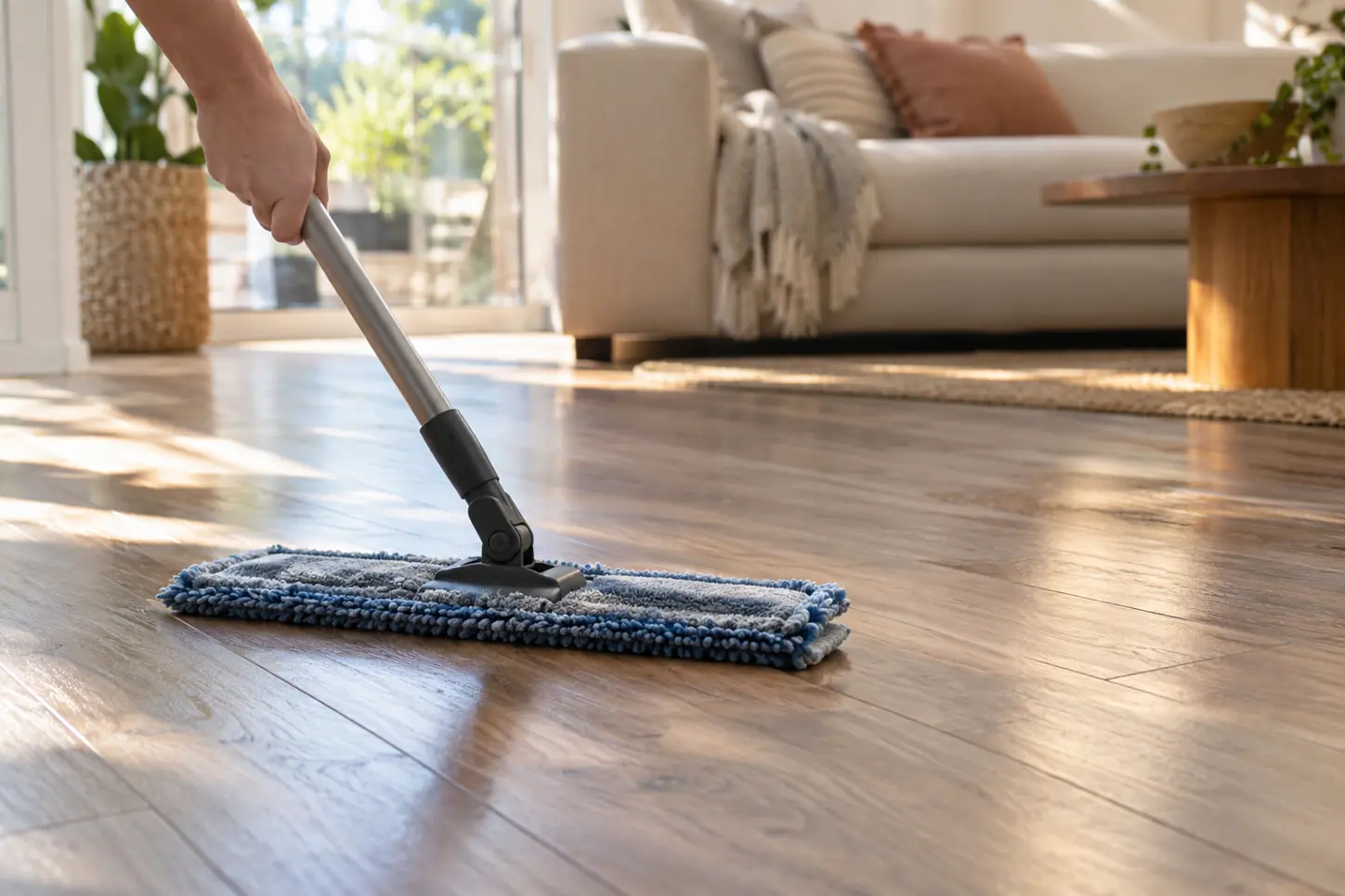
Step 3: Mop section by section (20 to 30 minutes)
- Lightly mist the floor in a section about 4 by 4 feet, or mist the microfiber pad directly. The floor should look damp for a moment, not wet.
- Mop along the length of the planks, not across them, and use long overlapping strokes.
- Rinse or swap the pad when it looks gray. A dirty pad moves dirt around.
- Immediately follow with a dry microfiber pad or a dry towel on sections near seams, doors, and kitchen sinks.
- Open windows or run a fan to speed drying.
Why wring it out: laminate swells from water in the seams, and vinyl can trap water under the edges. A mop that is “barely damp” has no drips and leaves a thin sheen that disappears in under a minute.
Step 4: Spot-clean after (5 minutes)
Look at the floor from a low angle with the light behind you. Streaks and shiny patches show up best that way. Go over them with a clean, slightly damp cloth, then buff dry.
Laminate-specific rules
- Seams are the weak point. Mop only as wet as the sponge you can wring out until it stops dripping.
- Dry spills right away, especially near dishwashers, refrigerators with water lines, sinks, and entry doors.
- Do not scrub. Laminate has a thin printed layer that can wear through with a rough pad.
- Do not polish or wax. It makes the floor look streaky and nothing bonds to it well.
- Use a laminate-specific cleaner if you want something labeled for the job.
- Mop in the direction of the planks so liquid does not push into the cross-joints.
Vinyl-specific rules
- Vinyl tolerates more moisture than laminate, but still avoid pooling water, especially on floating (click-lock) planks. Water can go under the edges, so do not flood the floor.
- Avoid rubber-backed mats. Some rubber backings can cause yellow or brown stains on vinyl over time, which can be permanent. Use mats labeled safe for vinyl.
- Skip abrasive tools like scouring pads. They dull the wear layer.
- Heat matters. Strong sun through a large window or door can fade or warp some vinyl. Close blinds during peak sun, or use a UV-filtering film if the manufacturer recommends it. Check your product guide.
- Do not use paste wax or oil-based polishes. They leave a film that attracts dirt.
Stain and scuff removal
Test any method on a hidden spot first and let it dry.
| Problem | What to try | Avoid |
|---|---|---|
| Scuff marks (rubber heels, furniture) | Dry microfiber, then a damp cloth with a drop of dish soap. A clean white rubber eraser can lift some scuffs | Abrasive pads or powders |
| Grease or cooking oil | Dish soap in warm water on a cloth, then wipe with a clean damp cloth | Letting it soak in |
| Dried food or gum | Harden gum with an ice cube in a bag, then lift with a plastic scraper or old credit card | Metal scrapers or knives |
| Marker or ink | Test isopropyl alcohol on a hidden spot, then dab a cotton ball on the mark, wipe clean | Soaking the area |
| Nail polish | Check the manufacturer. Some suggest a small amount of non-acetone remover on a cloth, dabbed briefly | Leaving remover on, which can damage the surface |
| Pet urine | Blot immediately, clean with an enzyme-based cleaner labeled safe for the floor, dry fully | Letting it sit, which can seep into seams |
| Heavy mud | Let it dry, vacuum, then damp wipe | Scrubbing wet mud into the surface |
| Hard water spots | Wipe with a damp cloth and dry immediately | Acidic cleaners without approval |
| Tire or rubber mark | Try an eraser or dish soap first | Solvents that can discolor vinyl |
Fixing a dull, hazy, or streaky floor
If your floor looks cloudy even after cleaning, the likely cause is residue: too much soap, a product with wax or polish, or hard water minerals left behind.
- Vacuum or sweep.
- Mop with plain warm water (no soap) using a clean, damp microfiber pad.
- Buff dry with a clean microfiber cloth right away.
- Repeat once or twice. Haze from residue often fades in a few passes.
- If that does not work, try a cleaner from the flooring manufacturer, or a pH-neutral cleaner at the exact label dilution.
Wax and polish haze can be harder. Floors with real wear damage, such as a scratched or worn-through wear layer, cannot be fixed with cleaning. Some brands sell touch-up kits. Ask your flooring retailer.
Streaks
Streaks usually come from too much cleaner, a dirty pad, or air drying. Use less cleaner, switch to a fresh pad, and buff dry. Mopping with slightly warm water also helps a cleaner evaporate more evenly.
Water damage: what to do if water got in
Water is the main way laminate fails. Fast action helps.
- Stop the source of water if you can.
- Soak up standing water with towels. Press, do not rub.
- Lift rugs and mats off the area.
- Run fans and, if you have one, a dehumidifier to help dry the room.
- Look for puffy, lifted, or peeling edges. Swollen laminate usually does not return to normal shape.
- If water got under the floor, or you see mold, smell mustiness, or the area is large, call a flooring or water damage professional. We do not repair floors or do water extraction.
If a spill dries quickly and you see no swelling after a day or two, the floor may be fine. A manufacturer or flooring retailer can tell you more about your specific product.
Mistakes that damage these floors
- Using a steam mop. Fix: use a damp microfiber mop only.
- Soaking the mop. Fix: wring it out until it does not drip.
- Using too much cleaner. Fix: follow the dilution on the bottle. More is not better.
- Using wax, polish, or oil soap. Fix: stop, and strip the film with plain water passes.
- Dragging furniture. Fix: lift it, or use furniture sliders and felt pads.
- Sweeping with a stiff, dirty broom. Fix: soft broom or dust mop, washed regularly.
- Leaving pet accidents. Fix: blot right away and use an enzyme cleaner approved for the floor.
- Using a vacuum with a spinning brush. Fix: turn the brush off, or use the hard floor setting.
- Using rubber-backed mats on vinyl. Fix: look for vinyl-safe mats.
- Ignoring the manufacturer’s guide. Fix: find it. It is the final word for your floor.
Products compared
| Type | Best for | Avoid on | Notes |
|---|---|---|---|
| pH-neutral floor cleaner (laminate or vinyl) | Routine cleaning | Nothing in normal use | Look for “no wax, no polish” on the label |
| Plain water and microfiber | Light dust, weekly upkeep | Heavy grease | Best for avoiding residue |
| Dish soap solution (a few drops) | Grease, sticky spots | Over-use | Rinse by wiping with a clean damp pad |
| Vinegar solution | Only if the manufacturer approves | Floors with warranties that prohibit it | Acid can dull some finishes |
| Enzyme cleaner | Pet urine and organic stains | Soaking | Check label for floor safety |
| Steam mop | Not recommended | Both floors | Heat and moisture risk |
| Wax, polish, shine sprays | Not recommended | Both floors | Leave a film |
| Ammonia or bleach products | Not recommended | Both floors | Can discolor and damage the surface |
Keeping them clean: a simple schedule
| How often | What |
|---|---|
| Daily | Wipe up spills right away. Quick sweep of entry and kitchen |
| Weekly | Vacuum with hard floor setting or dust mop all floors |
| Every 1 to 4 weeks | Damp mop with pH-neutral cleaner (more often in kitchens and with pets) |
| Monthly | Wash mop pads. Check felt pads on furniture. Wash entry mats |
| Quarterly | Check seams near sinks, dishwashers, and doors for moisture or lifting |
| Yearly | Review the manufacturer’s care guide. Consider whether climate or sun is affecting the floor |
For routines that span the whole house, see our weekly house cleaning checklist and our post on how to clean a house fast.
The Orange County angle
Fine dust, sand, and grit travel indoors easily in Southern California, especially in homes near beaches, trails, and construction. That grit is the biggest scratch risk to these floors, which is why an entry mat and shoes-off habit pay off. If you live near the coast, salty air and sandy shoes make the dry-clean step even more important.
Many homes here also have hard water. Mineral residue can show up as dull spots or streaks, especially when you let a cleaner air dry. Check your local water quality report if you want to know your hardness. Buffing the floor dry with microfiber after mopping reduces spotting.
Large windows and sunny exposures are common, so rooms with strong afternoon sun may fade rugs and floors faster. Blinds or window film can help, as long as they do not conflict with your manufacturer’s guidance. Also, many Orange County condos and apartments have flooring rules from the HOA, building, or lease, including approved underlayment and cleaning methods. Check yours before changing your routine. If you rent and are moving out, our guide to security deposits and move-out cleaning in California explains what landlords look for.
When to call a professional
You can handle routine cleaning, spot cleaning, and haze removal at home. Call a flooring professional for swollen or lifting planks, water under the floor, mold, and deep scratches or gouges. A flooring pro can replace individual planks in many floating floors.
We handle the routine side. A recurring cleaning plan can keep floors dry-dusted and damp mopped as part of each visit, and a deep clean covers baseboards, edges, and corners that are easy to miss. Tell us you have laminate or vinyl when you book so the crew knows to keep the mop damp and skip steam. As an example of our formula, a 2 bedroom, 1 bathroom home is (60 + 50 + 35) = $145 for a standard recurring clean before any frequency discount, and biweekly service takes 15% off, so $145 less $21.75 is $123.25. Get your exact number with the instant quote.
Frequently asked questions
Can I use vinegar on laminate or vinyl plank floors? Many people do, but it is not risk-free. Vinegar is acidic and can dull some finishes over time. Check your manufacturer’s guide, and if you use it, dilute it heavily and wipe the floor dry. A pH-neutral cleaner is the safer default.
Can I use a steam mop on vinyl plank or laminate? We recommend not to. Steam and hot moisture can push into seams, swell laminate, and loosen vinyl. Most manufacturers advise against it.
How often should I mop laminate or vinyl floors? Every 1 to 4 weeks, depending on traffic, with weekly sweeping or vacuuming in between. Kitchens and entryways need it more often than bedrooms.
Why does my floor look cloudy after I mop? Usually residue from too much cleaner, a wax or polish product, or minerals in the water. Mop with plain water and a clean pad, then buff dry. Use less product next time.
What is the best cleaner for laminate floors? A pH-neutral cleaner made for laminate, used at the label dilution. A few drops of plain dish soap in water also works for light cleaning. Avoid wax, polish, oil soap, and abrasive products.
Is Swiffer or a spray mop okay on laminate? A damp, well-controlled mop is fine. The question is how much liquid it leaves. Spray lightly, mop along the planks, and dry any wet spots. Read the cleaner’s label to be sure it is safe for your floor.
Can water ruin vinyl plank flooring? The vinyl itself resists water, but water can get under planks at the edges and cause problems below. Mop lightly and dry spills fast. A floor labeled waterproof is more forgiving, but not a reason to flood it.
How do I get scuff marks off vinyl? Try a dry microfiber cloth, then a damp one with a drop of dish soap. A white rubber eraser can also lift scuffs. Avoid abrasive pads.
Can I use a vacuum with a beater bar? Turn the beater bar off or use a hard floor setting. A spinning brush can scratch the surface.
What should I do if laminate swells after a spill? Dry the area quickly, run fans, and watch it for a few days. Swollen edges often stay swollen. If the area is large or water got underneath, talk to a flooring professional. See also how this fits into your routine in how often you should clean everything.