Eco Natural
How to Clean an Oven Naturally: Natural and Chemical Methods Compared
The gentlest way to clean an oven is a baking soda paste spread inside the cool oven, left for 8 to 12 hours, then wiped out with a damp cloth and a spritz of vinegar to lift the residue. It takes about 20 minutes of hands-on work, plus the waiting time. For thick, burnt-on carbon, a commercial oven cleaner works faster, but it needs more safety care and does not suit every oven.
This guide compares the natural method, the steam method, the self-clean cycle and a commercial cleaner. It also covers the racks, the door glass and the stubborn black layer that most advice glosses over, so you can pick what fits your oven and your tolerance for fumes.
Quick answer
- Time: 20 to 40 minutes of work, plus 8 to 12 hours of waiting for the baking soda method (or 30 to 60 minutes for steam).
- Difficulty: Moderate. Racks and thick carbon are the hard parts.
- Cost of supplies: Low. Baking soda, water, vinegar, a spray bottle, a plastic scraper and cloths.
- How often: Every 3 to 6 months for a typical household, plus a wipe after any big spill.
- Skip this if: You already ran the self-clean cycle recently and the oven looks fine.
Which method fits your oven
Ovens differ. Check your manual first, because a method that works on one oven can harm another.
| Oven type | Natural paste | Steam | Self-clean cycle | Commercial cleaner |
|---|---|---|---|---|
| Standard (manual clean) | Yes | Yes | Not available | Yes, if the label allows |
| Self-cleaning (high-heat pyrolytic) | Yes, before or instead of the cycle | Yes | Yes, but wipe loose debris first | Usually no. Many makers say do not use it |
| Steam-clean or aqua-lift | Yes | Built-in setting | Not applicable | Usually not recommended |
| Continuous-clean (catalytic liner) | Not on the liner walls | Gentle | Not applicable | No. Can damage the coating |
| Convection | Yes | Yes | Check manual | Check manual; avoid the fan area |
| Gas oven | Yes (avoid the pilot and burner openings) | Yes | Check manual | Keep it away from the burner and igniter |
| Electric oven | Yes (avoid the heating element) | Yes | Check manual | Keep it off the elements |
If your manual is lost, search for the model number on the maker’s website. The model plate is usually inside the oven door frame or along the edge of the oven.
Safety first
- Ventilate. Open a window and run the range hood. This matters for the self-clean cycle and for any chemical product.
- Never mix cleaners. Do not use vinegar with a commercial oven cleaner, and never combine bleach with ammonia or acids. Our guide on cleaning products you should never mix has the list.
- Let the oven cool. Start only when it is cold to the touch, except for the self-clean cycle.
- Wear gloves and eye protection. Oven cleaner is caustic, and even baking soda paste irritates cracked skin.
- Protect your pets. Fumes from the self-clean cycle can be harmful to birds in particular, because of coatings on non-stick cookware and oven surfaces. Move birds to another part of the home, ideally another room with a closed door and fresh air, and keep other pets out of the kitchen.
- Keep kids out of the room during chemical cleaning and self-clean.
- Disconnect or turn off gas and power where the manual advises, and never spray any liquid onto a heating element, igniter, thermostat bulb or fan opening.
- Do not use aerosol cleaner on a warm surface. It can fume or flare.
What you need
| Item | What it does | Notes |
|---|---|---|
| Baking soda | Mild alkali that loosens grease and carbon | Plain baking soda, not washing soda |
| Water in a spray bottle | Keeps the paste damp | Plain water is fine |
| White vinegar in a spray bottle | Reacts with baking soda to lift residue; cuts film | Use it only on the paste, not with oven cleaner |
| Dish soap | Cuts grease on racks and glass | A few drops in hot water |
| Plastic or silicone scraper | Lifts softened carbon without scratching | Never use metal on enamel or glass |
| Non-scratch sponge or scrubber | Gentle scrubbing | Avoid steel wool on enamel |
| Microfiber cloths | Wipe and rinse | Keep a stack handy |
| Old towels or a plastic sheet | Protect the floor and the open door | Oven cleaner and paste drip |
| Bucket or bathtub | Soaks racks | A large trash bag in the tub works for oversized racks |
| Rubber gloves | Protect skin | Chemical resistant for commercial cleaner |
| Citric acid or oxygen bleach powder | Optional for racks and stubborn film | Separate from vinegar and other acids |
Do not use: steel wool or hard pads on enamel or glass, aerosol oven cleaner on a self-cleaning or continuous-clean oven unless the manual allows it, or any cleaner on the heating element or the gas igniter.
Method 1: Baking soda paste (the natural method)
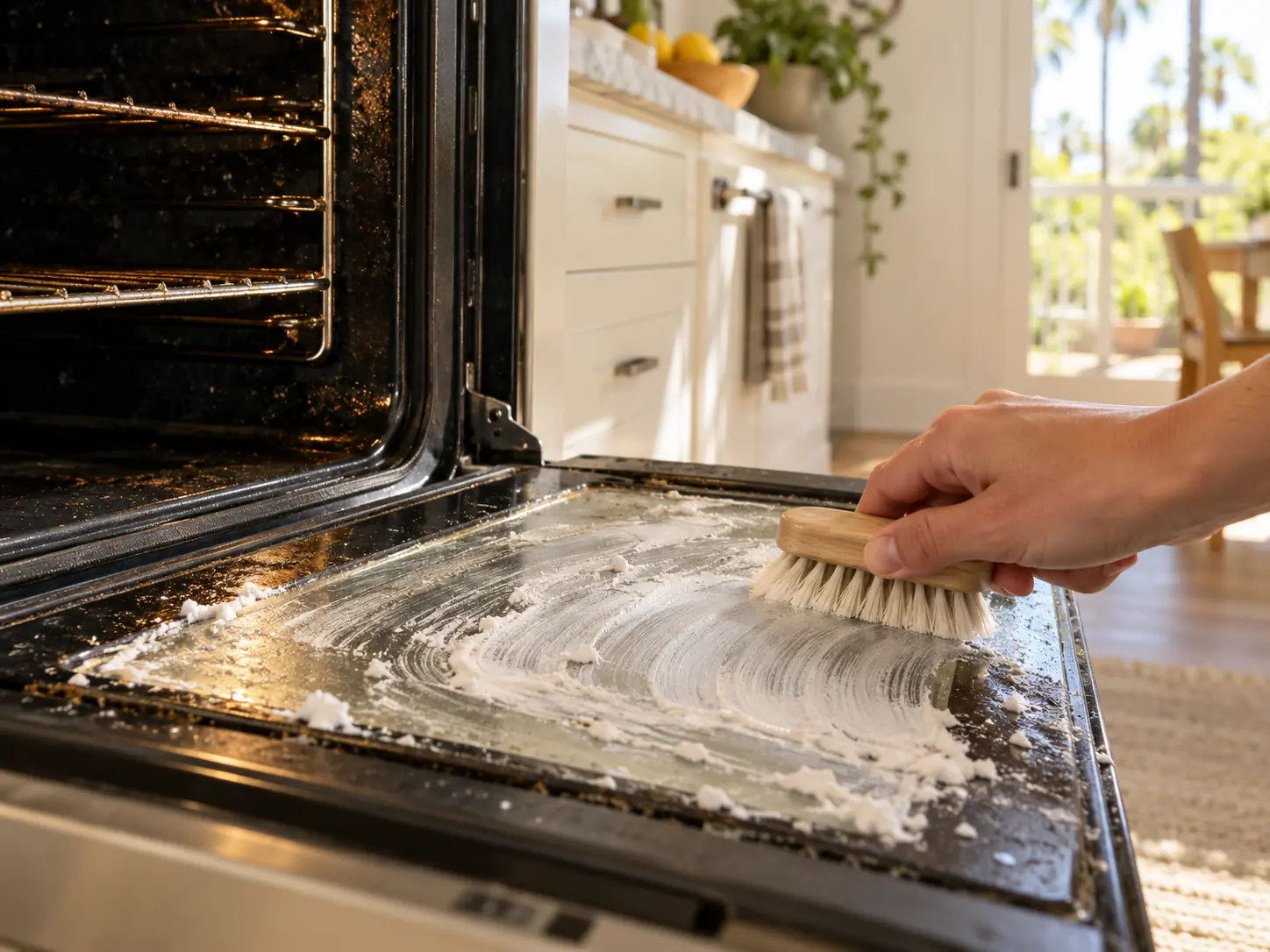
This is the standard approach for a manual-clean or self-cleaning oven. It is slow but gentle, with almost no smell.
What it needs
- 1/2 cup baking soda
- 2 to 3 tablespoons water (adjust for a spreadable paste)
- White vinegar in a spray bottle
- Scraper, cloths, gloves
Steps
1. Prepare the oven (10 minutes). Make sure the oven is cold. Take out the racks, thermometer, pizza stone and anything else loose. Lay a towel on the floor in front of the door. Scoop out loose crumbs and ash with a dry cloth or a handheld vacuum.
2. Mix the paste (2 minutes). Stir the baking soda and water until you have a thick, spreadable paste, roughly the texture of wet sand or frosting. Add a few drops of water at a time. Too wet and it runs. Too dry and it will not stick.
3. Spread the paste (10 minutes). Wearing gloves, coat the inside surfaces: floor, walls, back, ceiling and the inside of the door. Focus on greasy and burnt areas. Avoid the heating elements, gas igniter, gas openings, fan vents and any exposed sensors. Do not worry if it looks messy. Coat the greasiest spots more heavily.
4. Wait (8 to 12 hours). Leave it overnight. The paste dries into a crust and loosens grease. For light dirt, 2 to 3 hours helps.
5. Wipe out the paste (10 to 15 minutes). Use a damp cloth to remove the paste, working from the top down. Use the scraper on thick or stubborn spots, gently and flat against the surface.
6. Spritz with vinegar (3 minutes). Spray vinegar on any remaining white residue. It will fizz. Wipe with a damp cloth. Repeat until no white film remains.
7. Final rinse (5 minutes). Wipe with a clean damp cloth, then a dry one. Leave the door open to air out. Replace the racks.
Why this works: baking soda is mildly alkaline, which breaks down fats, and it has a gentle abrasive texture. Time does most of the work, which is why overnight beats scrubbing hard for an hour.
How long should baking soda sit in an oven?
Overnight (8 to 12 hours) is the usual guidance for heavy grease. For a light clean, 2 to 4 hours is often enough. Longer is not harmful, as long as the paste stays out of the elements and openings.
Can you use baking soda and vinegar together?
Yes, but in sequence, not mixed in a bowl. The fizzing between them helps lift loose residue from the surface, but the mixture itself neutralizes both and loses cleaning power. Use baking soda first, then vinegar as a rinse.
Method 2: Steam clean (light dirt, fast)
If the oven is only lightly soiled, steam loosens grease with little effort.
- Fill an oven-safe dish with water and a few tablespoons of vinegar or a few slices of lemon.
- Place it on the center rack.
- Heat the oven to about 250 degrees Fahrenheit (120 degrees Celsius), or the temperature your manual suggests for steam cleaning.
- Let it run for 20 to 30 minutes.
- Turn it off, let it cool until it is safe to touch, and open the door.
- Wipe the surfaces with a damp cloth. The softened grease should come off easily.
If your oven has its own steam-clean or aqua-lift setting, use that instead, since it is designed for the job. Follow the maker’s directions for water amounts.
When it works: fresh spills, thin grease, a quick refresh. When it will not work: baked-on black carbon. Steam softens, but it does not dissolve heavy build-up.
Method 3: The self-clean cycle
Self-clean heats the oven to a very high temperature, often around 800 to 900 degrees Fahrenheit, to burn residue to ash. It is convenient but has downsides.
How to use it more safely
- Read the manual. Some makers say to remove the racks, and some say they can stay, but enameled racks may lose their shine and slide poorly.
- Wipe up loose debris and large spills first. Heavy grease can smoke or even ignite.
- Ventilate the kitchen and run the hood fan.
- Move birds and sensitive pets to another part of the house, away from the kitchen, before you start.
- Set the cycle (often 2 to 4 hours) and keep an eye on the oven.
- After the oven cools and the door unlocks, wipe the ash with a damp cloth.
The case against relying on it
- The high heat can stress electronic controls and door latches. Repairs after self-clean are not rare.
- It can create smoke and fumes.
- It does not clean the oven door glass between the panes or the area outside the cleaning cavity.
- Racks left inside may discolor.
Many people use self-clean once or twice a year and the baking soda method in between. If your oven came with a lot of burned-on grease, scrape the worst before the cycle starts.
Method 4: Commercial oven cleaner
Commercial oven cleaners are usually strongly alkaline (often sodium hydroxide, also called lye). They dissolve grease and carbon quickly, but they are harsh.
When to choose it
- Heavy, burnt-on carbon that baking soda and steam did not remove
- A standard (manual-clean) oven whose maker allows it
- You can ventilate well and keep pets and children away
When not to choose it
- Self-cleaning or continuous-clean ovens, unless the label and manual both say it is safe
- Ovens with aluminum parts or racks. Lye can pit aluminum.
- If you cannot ventilate the kitchen
- If you have birds, or asthma and respiratory sensitivity
How to use it
- Read the label and follow it exactly. Directions vary.
- Wear chemical-resistant gloves, eye protection and long sleeves.
- Open windows and turn on the hood fan.
- Cover the floor with towels.
- Apply according to the label, avoiding the elements, igniter, fan and gaskets.
- Wait the stated time, usually 20 to 60 minutes for foam products or longer for others.
- Wipe with damp cloths, rinsing the cloth often. Residue can bake on and smoke the next time you heat the oven.
- Rinse well. Many makers suggest wiping two or three times with clean water.
- Leave the oven door open to air out before use.
Do not use vinegar, bleach or other cleaners on the same surface. Mixing can cause harmful reactions. If you want a gentler product, look for oven cleaners labeled “fume-free” or “low odor,” and compare their ingredients with your oven’s manual.
Methods compared
| Method | Hands-on time | Waiting time | Effort | Smell | Risk to oven | Best for |
|---|---|---|---|---|---|---|
| Baking soda paste | 30 minutes | 8 to 12 hours | Moderate | Very low | Very low | Routine cleaning, fume-sensitive households |
| Steam | 15 minutes | 20 to 30 minutes | Low | Low | Very low | Light dirt, quick refresh |
| Self-clean cycle | 10 minutes | 2 to 4 hours | Low | High (smoke, burnt smell) | Moderate (electronics, racks) | Heavy build-up if the manual supports it |
| Commercial cleaner | 20 to 30 minutes | 20 to 60 minutes | Low to moderate | High | Moderate (if misused) | Thick carbon on standard ovens |
| Professional clean | None | Scheduled | None | Low | Low | Heavy buildup, move-out, time-limited |
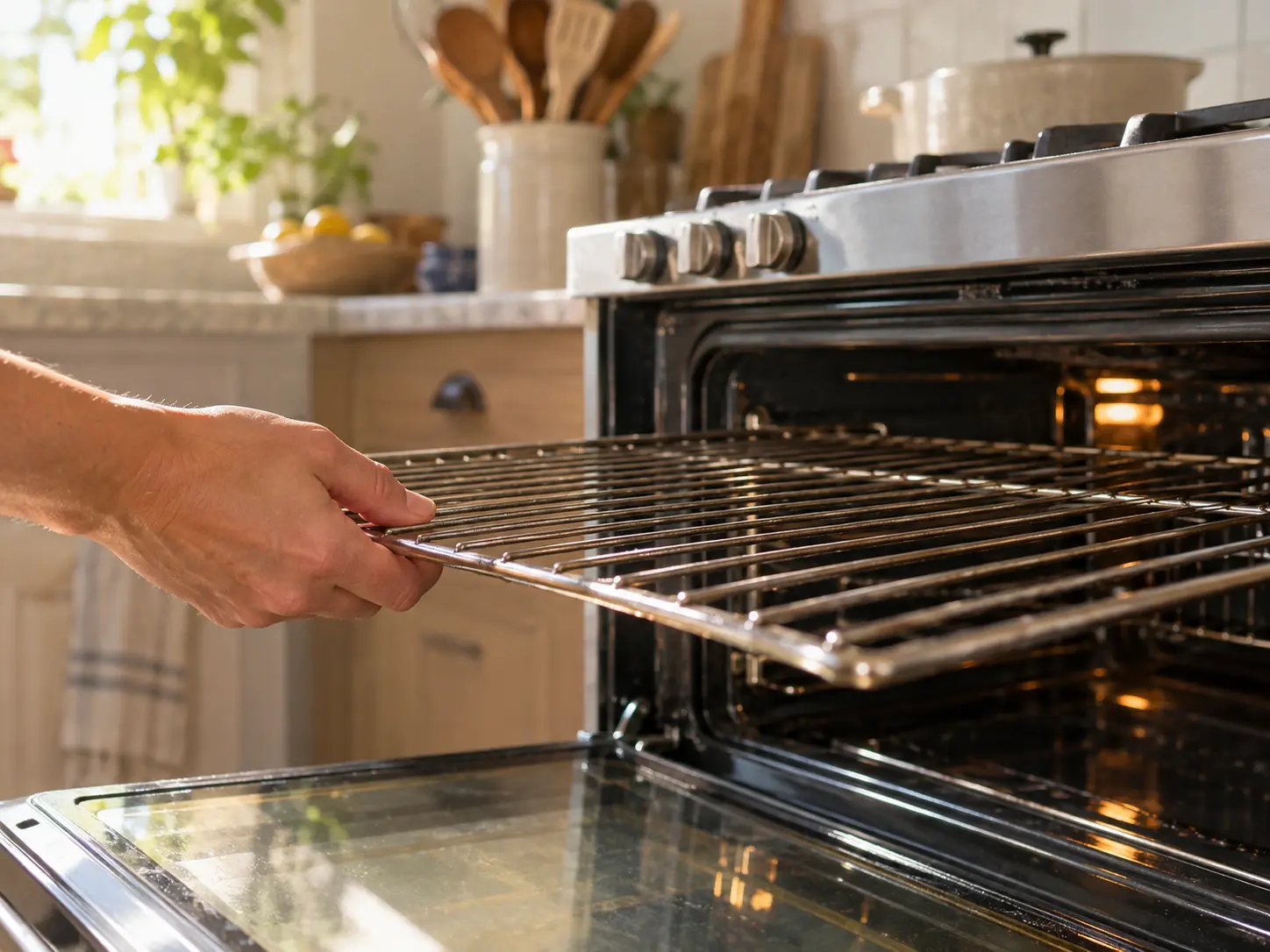
Oven racks
Racks are usually the hardest part, and most advice glosses over them.
Option 1: Bathtub soak
- Lay an old towel in the bottom of the tub to avoid scratches.
- Place the racks on the towel.
- Run hot water to cover them.
- Add 1/2 cup of dish soap or a cup of dishwasher powder (check that it suits your racks, and keep skin protected).
- Soak for 4 to 8 hours or overnight.
- Scrub with a non-scratch pad, then rinse and dry.
Option 2: Trash bag method (for tight spaces)
Put the racks in a large heavy-duty trash bag. Add a spray of cleaner (dish soap and water works) or a cup of baking soda and a splash of vinegar. Seal it, set it outdoors, and leave it overnight. Open the bag outdoors, since the fumes can be strong, then rinse.
Option 3: Oxygen bleach soak
Dissolve oxygen bleach powder (sodium percarbonate) in hot water per the label. Soak the racks for several hours. Rinse well. This works well on greasy chrome racks. Do not use it on racks with special coatings if the label says not to.
What not to do
Do not run racks through the dishwasher unless the manual allows it. Do not use oven cleaner on aluminum or coated racks. Do not scrub chrome with steel wool, since it will scratch and may rust.
Oven door glass
The glass often has two layers, and grease creeps between them.
- Mix a paste of baking soda and water, spread it on the inside of the glass and leave it for 15 to 30 minutes.
- Wipe with a damp microfiber cloth.
- For the final shine, use a vinegar and water spray, or a glass cleaner, and a dry cloth.
- Use a plastic scraper for baked-on spots. A razor blade scraper may be used on glass by some people, but it can scratch coated glass and void warranties, so we do not recommend it.
Between the panes
Many ovens let you remove the inner glass panel. Check the manual. It usually involves removing screws or releasing clips on the top of the door, and it can be fiddly. If your door is not designed to open, do not force it. A professional or a technician can do this safely.
If the grease between the glass layers bothers you, you can often reach part of it with a flexible microfiber cloth on a thin stick or a long wire hanger (wrapped with cloth). Be gentle.
Stubborn carbon: what actually works
Burnt-on black carbon is basically carbonized food. It does not dissolve easily.
- Soften it first. Apply a thick baking soda paste, mist it with water, and leave it overnight. Re-mist if it dries.
- Scrape gently. Use a plastic or silicone scraper held flat. Never dig into enamel.
- Repeat. Two rounds are often better than one aggressive scrub.
- Use a commercial cleaner as a last step on a standard oven if the manual and label permit.
- Accept staining. A faint brown discoloration in the enamel may never come out. It is cosmetic.
If you have used the self-clean cycle and carbon remains, the grease has likely baked into a glaze. Another round of baking soda paste usually helps.
Mistakes that damage ovens
- Running self-clean with heavy spills inside. It can smoke, set off alarms and in rare cases ignite grease.
- Spraying cleaner into the element, igniter or fan. It can damage parts and create a fire or shock risk.
- Using oven cleaner on a self-cleaning oven. The coating can be damaged.
- Using abrasive pads on enamel and glass. Scratches trap grease later.
- Leaving cleaner residue. It bakes into a film and smokes on the next use.
- Mixing cleaners. Never combine commercial cleaner, vinegar and bleach.
- Skipping the door seal. Do not scrub the gasket, which can be fragile. Wipe it gently.
- Cleaning a hot oven. Hot surfaces make cleaners fume and burn skin.
- Using foil to line the floor. Foil on the oven floor can block heat and damage the enamel. Use a sheet pan on a lower rack instead, as long as it does not block airflow.
How often to clean an oven
| Cooking habit | Full clean | Quick wipe |
|---|---|---|
| Cook daily, roast often | Every 2 to 3 months | After spills, monthly |
| Cook a few times a week | Every 3 to 6 months | Monthly |
| Cook lightly | Every 6 to 12 months | After spills |
| Before holidays or hosting | Clean 1 to 2 weeks ahead | Quick wipe before |
| Before moving out | Always | N/A |
A quick wipe after a spill is much better than waiting for a full clean. A cold oven wiped with a damp cloth takes a minute. A baked-on spill takes an hour.
Prevent build-up
- Use a baking sheet under messy dishes. Place it on a rack below, not on the floor of the oven.
- Use covers or lids on casseroles.
- Wipe spills when the oven is cool, or after the oven has cooled enough for safe cleaning.
- Do not use foil on the oven floor. It can damage the oven.
- Check the oven seal for gaps that let grease escape.
- Use the right-sized pan. Overfilled pans bubble over.
- Keep the vent clear so steam does not condense on the walls.
The Orange County angle
Many Orange County homes have both gas and electric kitchens, and plenty of rental and HOA-managed properties have older ovens whose manuals are long gone. If you rent, check your lease for expectations on appliance cleaning. The oven is one of the first things checked at a move-out inspection, and baked-on grease is a common reason for deposit deductions. Our guides on what landlords check at move-out and the California security deposit explain what is typical.
Coastal air and fine dust also settle on stovetops and range hoods, so wipe the hood and the vent cover too. If your kitchen is open to the living area, ventilation during self-clean matters even more, so open windows on opposite sides of the home if possible.
Skip this step: The oven is the chore people postpone longest. If it is the last item on your list before moving out or hosting, we can do it. Oven cleaning is an add-on at $35, and the inside of the oven is part of a deep cleaning visit (please confirm scope when you book). For a 3 bedroom, 2 bathroom home, a deep clean is (60 + 75 + 70) x 1.5 = $307.50. A move-out clean is $205 x 1.6 = $328. You can see your own price on our instant quote.
When to call a professional
Call someone else if:
- The oven has thick, layered carbon after several attempts
- You cannot ventilate the kitchen
- You have birds, or someone with asthma or respiratory illness lives in the home
- The door glass has grease between the panes and the door is hard to take apart
- The oven has a catalytic or continuous-clean liner that looks damaged
- Parts are cracked, the door does not seal or the igniter looks damaged (call a technician)
- You are moving out and need the oven done by a specific date
A cleaning crew can handle the grease, racks and glass. An appliance technician is the right call for parts, gas lines and electronics. We do cleaning only, and we will tell you if a problem is beyond that.
For more kitchen guidance, see the kitchen deep clean checklist and how to clean a refrigerator, which uses the same top-to-bottom approach. The weekly house cleaning checklist shows where a quick oven wipe fits, and how to clean a microwave covers the appliance next to it. If you are leaving a rental, the move-out cleaning checklist lists the oven among the inspection items, and our move-out cleaning service covers it. We serve every city in Orange County, including Irvine.
New customers get $39 off the first clean.
Frequently asked questions
Can I use baking soda and vinegar to clean an oven? Yes, in sequence. Spread baking soda paste, leave it for several hours, wipe it out, then spray vinegar on any white residue and wipe again. Do not mix them in a bowl first, since that neutralizes both.
Is it safe to use the self-clean function? It is designed to be used, but it carries risks: smoke, strong fumes, and stress on the oven’s electronics. Wipe out loose debris first, ventilate, keep birds and pets away, and follow your manual. If you have a cleaner method available, you may prefer to use it.
How long should baking soda sit in an oven? Overnight, usually 8 to 12 hours, for a heavily soiled oven. For light dirt, 2 to 4 hours is often enough. Keep the paste off heating elements and gas openings.
How do you clean the glass door of an oven? Spread a baking soda paste on the inside of the glass, wait 15 to 30 minutes, wipe with a damp cloth and finish with a glass cleaner or vinegar spray. Use a plastic scraper for baked-on spots. Grease between the panes may need the door disassembled per your manual.
How often should you clean your oven? Every 3 to 6 months for a typical household. Heavy cooks may need it every 2 to 3 months, and light cooks every 6 to 12. Wipe spills soon after they happen.
Can I use oven cleaner in a self-cleaning oven? Often not. Many makers warn that commercial oven cleaners can damage the coatings or enamel in self-cleaning ovens. Check the manual and the cleaner label before using any.
Is it safe to clean the oven with aluminum foil? Foil is sometimes used as a scrubber, but it can scratch enamel and glass. A non-scratch pad is safer. Do not line the oven floor with foil, because it can block heat and damage the finish.
What is the best natural oven cleaner? A baking soda paste, left overnight, followed by a vinegar spritz and a damp wipe. It is slow but gentle and works on most ovens. Citric acid or oxygen bleach can help with racks.
Why does my oven smoke after cleaning? Usually leftover cleaner or loosened grease burning off. Wipe the oven again with clean water, ventilate, and heat it empty at a moderate temperature for a short time. If the smoke continues, turn the oven off and check for debris near the elements.
Can I clean the oven with lemon? Lemon water steam can freshen the smell and loosen light grease, but it does not dissolve heavy carbon. Use it for a quick refresh and combine it with baking soda paste for real build-up.