Care Habits
How to Clean Shower Glass and Remove Hard Water Stains
Cloudy shower glass is usually one of two things: soap scum, which is greasy and comes off with a degreasing cleaner, or mineral film from hard water, which needs a mild acid such as white vinegar or citric acid. Most doors have both. Clean the soap scum first with dish soap and a non-scratch pad, then dissolve the minerals with an acid left on the glass for 10 to 15 minutes, then rinse and dry. If the glass is permanently etched, nothing will bring back the clarity, and the goal changes to stopping further damage.
This guide shows how to tell which problem you have, the methods that work and the ones that cause damage, how glass type changes the plan, and a short daily routine that keeps the door clear.
Quick answer
- Time: 30 to 45 minutes for a full clean of a standard door, plus a 10 to 15 minute dwell time.
- Supplies cost: typically under $10 if you already have dish soap, white vinegar, and a squeegee. Citric acid powder is cheap and lasts for many cleanings.
- Difficulty: easy for light film, moderate for years of buildup.
- How often: wipe or squeegee after each shower, do a soap-and-acid clean every 2 to 4 weeks, and a full tracks and seals clean monthly.
- Skip the DIY if: the glass feels rough after cleaning, shows a rainbow sheen that does not wipe off, or the coating is peeling. Those point to etching or coating damage.
Why shower glass gets cloudy
Three separate things can cloud glass, and each needs a different fix.
| Problem | What it looks like | What causes it | Does it wipe off? |
|---|---|---|---|
| Soap scum | White or gray film, streaky, feels waxy or greasy | Fatty acids in bar soap and body wash that bind with minerals in the water | Yes, with degreaser and effort |
| Mineral deposits (hard water) | White spots or haze that feels slightly gritty, often in drip patterns | Calcium and magnesium left behind when water evaporates | Yes, with a mild acid |
| Etching | Permanent cloudy patches that look the same wet or dry, may have a rainbow sheen | Minerals and acids that physically eat into the glass surface over time | No, it is damage to the glass itself |
Most shower doors have soap scum on top of mineral film. Treat them in order: degrease first, then use the acid. If you put acid on top of heavy soap scum, the scum blocks the acid from reaching the minerals underneath.
Quick diagnosis test
Before you buy anything, try this in a few minutes.
- Choose an unobtrusive corner of the glass.
- Wipe with a cloth and warm water and a few drops of dish soap. If the area clears, you had soap scum.
- Dry the spot, then dab it with a cloth dampened with white vinegar and wait 5 minutes. If the haze clears, you had mineral deposits.
- If the spot still looks cloudy when dry, and it turns clear when wet, you probably have a mix that needs repeat treatment.
- If it looks cloudy both wet and dry, and no cleaner changes it, suspect etching.
A flashlight held at a low angle across the glass shows texture. Film sits on top and looks uneven. Etching looks like a uniform frosted patch.
What you need
| Item | What it does | Notes |
|---|---|---|
| Dish soap with a degreasing label | Breaks up soap scum | Plain is fine. Avoid versions with added bleach. |
| White distilled vinegar (about 5% acidity) | Dissolves light mineral film | Smells strong. Ventilate. |
| Citric acid powder | Stronger, odor-free mineral remover | Dissolve about 1 to 2 tablespoons in a cup of warm water. Often sold in the canning aisle. |
| Baking soda | Mild abrasive paste for stubborn spots | Not for coated glass. Rinse thoroughly. |
| Non-scratch scrub pad or melamine sponge | Lifts buildup without scratching | Check it says safe for glass. Test first. |
| Microfiber cloths | Wipe and polish | Use clean, lint-free cloths. |
| Squeegee with a rubber blade | Removes water to prevent new deposits | The most useful tool for prevention. |
| Spray bottle | Applies solutions evenly | Label each bottle clearly. |
| Old toothbrush | Tracks, corners, and seals | Soft bristles only. |
| Gloves | Protects hands | Especially with acids. |
| Commercial limescale remover (optional) | Stronger acids for heavy buildup | See the product types section. |
Do not use: steel wool, metal scrapers on coated glass, abrasive powders, razor blades on coated or tempered glass without checking, or chlorine bleach on seals and metal frames.
Safety first
- Ventilate the bathroom with the fan on and the door open while you work.
- Never mix vinegar with bleach. The combination releases chlorine gas. Never combine acid cleaners with bleach or ammonia. See which cleaning products never to mix.
- Wear gloves and eye protection when spraying overhead.
- Test any acid on a hidden corner of the glass, the frame, and any seals first.
- Keep acids away from natural stone floors and shower curbs (marble, travertine, limestone). Acid etches stone. If you have a stone surround, rinse any drips immediately.
- Do not leave vinegar or acid sitting on metal frames, brass, or unlacquered finishes. Rinse promptly.
Step by step: clean cloudy shower glass
Step 1: Rinse and wet the glass (2 minutes)
Run the shower to rinse loose soap and warm the glass slightly. Warm glass helps cleaners spread. Do not use hot water on a very cold door, because large temperature swings are unkind to glass.
Step 2: Degrease with dish soap (5 to 10 minutes)
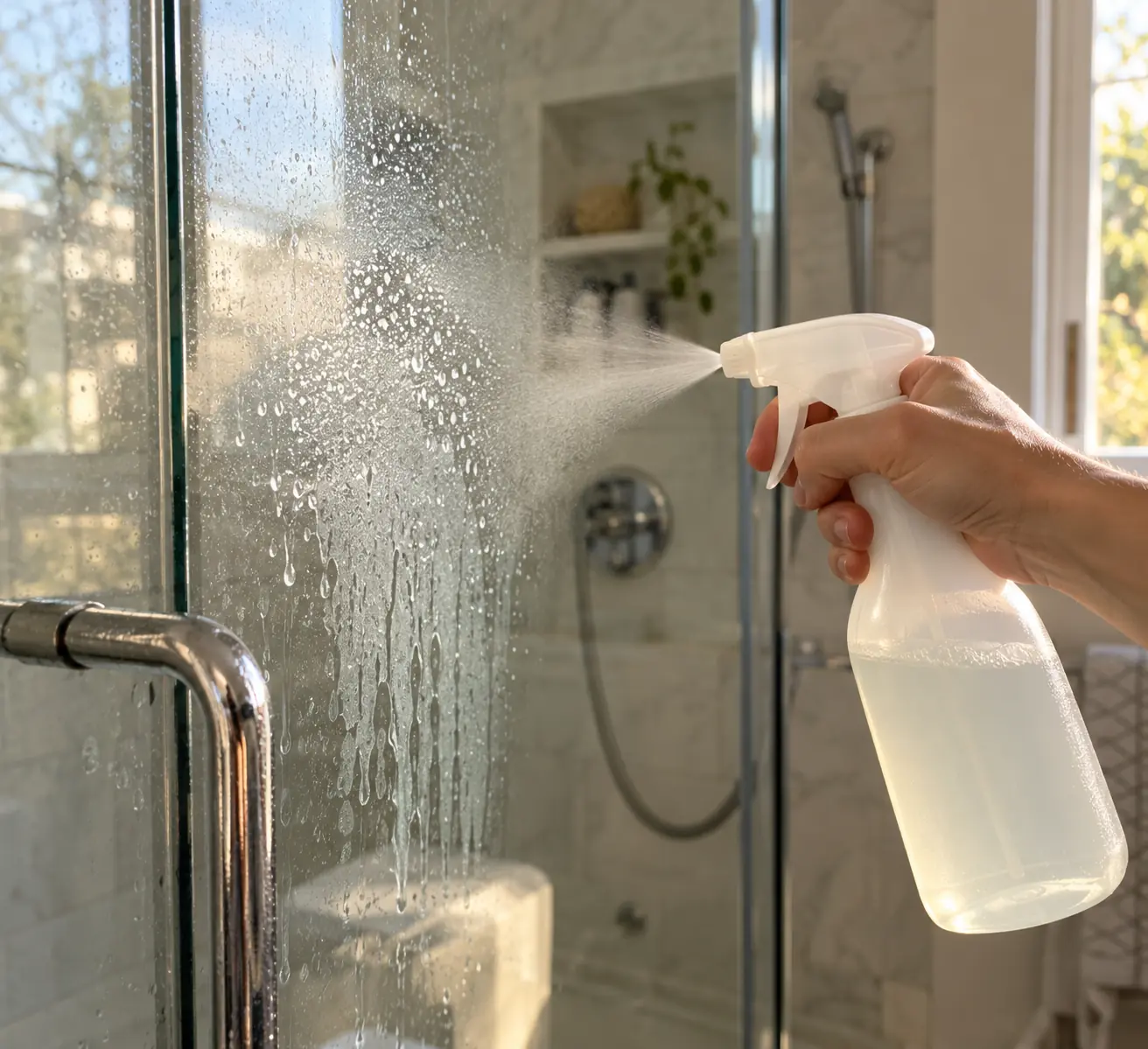
Mix a few drops of dish soap into a spray bottle of warm water. Spray the glass from the top down and scrub gently with a non-scratch pad using small circles. Pay attention to the lower third of the door and around the handle, where soap scum builds. Rinse with water or wipe with a damp cloth.
This step is the one most people skip, and it matters. Greasy scum sits between the acid and the minerals.
Step 3: Apply acid for mineral film (10 to 15 minutes dwell)
Choose one:
White vinegar. Spray it full strength, or mix about equal parts vinegar and warm water. Keep the glass wet for 10 to 15 minutes. For vertical glass, soak paper towels in vinegar and press them against the door so the liquid stays in contact.
Citric acid solution. Dissolve 1 to 2 tablespoons of citric acid powder in a cup of warm water, then spray or wipe on. It works similarly to vinegar without the smell, and many people find it more effective on stubborn spots.
Do not let the solution dry on the glass. If it begins to dry, re-wet it.
Step 4: Scrub the stubborn spots (5 to 10 minutes)
For leftover white spots, make a paste of baking soda and a little water. Rub it gently with a soft cloth or non-scratch pad, always in the same direction. Baking soda is a mild abrasive, but on coated glass any scrubbing can wear the coating, so test it first on a corner.
Step 5: Rinse thoroughly (3 to 5 minutes)
Rinse the glass with clean water from top to bottom. Leftover cleaner dries into streaks and can attract new deposits.
Step 6: Squeegee and dry (3 to 5 minutes)
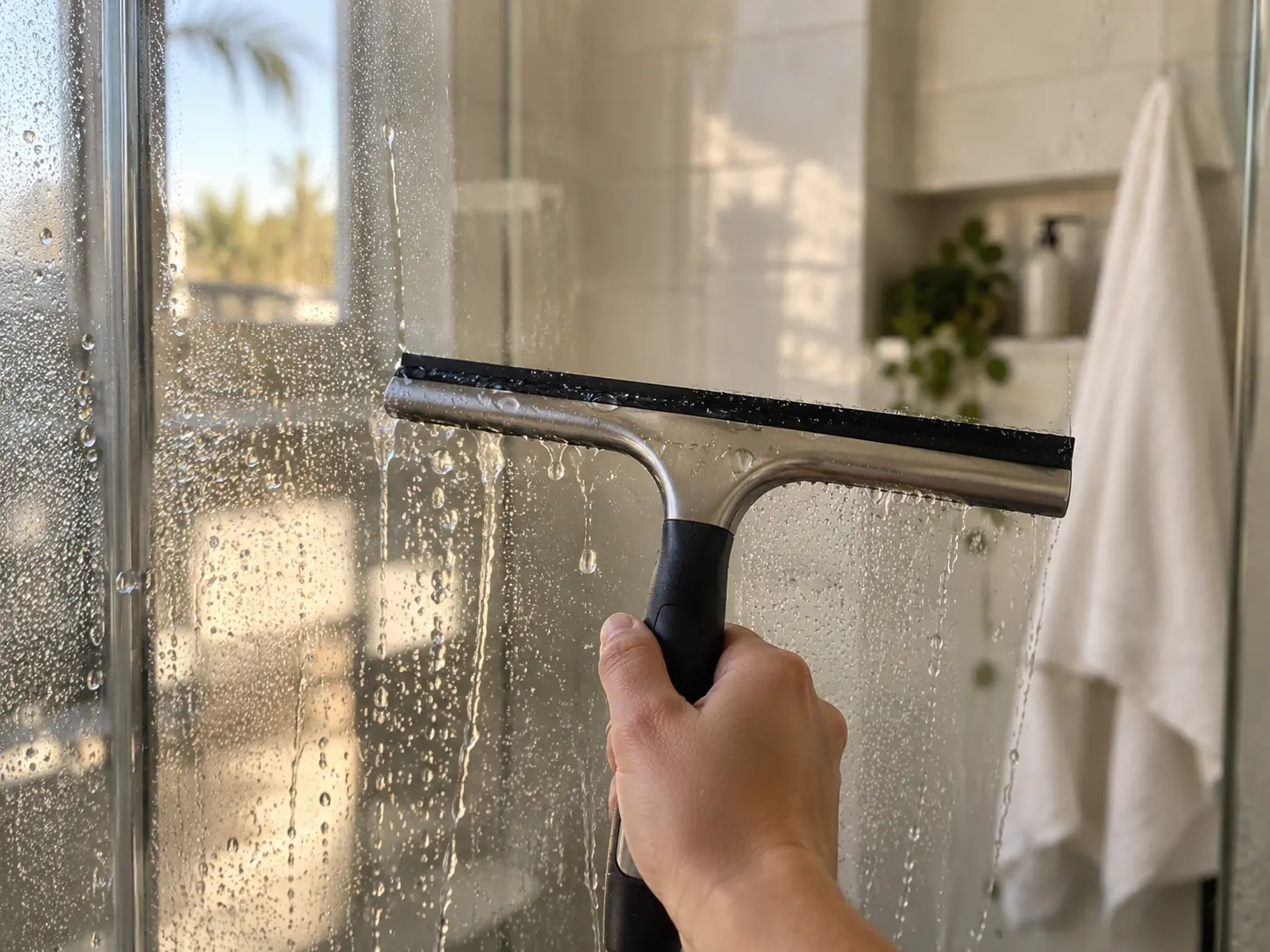
Pull the squeegee from top to bottom in overlapping strokes, wiping the blade between strokes. Buff the edges with a dry microfiber cloth. Drying immediately stops fresh spots from forming.
Step 7: Clean tracks, seals, and hardware (10 minutes)
Use an old toothbrush and a vinegar-water mix (or dish soap) to clear gunk from tracks and seals. Rinse and dry. Wipe the hinges and handles with a damp cloth. Mildew often hides in the bottom seal, so check for black spots. Our guide to preventing mold and mildew in your bathroom covers what to do if you find it.
Heavy buildup: commercial removers
When years of mineral deposits resist vinegar, a commercial limescale or hard water remover can help. You do not need a specific brand. Read the label for these points.
| Product type | Best for | Avoid on | Notes |
|---|---|---|---|
| Citric acid based gel or spray | Moderate to heavy film | Natural stone | Gentler on fixtures than stronger acids. |
| Phosphoric or sulfamic acid based | Heavy deposits | Stone, some finishes, coated glass | Read directions for contact time. |
| Hydrochloric acid based (strong) | Very heavy deposits on suitable surfaces | Most shower surfaces, stone, metal, grout | Often too aggressive for shower doors. Use only if the label allows glass and follow it exactly. |
| Non-acid soap scum remover | Waxy soap scum | None in particular | Does not dissolve minerals. |
| Glass polish compound (cerium oxide based) | Light etching | Coated glass | Needs patience and a polishing pad. Results vary. |
Whatever you use, follow the label for contact time and rinsing, test first, and wear gloves. Do not mix products. If a label says it is not for coated glass, believe it.
Framed, frameless, and coated glass
The type of door changes what is safe.
| Door type | What to know | Cleaning notes |
|---|---|---|
| Framed (metal frame, often aluminum) | Frame can corrode or stain with acid left on | Rinse acid off the frame quickly. Wipe the frame dry. |
| Frameless (thick glass, hinges only) | Few seams, but edges and hinges hold water | Dry the edges and hardware. Check the seal along the bottom. |
| Coated or treated glass (water-repellent coating) | Coating can wear off with abrasives and strong acid | Mild soap, a soft cloth, and a squeegee. Follow the maker’s care sheet. |
| Textured or frosted glass | Texture traps soap scum | Use a soft brush instead of a pad. |
| Tinted glass | Scratches show more | Avoid abrasives completely. |
| Sliding doors with tracks | Tracks hold water and gunk | Clean tracks first so water drains. |
If you are not sure whether your glass is coated, check the paperwork, or ask the installer. Water that beads up tightly on a clean door suggests a coating.
The squeegee routine that prevents it
Prevention takes less time than cleaning.
- After the last shower of the day, squeegee the door from top to bottom.
- Wipe the bottom edge and track with a small towel.
- Leave the door open a crack so air circulates.
- Run the exhaust fan for 15 to 20 minutes after showers, or follow your fan’s guidance.
That is about 30 seconds a day. Households that do it regularly rarely need the acid step more than occasionally. If you will not squeegee, a weekly light spray of diluted vinegar and a wipe is a good second best.
Some people use a daily shower spray. These sprays work by diluting minerals and soap before they dry, and many are mostly water with mild acids or surfactants. They can help, but they do not replace drying the glass.
Etched glass: when stains are permanent
Etching happens when minerals, acids, or years of repeated wet-dry cycles damage the glass surface. It often shows as a frosted patch that does not change when cleaned, sometimes with a rainbow sheen at angles.
What you can do:
- Confirm the diagnosis with the wet and dry test above.
- Stop using strong acids on the glass, since they can speed damage.
- Try a glass polishing compound for light etching, following the directions carefully. Results vary, and polishing can distort the glass if done unevenly.
- Consider a protective coating once the glass is clear or polished. Coatings reduce water spotting but need correct application and gentle care.
- If the etching is severe, replacement glass may be the only way to fully restore clarity.
Be honest with yourself about the goal. A door with light etching can look much better after a good clean, but it will not look new again.
Coated glass vs etched glass: how to tell and what to do
These two get confused constantly, and treating one like the other makes things worse. A coated door has a factory or installer-applied layer that makes water bead and roll off. Etched glass has lost part of its own surface. They call for opposite approaches.
How to tell them apart:
- Look at how water behaves on a clean, dry spot. Tight, round beads that slide off suggest a working coating. Water that spreads into a flat sheet suggests the coating is gone or was never there.
- Compare wet and dry. Cloudiness that vanishes when the glass is wet is usually film or deposits. Cloudiness that stays when wet and dry is a texture problem, which points to etching.
- Run a fingertip over the patch. Deposits feel slightly gritty or bumpy. Etched glass feels smooth or evenly rough, and nothing wipes off.
- Check the paperwork or ask the installer. Receipts, the manufacturer’s care sheet, or a label in the corner of the glass often name a protective treatment.
- Look at the pattern. Coating wear usually shows where hands, a sponge, or a squeegee touch most. Etching follows where water sat longest, such as the lower third of the door.
| Situation | What it means | What to do |
|---|---|---|
| Beads tightly, glass looks clear | Coating is working | Mild soap, soft cloth, squeegee. No abrasives or strong acid |
| Sheets water, clears with vinegar | Coating worn, glass fine | Clean gently, then ask the maker or installer about recoating |
| Cloudy wet and dry, nothing helps | Etching | Stop strong acids, try polishing only if you accept the risk, plan for replacement if severe |
| Rainbow sheen at angles | Residue or early etching | One careful clean pass, then reassess |
| Peeling or patchy film | Coating failure | Stop scrubbing and contact the installer |
With a coated door, think protection. With an etched door, think damage control: keep it dry, avoid anything that speeds the damage, and be realistic about what a polish can do.
A monthly prevention routine with squeegee timing
Squeegee timing matters more than squeegee effort. Water that sits for an hour leaves far more behind than water removed in seconds.
| When | What | Time |
|---|---|---|
| Right after the last shower of the morning and of the evening | Squeegee top to bottom, wipe the blade, dry the bottom edge | 30 seconds |
| Within a few minutes of a steamy shower, while glass is still wet | Pull the squeegee before water starts to dry in drips | Part of the above |
| Week 1 | Dish soap spray and wipe, then buff dry | 5 minutes |
| Week 2 | Diluted vinegar or citric acid spray, 10 minutes, rinse, squeegee | 15 minutes |
| Week 3 | Dish soap wipe, check tracks and drain slots with a toothbrush | 10 minutes |
| Week 4 | Full soap then acid clean, seals, hinges, and handle | 30 minutes |
Keep the squeegee on a hook inside the shower so it is in reach. Replace the rubber blade when it stops pulling a clean line, since a nicked blade leaves streaks and trapped water. Households with very hard water may want to repeat the week 2 step every week, and homes with a softener may be able to space it out.
A note on hard water in Orange County
Much of Orange County is known for hard water, though it varies by city and water district. To see what is in your own water, look up your local water quality report, which your water provider publishes each year. Homes with water softeners or filtration will have fewer deposits than homes without.
If your home gets heavy spotting on shower glass, faucets, and dishes, expect more frequent cleaning, and consider a simple prevention habit such as the squeegee routine. For more on this beyond the shower, our guide on removing hard water stains covers faucets, toilets, kettles, and more.
Skip this step: If you have a large frameless door, years of buildup, or just want the whole bathroom reset, our deep cleaning includes detailed bathroom descaling. Pricing follows our formula: a 2 bedroom, 2 bathroom home is $60 + (2 x $25) + (2 x $35) = $180, times 1.5 for a deep clean, which comes to $270. You can check yours with the instant quote.
Troubleshooting
| Problem | Likely cause | Fix | When it will not work |
|---|---|---|---|
| Glass still cloudy after vinegar | Soap scum still blocking, or etching | Degrease first, then repeat acid | If it is etched |
| Streaks after cleaning | Soap or minerals left, dirty squeegee blade | Rinse more, wipe blade between pulls, buff with microfiber | If the glass is coated and worn |
| White spots return in days | Water left to dry on glass | Squeegee after every shower | If hard water is extreme, consider softening |
| Frame looks dull or spotted | Acid left on metal | Rinse and polish with a damp cloth | If the finish is already damaged |
| Black spots on seals | Mildew | Scrub with soap and water, then dry. A diluted mild cleaner is fine on seals | If the seal is crumbling, replace it |
| Rainbow sheen | Early etching or residue | Try a cleaner pass, then polish | If it stays, it is likely etching |
| Coating peels | Abrasives or aging | Stop scrubbing, contact the installer | Recoating or replacement |
| Door tracks hold water | Debris in drain slots | Clear slots with a toothbrush | If the track is out of level |
Common mistakes
- Using acid on soap scum first. Degrease first.
- Letting vinegar dry on the glass. It leaves its own residue.
- Scrubbing coated glass with abrasives. It can remove the coating.
- Ignoring the metal frame. Acids can dull and stain finishes.
- Skipping the rinse. Residue attracts more deposits.
- Mixing products. Never combine bleach with vinegar or ammonia.
- Using a dirty squeegee blade. It drags grit and leaves lines.
- Cleaning only the glass. Tracks and seals feed the next round of grime.
Maintenance schedule
| When | What | Time |
|---|---|---|
| After each shower | Squeegee glass, wipe track edge | 30 seconds |
| Weekly | Quick spray of diluted vinegar or shower spray, wipe | 2 minutes |
| Every 2 to 4 weeks | Dish soap clean, then vinegar or citric acid, rinse, dry | 20 to 30 minutes |
| Monthly | Tracks, seals, hinges | 10 minutes |
| Twice a year | Check for etching, coating wear, and loose hardware | 5 minutes |
Frequently asked questions
What is the best thing to clean glass shower doors? A two-step routine works best: dish soap to remove soap scum, then white vinegar or a citric acid solution to dissolve mineral deposits. Finish with a squeegee. No single product does both jobs equally well.
How do you remove hard water stains from shower glass? Wet the glass with white vinegar or citric acid solution, keep it wet for 10 to 15 minutes, scrub gently with a non-scratch pad, rinse, and dry. Repeat for heavy buildup. Permanent etching will not come off.
Does vinegar damage shower glass? Vinegar is generally safe on plain glass for short contact. It can harm coated glass over time, stone surfaces, and some metal finishes. Check your door’s care instructions and rinse thoroughly.
Does Dawn and vinegar clean shower doors? Many people use a dish soap and warm vinegar mix. It can work, because dish soap handles grease and vinegar handles minerals, but it is more reliable to use them in two steps. If you combine them, use a spray bottle and rinse well.
How often should you clean shower doors? Squeegee after each use, do a thorough clean every 2 to 4 weeks, and adjust for how hard your water is and how many people use the shower.
Can I use a razor blade on shower glass? On uncoated glass, a new blade held flat can lift stuck deposits, but it can scratch if it is dull or held at the wrong angle. Never use one on coated or tempered glass without checking the manufacturer’s guidance.
Why does my glass look clean wet but cloudy dry? Water fills in microscopic roughness, so etched or mineral-coated glass can look clear when wet. If it clears only when wet and cleaning does not help, suspect etching.
Is baking soda safe on shower glass? Baking soda is a mild abrasive. It is usually fine on plain glass with gentle use but can wear coatings. Test a corner first and rinse well.
Do shower sprays work? They can reduce spotting by cutting down residue, but they do not replace squeegeeing. Check labels for safe use on your glass type.
When to call a professional
A professional can spend the time on heavy buildup, tracks, and seals, and has experience with different glass finishes. What you can do yourself is the daily squeegee, the monthly soap and acid clean, and spotting early signs of etching before they spread.
If your door is beyond what you want to scrub, our crews can handle the whole bathroom as part of a deep clean, and for glass in other parts of the home we also offer window cleaning. For the full price of your home, use the instant quote. It takes about 30 seconds. For a quick routine to keep the room fresh in between, read our bathroom cleaning routine that works, and see how to handle grout with our grout and tile guide.