Care Habits
How to clean a stove top: gas burners, electric coils, and glass
The right way to clean a stove top depends on the type of stove, because the method that is perfect for a gas grate can ruin a glass surface. Let everything cool, lift off what comes off, soften the grime with warm soapy water or a baking soda paste, wipe, and dry completely. The one rule that holds for every type: nothing abrasive on glass, and no water inside gas burner ports or electric connections.
This guide covers gas, electric coil, and smooth glass or ceramic tops, plus induction, with a step-by-step method for each, a table of what to use and what to avoid, and a plan for burnt-on food that has been sitting for weeks.
Quick answer
- Time: 10 minutes for a light weekly wipe, 30 to 45 minutes for a full clean, longer if grates need a long soak.
- Supplies cost: low. Most of it is already in a kitchen: dish soap, baking soda, microfiber cloths, a soft brush.
- Difficulty: easy for glass and coil tops, moderate for gas tops with many parts and crevices.
- How often: wipe after each use once the surface has cooled, do a full clean every one to two weeks if you cook daily.
- Skip this and call someone if: a burner will not light evenly, you smell gas, or a coil element is cracked. Those are repair issues, not cleaning issues.
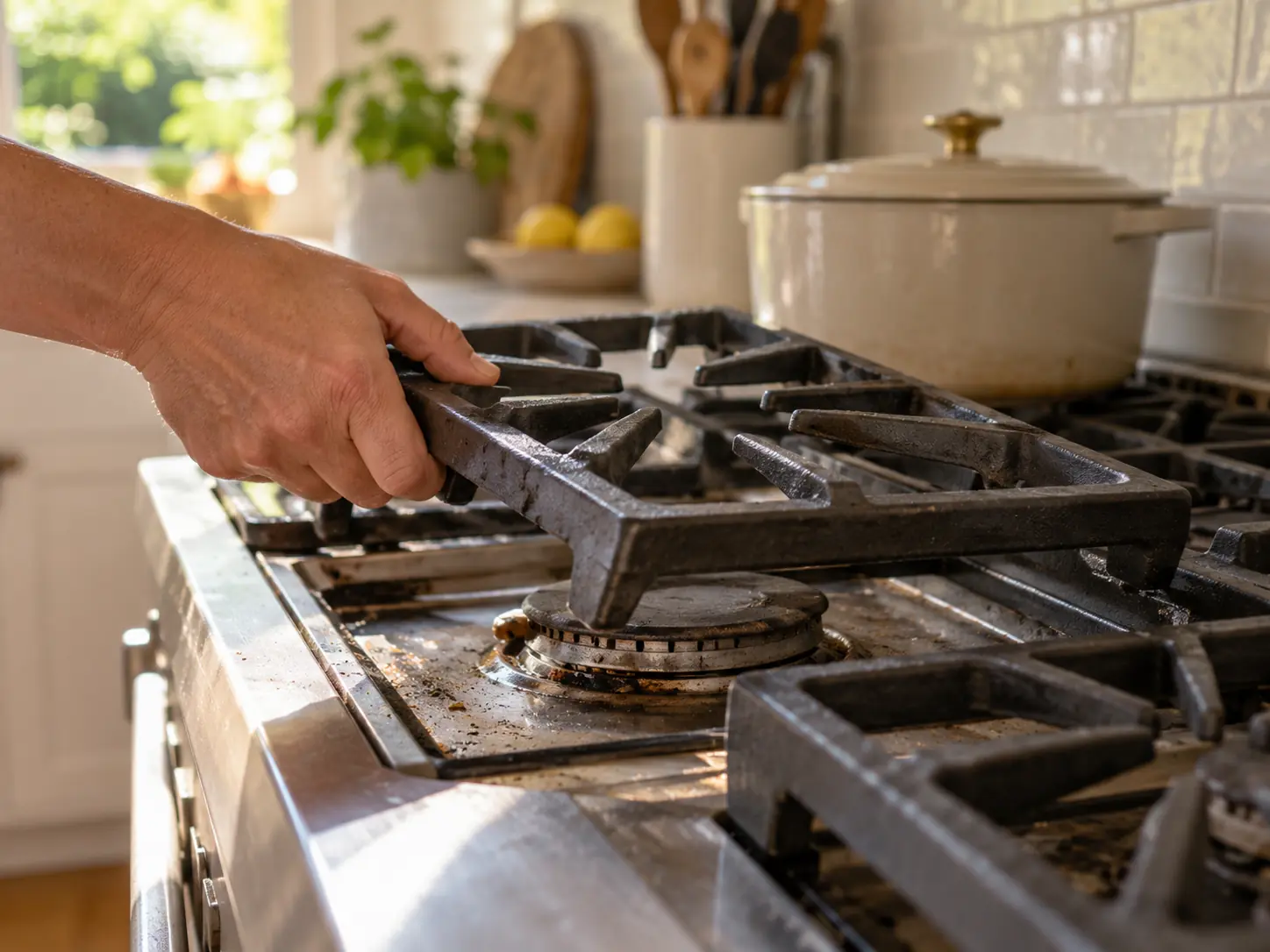
First, identify your stove top
Look at what is actually on top of the stove before choosing a method. People often assume they have one type and have another, especially in rental units and condos where the appliance was installed by a previous owner.
| Type | How to recognize it | Biggest cleaning risk |
|---|---|---|
| Gas with grates | Heavy metal grates over burner heads, blue flame | Water in burner ports, clogged igniters |
| Electric coil | Round spiral heating elements sitting in drip bowls | Soaking or submerging the coil itself |
| Smooth glass or ceramic | Flat black or white surface, burner circles marked on it | Scratches from abrasives, sugar spills that pit the glass |
| Induction | Flat glass like a ceramic top, but pans heat and the glass stays cooler | Same as glass, plus trapped moisture around the edges |
| Sealed gas burners | Gas flames, but burners are sealed to the top with no gaps | Scrubbing hard on enamel, which can dull |
Your owner’s manual is the final word. Manufacturers differ on which cleaners they approve, whether burner caps can go in the dishwasher, and which scrapers are safe. If you no longer have the paper manual, the model number is usually on a sticker inside the oven door frame or storage drawer, and most manuals can be found online by that number.
Safety first
A stove top mixes heat, electricity or gas, and chemicals. A few habits prevent most accidents.
- Cool completely. Spraying cleaner on a warm surface can bake it on, leave streaks, and with glass tops can cause damage. It can also burn you.
- Turn off the power or gas supply to the burner you are working on. For electric coil and glass tops, make sure the control knobs are in the off position. For a gas stove, the knobs must be off. If you need to remove a burner part and are not sure how, check the manual rather than forcing it.
- Ventilate. Turn on the range hood or open a window when using any commercial degreaser.
- Wear gloves. Hot soapy water and degreasers dry out skin, and burnt-on residue can have sharp edges.
- Never mix cleaners. Do not combine bleach with ammonia or with acids such as vinegar. Our guide on which cleaning products you should never mix explains why. On a stove, stick to one product at a time and rinse between them.
- Never spray directly onto a stove. Spray the cloth, or spray a small amount and wipe at once. Liquid running into control panels, switches, or burner openings causes the damage that is hardest to reverse.
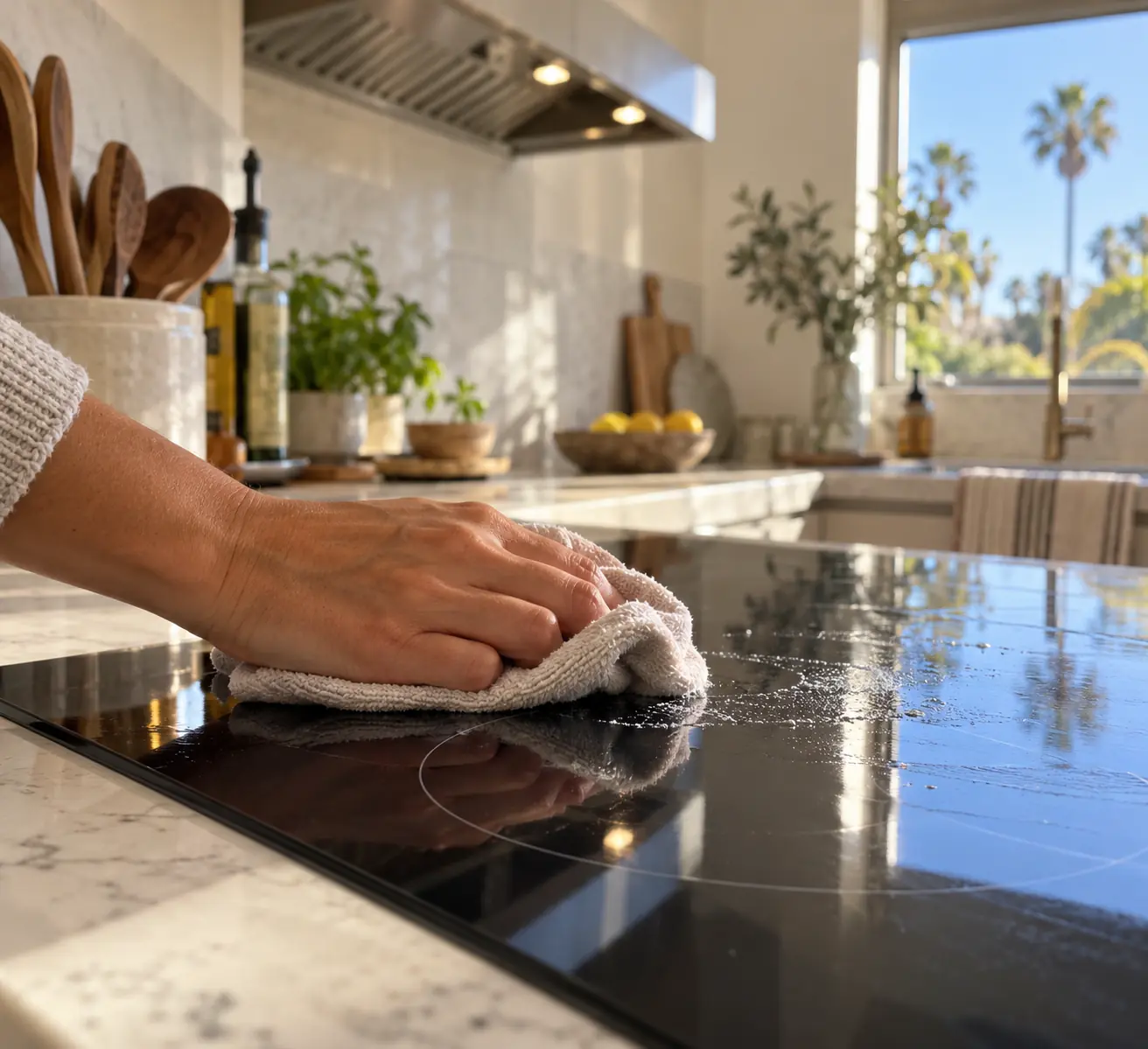
What you need
| Item | What it does | Notes |
|---|---|---|
| Dish soap (plain, not scented gel with dyes if you have a white top) | Cuts everyday grease | Works for all stove types |
| Baking soda | Mild abrasive that lifts dried food without scratching glass when used as a wet paste | Use a paste, not dry powder rubbed hard |
| Microfiber cloths (2 to 3) | One for washing, one for rinsing, one for polishing dry | Lint-free finish on glass |
| Non-scratch sponge or nylon scrub pad | Lifts crust from grates and enamel | Check the label says safe for non-stick or glass if using on those |
| Soft toothbrush or small detail brush | Burner ports, igniters, crevices | Keep a separate one just for the stove |
| Straight pin or paperclip | Opens clogged burner ports | Gas only, and only when burners are cold and off |
| Ceramic cooktop cleaner (optional) | Made for glass and ceramic tops, leaves a thin protective film | Look for “safe for glass and ceramic” on the label |
| Single-edge razor scraper made for cooktops (optional) | Removes carbonized spills on glass | Hold nearly flat, never dig |
| Degreaser, citrus or alkaline (optional) | For heavy grease on grates and enamel | Not for use on aluminum parts or unsealed finishes unless the label says so |
| Zip bag or large pot | Soaking small parts | Optional, helps with burner caps |
What not to use on any stove top: steel wool, scouring powder rubbed dry, metal scrapers other than a cooktop razor tool, oven cleaner on glass or painted surfaces (many oven cleaners are meant for the oven interior, not the cooktop), and bleach on aluminum or colored enamel.
Cleaning a gas stove top
Gas stove tops have the most parts, so they take the most patience. The goal is clean grates, clean burner caps and heads, clear ports, and a dry stove before you relight anything.
Step 1: Cool and remove parts (3 minutes)
Make sure all knobs are off and the surface is cool. Lift off the grates, then the burner caps (the round discs that sit on top of the burner heads). On most stoves the caps lift straight off. Leave the burner heads (the base with the small holes around the edge) in place unless your manual says they come off.
Step 2: Soak the grates and caps (15 to 30 minutes, mostly waiting)
Fill the sink or a tub with hot water and a generous squirt of dish soap. Lay the grates and caps in the water. For heavy grease, add a degreaser according to its label. Cast iron grates with an enamel coating handle soaking well. Raw cast iron can rust if left wet for hours, so do not leave it overnight.
If your grates do not fit in the sink, lay them on towels in the bathtub or in a large plastic tub. A zip bag with the grate, a little soapy hot water, and a good seal works too: shake and let it sit.
Why this works: soaking softens the fat that glues on carbon. You scrub less and scratch less.
Step 3: Wipe the stove surface (5 to 10 minutes)
While parts soak, brush crumbs into a dustpan or wipe them with a dry cloth so you are not smearing grit. Then wipe the stove with a cloth wrung out in hot soapy water. Work in sections, rinse the cloth often, and flip it so you are not rubbing grease back on.
For dried spots, lay a warm damp cloth over the spot for a few minutes to soften it, then wipe. If something is still stuck, apply a baking soda paste (about 2 parts baking soda to 1 part water), let it sit for 10 minutes, and rub gently with a non-scratch pad. Painted or enamel surfaces can dull if scrubbed hard, so use light pressure.
Step 4: Clean the burner heads and ports (5 to 10 minutes)
This is the step that affects how the flame looks and whether the burner lights. Using a barely damp toothbrush, brush around the burner head to remove crumbs and grease. If a port (one of the small slots or holes around the head) is clogged with food, gently clear it with a straight pin or paperclip, working in the direction of the hole, without enlarging it.
Do not pour water into the burner. Do not spray cleaner into the ports. If water gets into the burner, let it dry completely before lighting, which can take several hours, and check that the burner lights evenly.
Pay attention to the igniter, the small ceramic nub next to the burner. A greasy igniter clicks but fails to light. Wipe it gently with a cotton swab dampened with rubbing alcohol or plain water, and let it dry.
Step 5: Scrub and rinse the grates and caps (10 minutes)
Take the soaked parts out and scrub them with a non-scratch pad. Use a toothbrush in the corners of the grate where the fingers meet the frame. Rinse well in hot water. Soap film left on grates smokes the next time you cook.
Dry everything. Lay grates on a towel and dry with a cloth. Air drying leaves water spots and encourages rust on exposed metal.
Step 6: Reassemble and test (2 minutes)
Put the burner caps back on, matching each to its burner. Caps that sit crooked cause uneven flames. Place the grates, then turn each burner on briefly. A healthy gas flame is steady and mostly blue. If it is yellow, orange, noisy, or uneven, turn it off. Re-seat the cap and check the ports. If it persists, the burner needs a technician, not more scrubbing. If you ever smell gas, leave the area, do not operate switches, and contact your gas utility’s emergency line from outside.
Cleaning an electric coil stove top
Coil tops look simple, but the coil is the part people most often ruin by overcleaning.
The coil itself
Never submerge or soak a coil element, and never spray it with liquid. Most coil elements can be wiped with a barely damp cloth when cold and unplugged from their socket (check your manual, many lift out by tilting slightly and pulling straight back). Dry food on the coil burns off the next time it is heated, which produces smoke and a smell. That is normal for light spills, but heavy grease can smoke a lot.
If the coil is crusty, you can run the burner on high for a minute or two with the vent fan running so the debris burns off, then turn it off and let it cool. Some manuals discourage this for heavy spills, so check yours.
Drip bowls and trim rings
The drip bowls (also called drip pans) are the shallow metal bowls under each coil. They catch most spills. Lift them out when cool and soak them in hot soapy water for 15 to 20 minutes. Scrub with a non-scratch pad. Chrome-plated bowls can be polished with a damp microfiber cloth, but avoid abrasives that remove the plating.
If a bowl is blackened beyond cleaning, replacements are inexpensive and sold by model number. Reflective bowls reflect heat to the pan, so a bowl lined with foil changes how the burner works and can be unsafe, so most manufacturers advise against foil liners.
The surface under the coils
Wipe the stove top with hot soapy water, lift the edges gently, and clean around the receptacle (the socket the coil plugs into). Do not let water pool in the receptacle. Dry everything before re-seating the coils, and make sure each coil sits level and fully pushed in.
Cleaning a glass or ceramic stove top
Glass tops look sleek and show every smear. They also scratch more easily than most people expect, and a sugar spill left on a hot surface can pit the glass permanently.
Daily and weekly wipe (3 to 5 minutes)
- Let the surface cool until it is no longer warm to your palm. The “hot surface” indicator light, if your stove has one, should be off.
- Brush away loose crumbs with a dry cloth so you do not drag grit across the glass.
- Wipe with a microfiber cloth dampened with warm soapy water.
- Rinse with a clean damp cloth, because soap film is what leaves a cloudy look.
- Dry and buff with a dry, lint-free microfiber cloth.
For a streak-free finish, a small amount of distilled white vinegar diluted with water on the cloth can cut a light film on most glass tops. Always check your manual first. Some manufacturers prefer their own cleaners, and vinegar should be avoided on the rubber or plastic trim at the edge of the glass if it sits for long.
Burnt-on food (20 to 30 minutes, mostly waiting)
- Start with a cool surface.
- Spread a thin layer of baking soda paste over the burnt area, or apply a ceramic cooktop cleaner according to its label.
- Lay a hot damp towel over the paste and leave it for 15 to 30 minutes. This steams the residue loose.
- Wipe with the towel using gentle circles, no hard pressure.
- For a stubborn spot, use a single-edge razor scraper made for cooktops at a shallow angle of about 30 degrees, pushing forward in short strokes with moisture on the glass. Do not use a scraper with a chipped blade, do not use one on the printed burner markings, and never dig the corner into the glass.
- Rinse, dry, and polish.
Sugar and melted plastic
Sugar (jam, syrup, caramel) and melted plastic are the two spills that can permanently damage glass if they cool on it. If you spill them while the stove is hot, many manufacturers advise scraping the spill off while the surface is still hot, using a heat-safe tool and protecting your hand, then letting the surface cool before cleaning the rest. Because that involves working on a hot surface, follow the manual’s exact advice rather than improvising. If pitting has already happened, no cleaner reverses it.
Rust-colored rings and cloudy marks
Cloudy rings under pots are usually mineral deposits from boiled-over water, particularly in areas with hard water, or leftover cleaner film. Once the surface is cool, apply a ceramic cooktop cleaner or a thin paste of baking soda, let it sit, and polish. A drop of dish soap on a damp cloth removes most film. Heat marks that look like silver streaks from pot bottoms are often metal transfer from cookware and may need a ceramic cooktop cleaner to lift.
Induction tops
Induction tops are cleaned like glass, and because the glass itself does not get as hot, spills are less likely to bake on. Wipe spills quickly anyway. Keep the area dry around the edges, and do not use abrasive scouring pads. Check the manual for approved cleaners, since some control panels are touch-sensitive and misbehave when wet. If the panel stops responding, wipe and dry it completely before assuming something is broken.
Quick comparison: what to use on each surface
| Surface | Good choices | Avoid |
|---|---|---|
| Enameled gas grates | Hot soapy soak, non-scratch pad, degreaser per label | Steel wool on chipped spots, overnight soaking of bare iron |
| Bare cast iron grates | Quick scrub, dry immediately, wipe with a thin coat of cooking oil if bare | Long soaks, dishwasher |
| Stainless stove top | Soap and water, then wipe with the grain | Abrasive powders, chlorine bleach |
| Painted or enamel stove top | Warm soapy water, gentle baking soda paste | Hard scrubbing, harsh solvents |
| Coil elements | Dry or barely damp wipe when cold | Soaking, spraying |
| Glass or ceramic | Soap, cooktop cleaner, baking soda paste, cooktop razor at a shallow angle | Abrasive pads, scouring powder, ammonia-heavy cleaners (check the manual), dragging rough pot bottoms |
| Aluminum burner parts | Mild soap | Strong alkaline cleaners and bleach, which can discolor aluminum |
Burnt-on and baked-on grime: the stubborn stuff
If a stove top has not been cleaned in a long time, the grime has layers: oil, then carbon, then more oil on top of that. Trying to scrub through all of it at once wastes effort and scratches surfaces.
Work in passes instead.
- First pass: remove everything removable and soak.
- Second pass: a degreaser or hot soapy water to break the top layer of fat. Wipe off and rinse so you are not working through slime.
- Third pass: baking soda paste on the carbon, then a damp towel laid over it for 20 to 30 minutes.
- Fourth pass: gentle scraping or a non-scratch pad.
- Final pass: a plain-water rinse and a full dry.
Repeat the cycle once if needed. Two gentle rounds beat one aggressive round that leaves scratches.
For grates where black carbon will not budge, some people use an oven cleaner. Read the label. Many are made for porcelain oven interiors, they can strip finishes, and they involve fumes. If you choose that route, ventilate well, wear gloves and eye protection, and keep it off the stove surface. This is one of the tasks where hiring help is reasonable.
When it is worth handing off: heavy buildup across grates, burners, and the surface of the range is one of the most tiring parts of a kitchen to restore. Our deep cleaning service covers kitchen detail work, and you can add the oven for $35. For a 2 bedroom, 2 bathroom home, deep cleaning is (60 + 25 x 2 + 35 x 2) x 1.5 = $180 x 1.5 = $270, so with the oven add-on it comes to $305 before any offer. Get your exact number with the instant quote.
Mistakes that damage stove tops
- Cleaning while hot. Cleaner dries instantly on a hot surface, leaves streaks, and can bake in. Wait.
- Using abrasive pads or powders on glass. Scratches collect grime and never go away.
- Soaking electric coils. Water in the element causes shorts or trips the breaker.
- Flooding gas burners. Water in the ports prevents ignition and can cause uneven flames when it finally burns off.
- Mixing cleaners. The combination of bleach with ammonia or acids creates toxic gas. One product at a time.
- Dragging pans on glass. Rough or warped pot bottoms, especially cast iron, scratch glass. Lift instead of slide.
- Leaving sugar or melted plastic. Deal with these immediately, following your manual.
- Skipping the rinse. Cleaner film attracts dust and cooks into brown haze the next time you heat the surface.
- Using foil liners on drip bowls or burners. Many manuals warn against this because it can trap heat and damage the stove.
- Ignoring the manual. Brands differ on approved cleaners and removable parts.
What not to mix or use
This list is short but important.
- Bleach plus ammonia: produces toxic chloramine vapor. Some glass cleaners contain ammonia.
- Bleach plus vinegar or other acids: releases chlorine gas.
- Vinegar on natural stone counters next to the stove: vinegar and other acids can dull and etch marble and some other stones if they splash or are wiped across. Keep the countertop edges in mind when you spray.
- Oven cleaner on a cooktop surface: not made for it unless the label says so, and the fumes are strong.
- Dry baking soda rubbed hard on glass: use it as a wet paste.
- Pressurized sprays near gas igniters: liquids and aerosols near an ignition source are a bad idea. Spray the cloth.
If you ever react to fumes with coughing, a headache, or eye irritation, stop, open windows, and leave the room. For pets and birds, keep them out of the kitchen while you clean, since birds are especially sensitive to some cleaning and non-stick fumes.
How to keep the stove top clean after
Prevention takes less time than restoration. A few habits keep the heavy cleaning off your weekend.
| When | What | Time |
|---|---|---|
| After each cooking session | Wipe spills once the surface has cooled, glance at the grates for drips | 1 to 2 minutes |
| Weekly | Full wipe, rinse, dry, polish glass | 5 to 10 minutes |
| Every 1 to 2 weeks (daily cooks) | Remove and wash grates, caps, drip bowls | 20 to 30 minutes |
| Monthly | Clear burner ports, wipe igniters, clean around knobs and control panel, check beneath coil and drip bowls | 15 to 20 minutes |
| Seasonally | Deep clean including range hood filter and wall behind the stove | 30 to 60 minutes |
Small changes also help. Use a splatter screen when frying. Cover simmering pots with a lid ajar. Keep a dedicated cloth near the stove so wiping is easy. Use pans that fit the burner, because a pan much smaller than the burner lets food boil over onto the burner, and a pan much larger can discolor trim.
Do not forget what sits above the stove. The range hood filter holds airborne grease that drips back onto the stove top. Many filters are metal mesh and can be washed in hot soapy water, but check your model, and let the filter dry fully before reinstalling. A greasy hood makes every stove cleaning harder.
Cleaning the stove is also part of a bigger kitchen routine. If you want a bigger picture, see our kitchen deep clean checklist, the guide on how to clean a microwave, and the one on how to clean the oven without harsh chemicals. For day-to-day habits, how to keep your kitchen clean between cleanings is a good companion.
Orange County angle
A few local conditions affect stove tops in Orange County homes.
- Hard water. Much of Orange County has fairly hard water, though it varies by city and water district, so check your local utility’s water quality report. Boil-overs leave white mineral rings on glass and stainless, and mineral scale clogs steam and humidifying parts of other appliances. A cooktop cleaner or a light vinegar wipe (where the manual allows) removes most of it.
- Open windows and fine dust. In dry, windy weather, including Santa Ana wind days, fine dust and grit blow into kitchens with open windows. Dust mixes with cooking grease and forms a gummy film on and around the stove. Wiping dry before wet cleaning keeps you from grinding that grit into glass.
- Condos and rentals. Many OC homes are condos or rentals with older ranges. If you rent, document the stove’s condition at move-in and clean it thoroughly at move-out, because cooktops and drip pans are a common line item in deposit disputes. Our move-out cleaning checklist covers what a landlord typically looks at.
When to call a professional
Do the daily and weekly wipes yourself. They take minutes and prevent most problems. A professional cleaner is a good idea when:
- The stove has months of baked-on grease and you do not have the hours to work through the layers.
- You are preparing a home for sale, a rental turnover, or a move-out and the kitchen needs to be finished to a standard.
- Mobility, wrists, or back pain make scrubbing grates difficult.
- You would rather spend the afternoon on something else.
A cleaner will not repair a burner. If a burner will not light, the flame is uneven after cleaning, a coil is cracked, glass is chipped, or you smell gas, call an appliance technician or your gas utility. Cleaning does not fix mechanical faults and trying to can make them worse.
If you want help, recurring cleaning keeps a stove from reaching the baked-on stage in the first place, and the first clean carries a $39 new customer offer. See what your home would cost with our instant quote.
Frequently asked questions
How do you clean a stove top with burnt-on food? Let it cool, then soften the residue with a hot damp towel laid over a baking soda paste for 15 to 30 minutes. Wipe gently, and for glass use only a cooktop razor scraper at a shallow angle if needed. Repeat in a second pass rather than scrubbing hard.
Can you use vinegar on a glass stove top? Many people use a little diluted white vinegar on a cooled glass top to cut film, but some manufacturers recommend their own cleaner or advise against vinegar. Check your manual, and keep vinegar off rubber or plastic trim for long periods.
What is the best way to clean gas stove grates? Soak them in hot soapy water for 15 to 30 minutes, scrub with a non-scratch pad and toothbrush, rinse, and dry fully. For heavy grease use a degreaser according to the label. Bare cast iron should not soak long or air dry because it can rust.
Is it safe to put gas burner caps and grates in the dishwasher? Some are dishwasher safe and some are not. Enamel finishes can dull, and bare cast iron can rust. Check your manual before trying it.
How do you get the black residue off a glass top? Black residue is usually carbonized food or mineral film. Use a baking soda paste with a hot damp towel on top, then a ceramic cooktop cleaner, and a cooktop razor scraper only for stuck spots. Avoid scouring pads.
Can you scratch a glass stove top, and can scratches be removed? Yes. Abrasive pads, rough pot bottoms, and gritty cleaners scratch it. Light surface marks may be reduced with a ceramic cooktop cleaner, but real scratches are in the glass and do not come out. Prevention is the only dependable fix.
How often should you clean your stove top? Wipe it after each use once cool and do a full clean of grates, caps, and drip bowls every one to two weeks if you cook daily. Households that cook less can stretch it to monthly.
Can I use oven cleaner on my stove top? Only if the product label says it is safe for that surface. Many oven cleaners are made for porcelain oven interiors and can damage glass, paint, and aluminum. Fumes are strong, so ventilate well if you use any.
Why will my gas burner not light after cleaning? Water or residue may be in the ports or on the igniter, or the cap may be seated crooked. Dry everything fully, clear the ports gently, and reseat the cap. If it still fails, have a technician check it, and if you smell gas, leave and call your gas utility.
Why does my stove top smoke after I clean it? Leftover cleaner film or loose grease burns off the first time you heat the surface. Rinse well and wipe dry during cleaning, and run the range hood the first time you cook afterward.