Care Habits
How to Clean Windows Streak-Free: Inside, Outside, Screens, Tracks
To clean windows without streaks, wash with a little dish soap in warm water, remove the soap with a squeegee or a clean lint-free cloth, work on an overcast day or in shade so the glass does not dry too fast, and finish by wiping the edges. Streaks come from product left on the glass, dirty cloths, and drying in direct sun, not from the glass itself. A typical home takes a few hours to do properly inside and outside, and supplies cost very little.
Quick answer
- What you need: dish soap, a bucket, a squeegee, microfiber or lint-free cloths, a scrub brush or scrubber sleeve, a soft brush for tracks and a vacuum with a brush attachment.
- Best conditions: overcast or shaded glass, not midday sun and not windy.
- Time: about 10 to 15 minutes per ordinary window for a first-timer, faster with practice. Tracks and screens add time.
- Cost of supplies: low. Most of it is already in a kitchen.
- Difficulty: easy for ground-floor windows, harder for second-story and large panes. Know when to stop (see below).
- How often: see how often to clean windows for a schedule by window type.
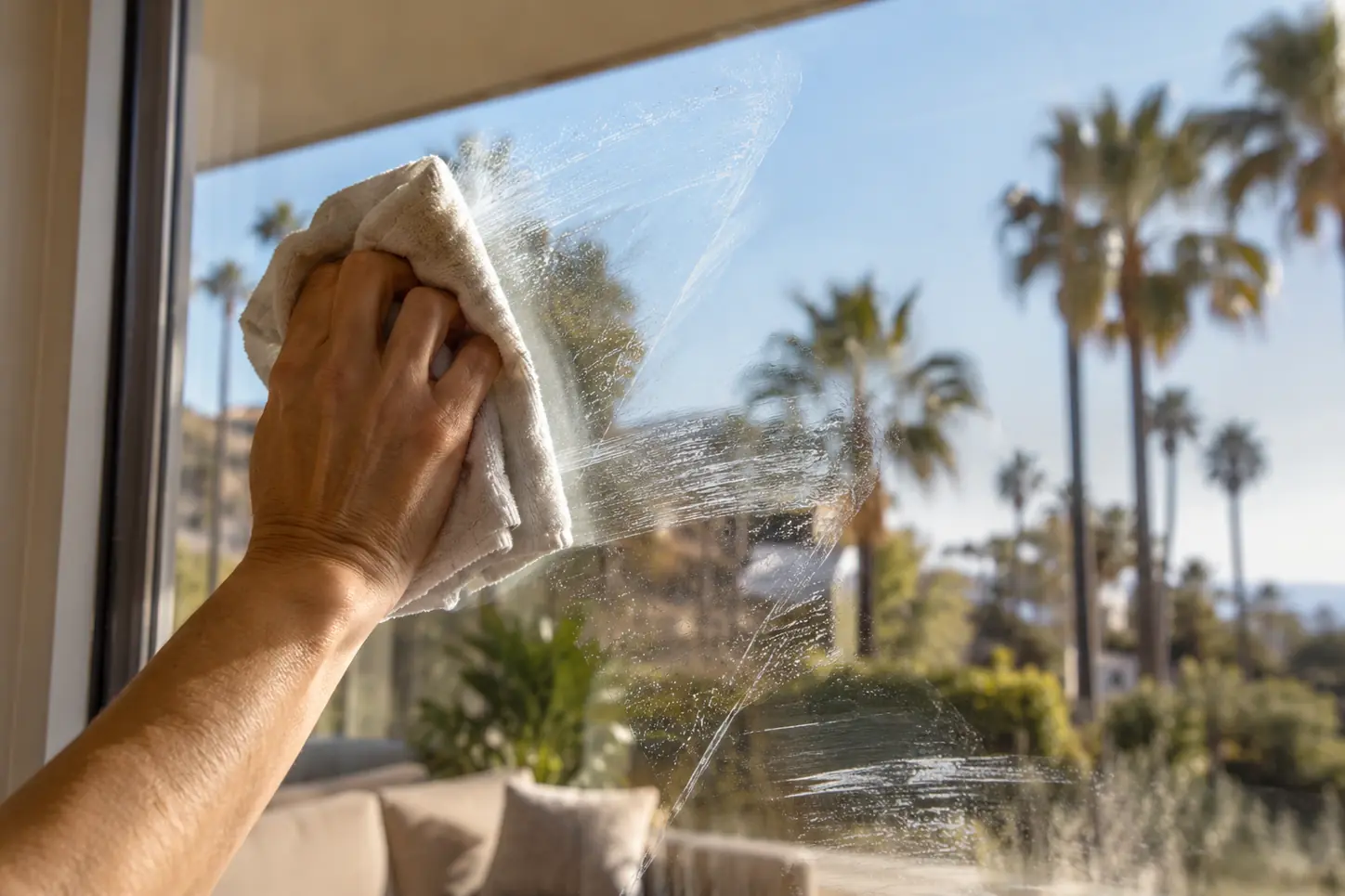
Why windows streak
Understanding the cause makes the fix obvious. Streaks, haze and smears come from a short list of problems:
- Cleaner left on the glass. Too much soap or product dries into a film.
- Dirty cloths. A cloth carrying oil, fabric softener or old cleaner re-deposits it.
- Drying too fast. In direct sun or wind, water dries before you can wipe it, leaving lines.
- Wrong towels. Paper towels leave lint and can scratch dirty glass. Cotton towels with fabric softener smear.
- Mineral deposits. Hard water leaves spots as droplets evaporate.
- Dirty frames and sills. Water running from a dirty frame drips onto clean glass.
- Pollen, salt or grease on the surface that a light wipe moves around rather than lifts.
What you need
| Item | What it does | Notes |
|---|---|---|
| Dish soap (a few drops) | Cuts grease and lifts dirt | Choose a plain one without added lotions |
| Bucket | Holds warm soapy water | Change the water when it looks gray |
| Scrubber or sponge | Loosens dirt | A scrubber sleeve helps with large panes |
| Squeegee (about 10 to 14 inches) | Pulls water off the glass | Most useful tool; keep the blade clean and nick-free |
| Microfiber cloths (lint-free) | Detail edges, corners, interior glass | Wash without fabric softener |
| Razor scraper with a fresh blade | Removes paint specks, stickers | Use flat on glass only; never on tinted film or coated glass |
| Soft brush | Cleans tracks and corners | An old paintbrush works |
| Vacuum with brush attachment | Removes loose grit from tracks and screens | Do this before any water |
| Spray bottle | For quick touch-ups | Optional |
| Step stool | Reaches the top of tall windows | Stable footing, not a chair |
Do not use: abrasive powders, steel wool, or coarse scrub pads on glass. Avoid ammonia-based sprays on tinted or coated glass unless the film maker says it is safe, and never mix ammonia with bleach.
Homemade vs commercial window cleaners
You do not need a specialty product, but you should know what each option does.
| Option | What is in it | Good for | Watch out for |
|---|---|---|---|
| Dish soap and water | Surfactants in water | Most dirt, grease, pollen | Use only a few drops, or it leaves film |
| Vinegar and water | Acetic acid, diluted | Light mineral spots, final wipe | Not for natural stone sills, and may damage some window films or rubber seals if overused |
| Isopropyl alcohol mix | Alcohol in water, sometimes with a drop of soap | Quick-drying touch-ups | Ventilate; keep away from flames |
| Commercial glass cleaner | Solvents, sometimes ammonia | Quick interior touch-ups | Can streak if over-sprayed; check label for coated or tinted glass |
| Squeegee-only with soapy water | Water plus a drop of soap | Large panes, outside windows | Needs technique |
Is vinegar good for cleaning windows?
It works on light haze and is a fine final wipe. It is not a strong degreaser, so dirt and grime still need soap first. Do not use it near marble or other natural stone, or on the rubber and metal parts that your window maker warns against. Our vinegar and baking soda guide covers where acid helps and where it hurts.
What is the best homemade window cleaner?
A small bucket of warm water with a few drops of plain dish soap, applied with a scrubber and removed with a squeegee, is hard to beat. A spray of water with a splash of vinegar or a little rubbing alcohol works for indoor touch-ups. Too much soap is the usual problem, so use less than you think you need.
What do professionals use?
Most window crews use a bucket of water with a small amount of soap, a scrubber (called a strip washer), a squeegee and a lint-free cloth for the edges. The skill is in the squeegee stroke and in keeping the blade and cloth clean. The supplies are simple.
Safety first
- Keep both feet on the floor. Do not lean out of an upper-story window to reach glass.
- Use a stable stool or ladder on level ground, with someone nearby for anything above a single step.
- Lock or secure windows before leaning on them, and check that screens are firmly seated.
- Wear gloves if you have sensitive skin, and eye protection if using any spray overhead.
- Ventilate when using vinegar or alcohol solutions in a closed room.
- Never mix ammonia, bleach or acidic cleaners (see cleaning products never to mix).
- Protect floors and sills with towels so water does not damage wood.
- Skip glass with large cracks, loose panes or failing seals.
- Avoid wet metal frames near electrical outlets and cords.
Pick the right moment
Cleaning in direct sun is the single most common reason for streaks. Water and cleaner dry on hot glass before you can remove them. Pick an overcast day, or clean each side of the house when it is in shade. In Orange County, marine-layer mornings in late spring and early summer are often ideal. Avoid windy days, when dust sticks to wet glass, and avoid the hours right before rain.
Step-by-step: windows, inside and outside
Total time for an ordinary window: about 10 to 20 minutes, including prep.
Step 1: Prepare the area (3 minutes)
Lay a towel on the sill and floor. Remove curtains, blinds that are in the way, and decor from the sill. Open the window if it is practical so you can reach the edges and the tracks.
Step 2: Dust and vacuum first (2 to 5 minutes)
Vacuum the frame, sill and track with the brush attachment, and brush cobwebs from the corners. If you wet dust, it turns to mud and smears on the glass. This is the step most people skip.
Step 3: Mix your solution (1 minute)
Fill a bucket with a gallon or so of warm water and a few drops of dish soap. The water should barely feel slippery. If it foams a lot, you used too much.
Step 4: Wash the glass (3 to 5 minutes)
Wet the scrubber, wring out extra, and wash the whole pane, edges included. Work from the top to the bottom so drips fall onto dirty glass, not clean. For grime, press gently, don’t scrub hard. Rinse the scrubber as it gets dirty.
Step 5: Squeegee the pane (2 to 3 minutes)
Use the technique described below. This step removes the water and soap in a few strokes.
Step 6: Detail the edges (1 to 2 minutes)
Wipe the border of the glass and the frame with a clean microfiber cloth. Squeegees leave a thin line of water along the edges.
Step 7: Check the glass at an angle (1 minute)
Look from the side and from the opposite side, and check against the light. Streaks show best at an angle. Buff any spots with a dry cloth.
Step 8: Clean the sill and frame (2 to 3 minutes)
Wipe the sill, the frame and the glass edge. Do this last for the interior, so you do not drip on clean glass.
Should I clean windows inside or outside first?
Do the outside first, then the inside. The outside is dirtier. Cleaning it first means any drips or streaks that remain on the glass are on the clean side, where you can see them from the inside, and you won’t track grime across the inside afterward.
A quick trick for finding streaks: wipe the inside with horizontal strokes and the outside with vertical strokes. When you see a streak, you will know which side it is on.
Squeegee technique
A squeegee looks easy and takes about five minutes to learn.
- Start with a clean blade. Check it for nicks. A damaged blade leaves lines.
- Wet the glass fully. A dry squeegee drags and may scratch if grit is on the glass.
- Begin at the top corner. Make one short horizontal stroke across the top to create a dry edge.
- Pull from top to bottom in an S or straight vertical stroke, overlapping the last stroke by about an inch.
- Wipe the blade with a lint-free cloth after every stroke. This is the part that prevents streaks.
- Finish at the bottom. Wipe the sill edge, then dry any water that has run down.
- Hold the squeegee at a slight angle, with steady pressure. Too much pressure leaves lines. Too little leaves water.
For small panes, a mini squeegee or a microfiber cloth with a light buff is enough.
Cloths: what to use for the final buff
Microfiber cloths designed for glass are lint-free and fast. Wash them without fabric softener and dry them on low. Avoid terry cloth and paper towels, which leave lint. Old cotton T-shirts work if they are clean and soft. Replace a cloth when it gets damp and starts to smear.
Windows by type
| Window type | Notes | Tips |
|---|---|---|
| Single or double hung | Sashes tilt in on many models | Tilt in to clean the outside from within, if your manual allows |
| Sliding windows and patio doors | Tracks collect grit | Vacuum tracks first, clean the track with a brush |
| Casement | Crank out | Open fully to clean the outside |
| Large fixed panes | Hard to reach | Use a long handle squeegee or call a pro |
| Tinted or low-E coated glass | Coating on one side | Avoid abrasive pads and harsh chemicals; follow the manufacturer’s care sheet |
| Windows with film | Adhesive tint | Avoid ammonia and blades |
| Skylights | High, sloped | Safety first; consider a professional |
| Mirrors | Same glass, backed with silver | Avoid letting liquid run behind the edge |
Screens
Dirty screens block light and show up as a haze on the windows even when the glass is clean.
- Remove the screens carefully, noting which window each came from.
- Lay them flat on a towel or a clean surface outdoors.
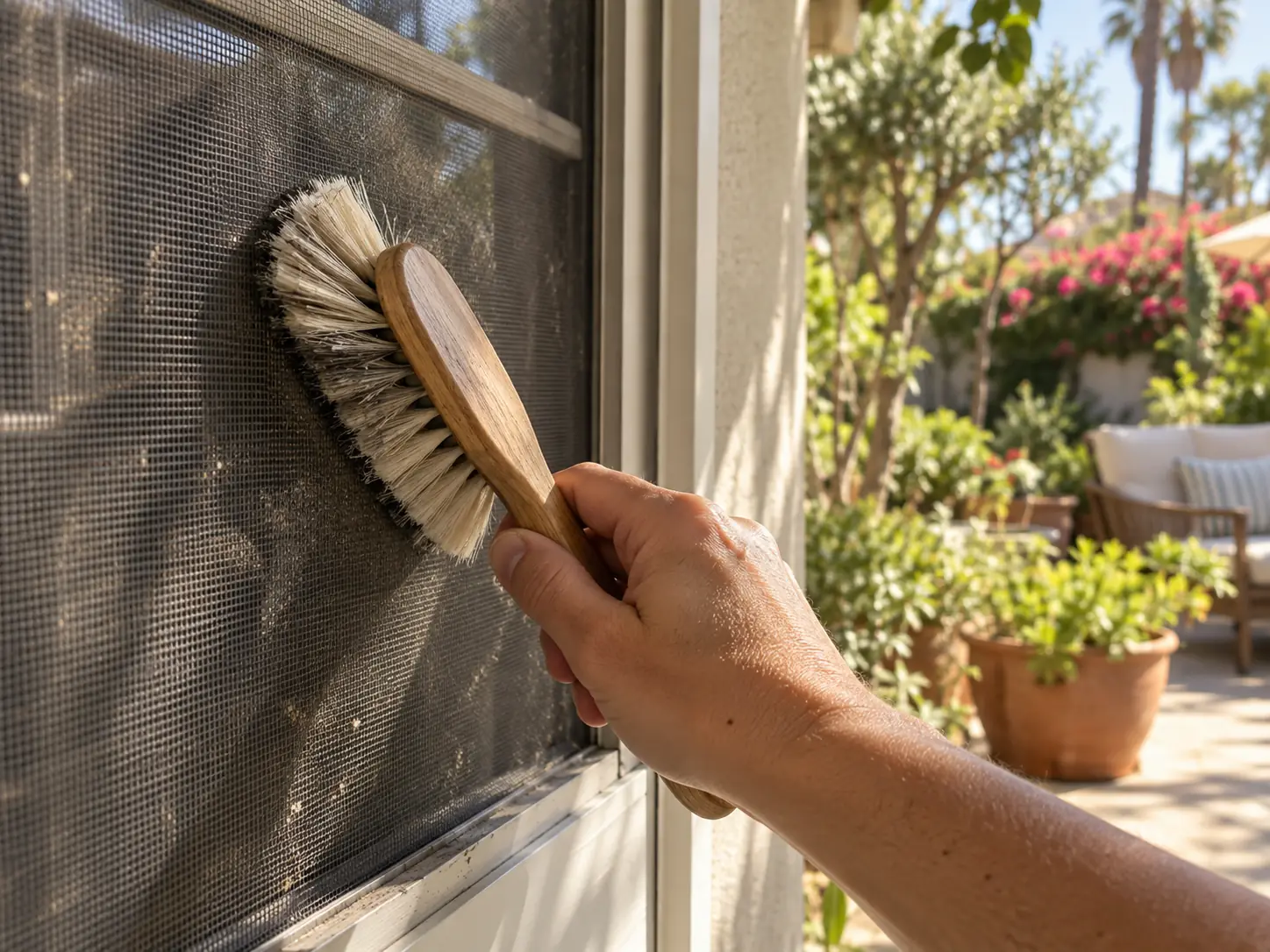
- Vacuum the surface with a soft brush attachment to remove loose dust.
- Scrub gently with a soft brush and soapy water, front and back.
- Rinse with a hose on a low setting. Avoid a pressure washer because it can bend the mesh.
- Let dry fully before reinstalling.
- Inspect for holes. Small holes can be patched with a screen repair kit.
Do not fold or press hard on fiberglass or aluminum screens, since they dent.
Tracks and sills
Tracks collect grit, dead insects and water stains, and they affect how windows slide.
- Vacuum loose debris using a crevice tool.
- Use a soft brush to loosen packed dirt.
- Wipe with a damp cloth and a drop of dish soap. A cotton swab or an old toothbrush works for corners.
- For stuck-on grime, spray with a small amount of soapy water or a diluted vinegar solution (not on stone) and let sit for 5 minutes.
- Wipe clean and dry with a cloth.
- Apply a small amount of silicone-based lubricant if the maker recommends one. Skip oil-based lubricants that attract dust.
Weep holes at the bottom of the track let water drain out. Make sure these stay open. A pin or toothpick clears them.
Hard-water and sprinkler spots
White spots on exterior glass often come from sprinklers or irrigation water. They are mineral deposits that dry on the surface and do not wash off with soap.
- Wet the glass with a 1:1 mix of white vinegar and water, using a spray bottle.
- Let it sit for 5 to 10 minutes without drying. Re-wet if it does.
- Scrub with a non-scratch pad.
- Rinse and squeegee.
- Repeat for stubborn spots.
If spots remain, glass may be etched. Etching is damage to the surface and cannot be removed by cleaning. Specialty glass-restoration products exist but can be abrasive, so test them on a small area or consult a professional.
To prevent spots, aim sprinklers away from windows. Much of Orange County has hard water, so this is a recurring problem (check your water provider’s quality report for local numbers).
Coastal salt film
Near the coast, salt in the air leaves a thin hazy film on exterior glass that can look like a streak from inside. It dissolves in water, so more frequent washing with plain water and a bit of soap works better than strong chemicals.
- Rinse the exterior with plain water from a hose first, to flush salt and sand before you scrub. Scrubbing sand across glass can scratch.
- Clean more often if you live close to the water.
- Wipe metal frames and hardware, which corrode faster from salt. Check the manufacturer’s guidance for your frame material.
Paint, stickers and sticky residue
- Paint specks: soften with warm soapy water, then scrape with a fresh razor blade held flat at a low angle. Keep the glass wet.
- Stickers: soak with soapy water, peel, then remove the adhesive with a drop of dish soap or rubbing alcohol.
- Tape residue: same approach.
- Tinted film or coated glass: do not use razors. Check the manufacturer’s care instructions.
Mistakes that leave streaks or damage glass
- Cleaning in direct sun. Water dries before you wipe.
- Using too much soap or spray. A film remains.
- Using paper towels or dirty cloths.
- Skipping the dust step. Wet dust becomes mud.
- Wiping blade-on-glass with a dirty blade. One piece of grit can scratch.
- Scraping dry glass. Always lubricate with soapy water.
- Cleaning frames last on the outside. Drips return.
- Using abrasive pads on coated glass.
- Pressure washing windows or screens. Water can enter seals and damage frames.
- Leaning out of windows. The risk is not worth it.
Troubleshooting
| Problem | Likely cause | Fix |
|---|---|---|
| Streaks in lines | Dirty squeegee blade or cloth | Wipe the blade after each stroke; use a clean cloth |
| Hazy film | Too much soap or product | Re-wash with plain water, then dry |
| Spots in drops | Hard water or sprinklers | Vinegar soak, then rinse |
| Lint | Paper towels or cotton | Switch to microfiber |
| Fog between panes | Failed seal | Cleaning cannot fix it; a window pro or manufacturer may help |
| Stuck windows | Dirty tracks | Vacuum and clean the tracks |
| Streaks only inside | Smoke, cooking grease | Use a degreasing dish soap solution |
| Streaks only outside | Salt, pollen, sprinkler water | Rinse first, use more frequent cleanings |
Tall, second-story and hard-to-reach windows
A good rule: if you need a ladder taller than a step stool, or you have to lean out of a window, stop. Second-story exteriors are a leading reason people hire professionals. Falls from ladders are a real hazard, and the work is awkward with a bucket and a squeegee.
You can still do the inside of those windows yourself. Hire out the outside. Some homes have tilt-in sashes that let you clean the exterior from inside, so check the manual before climbing.
Skip this step: if you have tall, second-story or hard-to-reach glass, our window cleaning service handles exterior and interior glass so you don’t need a ladder. As an add-on to a house cleaning, windows are $40. For cost ranges and what is included, see window cleaning cost in Orange County.
How often to clean
| Area | Typical frequency | Notes |
|---|---|---|
| Exterior glass | 2 to 4 times a year | More often near the coast, with sprinklers or heavy dust |
| Interior glass | 2 to 4 times a year, with spot cleaning between | More often with pets and children |
| Screens | Twice a year | Before spring and after fire or dust seasons |
| Tracks and sills | When you wash the glass | Vacuum monthly |
| Sliding doors | Wipe handprints weekly | Pets and kids |
Our detailed schedule is in how often to clean windows. After wildfire smoke or heavy ash, take care to avoid scratching glass with dry ash. See wildfire ash cleanup at home.
Keep windows clean longer
- Wipe handprints on glass doors with a damp cloth weekly.
- Wash the sills and frames when you clean the glass.
- Keep sprinklers pointed away from the house.
- Clean screens twice a year.
- Use a squeegee after showers for bathroom windows, to reduce spots.
- Trim plants that rub on glass.
- Keep a microfiber cloth near the door for quick touch-ups.
A printable checklist
- Choose an overcast day or shaded side of the house.
- Lay towels on sills and floors.
- Vacuum frames, tracks and sills.
- Mix warm water with a few drops of dish soap.
- Wash glass top to bottom.
- Squeegee, wiping the blade after each stroke.
- Wipe edges with a dry microfiber cloth.
- Check at an angle for streaks.
- Clean frames, sills and tracks.
- Wash and reinstall screens.
- Wash the exterior first, then the interior, next time you repeat.
When to call a professional
You can clean ground-floor and reachable windows with a bucket, a squeegee and an hour or two of patience. The result is as good as a pro’s when you control the sun, the soap and the blade.
A professional is a better fit for second-story glass, large picture windows, skylights, heavily neglected glass with mineral etching, and hard-to-reach exteriors. Pros also bring the right ladders and equipment and reduce the safety risk.
If you want it done along with a regular clean, add windows to a visit for $40. For a full reset, our deep cleaning for a 3 bedroom, 2 bathroom home is (60 + 75 + 70) x 1.5 = 205 x 1.5 = $307.50, and new customers get $39 off the first clean. Get a number for your own home using the instant quote.
Frequently asked questions
What is the best homemade window cleaner?
Warm water with a few drops of dish soap, removed with a squeegee, is the most dependable. For touch-ups, a spray of water with a little vinegar or rubbing alcohol works. Use less soap than you think you need.
Why do my windows streak?
Most streaks come from cleaner left on the glass, dirty cloths or blades, or cleaning in direct sun so the water dries too fast. Dirt on the frame can also drip onto clean glass.
Is vinegar good for cleaning windows?
It helps on light haze and mineral spots and makes a good final wipe. It is not a strong degreaser, and it should not be used on natural stone sills. Wash with soap first.
Should I clean windows inside or outside first?
Do the outside first, then the inside. It is dirtier, and doing it first means you won’t drag grime inside. Use different stroke directions on each side to find streaks.
What do professionals use to clean windows?
Typically a bucket of water with a small amount of soap, a scrubber, a squeegee and a lint-free cloth. The technique matters more than the product.
Can I clean windows on a sunny day?
You can, but it is harder. Water dries quickly on hot glass and leaves streaks. Clean in shade, in the early morning or on an overcast day.
Do I need to clean window screens?
Yes, twice a year is a good guide. Dusty screens dim the light and put grit back on the glass. Use a soft brush, soapy water and a low-pressure rinse.
How do I remove hard-water spots from windows?
Wet the glass with equal parts white vinegar and water, let it sit for several minutes, scrub with a non-scratch pad, and rinse. Etched glass cannot be repaired by cleaning.
Are newspapers or paper towels good for windows?
They can leave lint or ink and may scratch dirty glass. Use microfiber or a lint-free cloth instead.
How do I clean window tracks?
Vacuum loose debris, loosen packed dirt with a soft brush, wipe with a damp cloth and a drop of dish soap, and dry. Keep the weep holes clear.