Care Habits
How to reduce dust in your home: what actually works
You cannot get rid of household dust completely, but you can cut how much builds up by dusting top to bottom with a damp microfiber cloth, vacuuming with a sealed or HEPA-filter vacuum, washing bedding and soft items regularly, using a decent HVAC filter your system can handle, and stopping dust at the door. Those five habits do more than any gadget.
Dust is a mix of outdoor soil and pollen, fabric fibers, skin flakes, pet hair and dander, cooking residue, and tiny bits of everything else in the house. Because so much of it comes in from outside, how you clean matters as much as how often. This guide covers what works, what only moves dust around, and how to build a routine that keeps things down in Orange County conditions.
Quick answer
- What you need: a few microfiber cloths, a vacuum with good filtration, an extendable duster or a vacuum brush, a doormat, an HVAC filter that fits your system, and washable bedding.
- Time: a full top-down dusting of an average home takes roughly one to two hours the first time, then much less once it is routine.
- Cost of supplies: modest. The biggest line item is usually a better vacuum or filters.
- Difficulty: easy, but order and technique matter.
- How often: high-touch surfaces weekly, full rooms every one to two weeks, and the overlooked spots (vents, fans, blinds, tops of cabinets) monthly.
What dust is and why it keeps coming back
Dust is not one substance. It is a blend that changes from house to house.
- Outdoor particles: soil, pollen, and fine grit that enter on shoes, clothes, pets, and through windows and gaps.
- Fibers and fabric lint: from clothing, bedding, towels, rugs, and upholstery.
- Skin and hair: people and pets shed constantly.
- Cooking and combustion residue: fine particles from the kitchen, candles, and fireplaces.
- Debris from the building: drywall dust, insulation fibers, and paint particles, especially after renovations.
New dust appears every day. Even a spotless house will show a light film within a week. The goal is not to prevent every particle but to reduce the amount that enters, trap what does, and remove it without throwing it back into the air.
The dust control principles
Three ideas explain most of what works.
- Reduce sources. Less soft clutter, less tracked-in grit, fewer open-air pathways.
- Capture rather than disturb. Microfiber, damp cloths, and filtered vacuums trap particles. Feather dusters and dry rags launch them.
- Work in the right order. Dust falls. Start high, finish low, and finish with the floors.
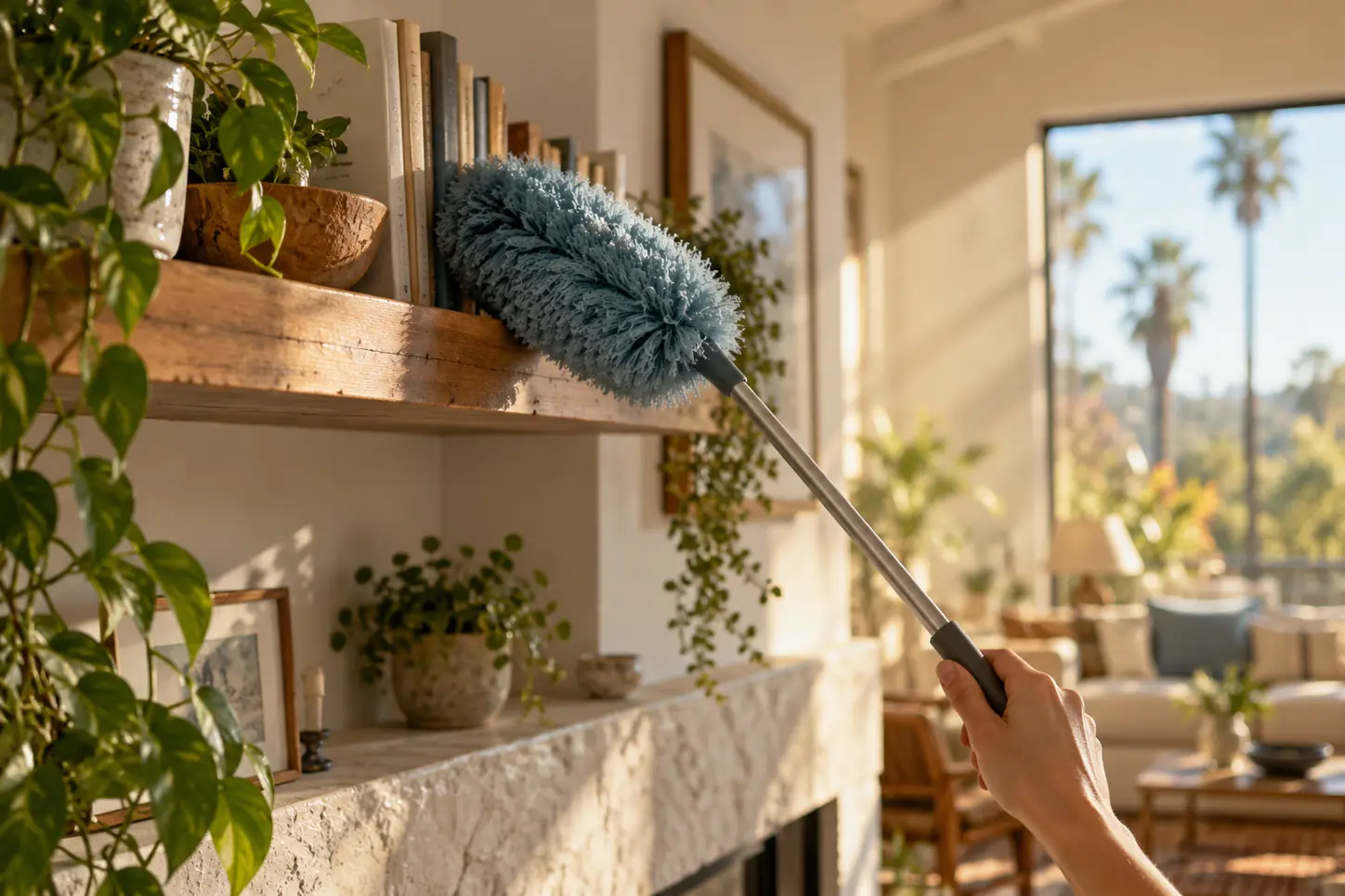
Top-down: the order that saves you from redoing work
If you dust the coffee table and then the ceiling fan, the fan will drop a fresh layer on the table. The rule is always the same.
- Ceiling and corners: cobwebs, ceiling fan blades, light fixtures (once cool and off).
- Tops of tall furniture, cabinets, and shelves.
- Walls, art, window frames and sills, blinds.
- Mid-level surfaces: dressers, desks, TV stands, countertops.
- Low surfaces: baseboards, chair legs, the lower shelves.
- Floors, last, so they collect what fell.
For particular items, our guides on cleaning blinds and ceiling fans and baseboards and walls give step-by-step methods that fit into this order.
Open a window a crack for ventilation only if the air outside is not dusty or smoky. Some people run the HVAC fan during dusting and for a few minutes after to pull airborne dust through the filter.
Dry dusting vs damp dusting
This is where many routines go wrong.
| Method | What it does | Best for | Watch out for |
|---|---|---|---|
| Feather duster | Flicks dust off surfaces into the air, where it resettles | Delicate objects where you want a light touch | Spreads dust around; not suited for allergy control |
| Dry cloth or old T-shirt | Moves some dust, leaves some, can scratch | Quick wipe of smooth, light dust | Cotton cloths leave lint and do not hold fine dust well |
| Dry microfiber | Holds dust through its fine fibers and static | Electronics, shelves, lightly dusty surfaces | Needs shaking out or washing regularly or it just redistributes |
| Slightly damp microfiber | Grabs and holds dust, prevents it re-floating | Most hard surfaces: wood (sealed), laminate, painted, glass | Too wet can mark unfinished wood or damage electronics |
| Vacuum with brush attachment | Pulls dust into a container | Blinds, upholstery, vents, books, lampshades, crevices | Poor filtration blows fine dust back out |
| Static dusting wand | Attracts dust with static charge | High and hard-to-reach spots | Loses charge; may leave shedding fibers |
A damp cloth is the best everyday tool for sealed hard surfaces. Use a cloth that is barely damp, not dripping, and fold it so you have a clean side as you go. When a section is full of dust, flip to a clean section instead of spreading.
Do not spray furniture polish or all-purpose cleaner directly onto every surface. Some polishes leave a film that attracts more dust. Plain water on a microfiber cloth is enough for most weekly dusting. Check the finish: unfinished or antique wood, veneers, and stone may have special care needs.
Do not use water on electronics, speaker grills, or screens. Use a dry microfiber cloth, and unplug items if you are cleaning near vents or ports. Follow the manufacturer’s instructions.
What you need
| Item | What it does | Notes |
|---|---|---|
| Microfiber cloths | Trap fine dust | Wash separately without fabric softener; softener can coat the fibers |
| Extendable duster or long-handled microfiber wand | Reaches fans, high shelves, corners | Wash the cover often |
| Vacuum with strong filtration | Captures fine particles without recirculating them | Look for a sealed system or a HEPA-type filter on the label; ask the manufacturer what the claim covers |
| Brush and crevice attachments | Cleans blinds, vents, upholstery, edges | Vacuum before wiping where possible |
| Doormats (inside and outside) | Catch grit at the entry | Wash or shake out regularly |
| Washable throw rugs | Easier to launder than wall-to-wall carpet | Wash according to the care label |
| Spare HVAC filters | Capture airborne particles | Size must match your system |
| Washable covers for pillows and mattresses | Reduce fabric dust | Launder on a schedule |
| Step stool | Reaches high spots safely | Never stand on a chair |
You do not need special sprays. A basic kit does the work.
Vacuuming: the most underrated dust tool
Vacuuming matters more than dusting for the dust that settles on floors, rugs, and upholstery, because that dust gets kicked back up whenever someone walks by.
- Use a vacuum that holds what it picks up. Vacuums with poor seals or worn filters send fine dust out the exhaust. Look for a sealed system and a filter that the maker describes as HEPA-type or high efficiency. Marketing terms differ, so read the product details.
- Empty the bin or change the bag before it is full. A packed bin loses suction and spills dust.
- Go slowly. Fast passes miss embedded dirt, especially in carpet.
- Vacuum in two directions on carpet to lift pile.
- Do hard floors too. Use a hard-floor setting or attachment so you do not scatter dust. Damp-mop afterward on suitable floors.
- Include the edges. Dust collects along baseboards and under furniture.
- Vacuum upholstery and mattresses with the upholstery tool. Our guide on how often to clean carpet and rugs covers schedules by traffic level.
Clean or replace vacuum filters according to the manual. A clogged filter turns a good vacuum into a dust spreader.
For hardwood and similar floors, see how to clean hardwood floors for damp-mop methods that do not damage the finish.
Stop dust at the door
A lot of indoor dust walks in.
- Shoes off at the entry. A shoe rack and a basket for guests help. Outdoor soil, pollen, and traffic residue ride in on soles.
- Doormats inside and outside. Use a rough mat outside and an absorbent one inside, and wash them.
- Seal gaps. Door sweeps, weatherstripping, and window seals reduce how much outside air leaks in. Check your lease or HOA before changing exterior elements.
- Pet routine. Wipe paws and brush pets outside. Our post on keeping a clean home with pets has more on managing fur and dander.
- Coats and bags. Hang them away from bedrooms to avoid carrying outdoor dust to the bed.
Your HVAC system and filters
Heating and cooling systems move your home’s air through a filter, and in many homes that air circulates several times an hour, so the filter has a real effect on airborne dust.
MERV basics
MERV is a rating scale for filter efficiency. Higher numbers catch smaller particles. In general:
| MERV range | Typical use | What to know |
|---|---|---|
| 1 to 4 | Basic disposable filters | Mostly protect the equipment by catching large debris; let fine dust pass |
| 5 to 8 | Standard residential | A step up for dust and pollen |
| 9 to 12 | Better residential | Often suggested as a balance of dust capture and airflow |
| 13 and up | High efficiency | Can restrict airflow in systems not designed for them |
Treat these ranges as general guidance. The right filter depends on your system. A very dense filter in a system built for a basic one can reduce airflow, strain the blower, and cause problems. Check the owner’s manual or ask an HVAC technician which rating your system can handle before upgrading.
Replace on schedule
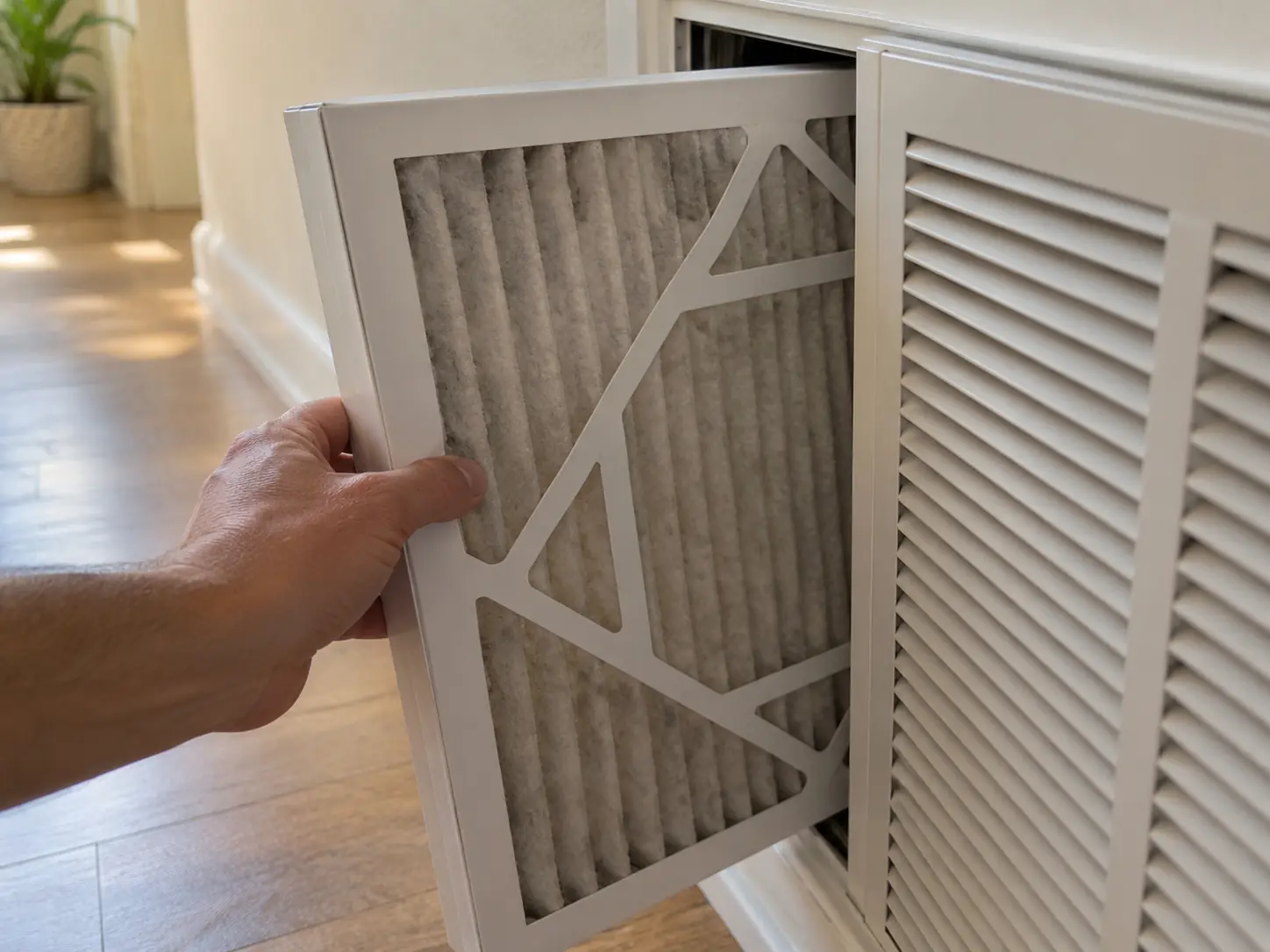
Filter life varies by type, thickness, and how dusty the house is. Many manufacturers suggest replacing standard one-inch filters every one to three months, with thicker media filters lasting longer. A dusty household, pets, or heavy use shortens that. Check the filter monthly and replace it when it looks gray and clogged. Write the date on the frame.
Other HVAC tips
- Run the fan a bit longer after cleaning if your system allows it, so dust passes through the filter.
- Wipe the vents and registers. Vacuum with a brush attachment and wipe with a damp cloth.
- Check that filters fit. A gap around the edge lets unfiltered air by.
- Consider duct inspection if dust seems to pour from vents, if rooms are dusty right after the system starts, or if there is visible debris around registers. A professional can tell whether ducts are leaking or contaminated. Routine duct cleaning is not always needed, so ask what they find and why.
Air purifiers
A portable purifier with a HEPA-type filter can help in a bedroom or living space if sized for the room. It reduces airborne particles but does not remove dust already on surfaces. Look for the room size and the clean air delivery information on the label, run it consistently, and replace filters on schedule. It is a supplement, not a substitute for cleaning.
Reduce the places dust hides
Dust settles where air is still and surfaces are textured.
| Dust trap | Why it collects dust | What to do |
|---|---|---|
| Decor on open shelves | Many small surfaces | Fewer items, or use glass-front cabinets |
| Heavy curtains | Fabric holds dust | Wash or vacuum monthly; consider washable panels |
| Wall-to-wall carpet and shag rugs | Fibers hold fine dust | Vacuum often; wash rugs that allow it |
| Throw pillows and blankets | Shed fibers and trap particles | Wash covers regularly |
| Blinds | Many slats | Wipe slats; consider simpler shades |
| Books and papers | Pages hold dust | Dust edges; store in closed shelves |
| Under beds | Low airflow | Clear space and vacuum; use closed storage |
| Electronics | Static attracts dust | Dry microfiber; keep vents clear |
| Ceiling fans | Blades gather film | Wipe monthly; clean before wiping tables |
| Clutter | Hides dust and slows cleaning | Declutter surfaces |
You do not have to live without textiles. The point is to know where dust accumulates and clean those places on a schedule. If allergies are a concern, our guide on reducing household allergens goes deeper on that topic.
Bedroom dust
Because you spend hours in bed, bedroom dust is worth extra attention.
- Wash sheets weekly or every other week, and pillowcases more often if you like. Follow care labels for water temperature.
- Use a mattress protector and wash it regularly.
- Wash or replace pillows as the label recommends.
- Vacuum the mattress occasionally with the upholstery tool. For deeper treatment, our guide on cleaning a mattress at home walks through it.
- Limit what is stored under the bed, and use lidded containers.
- Keep the door closed to pets if dander is a problem.
Dust mites live in bedding and soft furniture and feed on skin flakes. You cannot eliminate them, and the evidence on how much any single step helps varies, so treat the above as reasonable habits rather than a guarantee. If someone in the home has asthma or serious allergies, talk to a doctor about what to do.
Kitchen dust and grease
In the kitchen, dust mixes with cooking grease and becomes sticky, which makes it harder to remove. Wipe surfaces weekly, run the hood fan, and clean the tops of cabinets, where the layer builds up. If cabinets already have a gray film, see how to clean greasy kitchen cabinets for a method by finish.
Orange County dust sources
Local conditions add to the usual list. Our article on why Orange County homes get dusty fast explains these in detail, but here is what matters for your routine.
- Dry season and Santa Ana winds. Long dry spells and offshore wind events can carry fine dust and, at times, smoke and ash into the area. After a wind event or a wildfire, see wildfire ash cleanup at home for safe methods before you sweep or blow anything.
- Open windows. Many people here live with windows open for much of the year. That is pleasant but brings in outdoor particles. On windy or smoky days, keep windows closed and run the HVAC.
- Construction and busy roads. New development and traffic add fine particles to the air in many neighborhoods.
- Coastal air. Near the coast, salt and sandy grit settle on windowsills and patio doors and can make surfaces gritty.
- Condos and HOAs. Shared walls, shared ventilation, and rules about exterior changes can limit what you can modify. Check your documents before altering vents or exterior seals.
Check local air quality information on days when winds or smoke are an issue, and use it to decide whether to ventilate.
A weekly routine that keeps dust down
| Day or frequency | Task | Time |
|---|---|---|
| Every day | Shake out the doormat or wipe shoes; close windows on windy days | 2 minutes |
| Weekly | Damp-dust high-touch surfaces and visible shelves | 20 to 30 minutes |
| Weekly | Vacuum high-traffic floors and rugs | 20 to 30 minutes |
| Weekly | Wash sheets (or every other week) | Mostly machine time |
| Every two weeks | Vacuum upholstery; full-room damp dust | 30 to 45 minutes |
| Monthly | Ceiling fans, vents, blinds, tops of cabinets, baseboards | 45 to 60 minutes |
| Every one to three months | Check and change HVAC filter | 5 minutes |
| Quarterly | Wash curtains or covers, vacuum mattresses, clean under furniture | 1 to 2 hours |
| Twice a year | Wipe windows and tracks, wash pillows and throw blankets | Varies |
If you also use a weekly checklist, our weekly house cleaning checklist puts dusting in the context of the whole home, and how often to clean everything gives frequencies for more items.
Mistakes that make dust worse
- Dry dusting with a feather duster. It sends particles back into the air.
- Dusting after vacuuming. The dust that falls will land on a clean floor.
- Using a vacuum with a weak filter. It exhausts fine dust.
- Overloading a damp cloth. Too much water leaves streaks and can damage finishes.
- Forgetting the HVAC filter. A clogged filter does nothing and can strain the system.
- Using a much denser filter than your system can handle. Check with the manual or a technician.
- Skipping high places. Dust on the fan and the cabinet top comes down later.
- Washing microfiber with fabric softener. It coats the fibers and stops them from grabbing dust.
- Cleaning only what shows. Hidden dust under beds, behind furniture, and in vents keeps feeding the rest.
- Opening windows in wind or smoke. You are inviting dust in.
Troubleshooting
| Problem | Possible cause | What to try |
|---|---|---|
| Dust returns in a day or two | Open windows, leaky ducts, dirty filter, shedding textiles | Check windows, change the filter, vacuum soft furnishings |
| Fine gray dust on dark furniture | Normal settling; polish film | Damp microfiber, skip silicone-heavy polish |
| Dust near vents | Dirty registers or ducts, or a poorly fitted filter | Clean registers, check filter fit, consider an inspection |
| Gritty windowsills | Outdoor soil, sand, wind | Vacuum first, then damp wipe |
| Sneezing in one room | Bedding, pet bedding, rugs, dust mites, or something else | Wash bedding, vacuum, and talk to a doctor if symptoms persist |
| Dust after renovation | Drywall and sanding particles | Wet wipe, HEPA vacuum; see the post-construction guide below |
| Static cling dust on TVs | Static charge | Dry microfiber or an antistatic cloth made for electronics |
After remodeling, fine dust can get into vents and cabinets. Our article on what to expect from post-construction cleanup explains why it takes more than a normal clean.
When it is worth handing off
When it is worth handing off: Reaching high shelves, ceiling fans, vents, blinds, and baseboards takes time, and these are the spots that get skipped. A deep cleaning visit is a good way to reset a dusty home, and recurring cleaning keeps it from building up again. Our crews use eco-friendly products and bring their own equipment.
For a rough cost, a 3 bedroom, 2 bathroom home has a base price of $60 + (3 x $25) + (2 x $35) = $205. A deep clean uses a 1.5 multiplier: $205 x 1.5 = $307.50. A recurring clean is $205, and biweekly service takes 15 percent off: $205 x 0.85 = $174.25. You can run your own numbers on the pricing page. New customers get $39 off the first clean.
When to call a professional
DIY dusting works for most homes. Some situations call for help.
- Ducts and HVAC. If dust pours from vents, the system is old, or you suspect leaks, an HVAC technician can inspect it. A cleaner cannot fix duct problems.
- Mold or water damage. Dark spots that are not dust, or a musty smell, need a different approach.
- After construction or fire. Fine dust and ash need specific methods. See our guides on post-construction cleanup and wildfire ash.
- Health concerns. If dust triggers asthma or severe allergies, ask a doctor about a plan, and consider having someone else do the dusting while you are away.
- Big first-time reset. If a home has not been deep cleaned in a long time, a team can do in one visit what takes days alone, and then a routine takes over.
A cleaning team is not a substitute for filters, entry habits, or bedding care. It helps by handling the heavy, high, and repetitive jobs so your routine stays short. See the pricing page for an instant quote.
Frequently asked questions
Why is my house so dusty all the time? Dust comes from outdoors, fabrics, people, and pets, and some homes collect it faster because of open windows, leaky ducts, a clogged HVAC filter, or lots of soft furnishings. In Orange County, dry weather and wind add outdoor dust. Fixing the entry, filter, and cleaning method usually helps most.
What is the best way to dust so it does not come back? Dust top to bottom with a slightly damp microfiber cloth, vacuum last with a filtered vacuum, and keep up the habits that stop new dust. Nothing prevents it entirely.
Does a feather duster work? It tends to flick dust into the air instead of capturing it. A microfiber cloth or a vacuum brush traps dust better.
Is damp dusting better than dry dusting? For sealed hard surfaces, usually yes, because the moisture helps hold dust. Use dry microfiber on electronics and delicate or unfinished items.
What MERV rating should I use? Many sources suggest a mid-range filter, around MERV 8 to 12, as a balance between catching dust and keeping airflow. The right choice depends on your system, so check the manual or ask a technician before going higher.
How often should I change my HVAC filter? Often every one to three months for standard filters, and sooner with pets, heavy use, or lots of dust. Follow the manufacturer’s guidance and check it monthly.
Do air purifiers reduce dust? A HEPA-type purifier can reduce airborne particles in a room sized for it, but it does not clean surfaces. Use it alongside regular cleaning.
Should I vacuum or dust first? Dust first, then vacuum, because dusting drops particles onto the floor.
Does dust cause health problems? Dust can irritate eyes, noses, and airways, and it can aggravate allergies or asthma in some people. If you have symptoms, talk to a doctor. This guide is general cleaning information, not medical advice.
How do I get rid of dust after renovation? Wipe surfaces with damp cloths, use a filtered vacuum, replace the HVAC filter, and expect several rounds. Heavy dust is a good reason to bring in a professional crew.