Care Habits
How to Remove Hard Water Stains and Limescale at Home
Hard water stains are mineral deposits, mostly calcium and magnesium, left behind when water evaporates. A mild acid dissolves them: white vinegar for light spots, citric acid for stubborn ones, and a commercial limescale remover for heavy buildup on surfaces the label says it is safe for. The method is always the same: wet the stain with the acid, give it time to work, scrub gently, rinse well, and dry. The one big exception is natural stone, where acid causes damage.
This guide covers what the stains are, which acid is right for each surface, step-by-step fixes room by room, the stone warning, mistakes to avoid, and how to stop the stains from coming back.
Quick answer
- Time: 5 to 15 minutes of dwell time per spot, plus scrubbing. A whole bathroom takes about an hour.
- Supplies cost: usually under $10 for vinegar or citric acid, a scrub pad, and microfiber cloths.
- Difficulty: easy for fresh spots, moderate for old crust.
- How often: wipe fixtures dry daily, do a mineral clean every 2 to 4 weeks in hard water areas.
- Skip the acid if: the surface is marble, travertine, limestone, or unsealed natural stone, or if you do not know what the finish is. Test first, always.
What hard water stains are
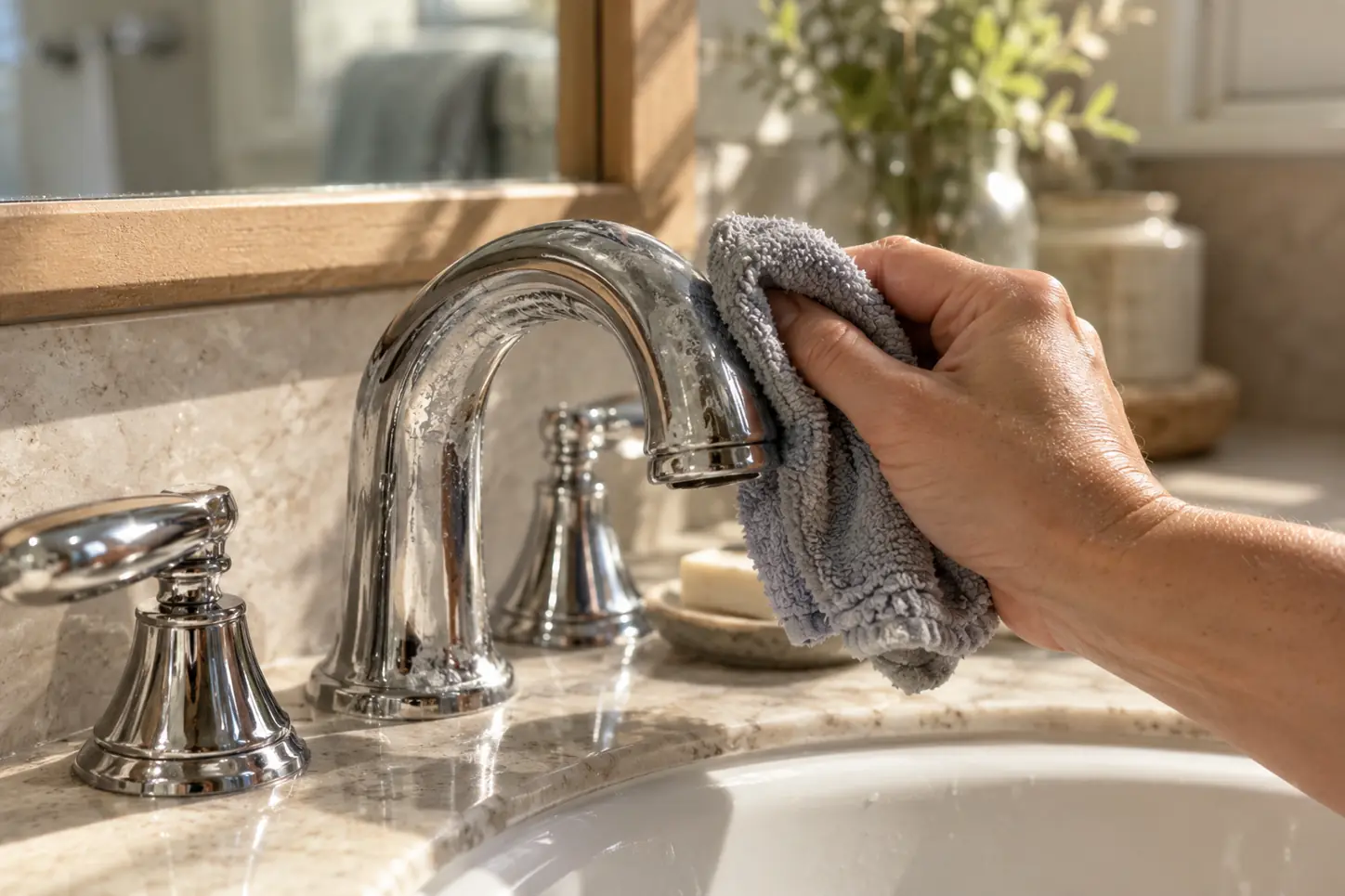
Water picks up minerals as it moves through rock and soil. “Hard” water carries more of them, mostly calcium and magnesium. When a drop of water evaporates, the water leaves and the minerals stay. Repeated over weeks, those tiny rings become white crust, cloudy film, or rough scale.
Some key points:
- The stains are alkaline, which is why an acid works to dissolve them.
- They are not a sign of dirt. A very clean home can have plenty of them.
- Heat makes it worse. Kettles, coffee makers, water heaters, and hot faucets build scale faster.
- Rust-colored stains or orange tint are different. They usually point to iron in the water or old pipes, and need a rust remover rather than a limescale remover.
- Green or blue streaks under faucets usually mean copper or brass corrosion, not hard water alone.
Quick answer by surface
| Surface | Safe approach | Avoid |
|---|---|---|
| Glass (shower doors, windows) | Vinegar or citric acid, non-scratch pad, squeegee | Abrasives on coated glass, razor blades on coated glass |
| Chrome faucets | Diluted vinegar or citric acid, short contact, rinse | Long soaks, steel wool |
| Brushed nickel, brass, bronze, oil-rubbed finishes | Mild soap first. Acid only briefly if the maker allows it | Strong acids, long contact, which can strip the finish |
| Stainless steel sinks | Vinegar wipe, rinse, dry with the grain | Chlorine bleach, steel wool |
| Porcelain and ceramic tile (glazed) | Vinegar or citric acid, soft brush | Strong acids on grout |
| Grout | Mild cleaner, brief acid contact only if sealed | Long acid soaks (they erode grout) |
| Porcelain toilet bowl | Citric acid or toilet bowl descaler, brush | Mixing with bleach |
| Acrylic and fiberglass tubs | Mild soap and diluted vinegar, short contact | Abrasive powders, strong acids |
| Natural stone (marble, travertine, limestone, some granite) | pH-neutral stone cleaner only | Vinegar, lemon juice, citric acid, any acid |
| Showerheads | Vinegar soak, brush the nozzles | Soaking brass or special finishes for long periods |
| Dishwashers and kettles | Citric acid cycle or soak | Using on non-food-safe products |
When a finish matters and you are unsure, start with mild dish soap and warm water, then escalate gradually.
Choosing an acid
Different acids have different strengths and risks. Choose the weakest one that works.
| Acid | Strength | Good for | Wrong for | Notes |
|---|---|---|---|---|
| White vinegar (about 5% acetic acid) | Mild | Light spots on glass, chrome, ceramic, kettles | Stone, unsealed grout, delicate finishes | Strong smell. Cheap and easy to find. |
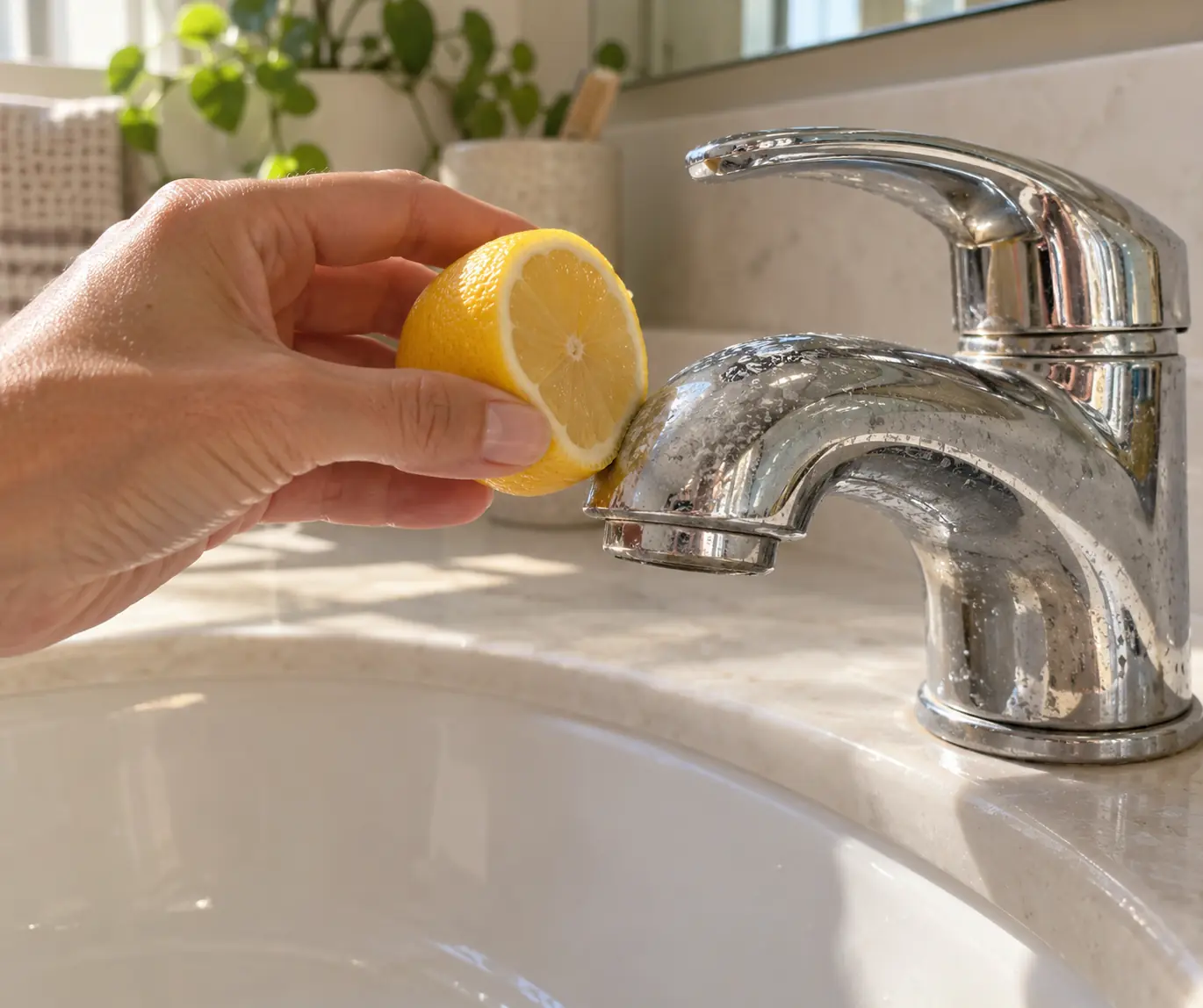
| Lemon juice | Mild | Small spots on chrome | Stone, fabrics | Weaker and less consistent than citric acid. Can leave sticky residue. |
| Citric acid powder | Mild to moderate | Showerheads, toilets, glass, kettles, dishwashers | Stone | Odor-free. Dissolve in warm water. |
| Commercial limescale remover (various acids) | Moderate to strong | Heavy scale on tough surfaces | Anything the label does not list | Follow contact time. Check fixture finish warnings. |
| Hydrochloric (muriatic) acid products | Very strong | Rarely right for homes | Most finishes, metals, grout | Often too aggressive. Use only if the label names your surface. |
A note on branded products: some well-known limescale removers contain acids strong enough to dull certain finishes, and the labels list surfaces to avoid. Read those lists before you spray, and test first.
What you need
| Item | What it does | Notes |
|---|---|---|
| White vinegar | Dissolves light mineral deposits | Use full strength or half and half with water. |
| Citric acid powder | Odor-free alternative | About 1 to 2 tablespoons per cup of warm water. |
| Spray bottles | Applies evenly | Label them. |
| Non-scratch scrub pads | Lifts loosened scale | Test on finishes. |
| Soft brush or old toothbrush | Reaches crevices and aerators | Keep one just for cleaning. |
| Microfiber cloths | Wipe and polish | Several, so you can swap. |
| Paper towels or old rags | Hold acid against vertical surfaces | Soak and press. |
| Zip bags and rubber bands | Hold vinegar around a showerhead or faucet | Cheap soaking method. |
| Squeegee | Prevents recurrence | A small one for the shower. |
| Gloves | Protect hands | Use them even with mild acids. |
| Baking soda | Mild abrasive paste for stubborn spots | Not for coated glass. |
Safety first
- Ventilate. Open a window or run the fan.
- Never mix acids with bleach or ammonia. Bleach and vinegar release chlorine gas. See our list of products you should never mix.
- Test on a hidden area, wait for it to dry, and look at the result in good light.
- Do not leave acid on fixtures longer than needed. Short contact, then rinse.
- Keep acids off natural stone, including countertops, floors, and shower walls. Splash drips get wiped up immediately.
- Wear gloves and eye protection for overhead work.
- Do not use acids on surfaces you are unsure about. Start with dish soap.
Step by step: the basic method
Use this approach on most surfaces, adjusting for the finish.
- Clear and wet. Wipe off loose dirt and soap with a damp cloth.
- Apply the acid. Spray vinegar or citric acid solution on the stain until wet. For vertical surfaces, hold it in place with a soaked paper towel or cloth.
- Wait. Give it 5 to 15 minutes. Keep it damp. Do not let it dry.
- Scrub gently. Use a non-scratch pad or soft brush. If the stain is thick, repeat the soak instead of scrubbing harder.
- Rinse well. Water removes dissolved minerals and leftover acid.
- Dry and buff. A dry microfiber cloth stops new spots and brings back shine.
Soak more, scrub less. Time does most of the work.
Step by step by location
Shower walls and glass (20 to 30 minutes)
Degrease with dish soap first if there is soap scum, then use the acid method. Squeegee at the end. Our detailed guide to cleaning shower glass and hard water covers door types, tracks, and etching.
Faucets and fixtures (10 to 15 minutes)
White crust often collects at the base of the faucet and around the aerator. Wrap a vinegar-soaked cloth around the base and leave it for 10 to 15 minutes. For polished chrome, that is usually safe. For brass, nickel, bronze, or special finishes, shorten the time to a couple of minutes, check the maker’s care guide, and rinse right away. Scrub gently with a soft toothbrush, rinse, and dry.
To clear the aerator (the screen at the tip), unscrew it by hand or with a cloth-wrapped tool, soak it in vinegar for 15 to 30 minutes, brush it, rinse, and screw it back on. If flow is weak, mineral clogging is a common cause.
Showerhead (30 minutes to overnight)
Fill a zip bag with vinegar, slip it over the showerhead, and secure it with a rubber band so the nozzles are submerged. Leave it 30 minutes to a few hours. For plated or brass finishes, keep the soak short and check it regularly. Remove, run hot water for a minute, and use a toothbrush on remaining deposits. Check that all spray holes are clear.
Toilet bowl (15 to 30 minutes)
Hard water rings form at the water line. Lower the water level by pushing it down with a toilet brush, or turn off the supply and flush so the bowl has less water. Apply citric acid solution or a toilet bowl descaler labeled for porcelain, wait 15 to 30 minutes, scrub with the brush, and flush. Never combine with bleach. Pumice stones are sometimes used on stubborn rings, but they can scratch porcelain, so use light pressure and a wet stone, and test first.
Sinks, bathroom and kitchen (10 minutes)
For porcelain and stainless steel, spray vinegar or wipe with a soaked cloth, wait several minutes, scrub, rinse, and dry. For stainless steel, wipe with the grain. Our guide to cleaning stainless steel appliances covers streak-free finishing.
Tile and grout (15 to 20 minutes)
Glazed tile handles mild acids well. Grout is more delicate, and repeated strong acid can wear it away. Use a mild solution, keep contact short, and rinse well. Seal grout afterward if it is due. More in our grout and tile guide.
Kettle and coffee maker (30 minutes)
Fill a kettle with equal parts water and white vinegar (or water with citric acid), bring it to a boil, turn it off, let it sit for 15 to 30 minutes, then pour out and rinse several times, boiling plain water once to remove the taste. For coffee makers, follow the manufacturer’s descaling instructions, because some warn against vinegar.
Dishwasher
White film on glasses often means hard water. Many dishwashers can run an empty cycle with a cup of citric acid or vinegar in a dishwasher-safe bowl, but check the manual first. A rinse aid helps prevent spotting. Our guide to cleaning a dishwasher covers the filter and spray arms.
Windows and glass exposed to sprinklers
Sprinkler overspray leaves white spots on outdoor glass, car windows, and patio doors. Wet the glass with vinegar solution, wait, scrub with a non-scratch pad, rinse with clean water, and squeegee. Long-term spotting can etch glass, so address it early and adjust sprinkler aim if you can. For large windows or hard-to-reach panes, window cleaning is an option.
Washing machine and humidifiers
Scale builds in humidifiers and some appliance parts. Follow the maker’s descaling instructions.
Natural stone warning
Marble, travertine, limestone, and some other stones contain calcium carbonate. Acids react with it and dissolve the surface, leaving dull, etched marks that cannot be wiped off. That means:
- No vinegar, lemon juice, citric acid, or acid-based tile cleaners on stone.
- Use a pH-neutral cleaner labeled for stone.
- Wipe spills and splashes quickly.
- If a stone shower wall has water spots, a stone professional is the safer choice than experimenting.
Granite is more resistant, but it is often sealed, and acid can break down the sealer. When you are unsure of the stone, treat it as acid-sensitive.
Troubleshooting
| Problem | Cause | Fix | Limits |
|---|---|---|---|
| Spots return within days | Water left to dry | Wipe or squeegee after use | Very hard water needs softening |
| Dull or cloudy chrome after cleaning | Too much scrubbing or long acid contact | Rinse, buff with microfiber | Plating damage is permanent |
| Brass looks dark or spotted | Finish stripped by acid | Stop using acid. Ask maker about refinishing | Often not fixable by cleaning |
| White crust inside a faucet | Scale in the aerator | Soak the aerator | If pipes are clogged, call a plumber |
| Orange or brown stains | Iron or rust in water | Use a rust remover labeled for the surface | Acid alone will not remove rust |
| Cloudy glass that never clears | Etching | Polishing compound or replacement | Etching is permanent |
| Stone looks etched | Acid contact | Professional stone polishing | DIY cleaning cannot fix etching |
| Film on dishes | Hard water minerals | Rinse aid, citric acid cycle | Dishwasher manual rules apply |
Common mistakes
- Using acid on natural stone. The most expensive mistake on this list.
- Letting acid dry on the surface. It leaves residue and can damage finishes.
- Scrubbing hard instead of soaking longer. Time beats force.
- Skipping the rinse. Leftover acid keeps working.
- Mixing cleaners. Never combine bleach with acids or ammonia.
- Using steel wool or harsh powders. They scratch chrome, glass, and acrylic.
- Ignoring the finish. Brass, bronze, and brushed finishes need extra care.
- Treating rust as limescale. Rust needs a different product.
- Cleaning but never drying. The stains return the same week.
Prevention
You cannot stop minerals from being in the water, but you can stop them from drying onto surfaces.
| Habit | Where | Time |
|---|---|---|
| Squeegee after showers | Glass and tile | 30 seconds |
| Wipe faucets dry | Bathroom and kitchen | 10 seconds |
| Rinse aid | Dishwasher | Part of each load |
| Run the exhaust fan | Bathroom | Automatic |
| Light vinegar spray weekly | Shower | 2 minutes |
| Descale kettles and coffee makers | Kitchen | Monthly or per maker’s guidance |
| Adjust sprinkler heads | Outdoor glass and walls | Once |
Longer term options include a water softener or filtration system. These are household decisions with costs, so look up your local water quality report, compare options, and ask a licensed plumber or water treatment provider. We do not recommend a specific system here.
Never use acid on these: surface by surface
Acid is the right tool for mineral scale and the wrong tool for several common materials. When a surface is on this list, switch to a pH-neutral cleaner, warm water, and patience.
| Surface | Why acid is a problem | Use instead |
|---|---|---|
| Marble, travertine, limestone, onyx | Contains calcium carbonate, so acid dissolves the surface and leaves dull etch marks | pH-neutral stone cleaner, a soft cloth, and prompt drying |
| Sealed granite and engineered stone | Acid can wear down sealer and dull the finish | Mild dish soap and water, then resealing per the installer |
| Unsealed or old grout | Cement-based grout erodes with repeated acid | Mild cleaner, brief contact, then rinse. See the grout guide |
| Brass, bronze, and oil-rubbed finishes | Acid can strip the lacquer or patina and leave blotches | Soap and water, soft cloth, dry right away |
| Brushed nickel with a PVD or special finish | Finish can cloud or lift | Check the maker’s care sheet, start with soap |
| Aluminum frames and cookware | Acid pits and darkens aluminum | Soap and water, rinse promptly |
| Cast iron and raw steel | Acid causes rust and removes seasoning | Hot water, scrub, dry, oil lightly |
| Coated or treated glass | Strong acid can wear the coating | Mild soap and a squeegee |
| Painted or lacquered surfaces | Can soften or dull the finish | Damp cloth and mild soap |
| Wood and laminate | Acid and standing water swell and dull them | Barely damp cloth, dry at once |
| Rubber seals and some gaskets | Long contact can dry and crack them | Soap and water |
The pattern is simple: if a surface is porous, plated, coated, or made of calcium, treat acid as a last resort. A hidden-spot test and a short contact time still apply to everything else.
Troubleshooting persistent stains
When a stain survives a first attempt, work out what failed before you try something stronger.
| Stain that stays | What probably failed | Why | Next step |
|---|---|---|---|
| White crust after vinegar | Contact time too short, or vinegar dried | Thick scale needs 15 minutes or more of wet contact | Hold a soaked cloth in place, re-wet it, repeat, then use citric acid |
| Haze that remains on glass | Soap scum under the minerals | Grease blocks the acid | Degrease with dish soap first, then redo the acid step |
| Ring in the toilet at the waterline | Water diluted the cleaner | Cleaner slid down the bowl | Lower the water level, apply descaler directly to the ring, wait, scrub |
| Spots that wipe off but return in days | Surface not dried | New minerals form as water evaporates | Squeegee and wipe after every use |
| Orange or brown streaks | Iron or rust, not limescale | Acid for scale does not remove iron staining | Use a rust remover labeled for that surface |
| Dull patch on chrome after cleaning | Too much scrubbing or acid contact | Plating or polish was worn | Rinse, buff with microfiber, and stop scrubbing |
| White cloudiness on sprinkler-hit windows | Etching from long exposure | Minerals have marked the glass | Try a glass polish on a test area, otherwise consider replacement |
| Crust deep in showerhead holes | Soak too short or not submerged | Nozzles were not fully covered | Re-soak with the nozzles fully submerged, then poke holes clear with a brush |
| Stains on stone that cleaning will not touch | Acid etching or deep absorption | Damage is in the stone itself | Ask a stone care professional about honing and polishing |
If two rounds with the right method and enough dwell time fail, the problem is usually permanent damage, not stubborn dirt. Stopping there protects the surface.
Hard water in Orange County homes
Water hardness varies across Orange County depending on the supply, and your provider’s annual water quality report lists the numbers for your area. Many homes see white spotting on shower doors, faucets, and dishes. Different cities can be served by different suppliers, so check your own report instead of assuming.
Some homes have softeners already. If yours does, you may see fewer deposits, though other minerals or residues can still appear. Homes with dry climates and frequent outdoor watering also pick up sprinkler spotting on windows and sliding doors, which is why outdoor glass looks cloudy.
If you rent, hard water crusts on bathroom fixtures and glass can be flagged at move-out. Cleaning them before inspection helps. See security deposits and move-out cleaning in California for what landlords commonly check, with the caveat that rules vary and you should read your lease.
When it is worth handing off: Heavy scale across several fixtures, a big glass shower, and sprinkler-spotted windows add up to a long afternoon. A deep clean covers detailed bathroom descaling. For a 2 bedroom, 2 bathroom home, the formula is ($60 + 2 x $25 + 2 x $35) x 1.5 = $270. A move-out clean for the same home is $180 x 1.6 = $288, which is handy if the hard water is part of a deposit concern: see move-out cleaning.
Frequently asked questions
What dissolves hard water stains? Mild acids. White vinegar and citric acid are the usual home choices. Commercial limescale removers use stronger acids and should be used only on surfaces their labels list.
Does vinegar remove hard water stains? Yes, for light to moderate deposits on glass, chrome, ceramic, and similar surfaces. It works best when it stays wet on the stain for 10 to 15 minutes. It is wrong for natural stone and risky on delicate metal finishes.
Will CLR damage my fixtures? Some strong limescale removers can dull or strip certain finishes, such as brass, nickel, and bronze, and can harm stone. Read the label for surfaces to avoid, test a hidden spot, keep contact short, and rinse. When unsure, use a milder acid.
How do you get hard water stains out of a toilet? Lower the water level, apply citric acid solution or a descaler labeled for porcelain, wait 15 to 30 minutes, scrub, and flush. Never mix with bleach.
Why are my windows and glass spotted with water? Sprinkler overspray or rain that dries on the glass leaves minerals. Clean them with a vinegar solution and squeegee, and consider adjusting sprinkler heads away from the glass.
Is lemon juice as good as vinegar? It is similar in strength but less consistent, and the sugars can leave sticky residue. Citric acid powder is a more reliable choice.
Can I use baking soda for hard water stains? Baking soda is mildly abrasive and can help scrub off a loosened film, but it does not dissolve minerals. It is not a substitute for the acid.
Can hard water stains be permanent? Yes. If minerals have etched glass, or acid or minerals have damaged stone or a finish, no cleaner reverses it. Early treatment prevents permanent damage.
Do water softeners remove existing stains? No. They reduce new deposits. You still need to remove old buildup.
How do I know if my water is hard? Look for white crust on faucets, spots on glasses, and a film in the shower. For numbers, read your local water quality report or use a test kit.
When to call a professional
A professional can spend the hours on a large shower, many fixtures, and tall windows, and knows when a finish is too fragile for acid. What you can do yourself is the habit side: wipe, squeegee, rinse, and the monthly mineral clean that keeps buildup from turning into crust.
If you want a price for a full-home reset, the instant quote takes about 30 seconds, with no obligation. New customers get $39 off their first clean. For outdoor glass spotting, see window cleaning and our guide on how often to clean windows. For a routine that prevents all of this, read our bathroom cleaning routine.