Care Habits
How to Wash Bedding, Pillows, and Comforters (and How Often)
Wash sheets and pillowcases once a week, duvet covers every one to two weeks, comforters and duvet inserts every one to three months, and pillows two to four times a year. Use the water temperature and cycle on the care label, make sure everything is completely dry before it goes back on the bed, and wash sooner after illness, spills, or a bad allergy week.
Most bedding problems come from three mistakes: overloading the machine so detergent never rinses out, drying things only partway so moisture stays in the fill, and ignoring the care label on feather or down items. This guide covers each fabric, each item, and the order that gets the whole bed done in a day without wrecking anything.
Quick answer
- Time: About 2 to 3 hours of mostly waiting for sheets and a comforter. Add a second day for a thick down or feather item that dries slowly.
- Difficulty: Easy for sheets and covers. Moderate for comforters and pillows because of size and drying.
- Cost of supplies: Low. Regular detergent, a few dryer balls (or clean tennis balls), and a stain pre-treater cover most homes.
- How often: Sheets weekly, covers every 1 to 2 weeks, comforters every 1 to 3 months, pillows 2 to 4 times a year, mattress protector monthly to every few months.
- Skip this if: The label says dry clean only, or the item is feather or down and too big for your machine. See the professional section near the end.
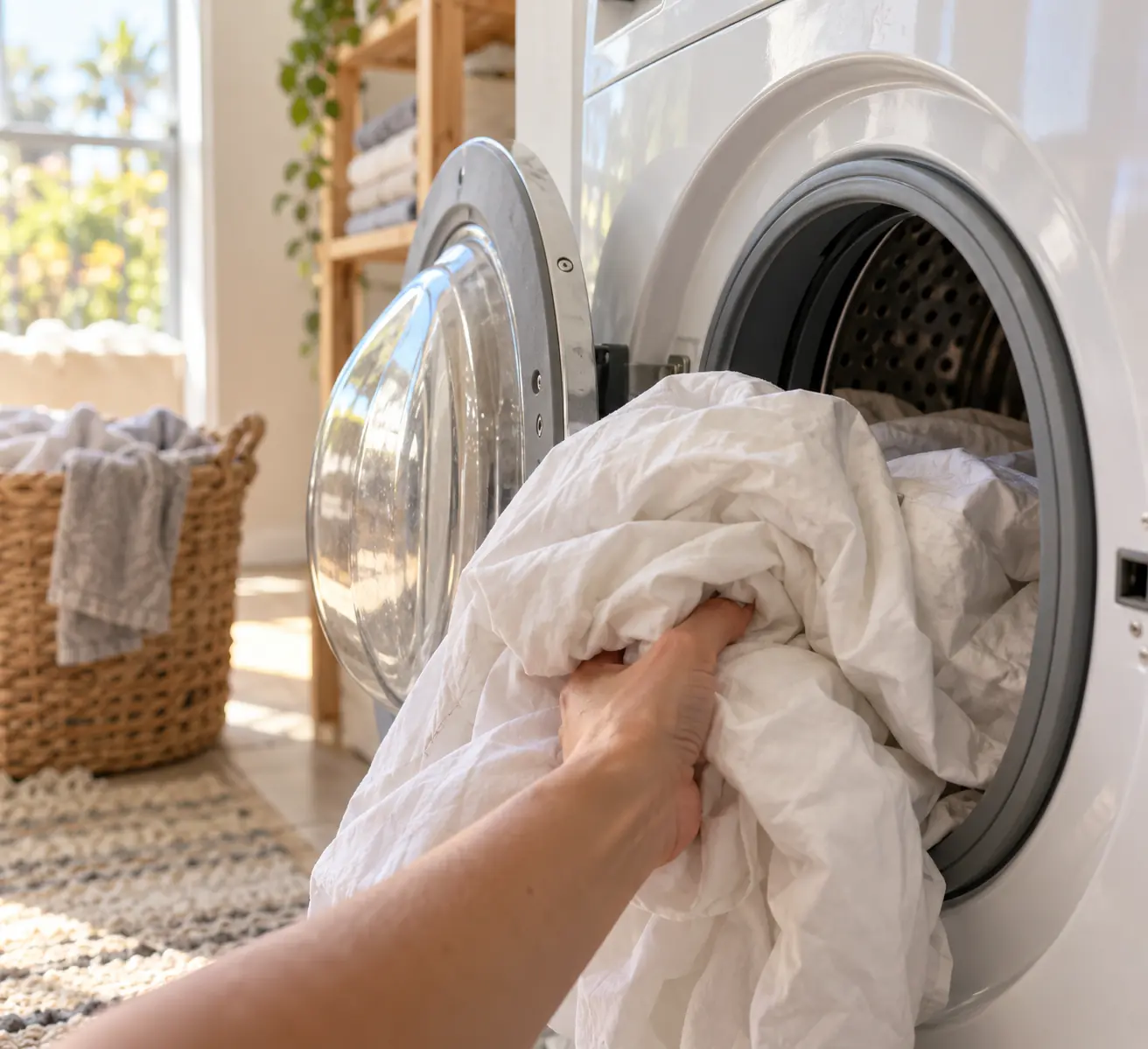
How often to wash each item
Sources disagree on exact intervals, and honestly nobody has one proven number. The ranges below are practical middle grounds. Shorten them if you sweat at night, share the bed with pets, have allergies, eat in bed, or just got over a cold.
| Item | Typical interval | Wash sooner if |
|---|---|---|
| Sheets (fitted and flat) | Weekly | Illness, night sweats, pets on the bed |
| Pillowcases | Weekly, or every few days with oily skin or acne-prone skin | Hair products, face creams, makeup |
| Duvet cover | Every 1 to 2 weeks (at least monthly) | Same as sheets |
| Comforter or duvet insert (no cover) | Every 1 to 2 months | Spills, kids, pets |
| Duvet insert (with a cover that you wash regularly) | A few times a year | Anything soaks through the cover |
| Blanket or throw on the bed | Every 1 to 3 months | Pets, food, illness |
| Pillows (washable fill) | Every 3 to 6 months | Odor, yellowing, flat and clumpy fill |
| Mattress protector | Every 1 to 3 months | Accidents, sweat, allergies |
| Mattress pad | Every 1 to 3 months | Same as protector |
| Bed skirt and decorative shams | A few times a year | Dust, pets |
If a number looks high to you, the useful way to think about it is contact. Sheets and pillowcases touch your skin every night. A comforter that sits under a duvet cover or on top of a top sheet touches it much less, so it can wait.
What you need
| Item | What it does | Notes |
|---|---|---|
| Regular liquid or powder detergent | Lifts body oils, sweat, and everyday soil | Use the amount on the bottle for your load size, then err on less for bulky items |
| Oxygen bleach powder (sodium percarbonate) | Brightens whites, helps with sweat yellowing, and works as a soak | Not for wool, silk, or items with a label that says no bleach. Test on a hidden corner |
| Stain pre-treater or enzyme spray | Breaks down protein stains like sweat, blood, and drool | Enzyme products work best on cool or lukewarm water; very hot water can set protein stains |
| Dryer balls or clean tennis balls | Keep fill from clumping while drying | Wool balls are quiet; tennis balls can leave a rubber smell on new ones, so wash them first |
| Large-capacity washer access | Needed for comforters | If yours is small, use a laundromat large front loader (the next section explains why) |
| Mild white vinegar (optional) | Some people add a splash to the rinse as a softener substitute | Never mix with bleach. Skip it if your washer manufacturer advises against it. See the safety box below |
Do not use: fabric softener on towels and moisture-wicking bedding (it coats fibers), chlorine bleach on down, feathers, or colored fabric, or more detergent than you need. Extra detergent is the most common cause of that stiff, slightly sticky feel.
Safety and fabric basics before you start
- Read the care label on every item. It is the one source that knows how that exact product was made. If the label and this article disagree, follow the label.
- Never mix bleach with vinegar, ammonia, or any acidic product. Do not combine cleaning products in the washer or in a bucket. Our guide on cleaning products you should never mix lists the dangerous pairs.
- Wash heavy comforters alone, not with clothing. They need room to move and rinse.
- Do not run the dryer if the fill is still wet and the item feels heavy. Damp fill that stays damp can grow mildew.
- If you have asthma or serious allergies, ask your doctor about your own bedding plan rather than relying on a general guide.
Water temperature by fabric
The care label comes first. When the label gives you a choice, this is a sensible starting point.
| Fabric or fill | Typical wash temperature | Dry setting | Watch for |
|---|---|---|---|
| Cotton sheets | Warm or hot if the label allows | Medium | Shrinkage on first washes, so avoid very high heat on new cotton |
| Cotton percale or sateen | Warm | Low to medium | Sateen can pill if washed too hot or with rough fabrics |
| Linen | Cool to warm, gentle cycle | Low, remove slightly damp | Linen softens with washing; high heat makes it brittle and wrinkly |
| Microfiber or polyester | Warm or cool | Low | High heat can melt or glaze the fibers and make them feel rough |
| Bamboo-derived or viscose blends | Cool, gentle cycle | Low | They often shrink and weaken with heat |
| Flannel | Warm | Low to medium | Lint from the first few washes; wash separately |
| Silk (pillowcases, sheets) | Cool, gentle or hand wash with silk-safe detergent | Air dry | Harsh detergent and heat ruin silk quickly |
| Synthetic fill comforter | Cool or warm | Low, with dryer balls | Clumping if loaded tightly |
| Down or feather | Cool or warm, gentle, extra rinse | Low, with dryer balls, for a long time | Mildew if not completely dry. Many labels say professional cleaning only |
| Wool blanket | Cool, wool cycle or hand wash | Air dry flat | Shrinks and felts with heat and agitation |
| Memory foam pillow | Do not machine wash | Air dry (spot clean only) | Water breaks down foam and takes days to dry |
You may read that you must use hot water to kill germs and dust mites. The health agencies cited by bedding sources have said hot water is not required for general household laundry, and detergent and a full wash cycle do the real work. If someone in your home has a specific infection or you are managing a diagnosed allergy, ask your doctor which temperature fits. A warm wash with a normal detergent is a reasonable default for most cotton and polyester bedding.
How to wash sheets and pillowcases
This is the weekly job. It takes about 10 minutes of hands-on time.
- Strip the bed (2 minutes). Pull off the pillowcases, flat sheet, and fitted sheet. Shake them out over a laundry basket rather than in the room so dust and skin flakes do not spread.
- Pre-treat spots (2 minutes). Apply a stain pre-treater to any makeup, drool, or sweat marks. Let it sit while you load the machine.
- Load the washer loosely (1 minute). Fill the drum about two-thirds full at most. Sheets twist into a rope in a crowded machine and trap detergent. A queen set usually fits; a king set plus a comforter does not.
- Choose the cycle (1 minute). Normal cycle for cotton and microfiber. Gentle for linen, silk, and bamboo blends. Use the temperature that fits the table above.
- Add detergent according to the bottle. If your sheets feel stiff afterward, you probably used too much. Cut back by a quarter next time, or add an extra rinse.
- Dry on medium or low (45 to 70 minutes). High heat is hard on elastic corners and shortens the life of the fabric. Take them out while a tiny bit of moisture remains, shake them, and either put them straight on the bed or fold them.
- Remake the bed. A tip that saves time: keep two sets of sheets per bed so you can put the clean set on right away and wash the first set while you do other things.
Why this works: the problem on sheets is body oil and sweat, which are mostly water-soluble or removable with ordinary detergent. The mechanical action of a loose load matters more than extreme temperature.
How to wash a duvet cover
A duvet cover is easy to wash and protects the insert, which is the hard part. Wash it every one to two weeks or on the same day as your sheets.
- Turn it inside out and close the buttons or zipper, so the corner ties do not snag.
- Tie or button the corner loops together to stop the insert’s tabs from tangling if you left them attached.
- Wash it on a normal or gentle cycle depending on fabric. Dry on medium or low.
- Check that corners are dry. Duvet covers hold moisture in the seams longer than the center.
How to wash a comforter or duvet insert
Wash this item every one to three months if you use it without a cover, and a few times a year if you use a cover and the cover is washed often.
Step by step
- Check the care label and measure. Look for words like “machine washable,” “dry clean only,” or “do not wash.” As a rough guide, a queen comforter often needs a 5 cubic foot drum or larger, and a king often needs more. Many home washers are too small. A tightly stuffed drum gives poor rinsing. If it does not fit loosely, use a large front-loading washer at a laundromat.
- Inspect for damage (3 minutes). Look for open seams or loose stitching. A small tear in a down comforter leaks feathers in the machine. Mend it first.
- Spot-treat stains (5 minutes). Dab with a mild detergent and cool water, or use a pre-treater suited to the stain. Do not rub hard on a thin fabric shell.
- Wash alone on a gentle cycle (about 45 to 60 minutes). Use cool or warm water as the label directs. Use a modest amount of detergent. Add an extra rinse if your machine has the option.
- Press out the water. If your washer has a final fast spin, use it. If water pools inside the fill, run another spin. A bulky wet comforter is heavy, so support its weight when you move it to avoid tearing the stitching.
- Dry on low heat for a long time (plan 2 to 4 hours). Add two or three dryer balls. Stop every 30 to 45 minutes to pull the comforter out and shake and re-spread the fill, breaking up any clumps with your hands.
- Test for dryness. Squeeze the fill in several places, especially along the seams and in the corners. It should feel light and fluffy, not cool or heavy. When in doubt, run it again or hang it over a rack for another day.
Why dryness matters: damp fill is the main reason a freshly washed comforter later smells musty. If you cannot get it fully dry the same day, it is better to hang it in a well-ventilated room or outside in dry air than to put it back on the bed.
Skip this step: If your comforter is too large for your machine, or the label says dry clean only, we do not wash bedding, but we can steam-clean and deodorize your mattress. See our mattress cleaning service (queen $75, king $95) for the surface your bedding sits on.
How to wash pillows
Wash pillows two to four times a year unless the label says otherwise. Replace them when they will not recover their shape (a folded pillow that stays folded is a common sign) or when stains and odors return right after washing.
Which pillows can go in the machine
| Pillow type | Machine washable? | Notes |
|---|---|---|
| Polyester fiberfill | Usually yes | Wash two at a time to keep the drum balanced |
| Down alternative | Usually yes | Dry slowly with dryer balls |
| Down or feather | Often yes, but check the label | Moisture left inside can cause mildew; some manufacturers advise professional cleaning |
| Memory foam (solid) | No | Spot clean only. Water ruins the structure |
| Shredded memory foam | Usually no for the foam; sometimes the cover is removable | Wash the cover only |
| Latex | No | Spot clean only |
| Buckwheat or millet hull | No | Empty the hulls, wash the cover |
| Body pillow with polyester fill | Usually yes | Large, so check drum size |
Method for machine-washable pillows
- Remove the case and any protector. Wash those separately.
- Spot-treat yellow sweat marks with a diluted detergent soak for about 15 minutes (a squirt of liquid laundry detergent in warm water), then blot.
- Wash two pillows at once, one on each side of the drum. This balances the load. A single pillow can throw the machine off balance and bounce around.
- Use a gentle cycle with an extra rinse and cool or warm water, per the label.
- Dry on low heat with dryer balls for 1 to 2 hours, pausing to fluff. Pillows are slow to dry in the center.
- Check dryness thoroughly. If you smell mustiness in the middle, it is still damp. Put it back for another round.
If a pillow has been through many washes and still smells, that is the fill breaking down, not dirt. Replace it.
Mattress protectors and pads
A protector is the cheapest way to keep a mattress clean and lets you handle the mess in the washing machine rather than on the mattress. Wash it every one to three months, or right away after an accident.
- Most waterproof protectors want cool or warm water and a low dryer heat. High heat can damage the waterproof backing.
- Skip fabric softener, which can reduce the protector’s performance.
- Do not iron them.
Washing the protector does not replace cleaning the mattress. For a full mattress routine, including vacuuming, stain removal, and drying, see our guide on how to clean a mattress at home. For professional costs, see how much mattress cleaning costs.
Dust mites, allergies, and what washing can and cannot do
Dust mites are microscopic and live in bedding, mattresses, and upholstered furniture, feeding mostly on shed skin. Washing bedding regularly reduces the number of mites and the allergens they leave, and many allergy sources recommend it. It does not remove them completely, and results vary from person to person.
What typically helps:
- Wash sheets and pillowcases weekly.
- Use zippered, tightly woven allergen-proof covers on pillows and mattresses (look for covers marketed as allergen barriers).
- Keep humidity in the bedroom reasonable and the room ventilated.
- Vacuum the mattress surface and the floor around the bed regularly.
- Reduce clutter and fabric decor on and around the bed.
If you have a diagnosed allergy or asthma, your doctor or allergist can tell you which of these matter most for you. Our general allergen reduction guide covers the whole house.
Common mistakes that damage bedding
- Overloading the washer. The bedding does not rinse properly. Fix: smaller loads, or a bigger machine.
- Using too much detergent. It leaves a film that feels stiff and attracts more soil. Fix: measure, and add an extra rinse when in doubt.
- Drying on high heat. It shrinks cotton, melts polyester fibers, and cracks waterproof backings. Fix: medium or low heat.
- Putting away damp pillows or comforters. Mildew follows. Fix: squeeze test, longer drying, or air drying in a ventilated room.
- Washing a feather duvet at home without checking the label. Fix: follow the label or pay a professional.
- Using fabric softener on everything. It coats fibers and reduces absorbency. Fix: skip it on towels, athletic bedding, and mattress protectors.
- Washing a stained item in hot water first. Heat can set protein stains like blood and sweat. Fix: pre-treat and wash cool or lukewarm.
- Ignoring the fitted sheet’s elastic. Fix: low heat. Remove it while slightly damp.
- Washing new sheets without washing first. Fix: wash them once before using to remove finishing agents.
Stain quick guide for bedding
| Stain | First step | Then | Avoid |
|---|---|---|---|
| Sweat yellowing | Soak in warm water with oxygen bleach powder (if safe for the fabric) | Wash as normal | Chlorine bleach on pillows or colored fabric |
| Blood | Rinse with cold water | Pre-treat with an enzyme product, then wash cool | Hot water |
| Drool or body oil | Dish soap on the spot, let sit | Wash as normal | Rubbing hard |
| Makeup or hair product | Dab with dish soap | Wash warm | Hot water on oil-based makeup |
| Coffee or tea | Rinse cold from the back | Pre-treat, wash | Drying before the stain is gone (heat sets it) |
| Urine | Rinse cold, then soak with an enzyme cleaner | Wash warm | Drying before the odor is gone |
| Ink or pen | Test isopropyl alcohol on a hidden spot, dab from the back | Wash | Heat |
For stains in the mattress itself, treat them with the steps in the mattress guide linked above. Wetting a mattress heavily and leaving it damp is a common way to cause mildew.
A realistic weekly and seasonal bedding schedule
| When | What |
|---|---|
| Every week | Strip and wash sheets, pillowcases. Wash duvet cover if used. Air the bed for 20 to 30 minutes before making it |
| Every 2 weeks | Duvet cover (if not weekly), blanket on the foot of the bed |
| Monthly | Mattress protector or pad if you sweat or have pets. Vacuum the mattress surface |
| Every 2 to 3 months | Comforter or duvet insert (more often if used without a cover) |
| Every 3 to 6 months | Pillows. Check whether any need replacing |
| Twice a year | Rotate or flip the mattress if the manufacturer says to. Wash bed skirts, shams, and decorative pillow covers |
| Yearly | Mattress deep clean. Replace worn-out pillows. Check the protector and replace if the waterproof layer has failed |
The Orange County angle
Many Orange County homes have hard water. Mineral content leaves a stiff feel on towels and bedding and can reduce how well detergent rinses out. Your water provider publishes a water quality report that shows hardness, so check yours rather than assume. If your water is hard, use the detergent amount on the bottle for hard water, consider an extra rinse, and avoid overdosing, since that makes the stiffness worse.
Coastal humidity near the beach cities and cooler mornings can slow air drying. If you hang a comforter outside, bring it in once it is dry and do not leave it out through damp evening air. Also, fine dust, pollen, and dry Santa Ana winds can leave a layer on anything hung outside, so shake items out and rinse the dust off the line first. Our post on why Orange County homes get dusty fast explains where that dust comes from.
Many condos and apartments have shared laundry rooms with small machines. If that is you, wash sheets at home and take the comforter and pillows to a laundromat with large front loaders, rather than forcing them into a tight drum.
When to call a professional
Hand off bedding that the label says is dry clean only, a large down or feather comforter that does not fit your machine, anything heavily soiled or moldy, and designer or hand-finished pieces. A dry cleaner or bedding specialist has larger machines and dryers and can dry thick fill fully. We do not wash or launder bedding ourselves, so for that job, ask your local dry cleaner.
What we do handle is the bedroom around the bedding. For the mattress itself, we offer a mattress cleaning service priced per item, and if you want help with the rest of the house, a recurring cleaning plan keeps the bedrooms on a schedule. As an example of our formula, a 3 bedroom, 2 bathroom home is (60 + 75 + 70) = $205 for a standard clean before any frequency discount, and biweekly service takes 15% off. Get your exact number with the instant quote.
If bedding is the part of your week that never gets done, our post on the weekly house cleaning checklist shows where laundry fits in a realistic routine, and how often to clean everything puts the rest of the house on a schedule.
Frequently asked questions
How often should you wash your sheets? Once a week is the common recommendation. If you sleep hot, share the bed with a pet, or have allergies, weekly is the minimum. If you sleep in a guest room that is rarely used, every two to four weeks is reasonable.
How often should you wash a comforter? Every one to three months for most households, and sooner after illness or spills. If you use a duvet cover and wash the cover regularly, the insert can wait longer, a few times a year.
Can I wash a comforter in a regular home washer? Sometimes. A twin or full may fit. A queen or king often does not, and a packed drum leaves detergent in the fill. If it does not fit loosely, a large front loader at a laundromat is the better choice.
How do you dry a pillow so it does not get lumpy? Use low heat, add two or three dryer balls, and stop every 30 to 45 minutes to fluff. It can take a couple of hours. Make sure the center is fully dry before use.
Can I wash memory foam pillows? No. Water breaks down the foam and takes a long time to dry. Spot clean the foam with a damp cloth and mild soap and wash the removable cover as the label says.
Do I need hot water to kill dust mites? Hot water is often mentioned, but the general guidance for ordinary household laundry is that a normal wash with detergent works well, and hot water is not required in all cases. Follow the care label, which can limit your temperature. If you have a diagnosed allergy, ask your doctor what to do.
How do I get yellow sweat stains out of pillows and sheets? Soak in warm water with oxygen bleach powder if the fabric label allows it, then wash. For pillows, soak in a mix of warm water and liquid laundry detergent for 15 minutes first. Do not use chlorine bleach on pillows or colored bedding.
Should I use fabric softener on bedding? It is optional, and not on mattress protectors or moisture-wicking fabrics. If you want a softer feel, try dryer balls or an extra rinse instead.
Can I put a down comforter in the dryer? Often yes if the label allows, on low heat for a long time with dryer balls. It must be dry through the center. If the label says dry clean only, follow it.
Why does my bedding smell musty after washing? It is usually still damp in the middle, or the washer itself has residue. Rewash with less detergent, dry fully, and clean the washer. Our washing machine cleaning guide shows how.