Kitchen Deep Clean Checklist: What Actually Needs Attention
A kitchen deep clean means going past what a sponge and countertop spray can reach: inside the fridge, oven, and dishwasher, behind and underneath appliances, cabinet fronts and interiors, and the grease film that settles on surfaces a normal wipe-down never touches. Below is what needs attention appliance by appliance, why grease builds up the way it does, and how kitchen work fits into a professional deep clean’s pricing.
Why grease and grime build up in the first place
Cooking releases oil into the air, not just onto the stovetop. Every time something fries, sautés, or roasts, tiny droplets of fat aerosolize and drift, landing on cabinet fronts, the wall behind the stove, light switches, and surfaces across the room. On its own that would just be dust. The problem is heat: repeated warming and cooling cycles near the stove cause that airborne oil to partially oxidize and thicken, turning a light film into something closer to a varnish. That’s why grease near a range gets harder to remove the longer it sits, and a fresh spill wipes away in seconds while a six-month-old film needs scrubbing.
This also explains why an all-purpose cleaner often makes stovetop-adjacent grime look worse before it looks better. Standard sprays lift water-based dirt, not oxidized fat. Run one over a greasy cabinet front and it tends to smear the film into a thin, still-visible haze rather than lifting it off. A degreasing cleaner works differently, breaking down the fat itself so it wipes away instead of redistributing. That’s the core reason grease-zone cleaning is its own category, not something a countertop spray handles on the way past.
Refrigerator
A fridge deep clean starts inside. Pull out shelves and drawers where removable and wash them separately in warm soapy water, since crumbs and sticky spills collect in the tracks and corners that a quick interior wipe never touches. 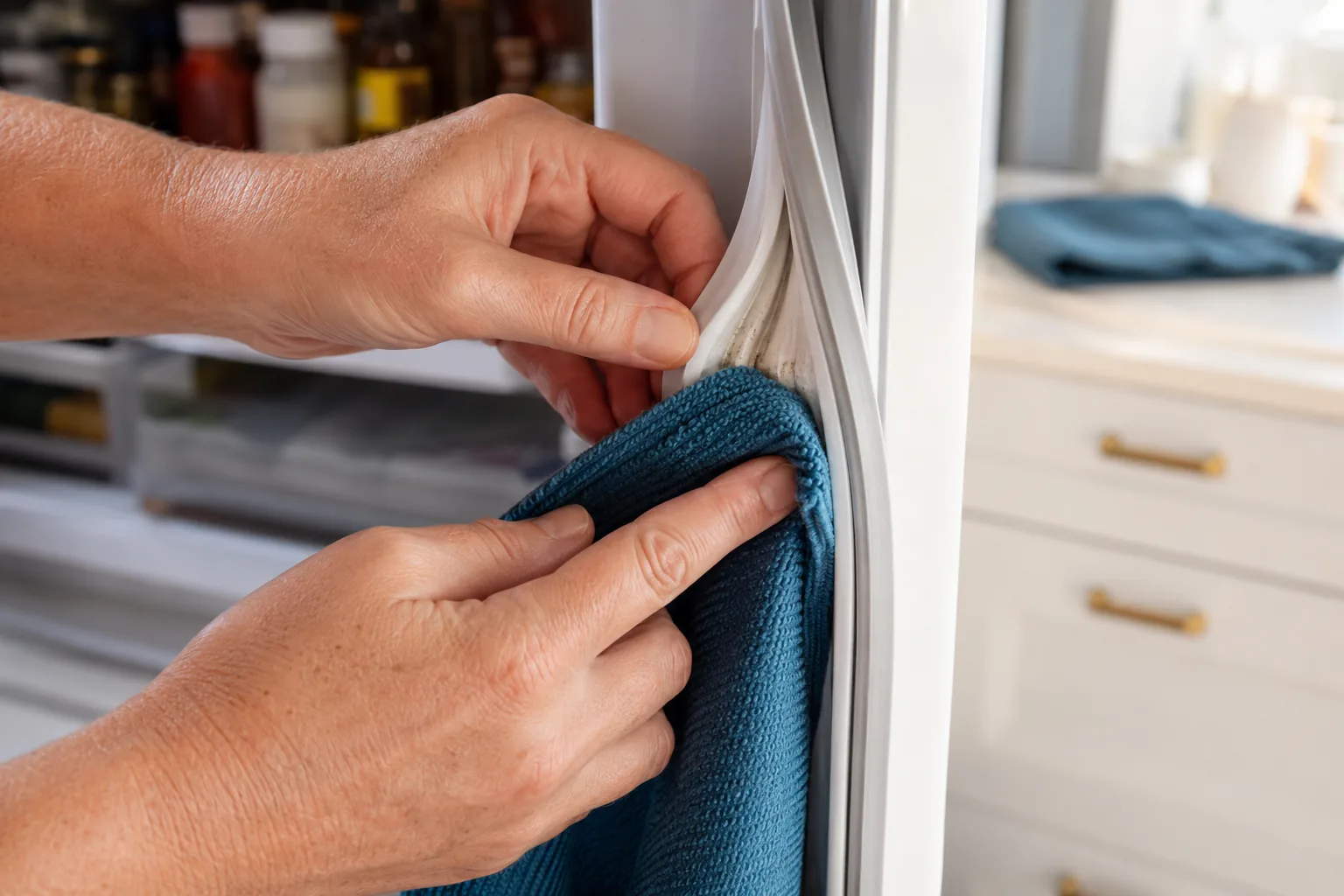
Door gaskets, the rubber seal around the door’s edge, need their own pass: spills that dry inside the folds are one of the most common sources of a fridge smell that lingers even after everything else is clean. A cotton swab or the corner of a cloth gets into the fold better than a flat wipe.
Behind and underneath the fridge is the part almost nobody reaches. Pulling the unit out from the wall, where safe, reveals dust and grease that’s often been sitting for months, plus the condenser coils, which run less efficiently caked in dust. A vacuum with a brush attachment clears them without scratching. The top of the fridge collects a flat layer of dust and, near a stove, a thin film of grease that’s easy to forget since it’s above eye level.
Oven
The oven interior is the single biggest job in a kitchen deep clean. Interior walls, the oven floor, and the racks all need scrubbing, since baked-on spills carbonize with repeated use and don’t respond to a quick wipe. Racks clean better removed, soaked in hot water with degreaser or dish soap for at least twenty minutes before scrubbing. The glass door deserves specific attention: many ovens have two layers of glass with a gap between them, and grease and moisture that get into that gap over the years cause the hazy, permanently dirty look that no exterior wiping fixes. Some door designs allow the glass to come apart for cleaning between the panes; others don’t, worth knowing before assuming a stubborn haze is a cleaning failure rather than a design limitation.
Self-cleaning cycles handle carbonized buildup on the interior walls but don’t reach the racks, the door glass gap, or the drip pans and burner caps on a gas range, which still need a manual pass. The area under the stovetop, where burner grates and caps sit, collects drips and food debris that fall through and bake onto the surface underneath, and lifting the grates off entirely is the only way to reach it.
Microwave
Microwave interiors need attention after every real splatter, but a deep clean covers what routine wiping skips: the door seal and handle, which pick up fingerprints and food residue faster than most people notice, and the turntable and support ring underneath, where crumbs and spilled liquid collect out of sight. A bowl of water with lemon or vinegar, microwaved a few minutes, loosens dried splatter with steam so it wipes off instead of needing to be scraped. On an over-the-range microwave, the vent filter underneath does double duty catching grease from the stove below, and needs the same degreasing soak as a range hood filter.
Dishwasher
A dishwasher looks self-cleaning, but food residue collects in specific spots a normal wash cycle doesn’t fully clear. The filter, usually a removable cylinder or screen at the bottom of the tub, traps food particles and needs to be pulled out and rinsed under running water. A dishwasher running with a clogged filter doesn’t clean as well and starts to hold odor. The door seal and gasket collect the same grime a fridge gasket does, and the spray arms have small holes that get blocked by mineral deposits or food debris over time, which shows up as dishes that aren’t fully clean on the top rack. Running an empty cycle with a cup of white vinegar in the bottom rack every month or two clears mineral buildup from hard water, common enough across Orange County to be worth doing as routine maintenance.
Small appliances
Toasters, coffee makers, blenders, and air fryers each need to be treated as their own cleaning job, not left in place and wiped around. Crumb trays in toasters should be emptied and wiped, not just shaken out, since shaking redistributes crumbs rather than removing them and leaves a layer that can eventually smoke or char. Coffee makers benefit from a vinegar or descaling rinse every few weeks; mineral buildup inside the internal tubing affects both taste and how efficiently the machine heats water, invisible until the coffee starts tasting off or brewing slower than usual. Blender bases and the rubber gasket under the blade assembly trap food residue a quick pitcher rinse never reaches, so the base should come apart for a real wash periodically. Air fryer baskets and the drawer underneath collect grease that hardens between uses, the same oxidized-fat problem described above: fresh grease wipes off, baked-on grease needs a hot soak first.
Cabinets and pantry
Cabinet interiors collect crumbs, spilled oil, and a layer of dust that builds up even when shelves look empty from a glance. Pulling everything out periodically, wiping shelves and interior walls, and checking corners near hinges matters most for cabinets near the stove, where airborne grease settles the same way it does on the wall behind the range. Cabinet fronts and handles need their own attention regardless of location, since hands touch them constantly and oil transfers from fingers every time, which is why handles closest to the stove tend to look worn faster than handles across the kitchen.
Pantry shelves are a related but separate job. Beyond wiping shelves down, an actual pantry reset means grouping like items together, checking expiration dates on anything pushed to the back, and wiping up the flour or sugar residue that settles at the bottom of shelves from small spills nobody notices in the moment. A pantry organized by category, baking, canned goods, snacks, rather than whatever fit where at the time, stays easier to keep clean, since it’s obvious when something’s spilled instead of blending into general clutter. Pantry shelves and cabinet interiors both hold personal items, so a crew won’t rearrange or empty them without being asked. If you want that level of detail included, mention it when you book.
Range hood, filter, and the grease zones around the stove
The range hood filter catches airborne grease every time you cook, and it gets thick with residue faster than most people expect given how invisible the buildup is day to day. A greasy filter also means the hood pulls smoke and odor out of the kitchen less effectively, so a dirty filter isn’t just a cleaning issue, it’s a functional one. Most filters can be soaked in hot water with degreaser and scrubbed, or run through a dishwasher cycle if the manufacturer allows it, worth checking the manual first. The hood surface itself, especially the underside facing the stove, collects the same residue and needs a degreasing wipe, not a plain damp cloth.
Grease doesn’t stay near the stove. It travels on air currents and settles as a fine film on the wall behind the range, the cabinet fronts closest to it, and nearby light switches or handles, often invisible until a cloth runs over the surface and the residue transfers onto it. This is the same aerosolized-oil process described earlier, and why a degreasing cleaner outperforms an all-purpose spray in this zone specifically.
Sink, faucet, and disposal
Beyond a basic wipe, a real sink clean means scrubbing the basin with a non-abrasive cleaner rather than something that scratches stainless steel or dulls a composite finish, polishing the faucet to clear water spots and mineral buildup, and running ice cubes and citrus peels through the garbage disposal to clear odor-causing residue a rinse never reaches.
Floors, baseboards, and the toe kick
Kitchen floors near the stove and sink take the most wear in the house, and grease from cooking settles into grout lines or seams even on sealed floors, harder to lift than on a flat, uninterrupted surface. The toe kick space beneath lower cabinets, that recessed gap at floor level, is easy to overlook but collects dust and crumbs swept under rather than picked up during a quick mop, since most mops and vacuums don’t reach that far back without a dedicated pass.
What a professional kitchen deep clean costs
Kitchen work is part of a whole-home deep cleaning rather than a standalone service, priced using the same formula as every service on the site: $60 base, plus $25 per bedroom, plus $35 per bathroom, with a 1.5x multiplier for deep cleaning. For a 3-bedroom, 2-bathroom home, a common Orange County size, that’s $60 + (3 x $25) + (2 x $35) = $205, times 1.5, for a $307.50 deep clean.
Oven interior and fridge interior are already part of that standard deep clean price, they don’t need to be added separately the way they do on a regular recurring clean, where interior appliance work isn’t part of the baseline. What’s genuinely extra is cabinet interiors, priced as a $35 add-on, since pulling everything off shelves, wiping the interior, and putting items back is real additional time beyond wiping fronts and handles. On that same 3-bed, 2-bath example, cabinet interiors bring the total to $342.50, before the $39 new customer offer applied automatically to a first clean.
Pantry shelves aren’t a standard line item and aren’t a separate priced add-on, so if you want them included, mention it when you book. Full pricing details, including how add-ons and recurring-plan discounts stack, are on the pricing page, and the broader deep cleaning checklist covers how kitchen work fits alongside bathrooms, bedrooms, and living areas in a full-home visit.
Kitchen deep clean FAQ
How is a kitchen deep clean different from a regular wipe-down? A regular clean covers counters, the stovetop exterior, and a quick sink wipe. A deep clean adds appliance interiors, cabinet fronts, behind and underneath appliances, the range hood filter, and grout and toe-kick areas routine cleaning skips.
Are oven and fridge interiors included in the price, or are they extra? For a deep clean specifically, both are included in the standard price. They’re only priced as separate add-ons on services where interior appliance work isn’t part of the baseline, like a regular recurring clean.
Is cabinet interior cleaning included automatically? No. Cabinet fronts and handles are included in every deep clean, but full interiors, pulling items off shelves, wiping inside, and replacing them, is a separate $35 add-on since it’s genuinely more time than a fronts-only pass.
Will the crew organize my pantry? Not automatically. Pantry and cabinet interiors hold personal items, so a crew won’t rearrange them without being asked. Mention it at booking if you want shelves wiped and items reset while they’re at it.
Why does grease near the stove need a different cleaner than the rest of the kitchen? Cooking oil that lands on nearby surfaces goes through heating and cooling cycles that thicken it over time, closer to a light varnish than fresh grease. A degreasing cleaner breaks that down; an all-purpose spray tends to smear it instead of lifting it.
How often should the range hood filter be cleaned? There’s no fixed interval that fits every household, since it depends on how much frying or high-heat cooking happens. Checking it every few weeks and cleaning at the first sign of visible grease keeps the hood working efficiently.
Can the fridge and dishwasher gaskets really cause odor? Yes. Spills that dry inside the folds of a door seal sit out of sight and keep producing odor even after every visible surface is clean, which is why gaskets get their own attention rather than a pass-over wipe.
Do I need to empty my cabinets before the crew arrives? Only if you want cabinet interiors included and prefer to control what’s inside. Otherwise, clearing countertops and cabinet tops so appliance fronts and the backsplash aren’t blocked is the more useful prep step.
How long does the kitchen portion take? It varies with kitchen size and how long since the last real clean, since a kitchen that’s gone a year without appliance-interior attention takes longer than one on a regular schedule. The deep cleaning checklist covers typical time ranges by home size.
What keeps a kitchen looking clean between deep cleans? Small daily habits, wiping counters and the stovetop after cooking, loading the dishwasher instead of stacking the sink, and keeping the trash on a rotation, slow down how fast grime resets. See how to keep your kitchen clean between cleanings for the full routine.
Does this affect stainless steel appliances differently? Yes, technique matters more than product on stainless steel, since wiping against the grain or using anything abrasive can scratch the finish. See how to clean stainless steel appliances for the grain-direction method.
Is a kitchen deep clean safe with pets in the home? Yes. Every clean, including deep cleans, uses non-toxic, pet-safe products, which matters in a kitchen specifically since counters and floors are where food gets prepared.
Ready to book?
If it’s been a few months since the fridge, oven, or cabinets got real attention, or the kitchen is due for a reset before starting a maintenance routine, a professional deep cleaning covers all of it in one visit: appliance interiors, cabinet fronts, the grease zones around the stove, and everything else a countertop spray never reaches. Get an instant quote for your Orange County city and see the exact price before booking.
or call +1 (949) 330-0081.