Care Habits
Powder vs Liquid Laundry Detergent: Which One to Buy
Neither form is better in every case. Liquid is the easier pick for cold water, greasy stains and pretreating, while powder tends to suit hard water, heavy dirt and warm or hot cycles, and usually costs less per load. The label on your machine and the label on the bottle matter more than the form, so this guide gives you a decision table, the facts you can verify on a label, and a dosing method that works for either.
Quick answer
- Pick liquid if: you wash mostly in cold water, you pretreat stains, you have a high-efficiency (HE) front loader, or you hate measuring dust.
- Pick powder if: you wash in warm or hot water, your tap water is hard, your laundry is mostly muddy or heavily soiled, or you want the lowest cost per load.
- Pods and sheets: convenient, pre-measured, and easy to overuse or misuse. Details below.
- Time to decide: about five minutes with your washer manual and the detergent label in hand.
- Biggest lever: the dose. Too much detergent leaves residue, makes clothes feel stiff or smell sour, and can build up inside the machine.
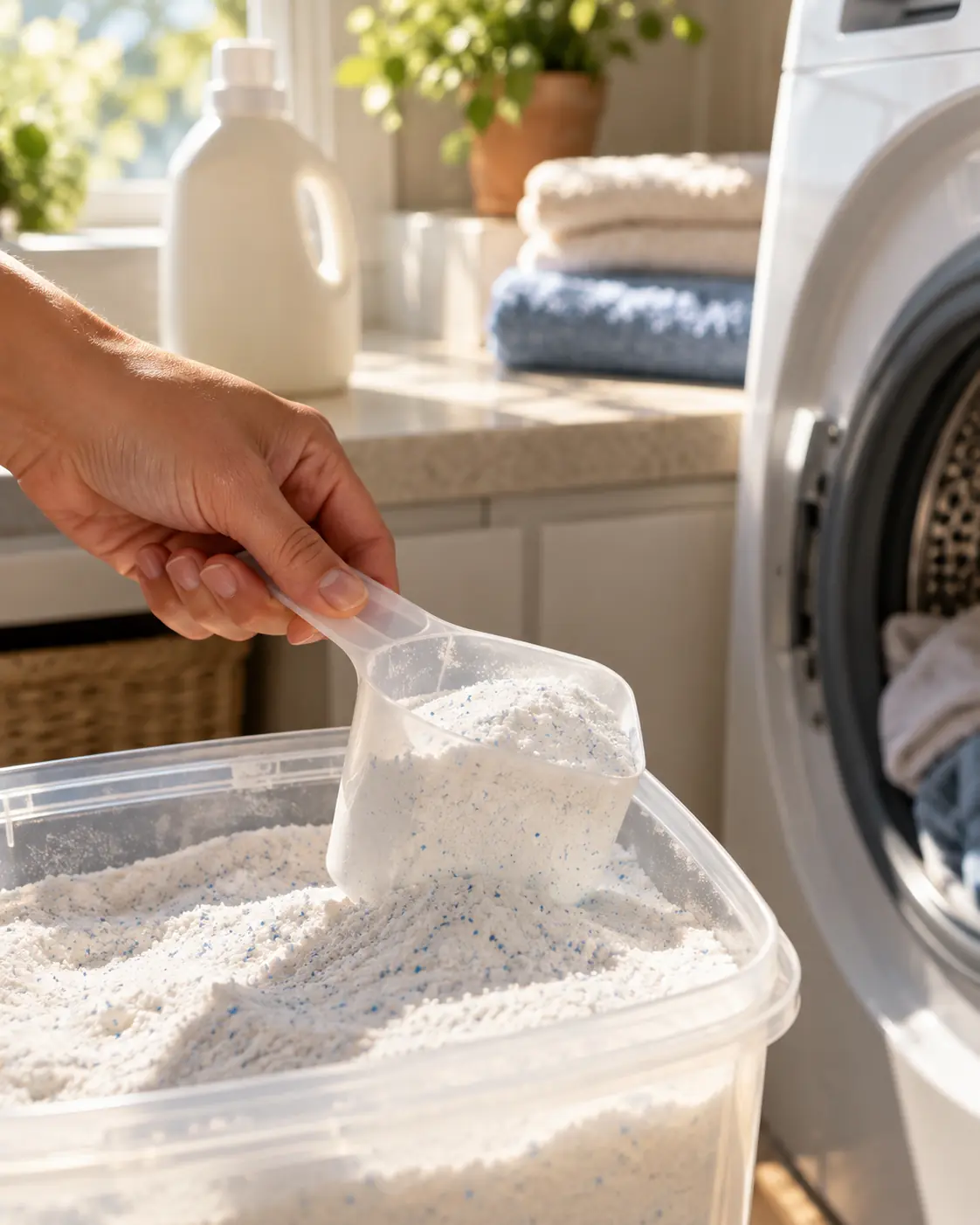
How each form works
Every laundry detergent does the same basic job. Surfactants lift oils and soil off fabric and hold them in the wash water so they rinse away. Enzymes, where included, break down protein, starch and fat stains. Builders soften the water so the surfactants work properly. The form changes how those ingredients are packaged, not what the wash is trying to do.
What is in powder
Powder detergent is a dry blend. Labels commonly list a surfactant, a builder such as sodium carbonate (washing soda) or a zeolite, a bleaching agent such as sodium percarbonate in some products, enzymes, and a bulking filler such as sodium sulfate. The builders are the reason powders have a reputation for handling hard water and heavy soil.
Powder dissolves more slowly than liquid, especially in cold water. If the label says it is made for cold water, that is a formulation claim worth reading. If it does not, expect the risk of undissolved grains on dark fabric in a short cold cycle.
What is in liquid
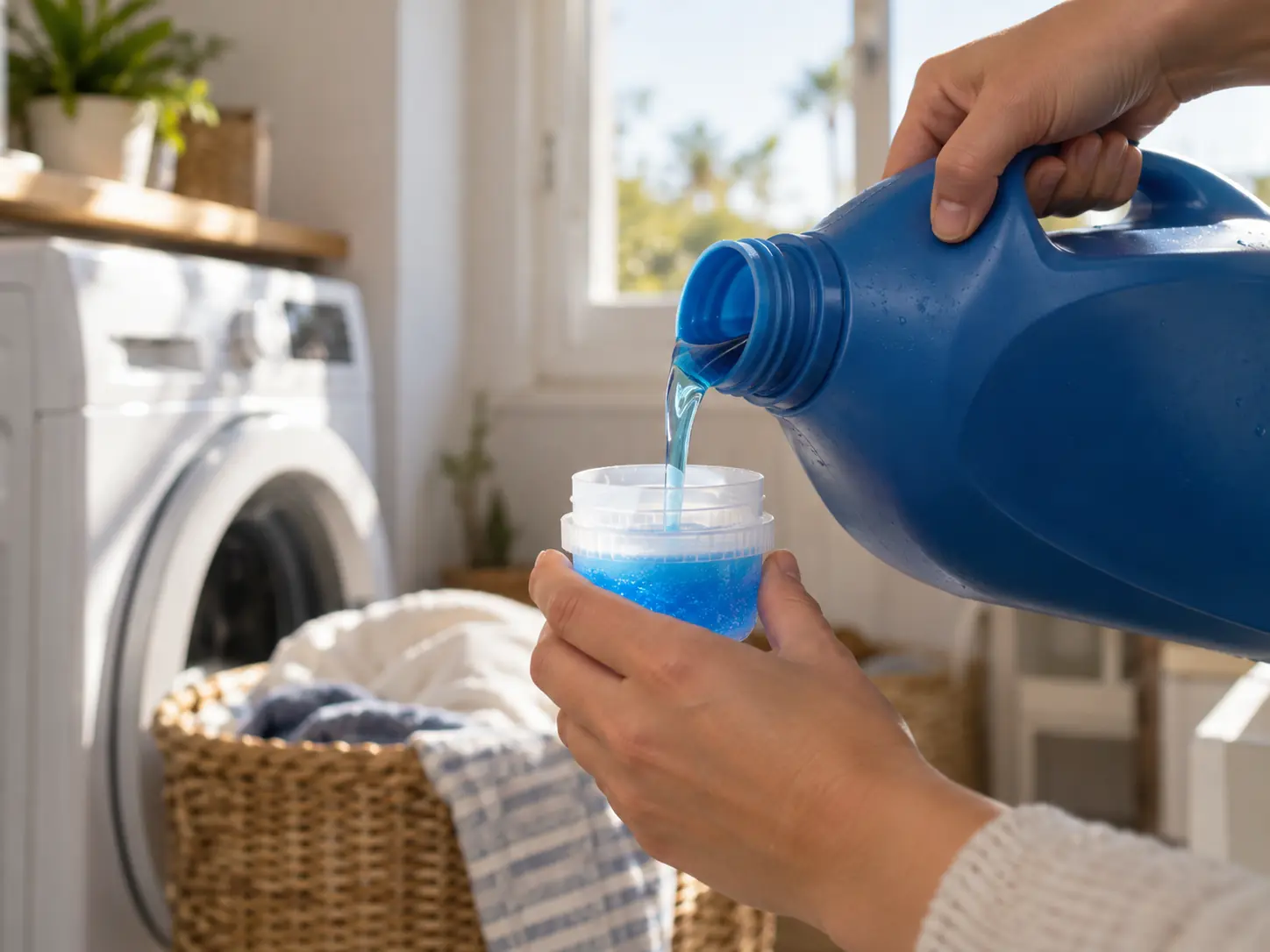
Liquid detergent is mostly water carrying surfactants, enzymes, and small amounts of other additives such as brighteners, fragrance and preservatives. Because the surfactants are already dissolved, liquids start working right away in cold water and double as a spot treatment you can rub straight into a collar or an oil stain.
The tradeoff is that you are paying for a lot of water, and most liquids contain fewer of the dry builders that help with hard water. Many liquids make up for that with a stronger surfactant package, but the performance in very hard water can still lag a good powder.
Why the washer matters as much as the detergent
A top loader with an agitator moves clothes through a deep pool of water, so either form dissolves easily. A front loader or HE top loader uses far less water and tumbles clothes, so a low-sudsing formula is essential. Look for the “HE” mark on the bottle or box. Regular detergent in an HE machine can create so much foam that the machine rinses poorly, runs longer, and leaves a film on clothes.
Decision table: which form for which situation
| Situation | Better fit | Why | Watch out for |
|---|---|---|---|
| Cold water cycles (about 60 F or lower) | Liquid, or a powder labeled for cold water | Liquid is already dissolved | Plain powder may not fully dissolve |
| Warm or hot water | Either | Both dissolve well | Hot water can set some stains, see below |
| HE front loader | HE liquid or HE powder | Low suds in both forms | Do not use non-HE products |
| Top loader with agitator | Either | Plenty of water to dissolve | Overdosing on large tubs |
| Hard water | Powder, or a liquid plus a water conditioner | Powders usually carry more builder | Residue if you overdose |
| Soft water | Liquid, and often a smaller dose | Less builder needed | Over-sudsing |
| Greasy or oily stains | Liquid, pretreated | Rub it in and let it sit | Hot water can set grease in some fabrics |
| Mud, clay, heavy outdoor dirt | Powder | Builders and abrasion help | Pre-rinse very muddy items |
| Delicates and wool | A detergent made for delicates, usually liquid | Gentler on fibers | Powders with bleach agents |
| Sensitive skin | Fragrance-free, dye-free of either form | Fewer irritants | Skipping the extra rinse on heavy loads |
| Small apartment with shared laundry | Pods or liquid | Easy to carry | Overuse, children and pets |
| Budget | Powder, as a rule | Less water and packaging | Cheap fillers if the dose is large |
Powder: pros and cons
Pros
- Typically costs less per load once you compare the same number of loads on the label.
- Stores for a long time in a dry spot and does not leak in a hall closet or a car trunk.
- Works well on mud, grass, sweat and heavy dirt.
- Better suited to hard water, since many powders include water-softening builders.
- Some powders include an oxygen bleach (sodium percarbonate) that brightens whites without chlorine.
Cons
- Can leave white residue on dark clothes if it does not dissolve, especially in cold water or on short cycles.
- Clumps in damp laundry rooms. Orange County’s coastal humidity can do this in garages and exterior closets, so keep the box sealed.
- Dust is a minor irritant for some people when scooping.
- Cannot be rubbed in as a spot treatment without first mixing it into a paste.
- May be less effective on oily stains than a liquid applied directly.
Does powder damage washing machines?
Not on its own. Problems come from overdosing, from using powder in a machine or cycle where it does not dissolve, or from not cleaning the machine. If you use powder in an HE front loader, add it to the drum or the powder compartment as the manufacturer directs, use the HE-labeled kind, and run a periodic cleaning cycle (see our guide to cleaning a washing machine).
Liquid: pros and cons
Pros
- Dissolves quickly, including in cold water.
- Easy to pretreat stains: apply a small amount and rub it in.
- Easy to measure with the cap, and less dust.
- Wide choice of formulas for delicates, dark colors, baby clothes and sensitive skin.
- Generally fits automatic dispensers in newer machines.
Cons
- Usually costs more per load.
- Heavier to carry, and bulkier to store.
- Often carries fewer builders, so hard water can reduce performance.
- Leaks, sticky caps and drips on the shelf are common.
- Easy to overpour because liquid looks like less than it is.
Pods and sheets
Laundry pods
A pod is a pre-measured portion of concentrated liquid sealed in a water-soluble film. The convenience is real: no measuring, no spills. The downsides are also real.
- Fixed dose. A pod is sized for a typical large load. In a small load or in very soft water, that can be more detergent than you need. In a very large or very dirty load, one pod may be too little.
- Placement. Manufacturers generally tell you to put the pod in the empty drum first, then add clothes on top, rather than in the dispenser drawer. Follow the package.
- Cold-water dissolving. Most pods are designed for cold water, but a very short cycle with a tightly packed drum can leave a film residue. If you see that, switch to a longer cycle or a looser load.
- Child and pet safety. Pods look like candy. Store them in the original container, closed, out of reach, and do not handle them with wet hands because the film dissolves on contact with moisture. If a child or animal bites one, call poison control or your veterinarian right away. This is label guidance on nearly every package.
- Never cut, puncture or dissolve them in a bucket for hand washing.
Detergent sheets and strips
Sheets are thin dissolvable strips of detergent. They are lightweight, use less plastic packaging, and are easy to travel with. The tradeoffs are that they are usually single dose, so adjusting for a very big or very dirty load means adding more sheets, and they sometimes do not dissolve completely in very cold water or tightly packed drums. Put the sheet in the drum first and check the package for how many sheets per load size.
Where each format fits
| Format | Best for | Not so good for |
|---|---|---|
| Powder | Hard water, heavy soil, low cost | Cold short cycles, spot treating |
| Liquid | Cold water, pretreating, dispensers | Very hard water, strict budgets |
| Pods | Travel, laundromats, speed | Small loads, tight budgets, homes with toddlers or pets that mouth things |
| Sheets | Travel, low packaging, light loads | Heavy soil, very large loads |
Hard water and how it changes the answer
Hard water carries dissolved calcium and magnesium. These minerals bind with detergent ingredients, which reduces how well the surfactants clean, and they can leave a gray or stiff feel on towels and whites. Much of Orange County has hard water, but the level differs by city and by water district. Check your local water quality report (your water provider publishes one every year) or use a home test strip to see where you stand.
If your water is hard:
- Use a detergent whose label mentions hard water, or choose a powder with builders listed.
- Do not just add more detergent. Overdosing creates residue, which traps soil and makes fabric stiff.
- Consider a laundry water conditioner (the label will list a builder such as sodium carbonate or a citrate or polycarboxylate) added with your usual detergent. Follow the label for quantity.
- Use warm water for towels and whites when the fabric care label allows it.
- Run a washing machine cleaning cycle regularly, because mineral scale builds up in the drum, hoses and dispenser.
Water softeners at the house level change the picture. If your home has one, you will usually need less detergent, and a liquid may be a better fit.
How much detergent to use
This is where most laundry goes wrong. The cap and scoop lines on the package are a starting point, not a rule. The amount that works depends on four things:
- Load size. A half-full washer needs less than a full one.
- Soil level. Lightly worn clothes need less than muddy sports gear.
- Water hardness. Harder water usually needs a little more, softer water a little less.
- Machine type. HE machines use less water and need less detergent.
A simple dosing method
- Start with the lowest fill line or scoop listed for your load size.
- Wash a normal load. Open the lid or door and check the drum and the clothes.
- If you see a lot of foam or the clothes feel slick or stiff after drying, you are using too much. Cut the dose by about a quarter on the next load.
- If clothes still smell or look dingy, raise the dose slightly or add a stain booster, and also check that the machine is not overloaded.
- Once you find the amount that leaves clothes clean and soft, mark it with a permanent marker on the cap or scoop.
Signs of too much detergent
- Visible suds in the drum late in the cycle
- Stiff towels or clothes that feel waxy
- Musty odor that returns quickly after washing
- White film on dark fabric
- A longer than normal cycle on HE machines, because the sensor is trying to rinse out foam
Signs of too little detergent
- Dingy whites, gray towels
- Body odor that persists after drying
- Stains that are not lifted
- A slimy feel on the inside of the drum
Water temperature and stains
Temperature changes what your detergent can do. This applies to both forms.
| Stain type | Start with | Notes |
|---|---|---|
| Sweat and body odor | Warm water, enzyme detergent | Let the load soak briefly in the machine if the cycle allows |
| Grease and cooking oil | Rub liquid detergent in, then wash warm | Check the fabric care label |
| Blood and other protein stains | Cold water | Hot water can set protein stains |
| Mud and clay | Let dry, brush off, then wash | Pre-rinse clay-heavy items |
| Grass | Enzyme detergent, pretreat | Test on colorfast fabrics |
| Tomato and other food dyes | Cold rinse, then pretreat | Oxygen bleach on colorfast fabrics may help |
| Coffee, tea, wine | Cold rinse right away | Avoid heat before the stain is gone |
| Ink | Treat before washing with a suitable solvent | Test first and check the fabric label |
When in doubt, check the care label on the garment. If it says cold only, follow it, whatever the detergent says on the box.
HE machines and sudsing
A high-efficiency washer uses a fraction of the water of an older top loader. Low water means that suds cannot rinse away easily, which is why HE machines need low-sudsing detergent. Both powders and liquids come in HE versions. If the label has the “HE” mark, it is formulated to work with the lower water level.
If you use regular detergent in an HE machine:
- Suds can overflow or interfere with the sensors.
- Cycles can run longer to rinse.
- Residue can collect in the door gasket, drum and detergent drawer.
- Mold and odor become more likely.
If you use HE detergent in an older top loader, it works fine, but you may need a slightly higher dose since the water volume is larger.
Sensitive skin and allergies
Skin reactions to laundry are mostly caused by fragrance, dyes, residue left on fabric, or irritants in additives. A few practical steps:
- Choose products labeled free of fragrance and dyes. “Unscented” and “fragrance-free” are not the same, since some unscented products use masking fragrance. Check the ingredient list.
- Do not overdose. Residue is a common culprit.
- Use an extra rinse for bedding, baby clothes and underwear if your machine allows it.
- Skip fabric softener if you notice reactions, because softeners leave a coating on fabric.
- If a rash continues, talk to a doctor. This guide is general information, not medical advice.
For allergen control in bedding, see our guide to reducing household allergens.
How to compare cost per load
Packaging claims and sale prices make it hard to compare. Use this method instead, with the actual product in your cart or pantry.
- Find the price you paid.
- Find the number of loads on the label. Note whether it is for regular or HE loads, and whether it is for a standard dose.
- Divide the price by the number of loads.
- Adjust for your real dose. If you use two-thirds of the label dose in soft water, your cost per load is lower than the label implies. If you use more, it is higher.
- Compare pods and sheets the same way, remembering that you cannot split a pod.
Do not trust the loads count on a jumbo bottle without checking the cap marks you actually use. A concentrated liquid with a small cap may beat a bargain powder, and a cheap powder with a large scoop may cost more than it looks.
Mistakes that leave clothes dirty
- Overloading. Clothes need room to move. A packed drum does not rinse.
- Overdosing. More detergent does not mean cleaner clothes.
- Wrong detergent in an HE machine.
- Using hot water on stains that set with heat, like blood.
- Mixing powders and liquids in the same load without need. It is not dangerous, but it is wasteful and can increase residue.
- Putting pods in the dispenser drawer instead of the drum, unless the package says to.
- Leaving wet clothes in the washer. Sour odors begin within hours in warm weather.
- Never cleaning the machine. Residue and scale build up.
- Ignoring the pockets. Tissues, receipts and lip balm ruin whole loads.
What not to mix
Never mix laundry products with each other or with cleaning products as a shortcut. Specifically:
- Do not pour chlorine bleach and an ammonia-containing product into the same load or the same bucket. They create toxic fumes. More on this in which cleaning products never to mix.
- Do not add vinegar to a load that already has chlorine bleach.
- Do not mix bleach with acidic products such as toilet bowl cleaners or some stain removers.
- Use chlorine bleach only if the fabric label allows it, and never on wool, silk or spandex.
- Pre-mixed boosters should be added the way the label says, not stacked.
For gentler cleaning habits at home beyond laundry, see natural cleaning with vinegar and baking soda.
Laundry items that should not go in the washer
Detergent choice does not rescue every item. Some things are better cleaned in place or by a specialist.
- Upholstered furniture and sofa cushions with non-removable covers
- Mattresses and mattress toppers (foam and memory foam)
- Large area rugs
- Items marked “dry clean only” (follow the label)
When it is worth handing off: for a sofa, armchair or mattress that needs a deep clean, our upholstery cleaning and mattress cleaning are priced per item. A queen mattress is $75 and a sofa seat is $35, according to our price list. You can see an exact figure in the instant quote.
A simple routine that works for most homes
If you want one plan to start with, try this for a month and adjust.
- Choose one HE-compatible detergent in the form that suits your water temperature habit. Cold-water user: liquid. Warm-water user with hard water: powder.
- Use the low end of the label dose for a normal load.
- Keep a bottle of oxygen bleach for whites and towels, labeled as safe for the fabrics you wash.
- Pretreat stains the same day when you can.
- Wash towels weekly and bedding every week or two, and run a machine cleaning cycle every month or so, according to your machine’s manual.
- Leave the washer door ajar after the last load so the drum dries.
Laundry tends to feed the rest of the house’s cleaning schedule. For a view of how laundry fits into a weekly rhythm, see our guide to keeping your house clean between cleanings.
When to call a professional
Detergent can fix most laundry problems at home. A professional helps when the problem is not a garment but the thing the garment lives on.
What you can do yourself: pick the right detergent form, dose correctly, pretreat stains, and keep the washer clean. These cost very little and make the biggest difference.
What a pro does better: deep cleaning furniture and mattresses, removing set-in odors from upholstery, and handling the cleaning tasks around the laundry room that tend to pile up. If you are catching up on a whole home and the washer, dryer and laundry area are only one part, our deep cleaning covers a full-house top-to-bottom clean. For a 3 bedroom, 2 bathroom home, the formula is (60 + 25 x 3 + 35 x 2) x 1.5 = 205 x 1.5 = $307.50, and a laundry add-on is $25. New customers get $39 off the first clean.
For an exact price on your home, use our instant quote.
Frequently asked questions
Is powder or liquid laundry detergent better?
Neither wins across the board. Powder tends to cost less per load and handle hard water and heavy dirt well. Liquid dissolves in cold water and works as a pretreater. Choose by your water temperature, water hardness and machine type.
Does powder detergent damage washing machines?
No, not by itself. Problems come from using too much, using powder that does not dissolve in cold water, or skipping machine cleaning. Use an HE-labeled powder in an HE machine and follow the dosing on the package.
Can I use powder in an HE washer?
Yes, if the package says it is for HE machines. Add it to the drum or the powder compartment as your machine manual directs, and use the dose listed for HE loads.
Is powder cheaper than liquid?
Usually, but check. Divide the price by the number of loads on the label, then adjust for the amount you really use. Concentrated liquids and sale prices can change the answer.
Which detergent is better for hard water?
Powders and detergents with builders usually do better, and a laundry water conditioner can help either form. Do not simply overdose, since extra detergent leaves residue. Check your local water quality report to know how hard your water is.
Can I mix powder and liquid detergent?
You can, but you rarely need to. It wastes product and can leave residue. If a load needs help, use a stain remover or an oxygen bleach booster instead.
Are laundry pods safe for the washing machine?
Yes, when used as the package describes, usually in the empty drum before the clothes. They are not a good fit for very small loads. They must be kept away from children and pets.
How do I know if I’m using too much detergent?
Look for lots of suds, stiff or slick clothes, a white film on dark fabric, or a sour smell that returns quickly. Lower the dose by about a quarter and see if it improves.
Do detergent sheets work as well as liquid or powder?
For light and normal loads they generally work. For heavy soil, very large loads or very cold, short cycles, check the package, since you may need extra sheets or a different format.
Should I use fabric softener?
It is optional. Softeners leave a coating on fabric, which can reduce the absorbency of towels and athletic wear, and bother sensitive skin. Skip it for towels and activewear.