Checklists
Office Cleaning Checklist for Small Businesses in Orange County
A good small office cleaning plan has three layers: a short daily routine that keeps high-touch areas and trash under control, a weekly pass that handles floors, restrooms and shared spaces properly, and a monthly deep task list for the things nobody notices until they are visibly dirty. Written down as a checklist, it takes the guesswork out of who cleans what, and it gives a cleaning crew a precise scope to quote and follow. This guide gives you the full checklist, laid out as tables you can copy, plus a worksheet for describing your office when you ask for a quote.
It is written for the owners and office managers of small businesses in Orange County: a dental practice, an accounting firm, a design studio, a real estate brokerage, a clinic, a small co-working suite. If you are comparing what cleaning should cost, our office cleaning cost guide explains how quotes are built, and there is a shorter general office cleaning checklist if you only want a one-page list. This article goes further: it separates tasks by frequency, tells you which ones to keep in-house, and shows how to turn the list into a scope of work.
Quick answer
- Daily: trash, restroom restock and wipe-down, kitchen or break room surfaces, reception and entry, high-touch points, spot vacuuming of traffic areas.
- Weekly: full vacuum and mop, restroom deep wipe, desk and shared surfaces, glass doors, dusting, break room appliances.
- Monthly: baseboards, vents, inside microwaves and refrigerators, upholstered chairs, window sills, ceiling fans, edge cleaning of floors.
- Quarterly or as needed: windows, carpet extraction, upholstery, and hard floor refinishing.
- Pricing: office cleaning is quoted for your space, not from a formula, so describe it with the worksheet below instead of looking for a flat number.
- Booking basics: no minimum booking, no upfront payment, free re-clean within 24 hours if something is missed, and 24 hours notice to cancel or reschedule with no fee.
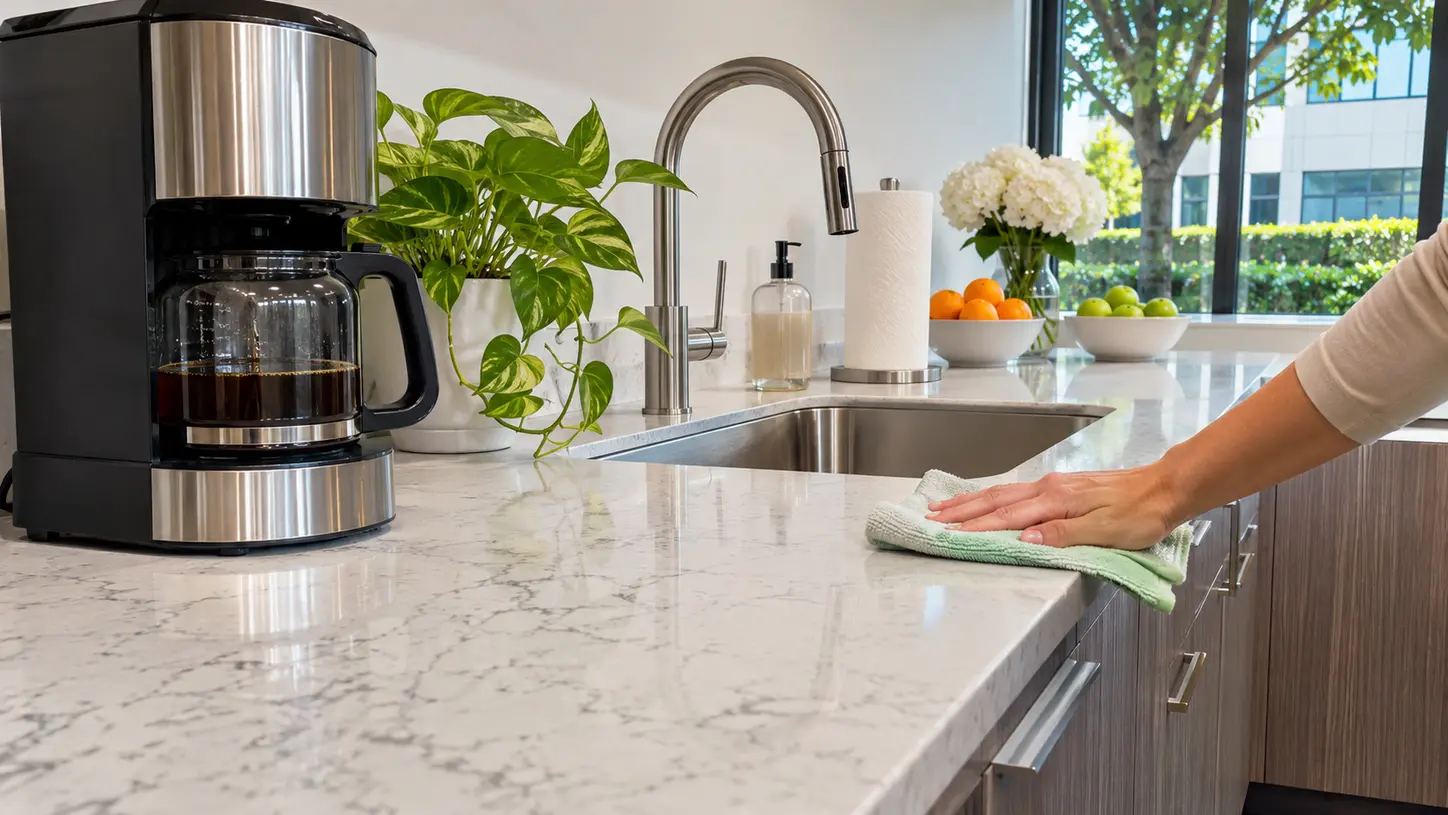
Why a written checklist matters for a small office
Most small offices begin with an informal arrangement. Someone empties the trash, someone wipes the break room counter, and the restroom gets cleaned when it is noticed. This works until the team grows, the office is shared with clients, or one person leaves. A written checklist solves four common problems.
- Accountability. Everyone knows which tasks belong to staff and which belong to the cleaning crew.
- Consistency. Visits look the same every time, no matter who is on site.
- Clear quoting. Cleaning companies can only quote what they can see. A checklist turns “make it look clean” into a defined scope.
- Fewer disputes. If something is missed, you can point to the line and ask for a fix.
A checklist also helps you decide how often to schedule cleaning. A five-person office with a private restroom may need a visit two or three times a week. A busy waiting room or a clinic needs more frequent attention, and a quiet back-office suite may need less. Rules for medical, dental and food businesses vary by industry and city, so check any health or licensing requirements that apply to your business separately, and do not rely on this article for legal compliance.
Step one: map your office
Before you write the checklist, walk through the space and count what you have. This is the same information a cleaning company needs to give you an accurate quote.
| Area | Questions to answer |
|---|---|
| Reception and entry | Glass doors? Hard floor or carpet? Waiting chairs? |
| Open work area | Number of desks, floor type, how many people use it |
| Private offices | How many, are doors locked, do staff want desks cleared? |
| Conference rooms | How many, tables and chairs, whiteboards, glass walls |
| Restrooms | How many, how many stalls or fixtures, supplied by whom? |
| Break room or kitchen | Sink, microwave, refrigerator, dishwasher, coffee station |
| Storage and server rooms | Cleaned or off-limits? |
| Floors | Carpet, tile, vinyl, hardwood, mix |
| Windows | Interior only, exterior, how many |
| Square footage and layout | Single floor or multi-level, elevator, parking |
| Access | Hours, keys, alarm code, building rules |
Write the answers down. They determine the scope and the schedule, and they give your cleaners everything they need on the first visit. Our guide to house cleaning keys, access and home security covers key and alarm practices that translate well to offices, and our insured, bonded and background-checked explainer shows what to ask before anyone gets keys to your space.
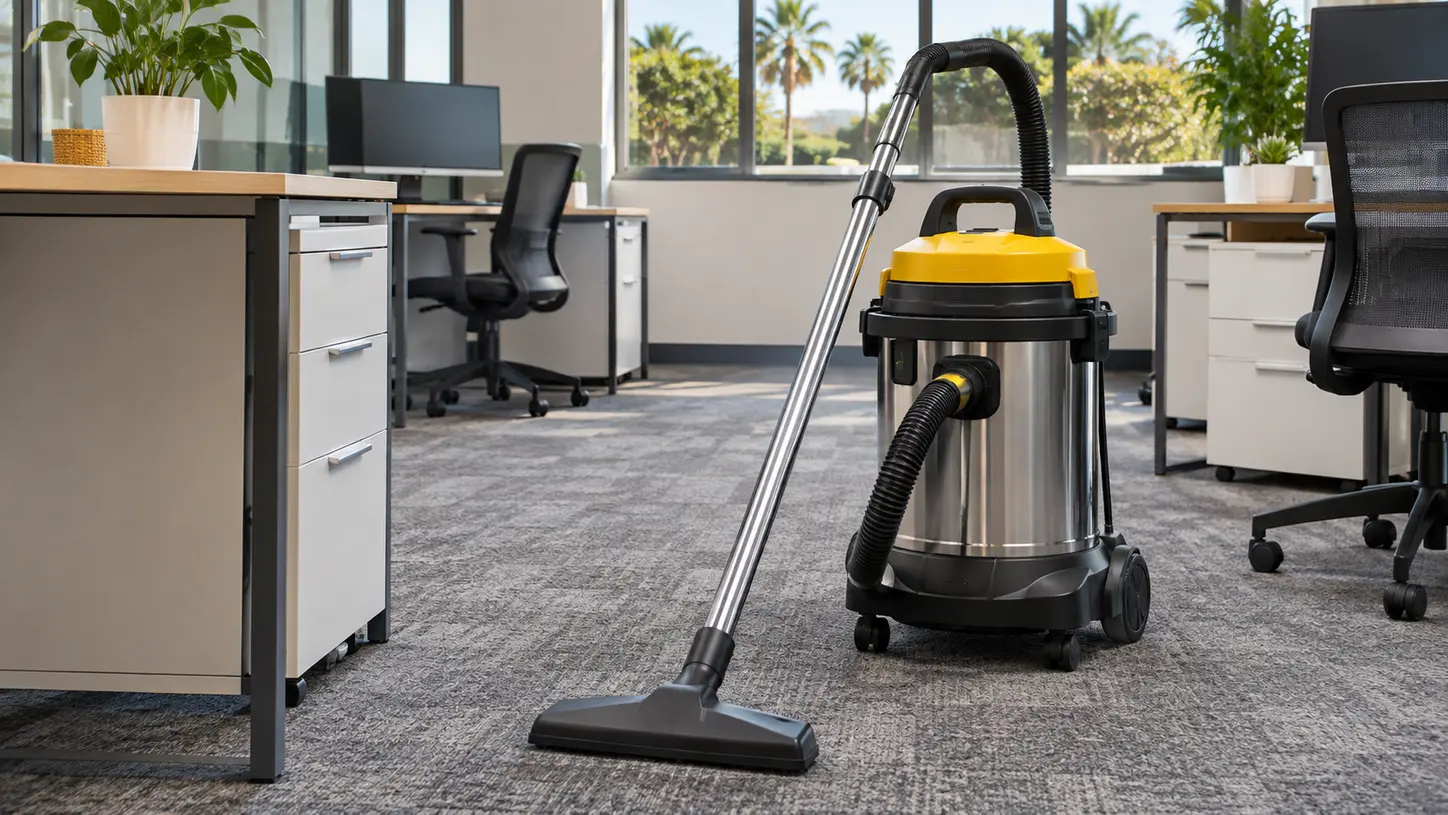
Daily office cleaning checklist
Daily tasks keep the office presentable and hygienic. These are the items that employees and visitors notice first. If your team handles some of them (many small offices do), assign them in writing and leave the more time-consuming ones to the crew.
| Area | Daily task |
|---|---|
| Entry and reception | Empty trash, wipe the counter and door handles, vacuum or sweep the mat, spot-clean glass |
| Work areas | Empty trash and recycling, spot-vacuum high-traffic paths, straighten chairs |
| Restrooms | Clean and disinfect toilets, urinals and sinks, wipe mirrors and counters, restock paper, soap, towels, empty bins, spot-mop floors |
| Break room | Wipe counters, tables and the sink, clean the microwave handle and fridge door, empty trash, wash or load dishes |
| Conference rooms | Wipe the table, straighten chairs, empty bins |
| High-touch points | Door handles, light switches, shared phones, elevator buttons, printer buttons, handrails |
| Floors | Sweep or vacuum entry and main corridor |
A few notes for the daily list:
- High-touch wiping is the most useful daily task for reducing germs in a shared space. A damp microfiber cloth with an appropriate cleaner is enough for most surfaces. Check the label on any disinfectant for the contact time it needs.
- Restrooms deserve their own line item because they are what visitors remember. A restroom that smells clean and has full dispensers makes a strong impression, and a neglected one undoes everything else.
- Trash timing matters. If your break room is the only place with food waste, empty it daily to avoid odors and pests, even if the rest of the trash can wait.
Weekly office cleaning checklist
The weekly pass is where an office actually gets clean. It handles the surfaces that daily visits skim.
| Area | Weekly task |
|---|---|
| All carpeted areas | Full vacuum, including under desks and along edges |
| All hard floors | Sweep and damp mop, with attention to corners and under furniture that moves easily |
| Restrooms | Deep clean toilets and urinals, scrub sinks and counters, descale fixtures, clean the floor and baseboard edge, clean partitions |
| Desks and workstations | Dust and wipe surfaces that are cleared of paperwork, clean phone and keyboard exteriors if permitted |
| Glass and mirrors | Clean entry doors, interior glass partitions, conference room glass, mirrors |
| Break room | Clean inside the microwave, wipe appliance fronts, clean the coffee machine exterior, wipe cabinet fronts |
| Dusting | Shelves, window sills, ledges, picture frames, the tops of monitors and equipment where safe |
| Trash and recycling | Wash bins as needed, replace liners |
| Entry mats | Vacuum or shake out, clean underneath |
| Waiting area | Wipe chairs, side tables and magazine racks |
Two practical points make the weekly list work.
Clear desks help. Cleaners are cautious around papers, laptops and personal items, and rightly so. If you want desk surfaces wiped, ask staff to clear them once a week. If you do not, say so, and the crew will leave desks alone.
Tell the crew what not to touch. Server racks, lab benches, filing systems, artwork and anything locked should be marked in the scope. A short “do not touch” line saves everyone embarrassment.
Monthly office cleaning checklist
These are the tasks that make an office look professionally maintained rather than merely tidy. You do not need them every week, but if they are skipped for months the dirt becomes obvious.
| Area | Monthly task |
|---|---|
| Baseboards | Wipe all baseboards and corners |
| Vents and returns | Dust air vents and return grilles |
| Ceiling fans and light fixtures | Dust blades, covers and accessible fixtures |
| Blinds | Dust or damp wipe the slats |
| Upholstered chairs | Vacuum the seats and the crevices |
| Refrigerator | Empty old food, wipe shelves and drawers |
| Break room | Degrease the microwave, clean the oven or toaster if present |
| Doors and walls | Spot-clean fingerprints and scuffs |
| Floors | Edge cleaning, move light furniture and clean under it |
| Windows | Interior glass and sills |
| Equipment | Wipe printers, copiers and monitors |
| Entry | Clean mats and the threshold, scrub grout lines near the door |
Many of these tasks are covered in our household guides, and the same methods work in an office. The baseboards and walls guide, the blinds and ceiling fan guide, the refrigerator guide and the microwave guide are useful references if your team handles any of them. The coffee maker cleaning guide is worth passing to whoever manages the break room.
Quarterly and as-needed tasks
Some work should happen a few times a year, not monthly.
- Window cleaning. Exterior and interior glass, tracks and sills. See our window cleaning service, and the guide to how often to clean windows for the typical rhythm.
- Carpet extraction. Deep cleaning carpet removes soil that vacuuming leaves. The carpet and rug frequency guide suggests an interval, and traffic should drive your decision.
- Upholstery. Waiting-room chairs and sofas collect dust and spills. Our upholstery cleaning service handles furniture, and the leather care guide helps with leather seating.
- Hard floor refinishing. Stripping and sealing is a specialty job, and you should ask any company about it directly.
- Deep clean of restrooms. Descaling, grout scrubbing and partition cleaning. See the grout and tile guide.
- Move-in or move-out cleaning when you change suites. Our move-out cleaning service is built for empty spaces. Check your commercial lease for what it requires at move-out, because rules vary and you should not rely on general advice.
- After renovation. A suite build-out or remodel needs a post-construction cleaning pass.
Who does what: in-house or crew
A common mistake is to ask a cleaning crew to do everything, or to leave everything to the staff. A balanced split works best for a small office.
| Task | Staff | Cleaning crew |
|---|---|---|
| Clearing personal desks | Yes | No |
| Washing personal mugs | Yes | Optional |
| Emptying trash at desks | Optional | Yes |
| Restroom cleaning | No | Yes |
| Floors | No | Yes |
| High-touch wipes | Shared | Yes |
| Break room fridge purge | Yes, weekly | Wipe |
| Dusting high areas | No | Yes |
| Monthly deep tasks | No | Yes |
| Restocking supplies | Yes | If included in scope |
If supplies like paper and soap are provided by you, say who restocks them and how the crew knows when to tell you they are low. A simple note on the checklist avoids empty dispensers.
Choosing products: eco-friendly and safe around staff
Offices are shared spaces. Strong fragrances and harsh fumes bother people who are sensitive, and clients may pass through at any time. We use eco-friendly, pet-safe products, which also suits offices where staff bring dogs or where visitors include children. Our article on eco-friendly cleaning products explains the types, and the green cleaning page shows how we work. Whatever products a crew uses, never combine them, as explained in cleaning products you should never mix.
For medical, dental or food-preparation spaces, you may need a specific disinfectant or protocol. That is a regulatory question for your industry, so confirm with your own compliance advisor and tell your cleaning company in writing what is required.
How to turn this checklist into a scope of work
A scope of work is a one-page document you share with a cleaning company. It makes quotes comparable and lets you check the work after each visit.
- Describe the space. Use the mapping table above.
- State the frequency. For example, three visits a week in the evening, with a weekly deep pass.
- List tasks per visit. Paste in the daily, weekly and monthly tables.
- Name exclusions. Server rooms, locked offices, exterior windows, anything you handle in-house.
- State access. Hours, entry method, alarm and parking instructions.
- Define supplies. Who provides paper goods, soap and trash liners.
- Define quality checks. How you want to report an issue, and how fast you expect a response.
Our guide to questions to ask before hiring a cleaning company and the how to choose a house cleaning company in Orange County article apply directly to offices. The list of red flags when hiring a cleaner is also worth a read. If you are weighing a crew against an individual cleaner, see cleaning company vs independent cleaner.
What to expect from a professional crew
Our office cleaning service is for small and mid-sized spaces, and the process is simple.
- You describe the space. Share the worksheet or call, and we confirm the scope.
- You get a quote for your space. Office cleaning is not priced from a published formula, so we quote it based on what you need.
- Crews are vetted. Our cleaners are insured, bonded and background-checked.
- Visits are on your schedule. You do not need to be present, which suits after-hours cleaning, and same-day or next-day visits are possible when crews have openings.
- If something is missed, we fix it. Tell us within 24 hours and we re-clean for free.
- Payment is simple. There is no minimum booking, no upfront payment and your card is charged after the clean.
- Changes are flexible. Cancel or reschedule with 24 hours notice and there is no fee.
For how much you can expect to budget, read the office cleaning cost guide, which explains the factors that move a quote up or down, such as size, frequency and restrooms.
Local notes for Orange County offices
Orange County offices range from suites in Irvine’s business parks to storefronts in Costa Mesa and professional buildings in Newport Beach. A few general points apply across them.
- Shared buildings may have rules about after-hours access, elevators and loading areas, so ask your property manager.
- Dust is a constant in our dry climate, and our article on why Orange County homes get dusty fast applies to offices too. A weekly dusting task is worth keeping on the list. For ideas that help between visits, read how to reduce dust.
- Glass storefronts show smudges fast. Include entry glass in the daily or weekly list.
- Allergies are common, so a vacuum with a good filter and damp dusting matter. See the allergen cleaning guide.
We serve businesses in Irvine, Newport Beach, Costa Mesa and across the county.
Common mistakes in office cleaning
- Writing “clean the office” with no list of tasks.
- Leaving it to staff to notice what needs doing.
- Forgetting restrooms and break rooms in the scope.
- Not telling the crew about areas that must not be touched.
- Mixing products or using harsh fragrance in shared spaces.
- Ignoring floors under furniture and along edges.
- Skipping a monthly deep task list.
- Changing the schedule without telling the crew.
- Having no way to report a missed spot.
A sample weekly schedule for a ten-person office
This is an example of how the tasks above might combine. Adjust it to your hours and your headcount.
| Day | Visit type | Focus |
|---|---|---|
| Monday | Standard | Daily list, restrooms, break room |
| Wednesday | Standard plus | Daily list, full floors, glass |
| Friday | Weekly deep | Daily list, weekly list, dusting, fridge wipe |
| First Friday of the month | Monthly add-on | Monthly list tasks |
Frequently asked questions
How often should a small office be cleaned?
It depends on traffic and use. A quiet office with a handful of people may be fine with one or two visits a week. A space with clients, a shared kitchen or heavy foot traffic often needs more. Restrooms and break rooms are the areas that tell you when the frequency is too low.
What should be included in a daily office cleaning?
Trash and recycling, restroom cleaning and restocking, break room surfaces, reception and entry, high-touch points, and spot vacuuming of traffic areas. The daily table above can be pasted into your scope.
Can your crew clean after hours?
Yes. You do not need to be present, and many offices schedule cleaning in the evening or early morning. Share access instructions and any alarm details when you book. The key and access guide linked above explains good practice for handing over entry.
Do you provide supplies and equipment?
Our crews bring their own products and tools. Paper goods, soap and similar consumables for your restrooms are usually supplied by the business, so agree who restocks them when you set the scope. Our guide on whether house cleaners bring their own supplies explains the usual arrangement.
Is office cleaning priced the same way as home cleaning?
No. Home cleaning has a published formula based on bedrooms and bathrooms. Office cleaning is quoted for your space, because offices vary so much in size, layout, restrooms and frequency. That is why we recommend writing a scope first.
What if my office has pets or allergy-sensitive staff?
Tell us in advance. We use eco-friendly, pet-safe products, and you can ask for fragrance-free preferences to be noted in the scope. For serious sensitivities, mention them when you book so we can plan accordingly.
What happens if something is missed?
Let us know within 24 hours and we will re-clean it for free. Give us the specific area, ideally with a photo, so the fix is fast.
Can I cancel or change the schedule?
Yes, with 24 hours notice and no fee. There is also no minimum booking and no upfront payment, because your card is charged after the clean is complete. The cancellation and rescheduling policy guide covers the details.
Ready to put your checklist to work?
Start by copying the tables above into your own scope, then tell us about your space through the contact page or check how our other services are priced on the pricing page. For a home or a move, the instant quote there gives a total in under a minute. For your office, we will quote the scope you describe, with no commitment. Related reading: the office cleaning cost guide and the deep cleaning vs regular cleaning guide for the difference between maintenance and reset visits.