The Complete Office Cleaning Checklist for a Healthier Workplace
Commercial cleaning covers everything residential cleaning does, then adds a layer residential never has to deal with: shared spaces used by people who do not know each other, restrooms built for dozens of daily users instead of a handful, and a schedule that has to work around business hours instead of a homeowner’s calendar. A clean office is not a bigger version of a clean house. It is a different job with different priorities: sanitation for shared surfaces, consistency for client-facing spaces, and a crew that can work without disrupting the people trying to get work done around them.
This guide covers what a full commercial clean includes area by area, how often different types of businesses actually need it, what changes between after-hours and daytime service, and what actually drives the price on a commercial quote. Office cleaning is priced individually based on your space, not through an instant online calculator. Tell us your square footage, restroom count, and schedule, and we will build a plan around it.
Reception and Common Areas
This is the first thing clients, patients, or visitors see, so it gets treated as a first-impression zone, not just another room on the list. A smudged glass door or an overflowing trash bin at the entrance undermines everything else a business does right, which is why this area gets attention on every single visit rather than being folded into a weekly deep clean.
- Wipe down and disinfect the reception desk and counter
- Clean entry glass, both sides, including handprints and smudges
- Vacuum or mop the entry floor, with extra attention to tracked-in dirt near the door
- Empty and reline trash bins
- Straighten and dust seating, magazines, or literature racks
- Wipe down door handles and push plates at the entrance
- Spot-clean walls near light switches and high-traffic corners
Desks and Workstations
Desks are personal territory even in a shared office, so this is the area where a crew has to balance thoroughness with respect for what belongs to someone else.
- Sanitize desktops, keyboard trays, and armrests, not personal electronics or paperwork
- Wipe down phones and shared peripherals
- Empty individual trash and recycling bins
- Dust monitors, shelves, and desk accessories without moving personal items out of place
- Vacuum under desks and around chair mats
- Leave cables and cords alone unless asked. Crews clean around cable runs, not unplug or rearrange them, since a disconnected monitor or a rerouted charger is a bigger problem than a little dust
- Skip anything personal: family photos, plants, paperwork, and desk drawers stay untouched unless an employee has specifically asked for something
Restrooms
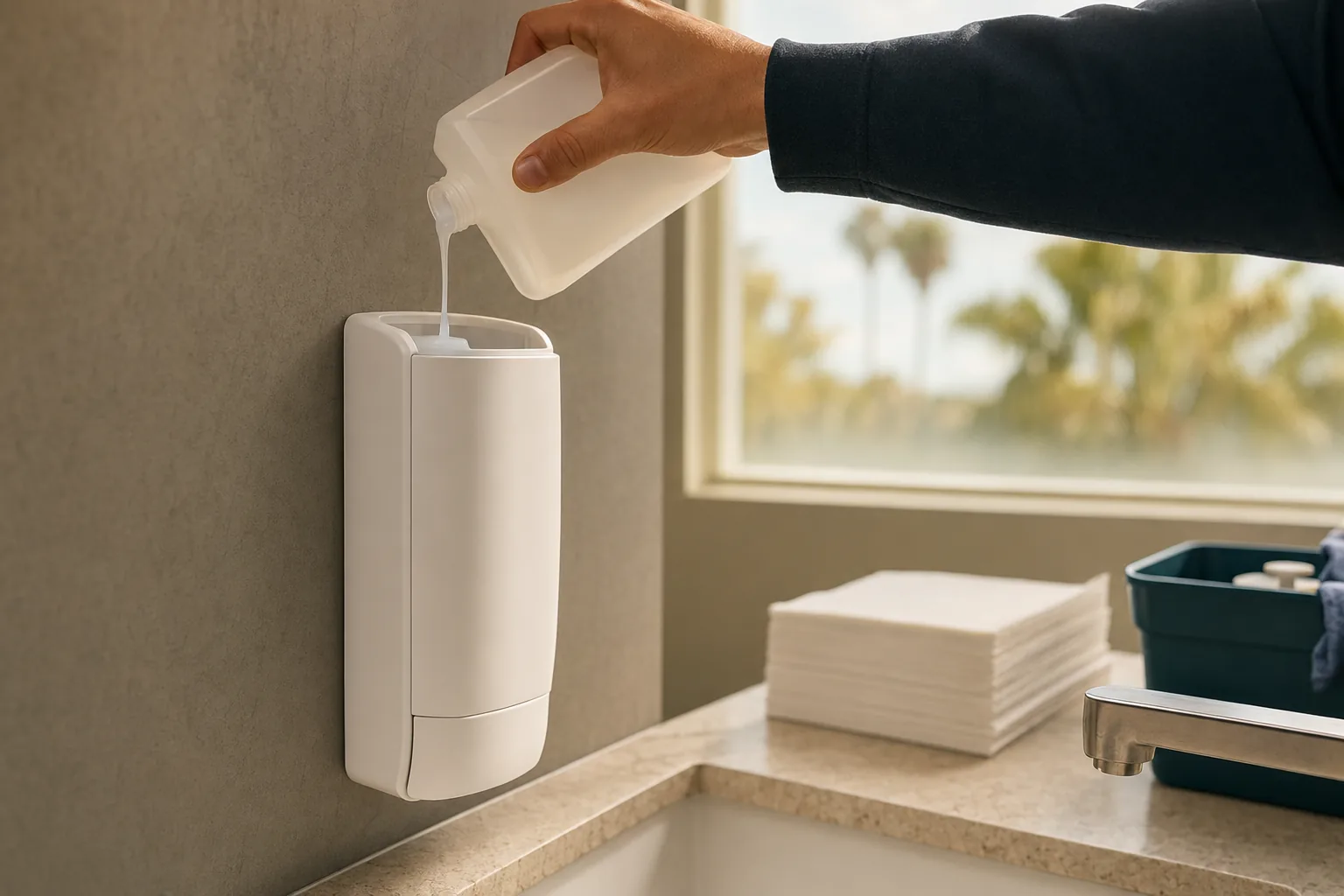
Restrooms are the single most labor-intensive area in a commercial clean, and the one place where lapses get noticed fastest. A single dirty restroom can undo the impression left by a spotless reception area, and an empty soap dispenser or an out-of-stock paper towel holder is the kind of detail employees and visitors remember long after they forget how clean the floor was.
- Clean and disinfect toilets, urinals, and sinks, inside and out
- Descale fixtures and faucets to prevent hard water buildup
- Wipe down partitions, stall doors, and handles, all high-touch points
- Clean mirrors and countertops
- Mop and disinfect floors, including corners and behind fixtures
- Restock toilet paper, paper towels, soap, and hand sanitizer
- Empty trash and sanitary bins
- Check for and address odor sources, not just mask them
Break Rooms and Kitchenettes
Shared food spaces get dirty fast because they are used by everyone and owned by no one.
- Wipe down and disinfect countertops and tables
- Clean the sink and surrounding area
- Wipe the exterior of appliances: microwave, refrigerator, coffee maker
- Clean inside the microwave, a common source of complaints when skipped
- Empty trash and recycling, including compost bins if you have them
- Restock napkins, coffee supplies, or paper products if that is part of your plan
- Sweep and mop the floor, checking under the table and near appliance bases where crumbs collect
Floors by Type
Carpet and hard flooring need different tools and different schedules, and treating them the same is how offices end up with matted traffic lanes or streaky tile.
- Carpet: vacuumed on every visit, with extra passes on high-traffic paths like the entry and hallways. Periodic deep extraction, typically a few times a year depending on traffic, lifts embedded dirt that vacuuming alone cannot reach.
- Hard floors (tile, vinyl, laminate, polished concrete): dust-mopped daily to catch grit before it scratches the surface, then wet-mopped with a floor-appropriate solution. Entry mats get vacuumed or shaken out separately, since they trap more dirt than any other surface in the building.
- Transition zones: entryways and areas near restrooms or break rooms need more frequent attention regardless of floor type, since that is where moisture and tracked-in debris concentrate.
Conference Rooms
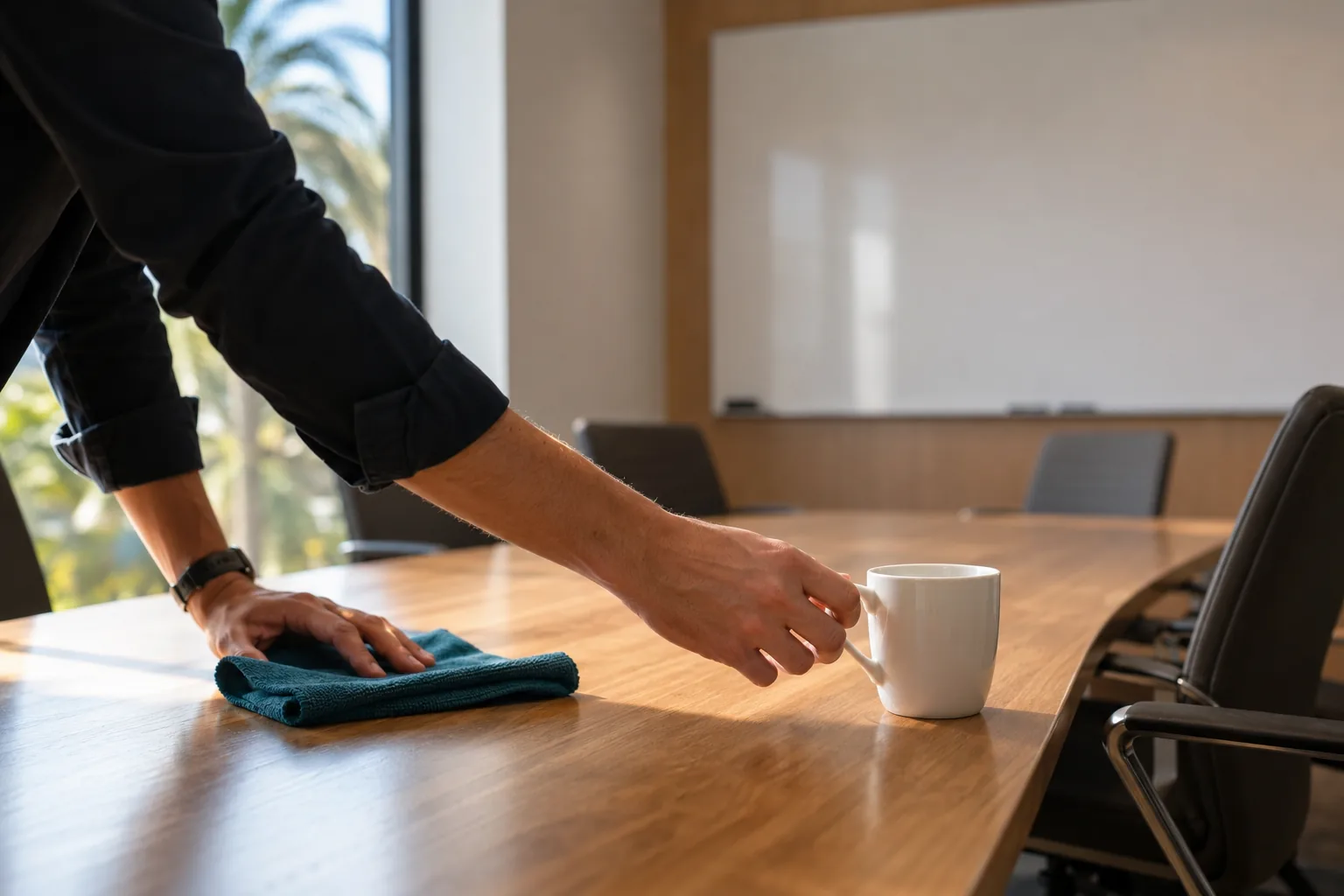
Conference rooms sit empty for stretches and then get used hard for a meeting, so they need a reset between uses, not just a fixed daily pass. A room that hosted a client presentation at 9am and an all-day workshop at 1pm needs a different level of attention than one that sat unused all week, which is why conference rooms are checked on every visit rather than cleaned on a set rotation.
- Wipe down the table and chairs
- Clean whiteboards or screens and any shared AV equipment: remote, phone, cables
- Empty trash
- Straighten chairs and reset the room to a neutral layout
- Vacuum or spot-clean the floor
- Check for leftover cups, papers, or catering trash after meetings
High-Touch Surfaces
These get wiped down on every visit regardless of what else is scheduled, because they are the surfaces the most people touch in a single day. A door handle at a busy office entrance is touched by every employee and every visitor, sometimes dozens of times before lunch, which is a different exposure level than a countertop that one household uses.
- Door handles and push plates throughout the space
- Light switches
- Elevator buttons, if your building has shared elevator access
- Handrails on stairs
- Shared equipment: printer and copier buttons, coffee maker handles, thermostat panels
- Phone handsets and intercom buttons
Cleaning Frequency by Business Type
Not every commercial space needs the same schedule. Foot traffic, health considerations, and appearance standards each push the right frequency in a different direction.
| Business type | Typical frequency | Why |
|---|---|---|
| Professional offices (law, real estate, accounting) | 2 to 3 times per week | Moderate foot traffic, appearance matters for client meetings, but the space is not shared by rotating outside visitors all day |
| Medical and dental suites | Daily, with between-patient disinfection handled by clinical staff | Higher infection control standards, waiting rooms and exam rooms see constant turnover of people |
| Retail stores | Daily | Constant customer foot traffic, entry glass and floors get dirty fast, appearance directly affects sales |
| Coworking spaces | Daily | High restroom and break room use relative to square footage, since the same facilities serve many different people who are not coworkers in the traditional sense |
A small professional office with five employees does not need the same schedule as a retail storefront with two hundred visitors a day. The right frequency is less about the size of the space and more about how many different people pass through it and what standard they expect when they arrive.
After-Hours vs. Daytime Cleaning
Most commercial clients choose after-hours cleaning, and for good reason: a crew working while the office is empty can move through every desk, restroom, and common area without waiting for a meeting to end or a desk to clear. No vacuum runs during a client call, no crew squeezes past employees in a hallway, and no room sits half-cleaned because someone was using it.
The tradeoff is access and coordination. After-hours service means the crew needs a reliable way in, whether that is a key, a code, or a building manager, and your team will not see the crew or be able to flag something in person. That works fine for most businesses, but if you want direct communication with the crew or same-day visibility into what got done, daytime service is worth considering instead.
Daytime cleaning fits smaller offices, businesses with predictable downtime such as a retail store before opening, or anyone who wants to point something out in person. The downside is working around occupied desks, meetings, and general foot traffic, which can slow a crew down and limit how thorough a single visit can be.
Either way, we build the schedule around your business hours, not the other way around. Evenings are the most common choice, but early mornings before opening and off-days work too.
What Drives Commercial Cleaning Cost
Office cleaning is quoted individually, not priced through an instant calculator, because commercial spaces vary too much for a flat rate to make sense. A few factors do most of the work in building your quote.
- Square footage: more space means more time on desks, floors, and common areas. A 1,500 square foot suite and a 15,000 square foot office floor are not the same job, even at the same frequency.
- Number of restrooms: restrooms take longer per fixture than almost any other area. A building with six restrooms across multiple floors costs more to service than one with a single shared restroom, even if the rest of the square footage is similar.
- Cleaning frequency: a recurring schedule, daily or weekly, generally costs less per visit than an occasional or one-time clean, since the crew maintains a baseline instead of resetting a space that has gone weeks without attention.
- After-hours scheduling: whether you need the crew during the day, in the evening, or overnight factors into staffing and scheduling, which is part of the quote.
The fastest way to get an accurate number is to tell us your square footage, restroom count, and preferred schedule, and we will put together a plan specific to your space.
How the Quote Process Works
Because there is no instant calculator for commercial spaces, the quote comes from a short intake process instead of a form you fill out alone.
- Tell us about your space. Square footage, number of restrooms, and the schedule that fits your business, shared by phone, email, or a short walkthrough.
- Get a custom commercial plan. Daily, weekly, or monthly service built around what you told us, not a generic package.
- Set up after-hours or daytime cleaning. We work around your hours so your team is never interrupted, whichever schedule you land on.
- Get consistent standards, visit after visit. The same crew keeps your workplace clean and sanitary every time, instead of a rotating roster that has to relearn your space each visit.
Health and Disinfection in Shared Workspaces
An office is a shared environment in a way a home is not: the same door handles, light switches, and break room surfaces get touched by everyone who works there or visits, every day. Cleaning and disinfecting are two different steps. Cleaning removes visible dirt and debris. Disinfecting targets what is left on a surface after it already looks clean. A thorough commercial clean does both, with disinfection focused on the surfaces people touch most: door handles, light switches, shared equipment, restroom fixtures, and break room counters.
Restrooms and break rooms carry the most day-to-day weight because they combine high touch frequency with shared use, food contact, or both. Consistent restocking of soap and hand sanitizer supports whatever hygiene habits your team already has. It cannot do that job on its own, but an office where soap dispensers run empty or trash overflows makes good habits harder to keep.
For medical and dental suites, general office cleaning and clinical infection control are two separate things. We handle the building-level cleaning: floors, waiting rooms, restrooms, break rooms, and shared surfaces. Between-patient disinfection of exam rooms and clinical equipment is a task for your clinical staff, following your practice’s own protocols.
Trash removal plays a bigger role in a healthy workspace than most businesses give it credit for. Bins that sit too long attract pests and hold onto odor long after the original source is gone, which is why trash and recycling get emptied on every visit rather than only when a bin looks full. The same logic applies to break room sinks and drains, where standing food waste is a bigger long-term problem than a dusty shelf.
Preparing Your Space Before the First Cleaning
A little prep before your first visit helps the crew scope the job accurately and get straight to work instead of guessing. The first visit sets the baseline for every visit after it, so a few minutes of setup upfront saves back-and-forth later.
- Walk the space or share a floor plan. This is part of how we build your quote, since square footage and layout affect the plan more than almost anything else.
- Flag off-limits areas. Server rooms, storage closets with sensitive inventory, or any space that needs restricted access should be noted upfront, not discovered on the first visit.
- Secure sensitive items. Client files, cash, prescription pads, and anything confidential should be stored the way you would before any outside service visit to your business.
- Clear desks of loose paperwork. A desk covered in paper cannot be wiped down, only wiped around, the same problem a cluttered countertop creates at home.
- Confirm access. Decide how the crew gets in, whether that is a key, a code, or a building manager, and confirm it before the scheduled date, especially for after-hours service when no one from your team will be on-site.
- Tell your team what to expect. A quick note about the schedule means no one is surprised by a crew in the building after hours or a vacuum running during a Tuesday morning lull.
- Note product preferences. If anyone on staff has a fragrance sensitivity, or a floor or surface needs a specific product, mention it before the first visit rather than after.
What a Commercial Cleaning Contract Typically Includes
A commercial contract is built around consistency, since businesses need to know what they are getting every time, not just on a good week. Unlike a one-time residential clean, a commercial contract has to hold up over months of visits, which is why scope, staffing, and standards get defined upfront instead of figured out as you go.
- Insured and bonded crews. Every crew entering a commercial space is insured, bonded, and background-checked before the first visit.
- A defined scope. The areas covered, tasks included, and frequency are set at the quote stage, so there is no ambiguity about what a visit includes.
- A consistent crew. The same crew services your space visit after visit, which means fewer surprises and a team that learns your layout and preferences over time.
- Supplies included. Cleaning equipment and eco-friendly products are included, and restroom restocking, toilet paper, soap, paper towels, is available as part of the plan.
- Flexible terms. Daily, weekly, and monthly schedules are all available, and most businesses start month-to-month rather than locking into a long-term commitment.
- A guarantee. If a visit does not meet expectations, tell us within 24 hours and the crew comes back to address it at no charge.
Frequently Asked Questions
How is office cleaning priced? Commercial spaces are quoted individually based on square footage, number of restrooms, and cleaning frequency, not through the instant online calculator used for residential cleaning. Tell us about your space and we will put together a custom quote.
How do I get a quote for my office? Share your square footage, restroom count, and preferred schedule, either by walking us through the space or sending a floor plan. We use that to build a plan and a price specific to your business.
Can you clean after hours? Yes. Evening and overnight service is the most common choice for commercial clients, since it means no disruption to your team during the workday. Early morning and off-day scheduling work too, if after-hours does not fit.
Do you handle recurring contracts? Yes. Daily, weekly, and monthly commercial schedules are all available, and the frequency can change as your needs do.
How long am I committed to a contract? Commercial contracts are flexible. Most businesses start month-to-month and adjust the schedule or frequency once they see how it fits, rather than locking into a long-term agreement upfront.
What if a specific area gets missed? Tell us within 24 hours and we send the crew back to address it at no charge, backed by our guarantee.
Do you clean after a company event or before a big client visit? Yes. A one-time add-on visit can be scheduled outside your regular contract for events, client visits, or anything outside the normal routine. Contact us with the date and scope and we will quote it separately.
Are your crews background-checked for commercial spaces? Yes. Every crew is insured, bonded, and background-checked before entering any workplace.
How does access work for after-hours crews? Access is arranged before the first visit, whether that is a key, a code, a lockbox, or coordination with your building manager. The same arrangement carries forward for recurring visits unless you tell us it has changed.
Do you bring your own supplies? Yes. All equipment and eco-friendly products are included, and restroom restocking is available as part of your plan.
Do I need to be present during the cleaning? No. Most commercial clients are not on-site during after-hours service. Daytime service works the same way if you would rather have someone available, but it is not required either way.
What size businesses do you work with? Offices, medical and dental suites, retail stores, and small commercial spaces across Orange County. If you are not sure whether your space fits, tell us about it and we will let you know.
What happens if my office closes for a holiday or an extended period? Let us know in advance and your schedule can be paused or adjusted around the closure, then picked back up when your team is back.
Is office cleaning priced the same way as residential cleaning? No. Residential cleaning uses an instant online quote based on home size and service type. Commercial spaces are quoted individually because layout, restroom count, and traffic vary too much for a flat instant price to be accurate.
Get a Custom Quote for Your Space
Office cleaning is not a fit for an instant online price, and it should not be. Every commercial space has a different layout, restroom count, and schedule, and your quote should reflect that instead of forcing your business into a generic rate. Tell us about your office and commercial cleaning needs, square footage, and preferred schedule, and we will build a plan around your business. Contact us for a custom commercial quote.
or call +1 (949) 330-0081.