Pricing Comparisons
How Much Does Office Cleaning Cost in Orange County?
Office cleaning in Orange County is priced from the space itself: its size, layout, restrooms, how often it is cleaned, and when the crew can get in. There is no single honest number, because a 1,200 square foot office with one restroom and a 6,000 square foot floor with a kitchen and a conference suite are different jobs. What you can do is understand how each pricing model works, so any quote you receive makes sense and can be compared fairly with others.
This guide explains the three common pricing models, what pushes a quote up or down, how frequency and after-hours work change the math, what a standard visit should include, and how to line up quotes side by side. We do not publish office rates here, because office cleaning is quoted individually and is not part of our instant calculator. To get a real number for your space, request a quote through our office cleaning service page.
Quick answers
- Office cleaning is quoted from your space and schedule, not from a flat menu price.
- The three common models are per visit, per square foot, and per hour. Each can be fair, and each can hide problems.
- The biggest cost drivers are square foot count, restroom count, visit frequency, and the level of soil.
- More frequent service usually lowers the cost of each visit, because the crew is maintaining instead of restoring.
- After-hours service is the norm for offices and is usually a scheduling matter, not a surcharge, but ask.
- A quote is only comparable to another quote if the scope, frequency, and supplies line up.
- No minimum booking applies to our work, and your card on file is charged after the clean.

The three pricing models, explained honestly
Every office cleaning quote you will see is built on one of three structures, or a blend. Knowing which one you are looking at tells you where the risk sits.
| Model | How it works | Who carries the risk | Best for |
|---|---|---|---|
| Per visit (flat rate) | One price for a defined scope, each time the crew comes | The cleaner, if the office is messier than expected | Stable offices with predictable needs |
| Per square foot | A rate multiplied by the cleanable area | Shared; the rate assumes an average office | Larger spaces, bid comparisons across vendors |
| Per hour | Crew time billed as worked | You, if the crew is slow or the scope is vague | Small or irregular jobs, one-time projects |
Per visit pricing
A flat per visit price is the easiest to budget. You agree on a scope, such as trash, restrooms, kitchen, floors, and desk wiping, and the price stays the same each time. The price is still built from the space underneath. A good estimator walks the office, counts restrooms, notes the flooring types, checks how many workstations exist, and works out how long the crew needs. That time becomes the visit price.
The upside is predictability. The downside is that scope creep is a real conversation. If the scope says “empty trash and vacuum common areas” and someone expects the inside of the microwave and the glass partitions, a flat price will not stretch to cover it. Ask for the scope in writing and keep it attached to the quote.
Per square foot pricing
Square foot pricing divides the job by area. It is popular with larger commercial buildings and with companies that bid on many sites, because it gives a common unit. It works well when the space is a fairly typical open office with a normal number of restrooms.
It works poorly when the space is unusual. Square footage alone does not tell a vendor whether the floor is carpet or polished concrete, whether there are six restrooms or one, whether the space has a full kitchen, or whether half the area is storage that never needs cleaning. Two offices of identical size can need very different hours. A fair per square foot quote adjusts for those facts, and a low one often ignores them, then runs into trouble on the first walkthrough.
One more caution. Rates published online for commercial cleaning are usually marketing pages from franchises or software companies, and they cover a wide spread across the country. They are not a quote for your building. Treat any national average as a rough sanity check at best, and never as a budget for Orange County.
Per hour pricing
Hourly pricing bills the time the crew actually spends. It is transparent in the sense that you pay for work done, and it suits small jobs, odd schedules, and one-time projects like a move into a new suite. It also exposes you to the pace of the crew and to how the work is directed.
If you are offered an hourly rate, ask three things. How many people will be on the crew, because an hourly rate per person is very different from an hourly rate for the crew? Is there a cap or an estimate for the visit, so you know the expected total? And are travel time and supplies included? Without those answers, an hourly quote cannot be compared to a flat quote.
What drives the cost of office cleaning
Once the model is chosen, the number itself comes from the facts of your workplace. These are the factors an estimator weighs, roughly in order of impact.
Size and layout
Cleanable square footage is the starting point, but layout matters as much as size. Long open floors with few obstacles clean faster than a warren of small private offices with doors, each with its own trash can and desk. A floor plan with many separate rooms adds time per square foot, because moving between rooms is time not spent cleaning.
Restrooms
Restrooms are the most labor intensive part of an office per square foot. They need disinfecting, restocking, fixtures wiped, floors mopped, and mirrors cleaned, and standards are higher because the room is shared. An office with the same footage but three restrooms instead of one will usually take noticeably more crew time. When you request a quote, give the restroom count and fixture count up front.
Frequency
How often the crew visits changes what each visit has to do. A space cleaned five nights a week is maintained, so each visit is a light pass. A space cleaned once a week accumulates five days of foot traffic, crumbs, and dust, so the weekly visit takes longer than a single nightly one. The total monthly spend tends to rise with frequency, but the cost of each visit tends to fall, and the office looks better throughout. We cover how to pick a frequency below.
Floor types and surfaces
Carpet needs vacuuming and occasional deeper treatment. Hard floors need sweeping and mopping. Polished or specialty floors need the right product and method. Glass walls, partitions, and entry doors add detail work. Upholstered furniture in a reception area is a separate matter, which is where upholstery cleaning comes in as an add-on rather than part of a routine visit.
Kitchens and break rooms
A break room with a sink, microwave, refrigerator, and shared coffee station behaves like a small restaurant kitchen in terms of mess. Wiping tables and counters is routine. Cleaning the inside of the refrigerator or microwave, or handling dishes left in the sink, should be spelled out. Many offices avoid trouble by making a rule that dishes go in the dishwasher and the crew handles only surfaces.
Level of soil and condition
A space that is cleaned regularly costs less to maintain than one that has not been cleaned in months. If a first visit has to deal with built-up grime, expect that visit to be scoped as a deeper clean, then drop to a lighter maintenance scope afterward. This is the same logic we use at home, and our guide on deep cleaning versus regular cleaning explains it in a residential setting that applies just as well to a first office visit.
Type of business
A dental or medical office has stricter sanitation needs than a design studio. A gym or a salon has different mess than a law office. A showroom or a client-facing lobby has a higher visual standard than a back warehouse office. The more sanitation or presentation your business requires, the more the scope and the quote will reflect it.
Supplies and equipment
Some vendors include paper products, soap, and liners. Others bill them separately. Some bring their own vacuums and mops, which is standard. Others expect to use yours. Always confirm who supplies what, because this is one of the most common gaps between two quotes that look similar. Our crews use eco-friendly, pet-safe products, which matters in offices where staff bring dogs, where people have sensitivities, or where a green policy applies.
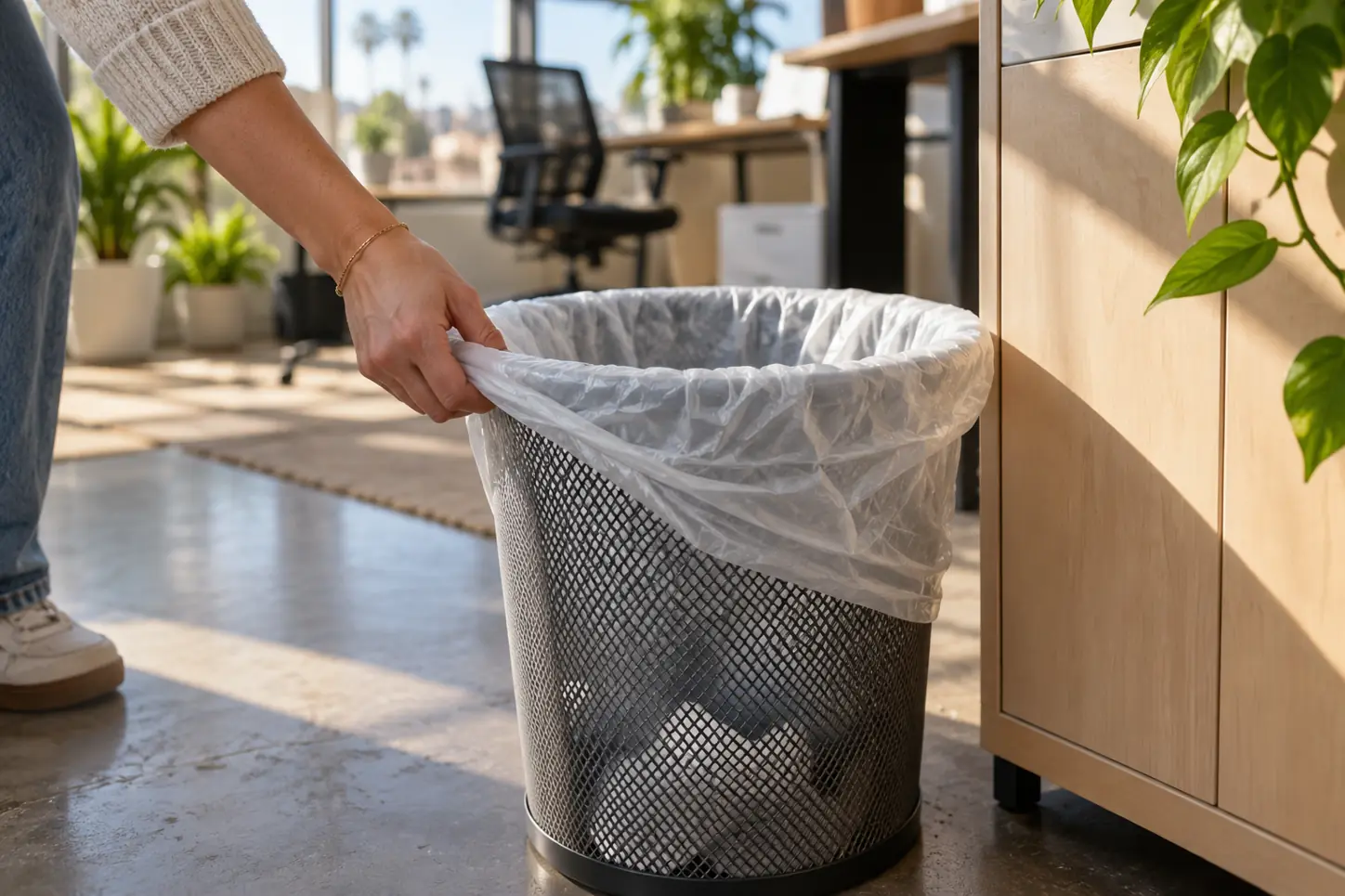
Frequency: how often should an office be cleaned?
There is no universal answer, but there are sensible patterns by workplace type. The right frequency depends on headcount, foot traffic, whether clients visit, and how sensitive your space is to dust and germs.
| Type of workplace | Common frequency | Why |
|---|---|---|
| Small office, 1 to 5 people, rarely visited | Once a week | Low traffic, low mess |
| Mid-size office, regular staff, some visitors | Two to three times a week | Restrooms and kitchen need regular attention |
| Client-facing office, showroom, or clinic | Daily or five nights a week | Presentation and sanitation standards |
| Co-working or high traffic space | Daily, with a mid-day touch-up | Heavy shared use |
| Seasonal or project-based space | As needed | Occupancy varies |
A useful way to decide is to look at the restrooms and the kitchen. If either looks tired by mid-week, you need more visits. If the space still looks fine between visits, you may be able to stretch the schedule. Many offices start with a higher frequency for the first month, see how the space holds up, and then adjust.
For residential recurring schedules, we use a clear discount ladder. Offices are handled differently, since the scope and the schedule are agreed individually. The principle still carries over: a steady, predictable schedule lets a crew plan its time, and that is reflected in how a quote is built. See recurring cleaning for how a steady schedule works in a home, and ask your office quote to reflect the same advantage for a standing arrangement.
What a standard office visit should include
Before comparing price, compare scope. A typical maintenance visit covers the following, though your quote should state its own list.
| Area | Typically included on a maintenance visit | Often priced or scheduled separately |
|---|---|---|
| Common areas and workstations | Trash removal, dusting reachable surfaces, wiping desks that are cleared | Cleaning around cluttered desks, electronics wiping, monitor screens |
| Restrooms | Disinfecting toilets, sinks, counters, mirrors, floors, restocking | Deep descaling, grout restoration |
| Kitchen and break room | Wiping counters and tables, sink, outside of appliances, floors | Inside refrigerator, inside microwave, dishes |
| Floors | Vacuuming carpet, sweeping and mopping hard floors | Carpet extraction, floor stripping and waxing |
| Entry and lobby | Glass doors, handles, floors, reception desk | Upholstered seating, large windows |
| Windows | Interior partitions and glass doors when listed | Exterior and high windows, see window cleaning |
Our office cleaning checklist lays out the full task list by area and shows how frequency changes what is done on each visit. Print it, mark the items that matter most to your team, and use it as the basis for your quote request.
After-hours, weekend, and daytime service
Most offices want cleaning done when staff are not there, so after-hours is the default in the industry. It is less of a premium than people expect, because a crew working in an empty building can move faster and does not need to work around meetings and phone calls. Where after-hours can affect pricing is in access: key or alarm handling, building security requirements, and whether the property manager limits the hours a vendor can enter.
Daytime cleaning has its place. Some offices prefer a day porter style visit to keep restrooms stocked and tidy during business hours. Others run a mid-day touch-up on top of a nightly clean. These are scheduling choices, and they change the scope and the time on site, so state your preference when you request a quote.
Same-day or next-day service is possible when crews have openings. For an office, that can be useful after an event, a client visit, or a water leak cleanup. Availability varies, so reach out as early as you can. We ask for 24 hours notice to reschedule or cancel without a fee.
What can make a quote rise unexpectedly
A quote that looks low can still lead to a high bill. These are the common ways the final cost drifts from the first number, and how to prevent each.
- Vague scope. If the quote says “general cleaning” without a list, anything outside the cleaner’s idea of general becomes an extra. Ask for a task list.
- Supplies billed separately. Paper products and liners can add up in a busy office. Ask whether they are included.
- Initial clean not scoped. A first visit in a neglected space needs more time. A fair quote says so in advance and states the extra scope instead of surprising you afterward.
- Access problems. If the crew cannot get in at the agreed time, or alarms and keys are not arranged, time is lost. Sort out access before the first visit.
- Cluttered surfaces. Crews generally will not move personal items, papers, and electronics. If desks are not cleared, they are not cleaned. A short clear-desk policy gets better results than a higher price.
- Scope changes mid-contract. Adding a conference room, a new floor, or a second restroom changes the job. Tell the vendor when your space changes.
How to compare office cleaning quotes fairly
Comparing price without comparing scope is how people end up choosing the wrong vendor. Use the same checklist for every quote.
- Give every vendor the same information. Square footage, restroom count, floor types, kitchen details, number of workstations, and desired schedule. If one vendor sees the space and another only gets a phone description, their quotes will not match.
- Ask for the scope in writing. A list of tasks per visit and per month. Compare lists, not totals.
- Confirm the pricing model. Is it per visit, per square foot, or hourly? Convert them to a monthly total at your intended frequency so you can see the true cost.
- Check what is included. Supplies, equipment, restocking, trash liners, and any recurring deep tasks like carpet or glass.
- Ask about the crew. Are they insured, bonded, and background-checked? Offices have equipment, data, and valuables. Our crews are insured, bonded, and background-checked, and our explainer on what insured, bonded, and background-checked mean shows what to ask any vendor to prove.
- Ask about changes and cancellations. What notice is needed, what happens if you skip a visit, and how are scope changes handled?
- Ask about problems. What happens if something is missed? If you tell us within 24 hours that you are not satisfied, we re-clean the area free.
- Look at payment terms. Some vendors require long contracts or prepayment. We have no minimum booking, and your card on file is charged after the clean.
A low quote that leaves out supplies, restocking, and the first deep visit is rarely cheaper in practice. A slightly higher quote with a clear scope and clear terms is usually the safer bet.
If you are weighing a cleaning company against an individual, our comparison of a cleaning company versus an independent cleaner walks through insurance, backup coverage, and consistency, and the same trade-offs apply to an office. For the general vetting questions, see how to choose a cleaning company in Orange County and the red flags to watch for when hiring a cleaner.
What top search results usually leave out
Many pages that rank for office cleaning cost lean on national price ranges. They are useful for a ballpark but skip several things that matter locally and practically.
- The range is wide for a reason. The spread between low and high national figures reflects differences in building type, frequency, and scope, not just regional wages. Your own quote depends on those facts, not on an average.
- Per square foot rates need a minimum. Small offices often cannot be priced on pure square footage, because a crew still has to travel to the site and spend a minimum amount of time. Ask whether a minimum visit charge applies.
- Restroom count matters more than most guides admit. It is a leading driver of crew time and rarely appears in a headline rate.
- First-visit scope is often hidden. A fair first visit may be heavier than the ones that follow.
- Your own habits change the price. A clear-desk policy, a dishwasher rule in the kitchen, and tidy storage all shorten visits.
- Contracts and cancellation terms are part of the price. A cheap rate with a long lock-in can cost more than a fair rate with flexibility.
Ways to keep your office cleaning cost reasonable
Quality is the goal, and smart choices can keep spend sensible without cutting corners.
- Match frequency to use. Pay for visits the space actually needs. Restrooms may need more frequent service than meeting rooms.
- Clear surfaces before the crew arrives. Time spent working around clutter is time you pay for.
- Set a kitchen rule. Dishes in the dishwasher, food out of the fridge on Fridays, and the crew handles surfaces.
- Report problems early. A quick message about a spill or a stain helps the crew bring the right tools on the next visit.
- Bundle tasks. Add periodic items like window cleaning or upholstery to a scheduled visit instead of booking them separately at odd times.
- Review quarterly. Headcount, layout, and hours change. Re-check that the scope still fits.
Offices in different Orange County cities
Pricing logic does not change from city to city, but access and logistics do. A suite in a downtown Santa Ana building, a shared office park in Irvine, and a storefront near the coast in Newport Beach each come with their own parking, building rules, and security. Crews that already serve your area travel less and can respond faster. We serve cities across the county, including Irvine, Newport Beach, and Santa Ana, among others. Tell us your address when you request a quote, and we will confirm coverage and scheduling.
What a good first conversation looks like
When you reach out, expect to be asked practical questions, and be ready to answer them. This is a sign of a vendor who intends to price the job properly.
- Address and building type
- Approximate square footage and number of floors
- Number of restrooms and whether they are single or multi-stall
- Flooring: carpet, tile, hardwood, or a mix
- Kitchen or break room details
- Number of workstations and private offices
- Desired days and times, and whether the building is accessible after hours
- Any special needs: medical-grade sanitation, allergies, pets, security procedures
- Whether you want a one-time initial clean followed by a recurring schedule
With those facts, a quote can be built from your space rather than a guess. You can send them through our contact page, or start at the office cleaning service page and follow the request options there.
Frequently asked questions
How much does office cleaning cost in Orange County?
It depends on your square footage, restroom count, frequency, and scope, so there is no honest single number. Office cleaning is quoted individually. Share the details of your space through the office cleaning page and you will get a quote built from them.
Is office cleaning priced per square foot or per hour?
Both are common, along with flat per visit pricing. Per square foot suits larger, typical spaces and makes vendors easy to compare. Per hour suits small or irregular jobs. Whatever the model, convert each quote to a monthly total at your intended frequency before comparing.
Why do two quotes for the same office differ so much?
Usually the scope, not the efficiency. One may include supplies, restocking, and the first deep clean while the other does not. Others differ in frequency, crew size, or what counts as “general cleaning.” Line up the task lists before the totals.
How often should an office be cleaned?
A small, rarely visited office can do well with a weekly visit. Offices with regular staff and visitors often need two or three visits a week, and client-facing or high traffic spaces often need daily service. Restrooms and kitchens are the best guide: if they look tired mid-week, add a visit.
Does after-hours cleaning cost extra?
After-hours is the standard way offices are cleaned, and it is typically a scheduling arrangement rather than a surcharge. Costs can arise from access requirements, such as alarm handling or building security. Ask your vendor to state it plainly in the quote.
What does office cleaning include?
A typical maintenance visit covers trash, dusting, restrooms, kitchen surfaces, and floors, with details set in your written scope. Items such as inside the refrigerator, carpet extraction, and exterior windows are often separate. See our office cleaning checklist for a full breakdown.
Do cleaners bring their own supplies?
Crews bring their own equipment and cleaning products. Paper products, soap, and liners vary by vendor, so confirm whether they are included. Our crews use eco-friendly, pet-safe products.
Do I need to sign a long contract?
You should not need to accept a surprise lock-in. We have no minimum booking, our card on file is charged after the clean, and you can reschedule or cancel with 24 hours notice at no fee. Whatever vendor you choose, read the term and cancellation language before signing.
Are your cleaners insured and background-checked?
Yes. Our crews are insured, bonded, and background-checked. That matters in an office, where crews have access to equipment, files, and workspaces.
What if the cleaning is not up to standard?
Tell us within 24 hours and we re-clean the area free. Reporting the specific area helps us fix it quickly.
Can you start quickly?
When crews have openings, same-day or next-day service is possible. For a recurring office schedule, we usually set a start date together after the quote is agreed.
Get a quote for your office
Office cleaning is priced from your space, so the fastest route to a real number is to tell us about it. Start at the office cleaning service page or reach us through the contact page. If you are also thinking about your home, our pricing page has the instant calculator for house cleaning, deep cleaning, and more, with no obligation.