Spring Cleaning Checklist for Orange County Homes
Spring cleaning in Orange County runs on a different calendar than it does almost anywhere else in the country. Most of the U.S. treats spring cleaning as chasing away months of ice and slush. Here, it means something more specific: clearing out what the rainy season left behind and getting the house ready before the county shifts into its long dry stretch and the first real heat wave hits.
Orange County’s rainy season typically runs from December through March. By April, the rain tapers off, offshore winds start picking up more often, and pollen from spring bloom reaches its peak. That transition is the entire reason a generic spring cleaning checklist does not fit this region well. Window tracks are holding months of rain grime. Pollen is collecting at every entry point. HVAC systems that sat mostly idle over a mild winter need to be ready to run hard once summer heat arrives, and a filter clogged with winter dust makes that harder on the system and on your air quality.
This guide covers a full room-by-room checklist, the climate reasons behind each task, an honest comparison to a standard deep clean, a week-by-week plan that spreads the work out instead of dumping it into one exhausting weekend, a decluttering framework, and real pricing so you know what a professional reset costs before you call anyone.
The room-by-room spring cleaning checklist
Windows and screens
Rain leaves mineral deposits on glass, and closed windows during a wet winter trap condensation and dust against the pane. Screens catch pollen and grime all season and rarely get touched until something forces the issue.
- Pop out screens where possible and hose them off separately, away from the house
- Vacuum window tracks with a crevice attachment before wiping, wiping first just pushes grit around and scratches the track
- Wipe interior glass with a streak-free glass cleaner or a vinegar-water solution
- Clean exterior glass where it is safely reachable from the ground or a stable ladder
- Wipe down sills and frames, checking corners where pollen and dust cake into a film
- Treat visible mineral spots from rain with a vinegar solution before they set permanently
HVAC and air quality
A filter clogged with winter dust and spring pollen forces the system to work harder and pushes more particles through the house instead of trapping them. Spring, before the first heat wave, is the right time to deal with this, not after the system is already running nonstop.
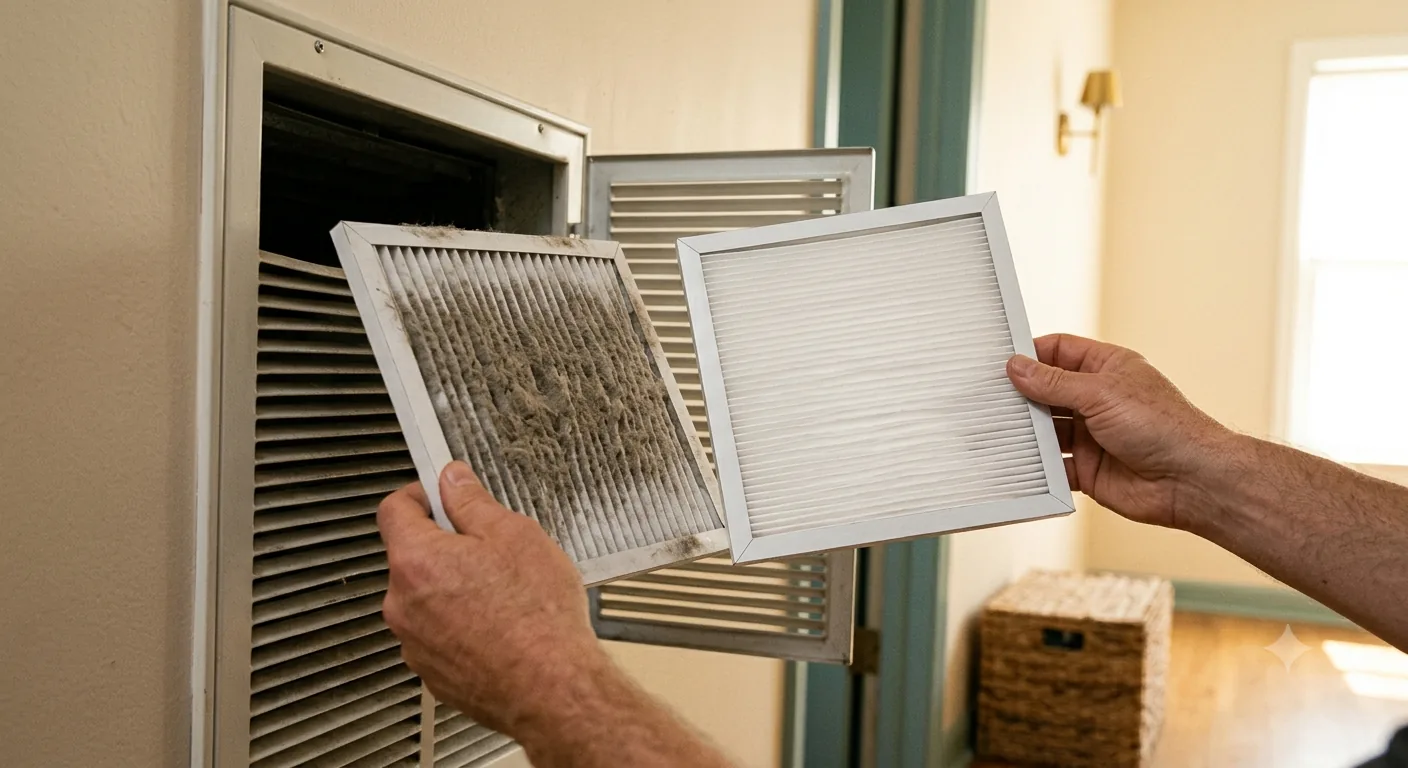
- Replace the HVAC filter, checking the size printed on the frame rather than guessing
- Keep a spare filter on hand so a heat wave does not catch you without one
- Vacuum interior vent covers and return air grilles
- Wipe visible dust from vent grilles and around the thermostat
- If the system was not serviced last fall, spring is a reasonable time to schedule an HVAC technician before summer demand peaks
Closets: seasonal wardrobe rotation as a cleaning trigger
Closets rarely get emptied outside of a seasonal swap, which is exactly why spring is the natural window to clean them properly. Pulling out winter clothing gives you full access to shelves, rods, and the closet floor that stay covered the rest of the year.

- Pull winter clothing and bedding to rotate into storage
- Wipe down shelves, rods, and closet walls while the space is empty
- Vacuum the closet floor, including corners behind where shoe racks or bins normally sit
- Check closets on exterior walls for any musty smell or dampness from a wet winter before storing clothes back inside
- Sort items into keep, donate, or toss as you go, see the decluttering framework below for a practical method
Garage and outdoor-adjacent areas
Garages, entryways, and patios take the brunt of the shift from a wet winter to a dry spring. Tracked-in mud, dead leaves, and dust all pass through these spaces before they reach the rest of the house.
- Sweep the garage floor and entryway, including corners where wind-blown debris collects
- Wipe down patio and outdoor furniture before it gets used again for the season
- Clean or replace door mats that trapped debris over the winter
- Wipe down light switches and doorknobs at every entry point, these are high-touch surfaces that carry in whatever is on your hands after being outside
- Check garage shelving and storage edges for dust that settled during storm season
Kitchen: deep appliance reset
A standard wipe-down keeps counters looking fine, but appliances build up grease and grime year-round in spots a quick clean never reaches.
- Clean inside the oven, including the door glass and racks
- Clean inside the refrigerator: shelves, drawers, and door seals, where crumbs and spills collect unnoticed
- Wipe down cabinet fronts and handles, which pick up hand oils and cooking residue over months
- Descale the faucet and sink
- Clean behind and under appliances where they can be safely moved or reached
- Wipe the backsplash and countertops, including behind small appliances that rarely get moved
Bathrooms
Bathrooms hold more buildup than they show on the surface, and grout, fixtures, and exhaust fans are the areas a quick wipe-down consistently skips.
- Scrub tile and grout, where soap scum and mildew build up fastest in a humid room
- Descale shower glass and fixtures
- Clean the toilet inside and out, including the base and behind it
- Wipe mirrors, counters, and cabinet fronts
- Clean baseboards and the floor, including corners behind the toilet
- Check the exhaust fan for dust buildup, a clogged fan traps humidity and contributes to mildew
Bedrooms
- Dust top down: ceiling fans, light fixtures, and shelves, before moving to lower surfaces
- Wipe baseboards and door frames
- Vacuum under the bed and behind reachable furniture
- Wash bedding and consider a seasonal comforter swap as part of the same pass
- Vacuum and mop floors last, so dust from higher surfaces does not resettle on a floor you already cleaned
Living areas
- Dust top down: shelves, picture frames, and electronics
- Vacuum upholstery and cushions, including underneath removable cushions
- Wipe down light switches, remotes, and other high-touch surfaces
- Clean glass surfaces like coffee tables and cabinet fronts
- Vacuum and mop floors, finishing the room the same way as the bedrooms
Why Orange County’s climate shapes this checklist
The rainy-to-dry transition
Orange County’s wet season is short and mild compared to most of the country, but it still leaves a real mark: mineral deposits on glass, grime pushed into window tracks, and dust that clung through a wet winter instead of blowing away. Once the rain stops, the county moves into a long dry stretch that runs through fall, and that dry air keeps dust airborne longer instead of letting it settle out quickly the way humidity does in other climates. Spring cleaning here is as much about catching that transition as it is about a seasonal reset.
Pollen season timing
Pollen season overlaps directly with spring cleaning in Orange County, and it collects fastest at entryways, window sills, and anywhere air moves through the house. If anyone in the home has allergies, entry points and window tracks are the highest-payoff areas to stay on top of during these weeks, since that is where outdoor pollen makes first contact with indoor surfaces.
Coastal versus inland differences
Homes closer to the coast deal with an added factor that inland homes mostly avoid: salt air. Ocean air carries fine salt particles that combine with regular dust and settle on windowsills and outdoor-facing furniture, which is part of why coastal homes often notice a gritty film that inland homes see less of. Inland homes, especially those near open hillsides or newer developments with less landscaping, tend to notice more wind-blown dust instead. The checklist above works for both, but which sections need the most repeat attention depends on where in the county you are.
Spring cleaning vs. a regular deep clean: what’s actually different
The honest answer: spring cleaning is largely a deep clean with specific timing, not a fundamentally different service. A professional deep clean already covers baseboards, inside the oven and fridge, grout and tile, vent and fan dusting, cabinet fronts, and detailed bathroom descaling, which handles most of the checklist above.
Where spring cleaning genuinely adds scope beyond a standard deep clean:
| Area | Included in a standard deep clean | Extra for spring |
|---|---|---|
| Baseboards, grout, appliance interiors | Yes | No extra needed |
| Vents and fans | Yes, dusted as part of the service | No extra needed |
| Window glass, screens, and tracks | Not included | Add-on, worth prioritizing this season |
| Garage and outdoor-adjacent edges | Not included | Usually a DIY task, see the checklist above |
| Closet rotation and decluttering | Not included | DIY task best done before booking a clean |
In practice, this means the most efficient spring routine is handling windows, the garage, and closet decluttering yourself on the timeline below, then booking a professional deep clean for the kitchen, bathrooms, baseboards, and vents, the parts of the checklist that take the most time and are easiest to under-clean without the right tools.
A realistic week-by-week spring cleaning plan
Trying to do all of this in one weekend is how spring cleaning turns into a dreaded chore instead of a manageable reset. Spreading it across four weekends keeps each session under a few hours and lets you actually finish instead of abandoning it halfway through.
| Weekend | Focus | Tasks | Time estimate |
|---|---|---|---|
| 1 | Entry points and closets | Garage, entryway, patio, door mats, closet rotation and decluttering | 3 to 4 hours |
| 2 | Windows and air | Windows, screens, tracks, HVAC filter and vents | 3 to 4 hours |
| 3 | Kitchen and bathrooms | Appliance interiors, cabinet fronts, grout, descaling | 3 to 4 hours, or book a professional deep clean for this weekend instead |
| 4 | Bedrooms and living areas | Top-down dusting, upholstery, floors, final walkthrough | 2 to 3 hours |
If a full weekend is more than you have available, weekend 3 is the one most worth outsourcing. Kitchen and bathroom deep resets take the longest and benefit the most from equipment and products most households do not keep on hand.
Decluttering first: the keep, donate, toss framework
Decluttering before cleaning, not after, is what actually makes the cleaning faster. Fewer items on a shelf means fewer things to move and dust around, and a closet that is not packed floor to ceiling takes a fraction of the time to vacuum and wipe down.
A simple framework that works room by room:
- Keep: used or worn in the last year, and still in good condition
- Donate: in good condition but not used in the last year, or duplicates of something you already have
- Toss: damaged, expired, or incomplete, this includes stained clothing, expired products under the bathroom sink, and anything missing a matching piece
Work through one closet, drawer, or shelf at a time rather than pulling everything out of every room at once. A single overwhelming pile in the middle of the living room is the fastest way to abandon a decluttering session halfway through. Bag donations as you go and get them out of the house the same day, since a bag sitting by the door for weeks tends to quietly get unpacked back into the closet it came from.
DIY vs. professional help for spring cleaning
Some parts of this checklist are genuinely easy to DIY, and some are not worth the time it takes to do them properly without the right equipment.
Reasonable to DIY:
- Windows and screens, if you have a ladder and a free afternoon
- Garage, entryway, and patio reset
- Closet rotation and decluttering
- HVAC filter swap, this takes a few minutes once you know your filter size
Usually worth booking:
- Kitchen appliance interiors, especially the oven, which takes real time to do thoroughly
- Grout and tile scrubbing, which needs the right products to actually lift buildup instead of just moving it around
- Full baseboard runs through an entire home
- A whole-home reset in a single visit, if you do not have four weekends to spread the work across
Spring is also one of the better times of year to book a professional deep clean generally, since it resets the home before a busy summer of guests and outdoor entertaining, and it gives a clean baseline if you are considering switching to a recurring cleaning plan afterward.
What spring cleaning costs in Orange County
A professional deep clean is priced from a base rate plus your home’s bedrooms and bathrooms, with a 1.5x multiplier applied since a deep clean covers more ground than a standard visit: inside appliances, grout, baseboards, and vents.
| Home size | Base + bedrooms + bathrooms | Deep clean price (1.5x) |
|---|---|---|
| 2 bed / 1 bath | $60 + $50 + $35 = $145 | $217.50 |
| 3 bed / 2 bath | $60 + $75 + $70 = $205 | $307.50 |
| 4 bed / 3 bath | $60 + $100 + $105 = $265 | $397.50 |
Worked example, 3 bed / 2 bath home: Base $60, three bedrooms at $25 each is $75, two bathrooms at $35 each is $70. Subtotal $205. Applying the 1.5x deep clean multiplier brings it to $307.50. New customers get $39 off their first booking, bringing this example to $268.50.
Worked example, 4 bed / 3 bath home with windows added: Base $60, four bedrooms at $25 each is $100, three bathrooms at $35 each is $105. Subtotal $265. Applying the 1.5x multiplier brings it to $397.50. Since window tracks are the one common spring task not included in a standard deep clean, adding the windows add-on at $40 brings the total to $437.50, before the $39 new-customer discount brings it to $398.50.
These numbers are before any additional add-ons like inside cabinets or laundry. The fastest way to get your exact price is the instant quote on the deep cleaning page, which factors in your home size, bathrooms, and any add-ons in about 30 seconds.
Spring cleaning FAQ
When should I start spring cleaning in Orange County?
As soon as the rainy season tapers off, typically starting in April. Starting before pollen season peaks means less buildup to deal with at entry points and window sills later in the season.
Is spring cleaning just a regular deep clean with different timing?
Mostly, yes. A standard deep clean already covers baseboards, appliance interiors, grout, and vents. Spring cleaning adds windows, screens, tracks, and garage or closet resets that a standard deep clean does not include.
How long does a full spring cleaning take?
Spread across four weekends as outlined above, expect roughly 12 to 15 hours total. Done in a single day, it typically runs 6 to 10 hours depending on home size and how long it has been since the last thorough clean.
Do window screens need to be cleaned separately from the glass?
Yes. Pop screens out and hose them off away from the house. Cleaning glass without addressing the screen just means pollen and grime on the screen recontaminate the window within days.
How often should HVAC filters be changed in spring?
Check the filter size and replace it once at the start of spring, then again before the first serious heat wave if pollen or dust has been heavy. A visibly gray or matted filter is already overdue.
What’s the safest way to clean window tracks without scratching them?
Vacuum with a crevice attachment first to remove loose grit, then wipe with a damp cloth or an old toothbrush for corners. Wiping before vacuuming just drags grit across the track and can scratch the finish.
Should I declutter before or after cleaning?
Before. Fewer items on shelves and in closets means less to move around while cleaning, which makes the actual cleaning noticeably faster.
Do I need a professional for spring cleaning, or can I DIY it?
Windows, entryways, closets, and the garage are reasonable to DIY. Kitchen appliance interiors, grout, and full baseboard runs are the parts most worth booking professionally, since they take real time and the right products to do thoroughly.
How much does a spring deep clean cost in Orange County?
Price depends on home size, bathrooms, and any add-ons like windows. A typical 3 bed / 2 bath home runs about $307.50 for a standard deep clean, or $268.50 for new customers after the $39 first-booking discount.
Is spring cleaning worth it if I already book recurring cleaning?
Yes. Recurring cleaning maintains visible surfaces but does not typically include inside appliances, grout, or window tracks. A seasonal deep clean resets those areas so your recurring visits keep pace instead of slowly falling behind.
What should I prioritize if I only have one weekend?
Windows and HVAC first, since both directly affect indoor air quality and get worse the longer pollen season runs. Kitchen and bathrooms are the next priority if time allows.
Does spring cleaning help with allergies?
Cleaning entry points, window tracks, and HVAC filters directly reduces the pollen and dust that trigger allergy symptoms indoors. These are the exact areas where outdoor allergens make first contact with the inside of your home.
Should the garage be included in spring cleaning?
Yes, especially the floor and shelving nearest the entry door. Garages take on tracked-in debris and wind-blown dust all winter, and that debris gets carried into the rest of the house through the entryway if it is not addressed.
Getting your home reset before summer
The room-by-room list above covers everything, but the fastest way to get it all done without losing a month of weekends is to split it: handle windows, the garage, and closets yourself, then let a professional crew take the kitchen, bathrooms, baseboards, and vents in a single visit. Get an instant quote for deep cleaning in your Orange County city, whether that’s Irvine, Newport Beach, Mission Viejo, or anywhere else on our service list, and start summer from an actual clean baseline instead of a running list of what still needs doing.
or call +1 (949) 330-0081.