Why Orange County Homes Get Dusty Fast (and What to Do About It)
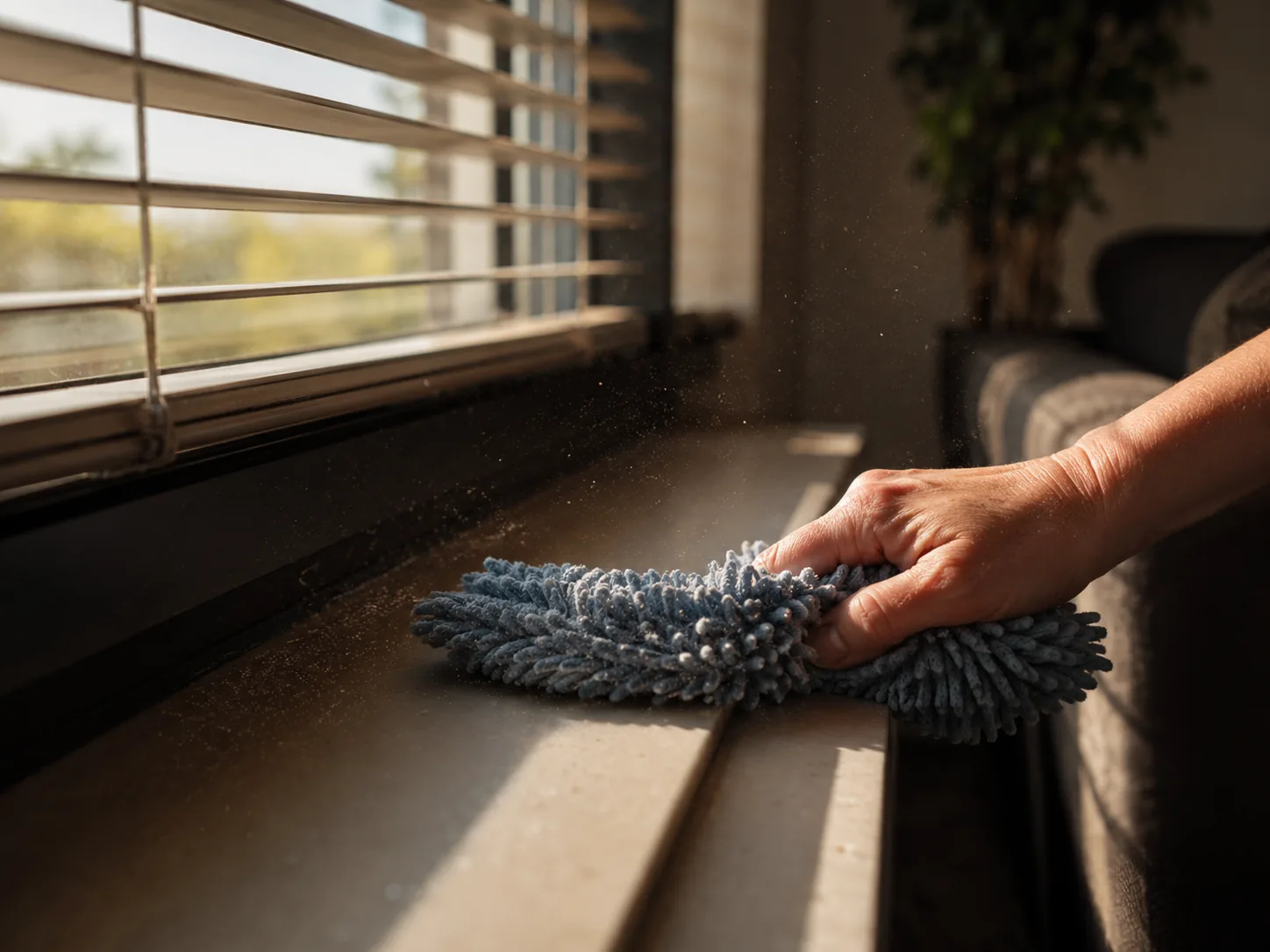
Orange County homes collect dust faster than homes in most other parts of the country, and it usually has nothing to do with how often anyone cleans. Santa Ana winds, a long dry season, heavy freeway traffic, and central HVAC systems all push more dust into the average OC home than a typical cleaning schedule accounts for. Understanding why makes it easier to know where to focus, and how often, instead of guessing.
Why Orange County dust behaves differently than dust elsewhere
Most cleaning advice assumes dust builds up at a fairly even, predictable rate. That assumption does not hold up well here. Four regional factors, wind, dryness, traffic, and how homes are heated and cooled, combine to push more dust indoors and keep it airborne longer once it arrives.
Santa Ana winds push inland dust straight at the coast
Santa Ana winds form when high pressure builds over the Great Basin and pushes air downslope toward the coast, the reverse of the onshore breeze that usually keeps Southern California’s air moving out to sea. That offshore flow picks up fine dust and dry soil from the inland deserts and foothills and funnels it through passes like the Santa Ana Canyon on its way to the coast. By the time it reaches most Orange County neighborhoods, the air is carrying a real load of particulate, not just wind.
Closed windows do not fully stop this. Dust this fine works its way in through door gaps, attic and dryer vents, and anywhere else air exchanges with the outside, including small gaps around HVAC intakes. Homes near open hillsides, canyons, or newer developments where less of the surrounding land is paved or landscaped tend to notice it the most, since there is less groundcover to catch the dust before it reaches the house.
A long dry season keeps dust airborne instead of washing it out
Most of Orange County’s rain falls between December and March, which leaves several months where nothing is regularly rinsing dust out of the air or off outdoor surfaces. In a wetter climate, rain periodically knocks dust and pollen out of the air and washes it off roofs, siding, and patios. Here, whatever settles outside during the dry season mostly stays put until wind, foot traffic, or an open door moves it again, this time indoors.
Dry air also changes how dust behaves once it is airborne. Humidity adds weight to dust particles and helps them settle out of the air relatively quickly. Southern California’s low humidity does the opposite, keeping fine particles suspended longer, which means more of what enters a home ends up drifting onto furniture, shelves, and floors instead of dropping out of the air near wherever it came in.
Freeways and ongoing construction add a steady stream of fine particulate
Orange County runs on one of the densest freeway networks in the state, and homes near routes like the 5, 405, 55, 73, or 91 pick up a continuous supply of vehicle-related particulate: exhaust, brake dust, and tire wear, all fine enough to travel with the wind well past the shoulder of the road. The county’s steady pace of development adds to it. Grading a hillside for a new housing tract, widening a road, or even a nearby remodel kicks loose soil and construction dust into the air, and prevailing wind carries a portion of it toward whatever homes sit downwind.
None of this requires living directly next to a freeway or an active job site to notice. Fine particulate travels well beyond its source, so a neighborhood a mile or two from consistent traffic or construction still ends up with more ambient dust than one further removed from both.
Central HVAC systems recirculate more dust than people expect
Most Orange County homes run on central, forced-air HVAC, which means the same system that heats and cools the house also moves a large volume of air, and whatever is in it, through ductwork many times a day. That is efficient for climate control, but it also means airborne dust gets pulled through the system and redistributed to every vent in the house, not just wherever it originally entered.
A clean filter catches most of this before it recirculates. A dirty or overdue filter does not, and it also restricts airflow, which can push more unfiltered air around the filter’s edges instead of through it. In a region already dealing with wind-blown dust and long dry stretches, an overdue filter has more to catch than it would somewhere with cleaner ambient air, so the cost of skipping a change shows up faster, and more visibly, on surfaces throughout the house.
Practical ways to cut down how much dust actually settles
A few specific habits make a real difference against these conditions:
| Habit | Why it matters here |
|---|---|
| Check HVAC filters on a set schedule, not just when they look dirty | Standard filters are usually rated for 60 to 90 days, but a windy stretch or nearby construction can use up that window faster |
| Add a walk-off mat at every entry point and go shoes-off indoors | A large share of tracked-in dust and grit arrives on the bottom of shoes |
| Close windows during Santa Ana wind advisories, reopen once conditions calm | Screens filter almost nothing at the particle sizes carried by these winds |
| Weatherstrip gaps around exterior doors and windows | Cuts fine-dust infiltration on high-wind days without limiting normal ventilation |
| Run a portable HEPA air purifier in bedrooms or high-use rooms | Most useful during peak Santa Ana season in fall, when outdoor particulate spikes |
| Add mulch or plantings around the foundation instead of leaving bare soil | Reduces dust getting kicked up right at the house and tracked in on shoes |
| Dust top to bottom on a regular rotation | Settled dust on fans and shelves falls onto lower surfaces, so bottom-up means redoing work |
| Vacuum with a sealed system and HEPA filtration, especially on carpet and rugs | Rugs and carpet hold fine dust far longer than hard flooring |
| Wash bedding and curtains on a regular cycle | Fabric that stays in one place traps airborne dust more than most surfaces do |
None of these habits require special equipment beyond what most households already have or can pick up cheaply. The bigger shift is treating them as a recurring routine tied to wind and season, not a one-time fix.
Why a regular dusting and deep-cleaning cadence matters here specifically
A dusting routine that works fine in a calmer, wetter climate tends to fall behind in Orange County, not because the routine itself is wrong, but because dust reaccumulates faster here. A single Santa Ana wind event can undo a week of light dusting in a single day, and the several dry months between rains give outdoor dust nowhere to go except toward whatever gaps let it inside.
That gap between how fast dust builds and how often a home actually gets dusted is where problems accumulate, not on the countertops and coffee tables people wipe down regularly, but in vents, blinds, baseboards, behind furniture, and inside ceiling fan housings, places a quick daily or weekly pass does not reach. Left long enough, those spots become a reservoir that keeps re-seeding the surfaces already being cleaned, which is part of why a home can look freshly wiped down and still feel dusty within days.
This is why the region benefits from a two-layer approach: frequent light dusting to keep visible surfaces in check, plus a periodic deep clean that resets the areas regular dusting skips. Without the second layer, the first layer is fighting buildup it cannot fully see or reach. For households already dealing with allergy symptoms, that same reservoir of dust in vents and blinds is where allergens like pollen and dander concentrate too. Our guide to reducing allergens at home covers where else they tend to build up and how to stay ahead of them.
FAQ
Why does Orange County get dustier than other parts of the country?
A combination of Santa Ana winds carrying inland dust toward the coast, a long dry season with little rain to rinse particulate out of the air, dense freeway traffic, and central HVAC systems that recirculate air through the whole house. Most climates only deal with one or two of these factors at a time.
How often should I change my HVAC filter living in Orange County?
Standard filters are usually rated for 60 to 90 days, but check sooner after a windy stretch or if there is active construction nearby. A filter that looks visibly gray or matted is already overdue regardless of the calendar.
Does living near a freeway actually add to indoor dust?
Yes. Exhaust, brake dust, and tire wear particles are fine enough to travel with the wind well past the road itself, so homes within a mile or two of a busy freeway typically deal with more ambient particulate than homes further away.
Should I keep windows closed during Santa Ana wind events?
It helps. Closing windows during an active wind event and airing the house out once conditions calm down keeps a noticeable amount of wind-blown dust from entering directly, especially compared to leaving windows open through a windy stretch.
Do screens stop wind-blown dust from entering through open windows?
Not really. Screens are built to keep out insects, not fine particulate, so they do little to filter the dust carried in during a Santa Ana event or a generally dry, windy day.
Is dust worse for homes near active construction or hillside grading?
Usually, yes. Grading and construction loosen soil that would otherwise stay compacted, and prevailing wind carries a portion of that dust toward nearby homes, adding to whatever wind-blown and traffic-related dust is already in the air.
What’s the difference between everyday dust and wildfire ash?
Regular dust is made up of larger particles that settle and stay settled. Wildfire ash includes much finer particulate that stays airborne longer and needs a different cleanup approach. See our guide on wildfire ash and smoke cleanup if you are dealing with ash specifically rather than routine dust.
Do air purifiers actually help with Santa Ana wind season?
A HEPA air purifier can meaningfully reduce airborne particulate in a single room, particularly a bedroom, during a wind event or the weeks after one. It does not replace closing windows or maintaining the HVAC filter, but it addresses what still gets through.
How long does it take for dust to build back up after a deep clean?
It varies by household and by whether a wind event happens soon after, but visible dust on regularly touched surfaces typically starts reappearing within a week or two. What builds up more slowly, and less visibly, is the buildup in vents, blinds, and baseboards that a deep clean specifically targets.
Do coastal Orange County homes deal with more dust than inland homes?
Somewhat differently rather than simply more or less. Coastal homes deal with added salt air that combines with regular dust and leaves a gritty film on windowsills and outdoor-facing furniture. Inland homes, especially near open hillsides or newer developments with less landscaping, tend to notice more wind-blown dust directly.
Getting ahead of it
Wind, dry air, traffic, and HVAC systems are not going away, but a routine built around them keeps a home from feeling like it is always a step behind. Get an instant quote for deep cleaning in your Orange County city and start your regular dusting routine from a genuinely reset baseline instead of one still catching up on last month’s buildup.
or call +1 (949) 330-0081.